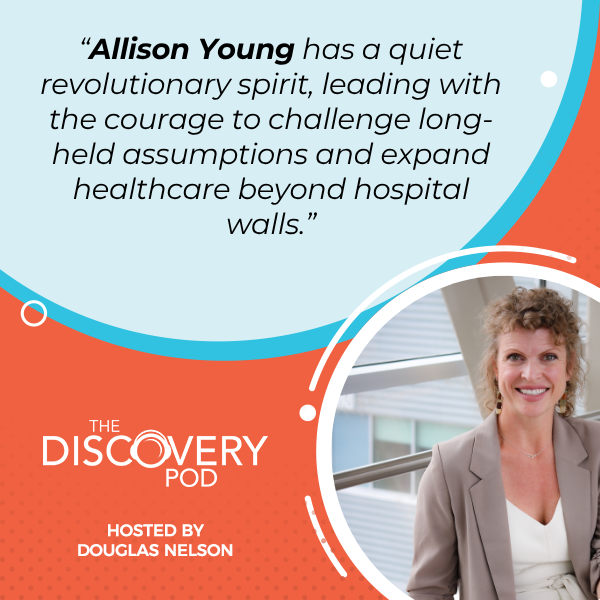
Healthcare is changing rapidly, demanding that organizations look past traditional fundraising to build deep, trust-based community relationships. At the forefront of this shift is the KGH Foundation, an organization redefining how healthcare philanthropy operates both inside and outside hospital walls. In this conversation, host Douglas Nelson sits down with Allison Young, the outgoing CEO of KGH Foundation, to explore her decade of transformative leadership. Allison shares her insights on challenging long-held assumptions about hospital foundations and how to lead with courage when pioneering new collaborative models. She also discusses the creation of Thrive Okanagan and the revolutionary Jim Pattison Centre for Health Systems Learning and Innovation, demonstrating what is possible when community generosity meets bold system change.
—
Listen to the podcast here
Trust Before Dollars: Leadership Lessons With Allison Young, CEO, KGH Foundation
Redefining Healthcare Philanthropy: Relationship-Based Leadership
Welcome to the show. I’m excited to welcome Alison Young, CEO of the KGH Foundation. Allie has spent her career bringing people together around a shared purpose of helping organizations, communities, and leaders create better outcomes for the people they serve. Through her work at KGH Foundation, she’s helping advance the future of healthcare by connecting generosity, innovation, and community support.
What stands out about Allie’s leadership is her belief that strong organizations are built through relationships by investing in people, creating clarity of purpose, and empowering teams to do their best work. She shares so many examples of the power of convening, coming up with a plan, and continuing to do the work until you get to the finish line. It is rare that we have the opportunity to have a leader who is in the midst of a planned transition from the CEO role, looking back over what she and her colleagues have accomplished in her time as CEO and looking ahead to what is next for KGH Foundation and for healthcare foundations all across this country.
Allie shares what she’s most proud of, how you get people to come together, bring their best ideas, and how you build a structure around them that allows those ideas to become reality when it comes to health system innovation. She talks about a much bigger role for philanthropy than most healthcare foundations. It is an exploration of what is possible, explained by someone who has made it possible. Please enjoy my conversation with Allie Young.
—
Welcome to the show, Allie.
It’s great to be here, Doug. Thank you.
This is going to be a great conversation. It is rare in the course of the show that we have the opportunity to talk to someone who’s had a great impact in their organization and is now moving towards the transition of being the former CEO, with the search underway. We’re expecting some real inside hardball, unedited nuggets from you.
I will try not to disappoint.
I would imagine you would have said that whether you were leaving or not. You are a person who’s known for having clear opinions, well expressed. As we get started, some of our audience may not be aware, and they’re going to learn a lot about the work that you and your colleagues have done there. Tell us what KGHF is and who you serve.
KGH Foundation is located for those who may not live in the interior. We are in a beautiful spot, Kelowna, British Columbia, unceded territory of the Okanagan South people. We are a hospital foundation, KGH Foundation. We work really closely with our local hospital here in Kelowna, which is responsible for a catchment of almost a million people. We are focused on our hospitals, certainly, but also on healthcare that happens beyond the hospital walls, which is something that I’m incredibly passionate about.

KGH Foundation: We are focused on our hospitals, certainly, but also on healthcare that happens beyond the hospital walls.
It’s something that we’re talking about more and more in our sector. KGH Foundation will be 50 years old in 2028. We’ve been around a long time. We were established by a very generous community that wanted to have an impact on the care that they are able to access right here in their community, and that legacy has continued. I’ve been fortunate to serve here for ten years, and by that time, as CEO.
What our audiences may not know, if they’re not in the province, your foundation has really set a standard for others to follow in terms of how you work with your health authority and how you work independently of your health authority to support the care and the needs of the community that you serve. We’ll get there. One of the things that I’ve heard you talk about before, I’d love to learn more about and share that with our audiences. You talk about your foundation as being a relationship-based organization, not just a fundraising shop. What does being a relationship-based organization mean?
Fundraising, the dollars we raise and the resources we’re able to generate a result and an outcome rather than being the focus. Thank you for saying that, Doug. It’s something that I think is critically important in our work. If we do not have trust and we do not have relationships, we will not have an impact. KGH Foundation is very much focused on how we build connections and relationships with the multiple shareholders, stakeholders, and rights holders that are essential for us to work with and connect with so that we are able to capitalize on great things for our hospital and in our community.
We focus there first, and then that often informs where we will look to generate interest and resources. The outcomes have been fantastic. We continue to see really strong growth in our revenue and in the types of projects that we’re able to support. If it’s okay, jumping back to our relationship with the health authority, we work very closely. We are a separate legal entity.
We do have autonomy, and we’re able to, I guess, leverage that soft power, both of the relationships that we have and the resources we’re able to generate, to not only work with the health authority to advance their priorities, but to ensure that the community’s interests and what really matters to local citizens here in the Okanagan and through the Southern Interior of British Columbia. Make sure that what matters to them is a representative friend and center in our work all the time. You cannot do that without relationships.
Challenging The Status Quo: Rethinking Long-Held Assumptions Of Hospital Foundations
Of course. One of the other pieces that you had the chance to talk with you on a few other occasions, you’ve talked about challenging the assumptions that people have about hospital foundations. In our work here at the Discovery Group and on this show, I love to talk about the importance of starting with abundance. Start with what’s working rather than jumping into the pool of all the things that are wrong and not working. What are some of the long-held assumptions that need to be challenged about what a hospital foundation is and can do?
If we do not have trust and we do not have relationships, we will not have an impact. Share on XI would say that people see hospital foundations as a place where those with wealth give big gifts. It’s those big gifts that have an impact on hospitals and on the programs. That’s not untrue. We certainly are grateful for the generosity of those who are able to give in our community. It is all gifts and all people who can have an impact. The other thing, too, is different across the country.
For sure, here in BC, hospital foundations are really challenging the idea that the only healthcare that we should be focusing on is that which happens inside hospital walls. Really stepping into the community and recognizing that investing in prevention and health promotion and keeping people out of the hospital is a really good strategy and a really good focus for our work.
Partnership, you touched on abundance, scarcity, and what is it that we focus on together? It’s important to acknowledge the challenges that we are all facing and realize that we are truly better together. When we can come to the table and find common ground, and then leverage each of our unique strengths. Sometimes that means two foundations or two nonprofits coming together and appealing to the community together.
That’s where we’re going to have the greatest impact. We’re definitely seeing that shift. I talk to colleagues across the country and in some of my other roles. That spirit is starting to pop up for sure. I feel like we’ve definitely been a leader in that space, and we’ve been brave for a while. I would say it’s really paying off for our community and for us.
No doubt for your community, and I think really setting a lot of very positive examples for others to follow. I can think of a number of organizations that are learning from and following the example that you and your colleagues have set there, and that expanding beyond the four walls of the hospital and really engaging in the community to make a difference in the overall health of the community, and in some ways to offset the demand on the hospital itself if people are better looked after in the community.
Beyond The Four Walls: The Spark Of Collaborative Community Healthcare
I’m hoping you can take us back. You mentioned being organization’s almost 50 years old. You’ve been there for a decade. I’m sure it has not always been the case that your foundation was out beyond the four walls of the foundation. Is there a moment in time where we’re not going to take it anymore, a moment where you said we’ve got to do something differently here? What was the spur that caused your foundation to really break out of those four walls?
There were a couple of things that, if I reflect back on COVID, I think for all of us, demanded that we behave differently as organizations, as leaders. The relationships that we desire to have as organizations and as leaders with our partners, for us, because I can speak to our context, we have probably had four decades of a relationship that was far more transactional. The hospital had a project. The project would be announced by the province, by the health authority, and there would be a gap or a deficit.
KGH Foundation: COVID just forced us to very quickly expand our view of what we do beyond fundraising. It really set the tone for us for the decade to follow.
The hospital foundation would step in and appeal to the community. Together, we would fill that and make the X program happen. Buy a CT machine, for instance. It’s a very important matter to people who rely on healthcare. There was a growing desire from our board, members of the community, and donors to be more a part of that conversation. We needed to really focus on approaching that relationship differently and looking at how we can build trust and be a part of the conversation before the gap is even identified.
It did come through those partnership tables. There was a project that we were asked to consider at the time. It was 2017, by CMHA Kelowna. They were looking to establish youth mental health clinics in our community. To their credit, they recognized that they’re very good at providing services, and they’re really good at convening partners who are going to be a part of providing that service. What it took to fundraise for the capital components and the program components was that they had great relationships. That was not their strength.
They approached the KGH Foundation and asked if we’d consider being the fundraising partner in that. At that time, our board and leadership were brave, and they leaned in, and they tried a model that had not been done. It was quite novel, at least in our province. You’re now again touching on that idea of sharing donor names, appealing to the community together, trying something that’s a little bit different. It was for something that, while it was clinical, it was not within the walls of the hospital. You learn by doing. There were lots of great wins from that project, and there were lots of great mistakes.
It’s almost like you had not done it before.
Absolutely. I always say that sometimes we spend so much time thinking and planning and trying to get everything just right before we step into a space that’s new. In my experience, learning by doing and taking a small project that actually helps you build trust and recognize where things are working and not working. That was a great first step. COVID, I think that we looked at our hospital and asked, “Where can we lean in? Where can we support?”
Learning by doing and taking on a small project helps you build trust. Share on XThose we were talking to at the time said, “We need help everywhere.” If you can support those who are providing service in the community, if you can provide support to our physicians, what do they need? Medical staff, because they were under real. They were experiencing moral injury, just the conditions of the workplace. It just forced us to very quickly expand our view of what we do beyond fundraising. It really set the tone for us for, I guess, the decade to follow.
You said, and I believe it’s true, that this is not challenging. You said the board and management took that brave step and just moved forward. If you can share, what was that conversation like in the boardroom? It’s because it is so different. It is beyond the four walls. It’s that partnership. We’ve invested so much money in building our brand. Why would we do this? We have donor relationships. Why would we share them with it? As reasonable questions that board members are asked. Was it obvious, or how did you navigate that as the CEO?
Those conversations are not easy. In the example of the mental health clinic, I was the chief development officer at the time. I went to the board very prepared with a plan, and showed them how things were going to work. Everything that I just said, I try first, do the planning. The big planning later. In this example, what the board really needed was to see and understand how we were going to work together and what the critical steps were that we needed to take as organizations. We actually brought our boards together to have a very open conversation.
Just back to that idea, we have to do more and more of getting those who care about something or who have a vested interest in something to bring together to talk through it, break through the silos. That’s also how you build trust. Those early discussions and the demonstrated readiness and preparation did definitely help set the stage for the board. Another important piece that we’ve really focused on since then, Doug, is the time that we take to talk strategies.
One thing that I’ve witnessed with fundraising organizations, especially a lot of fundraising organizations, is that they have really good campaign strategies. They’ve got strategies that talk about donor retention, dollars raised, costs to raise a dollar, but not all have really talked about what their role is as a catalyst in healthcare. What type of innovation do they want to support externally, and what type of innovation does the organization itself want to embark on?
The more time that we spend having that conversation and documenting that conversation, really positions me well as a CEO, to then take forward projects that touch on those areas that the board themselves have already had time to wrestle with the fact that this is different, and what’s going to guide us in this decision-making. We’re not trying to convince them of an opportunity at the moment. We’ve already done a little bit of preparatory work leading up to those things.
That’s great advice for any organization. It’s something we see in our work. We’re often working with organizations to develop what the criteria are under which we would consider a partnership or what the criteria are that would be outside the four walls, or whatever is relevant to them. The what-if conversation, or what is necessary, or what is most important? What do we need to protect in a partnership? What are we willing to put on the table to negotiate a partnership? You need to have the specifics in order to make a decision.
The muscle to be able to go through that is something that you can be developing without a particular project in mind or well in advance of the board needing to make those details. If they understand the context and the criteria, then it’s a conversation about how we make this possible. How do we make this fit our criteria rather than “Here’s this completely new idea that you’ve never heard of and feels threatening, and please say yes right now”
The Invisible Work: Driving Collective Impact With Thrive Okanagan
By the way, the orders are being served in five minutes. You’ve built on that. I appreciate you going into detail in that example, because there are two others that I’m hoping that you’ll touch on. One is the concept of Thrive Okanagan. This is something I think is worth reading about. It is so cool. It is something that I’ve heard so many leaders talk about wanting to do. It’s often CEOs of community foundations talking about how they bring everyone together. You’ve been a vital part of making that happen. What is Thrive Okanagan?
Thrive Okanagan is a collective impact initiative for which the foundation is providing the backbone funding. It’s something that we continue to define and answer really thoughtfully because it’s such an important activity that requires funding, and anyone who’s worked in nonprofits and service organizations or in foundations knows this is the stuff. This is the invisible work that everybody recognizes is essential in order to move anything forward.

KGH Foundation: This is the invisible work that everybody recognizes is essential in order to move anything forward. It is the activity that does not get recognized and rarely gets funded.
It is the activity that does not get recognized and rarely gets funded. How it started. I’m going to go back to COVID again. We were asked to raise funds for mental health. Everybody would agree, 2022. Things were tough. Most of us who are typically well were also not feeling super well. Really, then, as a foundation, we talked to our hospital. They said, please talk to the community. We need to keep people as supported as we can because once they get here, things are at a tipping point.
We pulled together the relationships we had with the service providers, all in the mental health space. I remember sitting in the room with them, and I said, “I’ve never really done this before.” I might get this wrong. Here’s the agenda. I do not want to assume you know what it is, but we’re here to learn how we can help and work with you. There was a great discussion held. One thing that we all collectively recognized is that it was the first time that a group of people had come together in a shared space since the beginning of COVID.
It had been like three years. Everybody started talking about the different gaps or opportunities they saw. While we identified some things that we could fundraise for coming out of that room, what we recognized was even more powerful was the fact that we called the ring together, we scheduled the meeting, we paid eventually for our facilitator to help support those conversations, and then identified the actions that everyone collectively recognized were important.
The relationships that were being built were an intervention in themselves. Those ones are hard to track. The two service providers said, “Wait, let’s follow up after this meeting and have a conversation because I think we’re trying to do a similar thing and we might do it better together.” It’s really hard to track that incredible impact. What we recognized was that there were several tables in our community of people who were trying to come together to problem-solve and work together, but everybody’s doing it off the edge of their desks.
When you're challenging the status quo, you are going to be super uncomfortable. Share on XThrive Okanagan focuses on mental health from a wellness perspective. How do we invest in initiatives, programs, and actions that support people and keep them well in the community? We do not necessarily do that through funding wellness programs. We do it by funding the people who provide the programs and the care, and their coordinated effort in coming together. It’s clear as mud.
The exciting part about it is that it really touched on something that the board had identified as important, which is looking at how we can start to support upstream activities and initiatives as, again, a health intervention. The catch is, every time I bring this back to the board, there is a lot of discomfort. Going back to that muscle-building with the board. I had to do a lot of change management there, bring everybody back to the beginning, and then walk them to the point that we were at. Are we uncomfortable? The consensus was generally yes.
I said, “Great, it’s working then.” When you’re challenging the status quo, you are going to be super uncomfortable. It’s a really exciting initiative. It’s something we’d like to continue to support. We now have some impact and stories. We’re starting to attract donations. That’s the other thing. We did an initial raise. We’ve also had to, as an organization, commit some general and unrestricted funding to this because until you can demonstrate impact, it’s harder to face. It’s something that we’re still learning from. We’re really excited that we’re involved.
Just such a wonderful example. The advice to audiences and people thinking about their own organizations. You’ve used the phrases courage and bravery a couple of times in our conversation. Just that showing up and saying, “Here’s the agenda. We’re not sure this is even what we should be talking about, but here’s why we’re here.”
The Jim Pattison Centre For Health Systems Learning And Innovation
Leading with the purpose is, I think, just such a great piece of advice for people to take into their next board committee meeting or into their conversations with potential partners in the community. The second one that I’m really keen to hear more about and to share with our listeners is the Jim Pattison Center for Health Systems, Learning and Innovation. I have 3 or 4 different questions that I want to ask all at ones. Tell us what the center is and how it came to be.
Jim Pattison Center for Health Systems and Innovation is probably the longest name for any entity that you will ever hear. That was by design. The JP Center, for short, focuses on providing services for the introduction, implementation, and scale and spread of innovation in the health system. Essentially, it’s coordinated services. It’s a place that sits between industry, the community, and the health system. It acts as a bridge to get ideas in and have them implemented again. Also, to understand what the needs are inside the system, what the problems are, and look for those ideas that might exist out in industry and community. How it came to be is the foundation. We have a pretty good pulse on where there are some opportunity gaps.
It’s very diplomatic.
Thank you. That’s why it comes down to relationships. The more conversations you get invited into, the better you get a real good sense of where the tensions are, where the opportunities lie. We also had industry. I say industry because it was more inventors and businesses who had really great ideas and solutions. They were interested in contributing to get their ideas into the system. We ended up being this natural doorway because you cannot go up into Southampton Finder or the hospital if you’ve got a great solution and the hospital.
Most of the folks who recognize and are right on the ground with the problems are clinicians. We’re also not designed to do that. We held that space, and I often will say to the team, “We have to allow for a little bit of flex, especially when we’re recognizing new opportunities, and we’re assessing what our role in the night will be.” We’re not the ones who can oversee these projects or support a lot of the activities that are required to actually successfully get something implemented in the system. We saw that there was an opportunity.
We involved early on the health authority and the board, my board, and several members of the community who had experience in the space and said, “What if?” Eventually, we did and planned the paper as the catalyst. We pitched this concept to the Jim Pattison Foundation. For them, too, and it still is. It was quite novel. They have said, and I’m sure if you spoke to them, they would say, “We have never really done anything like this.” It’s like finding this startup.
The JP Center is a for-profit corporation that lives inside a trust. The KGH Foundation is the sole shareholder and beneficiary of that trust. Any revenue that is generated from the fee-for-service, or licensing or royalties as a result of any solutions that are introduced into the system, comes back to the foundation only to circle back into the health system. It’s a beautiful loop.
We stood that up just here in the last couple of years. There is a full team. There’s a really strong board of directors. We’ve now seen four projects. Two are completed, four more are actively working their way through, and like anything, it takes time. We’re really excited. Now that there’s this space that’s dedicated to this activity, we’re really hopeful that we’ll start to see more really big ideas implemented here in Kelowna.
I’m hoping our audiences are getting the sense of the quiet revolutionary spirit of all the things that you’re sharing with us in this conversation, Allie. Often, particularly in the health hospital foundation space, there is a strong commitment to incrementalism. We will make this better. There are a lot of ways that philanthropy does make things better on a day-to-day basis for people in their communities or across the system through their giving. We hear a lot from donors.
I’m sure you’ve heard it too, “I’m concerned about making an investment in a system that clearly is not working, that is overwhelmed, and is not showing signs of fixing it.” I do not think that, as fundraisers as you are, and as good as some of your colleagues are, you can make the case to say, “Just give us $5 million, and we’ll fix the healthcare system.” If it were $5 million or $50 million or $500 million, and it were fixable, it would be fixed.
Donors are looking for another way to be involved. They’re looking for the specifics of a project. “I care about this area of this hospital. I’m going to give it to them, and it’s going to be better so that there’s a margin of excellence they can measure,” or “I’m going to give generally in the hopes and the expectation that really good people, physicians, researchers, nurses, foundation execs, and board members, really smart people trying to do a good job are going to find a way to make things a little bit better.”
That seems to be the ethos of a lot of what is happening in our sector across the country, with some great examples of innovations that come out of that. What you’re describing is something altogether different, which is what if there were an entirely different path that we could explore, that we could invite donors and partners to walk down? If your board was uncomfortable going back a few years and partnering with CMHA Kelowna on community clinics, how did you get, as an organization and in conversation with your board, to the place to take this really revolutionary step of a private company inside a trust where you’re the sole beneficiary? It is unique. It is brilliant. How?
To be perfectly honest, I’m not entirely sure, Doug. As CEOs, we hopefully have the skills of a diplomat. We’ve got the imagination of story writers. It’s this constant drip of influence and inspiration, and also providing the information that directors need so that they feel that they are comfortably able to fulfill their fiduciary duty, and that they are able to protect the organization. It’s learning how to do both. Expand the space, but also meet people where they’re at.
KGH Foundation: As CEOs, we need to have the skills of a diplomat and the imagination of story writers. It’s this constant drip of influence and inspiration.
It really was bringing in the board probably earlier than it was, maybe conveniently, because it required a lot of effort and energy on my part. It was bringing in experts like yourself. You may not want to be called an expert or a specialist. Bringing people in who have done something similar, bringing those in who have the legal or governance expertise or experience to provide the reassurance. This was a slow drip. It took about three years, really, to stand up the center, and two of that was spent behind the scenes with my board.
It’s showing the opportunity cost of not doing it. I wish I had just a clear path. I love one of my favorite slides that we’ll often use, and you’ve probably used it yourself. It’s like, “This is where we needed to go. This is where we were.” I was like, “It’s easy.” It’s like “Here to there,” but it was not. It was like all of this. If I can depart just from the Pattison Center for a second, I think what you said, too, was really interesting about this incremental investment and change, and everything that you just described is so important. It’s recognizing the importance of that and the responsibility that we have as organizations to define where we’re going to lead.
I personally think that fundraising and contributing philanthropic dollars are very important. It’s a way that we can comfortably support and will continue to support systems. The impact will be tremendous, and we should not ever completely depart from that. We have a responsibility to start thinking about the spaces that we can lay as foundations. Where we have the structures, and we have the relationships, and we have the influence, and whether it’s standing up a small innovation center or if it’s building a health building that provides the services or space for the services that the government cannot yet get to, if it’s convening communities.
That’s the big question I think that all boards should be thinking about. We all know that we fundraise really well, and we’re going to continue to do that. What is one thing we’re going to lead, or we’re going to put our necks out on and try to implement because it will benefit their community, but then, like, our story, hopefully, we can inspire others to maybe try something similar on themselves?
Navigating A Planned Transition: Leadership Lessons, Self-Compassion, And Strategic Pacing
That is excellent advice. Thank you very much for sharing that. I mentioned at the outset that you’ve announced a well-planned transition from the CEO chair as you prepare to walk out of the office for the last time in a couple of months’ time. Looking back, is there any advice you would give yourself when you first made that transition from chief development officer to CEO going back five years? What advice would you give yourself as the incoming CEO?
Probably to be a little bit more self-compassionate. It might not be what you were looking for. I do not know if I would do much differently because I’m so proud of where we’ve landed and where we’ve come and everything we’ve done. If I could just be a little bit more self-compassionate and a little bit more patient, I think that would be great advice because I kept myself up at night a lot, and it was sometimes because of things that had happened in the office or at the board level.
A lot of times it was questioning myself. “Am I doing enough? Am I doing it right? Have I thought this through?” I’ll keep it clean. What if this recommendation or this project does not land? I’ve invested so much time, energy, and resources. If I could just go back and be a bit more present, be a bit more self-compassionate, and also give myself a little bit more time when I was out of the office, just to be unplugged and to replenish myself. Those would be the key things I would focus on.
This idea seems so clear to me during the day, but at 3:00 AM, it seems absolutely absurd. What was I thinking in the first place? Not often very helpful thoughts.
No. The other thing, too, is that I do not know, in your experience as a CEO, especially working with volunteer boards, whether this could be a whole topic, I think, on its own. Very smart, very passionate people all wanting to make a difference and have an impact. You’ve got whatever your terms are. For us, just somebody really understanding the organization they’re leaving. You’re teaching a new group of people. You try, at least I did, to speak ten different languages.
Maybe somebody else would be wiser than I was, constantly trying to reshape and redeliver and represent information so that I could feel good about the board having a common understanding. I also realized that’s just not possible because directors experience the organization differently than staff do. That’s another one. I really turned myself inside out over the years, trying to get it just right for everybody. That probably says something about me.
It’s the case with a lot of the CEOs that I get to work with. There is a meeting. First, you meet the board where it’s at. Often, to move the board from where it’s at, you need to meet a certain percentage or all of your board members where they are individually. Try to bring that in the same direction. As CEOs, I think we take it on. Take that responsibility on ourselves a lot. If you’re going to get big things done, it’s a really heavy pull.
It is. There can be a cost to change, and there is a cost to leadership. I’m not saying it’s negative. You go all in, and there’s the last piece, and somebody told me this, but that’s the whole idea. It’s a marathon, not a sprint. You are accelerating, and you’re in your 5th or 6th gear the entire time. At some point, your engine’s going to blow up. Just pacing.
There can be a cost to change, and there is a cost to leadership. You go all in, do your best, and contribute. Be done on your own terms and leave the organization better than you found it. Share on XI’ve heard that it’s a marathon, not a sprint, but it’s a marathon. Run as fast as we can while holding our breath.
A hundred percent, and then you do your best. You contribute. If you can, be done on your own terms and leave the organization better than you found it.
You certainly have done that. As we come to the end of our conversation, Allie, what are you looking forward to?
I’m looking forward to taking some time and really reflecting on the contributions I’ve been able to make together with amazing people. I’m excited to still have energy, and I am excited to build something, albeit different, to really lean into another way of community building and integrating everyday connections. As humans, we’re hungry to slow down, to spend time, to be a bit more analog, a little bit in real life and together, and just see where that takes us. After a little bit of time, I think I’ll have a clear idea of what the next ten years and beyond are going to look like.
Allie, thank you so much for all that you’ve done and for showing so many of us the way and the innovations that you and your colleagues have done there at Kelowna General Hospital Foundation. Thank you so much for being a part of the show.
Thank you, Doug, for everything you do. It’s been a pleasure.