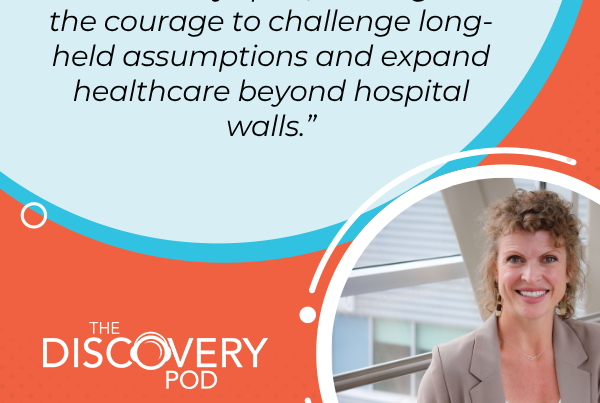
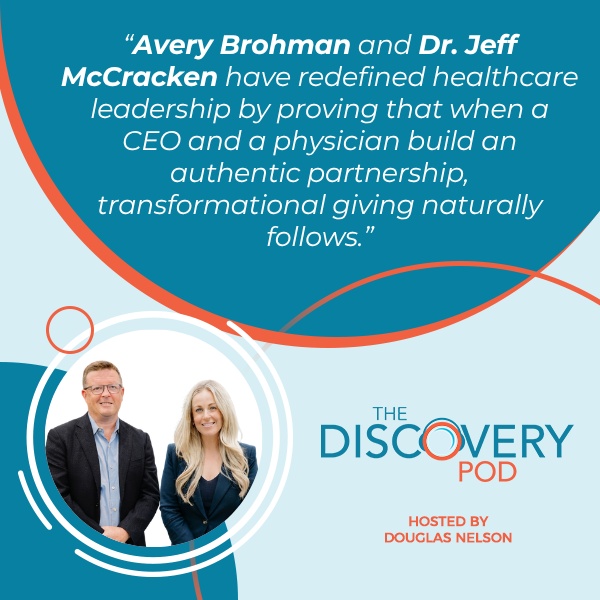
A successful healthcare foundation relies on strong trust between clinical leaders and executive visionaries. Establishing an effective CEO-physician partnership can transform how hospitals engage donors and elevate patient care across an entire region. In this episode, host Douglas Nelson welcomes Avery Brohman, Chief Executive Officer at Victoria Hospitals Foundation, and Dr. Jeff McCracken, Chief Urologist and Head of Robotics at Royal Jubilee and Victoria General Hospitals. Together, they discuss how their close collaboration became the strategic catalyst behind raising tens of millions of dollars for surgical innovation. From breaking down administrative silos to uniting physicians, executives, and donors around a shared vision, Avery and Dr. McCracken share practical insights on how healthcare leaders can build lasting partnerships that redefine medical excellence.
—
Listen to the podcast here
The CEO-Physician Partnership: Avery Brohman, CEO Of Victoria Hospitals Foundation, & Dr. Jeff McCracken, Head Of Robotics At Royal Jubilee And Victoria General Hospitals
Working With Physician Partners In Healthcare Philanthropy
We’re going to answer a question or explore an issue that we hear a lot about in our work with clients, which is working with physician partners in a healthcare foundation environment. I thought it would be best to bring on two people who are doing it very well in a partnership at Victoria Hospitals Foundation and share the tools, tricks, and tips that they have that have made their work so successful.
Hopefully, our audience can learn a lot and get answers to questions their board members, health authority partners, or doctors may be asking. First, I’m pleased to welcome Avery Brohman, Chief Executive Officer at the Victoria Hospitals Foundation. She’s been at the foundation since 2018 and has led a remarkable growth of that organization, more than doubling revenue to help ensure that Royal Jubilee and Victoria General Hospitals have the resources they need to deliver exceptional care. We’re also joined by Dr. Jeff McCracken.
He’s the chief urologist and head of robotics at Royal Jubilee and Victoria General Hospitals. He is a recognized expert in robotic-assisted surgery. Dr. McCracken has played a pivotal role in establishing Victoria as a provincial and national leader in surgical innovation. In our conversation, they talk about how the partnership formed, how they work together to develop the priority, put it in front of donors, and raise an incredible amount of money for the elevation and the extension of care as it relates to robotic surgery in Victoria. It is a case study with a lot of lessons to be learned, and I hope you enjoy the conversation.
—
Welcome to the show, Avery and Dr. McCracken.
Thank you.
Thank you.
Jeff McCracken, I said before we started recording that the most important thing was that he goes by Jeff, not Dr. McCracken, but I thought we would start that way to add and make sure that all of our listeners are sitting up a little straighter as they’re listening to words from him as we go through.
I’m really excited about this conversation to talk about the really incredible work that’s happening at Victoria Hospitals Foundation in partnership with Jeff McCracken and his colleagues, and to talk a little bit about that partnership between medical partners and hospital foundations, which is something we hear a lot about and work with a lot of clients here at the show. We’ve got two experts on today for that conversation. As we move into that, Avery, tell us a little bit more about Victoria Hospitals Foundation and the growth of your organization over the last couple of years.
Thank you, I’d be delighted to. Simply put, we’re transforming healthcare for this entire region. We exist to help patients across Vancouver Island have access to the very best healthcare possible, close to home. Through philanthropy, we accelerate investments in technology, which you’ll hear about in research, equipment, and education, to help both Royal Jubilee and Victoria General Hospitals, the referral sites on the island, deliver better outcomes for more than 930,000 Islanders. Just last year alone, we generated over $40 million in revenue, and that’s more than double our impact over the last three years. The key to that success was this collaborative partnership with our caregivers, and that’s what I’m most excited to talk to you about.
Through philanthropy, we accelerate investments in technology, research, equipment, and education to help our hospitals deliver better outcomes. Share on XI’m looking forward to that. Jeff, I’ll come to you. When you’re in medical school, you, of course, I did several courses on fundraising to be prepared for this. This was your minor in medical school in fundraising. Is that right?
It feels like it at this point. It feels like it could have been.
Tell us a little bit about your work, Jeff, and really curious about the moment when you realized we needed some fundraising to help us with this.
The Vision For Robotic Surgery And Early Philanthropic Needs
The story goes back a long way, and I’ll try to keep it brief. I was born and raised in Victoria. It’s my hometown. My dad was a family doctor here. Coming back to Victoria was always my goal when I went off to do training. I was given a goal to learn robotics, to get the gift of coming back here. That was now way back in 2008, when I returned from Seattle after doing a year of robotics down there. Philanthropy, even in the United States, was a big part of robotic surgery because there are large capital investments, and then there are, of course, ongoing costs per surgery.
These things often come from philanthropy, even in a more capitalistic medical system. When I came back, there were promises that we would get this going. There were multiple times when we had momentum. Things like COVID came along, and priorities all shifted. We never really had the unity that we’ve had since the foundation really engaged with us about three years ago. Robotic surgery is something that’s, in general, quite exciting. It’s good for everybody. It’s good for the surgeons. It’s good for the hospital staff, and it’s particularly good for the patients.
It brings a lot of excitement, I think, to the hospital in general. It’s also become a tool that’s absolutely essential for recruitment because everybody who’s learning is learning robotics. If you do not have a system handy, people really have to change how they practice. There are a lot of layers to robotics that make the hospital better. At the end of the day, without the help of the donors in particular, and subsequently the foundation, I do not think we’d be seeing anything close to what we’ve got going on right now.

CEO-Physician Partnership: Robotic surgery is something that’s good for everybody. It’s good for the surgeons, it’s good for the hospital staff, and it’s particularly good for the patients.
Thank you for that. That story of we have the potential to do this really exciting thing to bring this margin of excellence to the hospital or to the care environment. There are other healthcare priorities, of course, that shift that. We need to find another way. I’m curious, take me back to the first conversation the two of you had about it’s time to raise money for robotics here in Victoria.
Avery tells a story I think better than me, but I became somewhat obsessed with trying to get the attention of the administrators and the foundation to try to push this along. A lot of the time, the priorities are just such that this is such a complex thing to undertake that it takes a lot of meetings and a lot of trying. I can tell you that I’ve been at a lot of meetings where I feel like the person across the table is there just to listen to me and just to make sure that I feel like I’m heard, but not actually have any ability to run with it. I’ll hand over to Avery to tell the story of how things got started.
Jeff was relentless, as you should be. With any bold transformation in a healthcare system, it takes champions, and Jeff certainly is one of those. I first joined the foundation over eight years ago when I started leading the foundation seven years ago, and every single time I saw Jeff in the hallway, he’d pull out this paper from his back pocket, just waiting for the moment to see me or the foundation to show me the FAQ on surgical robots. We absolutely knew that it was critically important to operationalize that type of innovation in our hospitals.
With any bold transformation in a healthcare system, it takes champions. Share on XObviously, timing is everything. I will say the pandemic did take us back. We had to pivot and focus on the now and the urgent needs, especially in critical care. This was always on the horizon. Our foundations have changed a lot over the last few years, and we’ve been embracing transformational initiatives. It really started with a simple question to the frontline caregivers like Jeff, and we always say, “What is going to have the greatest impact on patients?” We knew years ago that, in medical imaging, there was a serious need to refurbish our MRIs and CT scanners.
With that, we worked with a division head of medical imaging, and he showed us the power of innovation and working collaboratively with our medical leads and department leads. That tipped us in the right direction, where donors were really excited about innovation. They were telling us that their donation meant more to them than donating to a large bucket of needs that, in simplified terms, should be free. Healthcare is free. The government is funding our hospitals. They really got behind this refurbishment project, and we started innovating how we were going to replace these MRIs.
It was one-third of the cost. We were not replacing the machine as a whole. We were stripping it down to its magnetic core, replacing some key parts, and building it back out. It was a win-win. That momentum of the campaign showed us that we could go bigger. We knew that a robotics campaign would be the largest campaign to date that we’d have to embrace. We tested the waters first, honestly, Doug, and we wanted to see if our donors had the appetite to advance innovation and if this is the foundation space.
Building A Comprehensive Campaign For Multi-Specialty Surgical Innovation
Is this where we should be? Collaboratively with our board of directors, our leadership team, and our entire staff, we started asking department heads, how can we have the biggest impact? When we were able to give Jeff the phone call to say, “We’re ready.” I do not know what’s more innovative than a surgical robot, and let’s do this properly.
This was the very first comprehensive campaign we launched to Doug, meaning we knew that it was going to be for multiple years. To embrace surgical innovation, it’s not just one suite. It’s not one robot. It’s so much more than that. We knew that this would be really intriguing in our community, but we wanted to do this right. We asked Jeff and his colleagues, if you could wave a magic wand, what would you need here to make surgery the best?
That is a very dangerous question to ask.
It was like Christmas for all of them, and that’s why we’re in our third year. We have made a transformational impact because of that. We have not put a band-aid on or found a solution. I know that we’re approaching our third year now for surgical innovation. I know that once this third phase is over, we will look at surgery and how it’s performed on the island. In all honesty and integrity, be able to say we were the catalyst for change. Our donors made such a difference here.
When we asked Jeff how we should embrace this, Jeff did what most urologists or surgeons, I do not think, do in healthcare systems that would have the ability to have a robot or be large enough and with the size and scope to do that. He didn’t just focus on his specialty. He embraced all his colleagues. Everyone in surgery, what could this look like? How do we actually bring a robotic system that we can share? It’s not just one patient population that is going to receive the benefit of minimally invasive surgery. Let’s do this for all patients.
That’s why, to date, we’ve got three robotic systems here. We are the leading center in Canada right now. If you look at a community hospital of our size, you do not see three suites, and hopefully there will be more to come, but that was because of Jeff’s vision. Having one internal champion who has the respect of their colleagues, has the respect of hospital administration, and can do this properly was the key to our success, truly.
CEO-Physician Partnership: Having one internal champion who has the respect of their colleagues, has the respect of hospital administration, and can do this properly was the key to our success.
What Jeff did was build out a proper strategic plan with us. What could year one look like? What could year two look like? What could year three be? Engaging all of his colleagues. In our first year, we launched a $17 million campaign. We thought it would take us two years because we could just come off the heels of Imaging is Power, that other innovative campaign, which was $11 million. We’re like, okay, let’s stretch this a bit. Give us time. It took us less than a year to raise $17 million dollars.
There was one robotic suite as well as 50 pieces of tools and technology that all of our surgeons chose, and that was really a profound moment for us because here are surgeons not only saying, “This is how I can treat a patient better, and this will keep me engaged in the long run, and this is what’s going to keep me close to home here in Victoria.” We also had the gift of their giving us access. They were taking our donors behind the scenes.
They were sharing patient journeys. Our donors felt so close to this physician and surgical group because they were hearing firsthand what that tool or technology would mean to them and what it would do for better patient care. We were able to steward our giving so much more strongly because of that. Jump to phase two with Jeff’s vision, we wanted to make sure that women and gynecological oncology had an opportunity with this robot. Here in Victoria, there are two hospitals, Royal Jubilee and Victoria General. Victoria General is where women are treated.
There are some specialties there that are not necessarily at Royal Jubilee. There’s our case for needing a second robot. We also talked about robotics and other specialties, including neurology. That’s when we got a neuro robot. That phase was $21 million. We thought, “This could stretch us two years.” We did two surgical suites and 60 pieces of tools and technology. Again, ensuring that everyone had an opportunity to come forward with us and share what tools and technology would make their patient care better.
That again took us less than a year. We were seeing that when we worked closely with those at the bedside, where we could ask, what is the greatest impact we will have on patient care on Vancouver Island? That was the game changer. That was our strategic differentiator. Granted, Island Health had to be on board, and they were on board. They were grateful that we were directly working with the right people at the bedside, incredibly strong leaders in our hospitals. Jeff is not someone who only looks out for urology patients, as I mentioned before. He’s looking at the system as a whole.
He’s looking at every patient matter. That was also great. All in all, this started with a vision that was much smaller than what it is now. I’m very proud we’ve just completed the second phase of the surgical innovation campaign, and we’re going to be launching the third and final stage. It’s going to be very ambitious, and Jeff’s been with us every single step of the way. It really takes those key internal champions to make us better and to make us good.
One of the most important lessons from this campaign is that the culture of philanthropy begins with partnership. Those partnerships are those that are working directly with patients. Our role was to listen, help shape vision, and connect with communities that wanted to make a difference. It’s one of the reasons why we’ve been so successful, and that was built collaboratively.
One of the most important lessons from this campaign is that the culture of philanthropy begins with partnership. Share on XThank you for walking through that, Avery, and congratulations on that success. What I hear is it’s important to have a plan, but it’s really important where that plan starts. That starts with the brilliant women and men who have the ideas that are connected to care as closely as possible, and building out from there. We could have, like, an unscripted or a post-interview that we could sell tickets to for the conversations to ensure the collaboration between the health authority and the physicians at the same time and make sure everybody’s on the same page.
That is where we see a lot of our clients really struggling to be caught in between and make those connections. It is not because there are any bad folks trying to do bad things, but aligning priorities and aligning budgets can be really challenging. It sounds like you’ve navigated some very challenging waters quite smoothly, or at least you’ve come out the other side, and you can make it sound smooth, which is almost as good. In fact, it’s probably better. Jeff, I want to come to you very tactfully.
It is one thing to go to meetings where people say, thank you, I understand that you have an issue. Thank you for your time, Dr. McCracken. They leave, and then they go on to the next meeting to try to make the next doctor feel better. I love the image of you waving a pamphlet at Avery in the hospital corridor. It’s a go. We’re going to go very practically, tactically. What were you thinking when you were getting ready to go to that first donor meeting where you were going to talk about the importance of this campaign? How did you get ready to start talking to donors about this project?
Engaging Donors And Communicating Value At The Bedside
Man, somebody’s got to hold me back from talking about this type of stuff. More than getting ready. I’m born ready for that. Chill out. Excitement is not a strong enough word to describe where we went. As a surgeon, you have anxieties about am I right about this. What is this going to look like on the other side? The other thing is, we had to get ready for the imminent delivery of the robot. I have not done robotic surgery for like the better part of seventeen years at that point. There’s a lot of training going on at the same time that we are in the sort of final leg of pushing through with the donation. A lot was going on at that time.
I have to say that the donors immediately took up the idea, and there was so much support that I never really felt like we were being questioned or scrutinized or ever like being hung out to dry by the administrators. It all just moved ahead very smoothly once we had got to that sort of final push. That carried through into the second phase of this, where we actually could sort of use that momentum to carry us through to the second system that’s there.
The beautiful thing is that it addresses so many of the issues that are in the hospital, particularly like just the actual square footage and beds. We can have patients going through so reliably that the next patient is basically ready to get surgery when the other patient from yesterday is going out the door. Anyway, with the donor support, it made pushing all those issues out to the public, out to the administrators, much easier.
How did you feel being in those rooms where donors are asking questions about why the government does not pay for this, or is this really going to work, or could you do me first, please?
I would say that a lot of the face-to-face donor question-and-answer periods that we’ve had, they get quite personal. A lot of people start bringing up their own health stories, and you have to find a way to bring it into how what we’re doing is going to affect them directly. There certainly are not always questions about what the government’s role is. Because we are now so far beyond what so many other hospitals are, people can tell that this is not something that’s just a standard that we’re trying to catch up to. Of course, that is, in my mind, what do donors want to hear?
I think of a donor as not donating money. I think of them as spending money. If you spend money, you want value, and where does that value lie in what we’re doing? Those real critical elements, they want to see that there’s leadership. They want to see that what I call what Avery’s done with the administrators and the doctors is not just a relationship. It’s an ecosystem where we all have a role to play. Without somebody in that circle of things that are going around, if they’re not part of it, it’s not going to work.
CEO-Physician Partnership: What I call what Avery’s done with the administrators and the doctors is not just a relationship. It’s an ecosystem where we all have a role to play.
Avery has really facilitated that between the donors, the doctors, and the administrators to make it successful. At the end of the day, what I see as being the most valuable for donors is that there’s going to be efficiency that’s created by it, which is going to help with wait lists. It’s going to help when I go to the hospital with a problem. I’m going to leave without that problem. I’m not going to end up coming back to the hospital for more things.
In the future, where I see the foundation playing a huge role is that in every department of the hospital, there are issues that we have to tackle, and they all require funding and money. Administrators see risk anytime they agree to pay for something. We can soften the risk by obviously having funding for it from elsewhere. I’d like to see every day like this is very focused on surgery, which is obviously great for the surgeons. There are donors in every part of the hospital that could potentially be embraced by doctors who are thinking along those lines. I really look forward to more projects that are going to involve maybe smaller visions, but more frequently and more spread out to create better hospital efficiencies, is where the value is.
You think Avery will have some work to do for at least a couple more years?
I cannot retire anytime soon, but on that, Jeff. The future for us is these comprehensive campaigns in nature. We want to go to a department and not just pick the highest-priority equipment needs on the capital list. It’s so much more. It’s collaborating with those who are seeing patients every single day, seeing where the gaps are. Our donors want to do that, truly. Bringing them into the story, being incredibly transparent, and sharing the impact every opportunity we can has also been key to our success.
They believe in this work that we’re doing because they’re so close to it, and we make a conscious effort to relay and share the impact they’re having weekly and monthly. Many of our physicians are bringing forward their patients who have benefited from campaign initiatives, where we get to share those grateful patient stories, and that real, authentic storytelling has also been key to success in this campaign.
I remember a day when it was really hard to get a patient’s story, and now patients are writing in to say, “Thank you, I just received a surgery I would have had to go to Vancouver for. If you’d like my story, here it is.” What a gift, what a true gift to be able to do that. I want to say, like, our donors just get it. They understand the role that ministry plays, that health authority plays, and that we play. We have to do our due diligence to make sure that they see where we all fit in this big ecosystem, but it’s working. I will say I’m grateful to Island Health for taking the risk with us. Of course, we were committing the funding, but being the first at something is hard to do, especially in a healthcare space. Now we have our colleagues.
I have my colleagues from hospital foundations across the country asking how we’ve done this, and that feels really good. That is a testament to the commitment that not only our donors have given, but our surgeons have given their time and expertise, and our health authority has believed in this and said yes to us. That is trust, and it’s been built on trust, and philanthropy is about people as you know. The same goes inside our hospitals. When this is about a donation, when this is about a donor or philanthropy as a whole, our hospital administrative team treats it that way. We’re lucky here, honestly.
You make your own luck in a lot of ways in this work, in every way in this work. You make your own luck. You mentioned gratefulness a couple of times in your last answer there, Avery. I want to come back to that. What is the role of grateful patients in the conversations the two of you have had around fundraising for the first two phases of surgical innovation?
Without grateful patients sharing their stories.
Not just their story. A number of grateful patients are often the first folks that we would think of as fundraising from to support some of that. That conversation about, so we got to raise all this money, Jeff, who are we going to talk to?
There’ve been some really strong allies that go back even before I met Avery, who have been on my side and kind of at the ready to get started. The patient side of it is an underutilized resource in general. The fact is that we see so many people who want to be doing stuff like this, and just understanding how to do it has been something that is not always addressed by doctors.
The Role Of Grateful Patient Programs In Healthcare Transformation
It’s actually one of the last things that we would ever want to talk about with patients when they express their gratitude that they have this opportunity, but we find subtle ways to work around that. We’ve got postcards in our office that talk about robotics, surgery, and other things just to keep people aware. Of course, you have some patients that just come up to you, and they say, “I want to help. How do I do it?” They’re really upfront about it.
I also find that sometimes the donors, as well, are, I mean, they’re not necessarily grateful patients. There are people who feel like the system is broken and needs to be fixed, and they’re here to help do that. A lot of them have got stronger convictions even based on that. There’s so much opportunity as a doctor to curate a culture that allows for participation in this type of behavior. Just have to find a way to do it that’s not obtrusive and insensitive.
Respectful and appropriate, of course. Did you find yourself getting more comfortable with that role over the course of the campaign?
I think so. If you look at how I talk to people about how they can help, I’ve got a much more refined way to talk to them about it. With respect to bringing it up, I try to really sort of steer clear of that. We deal with a lot of sensitive things in urology, and it’s not always, or it’s rarely, an appropriate time really to start talking about that thing unless the patients bring it up themselves. Having the things in the office to make them aware of the opportunity is, I think, the most appropriate way to do it.
I’ll try to wipe all of the images that went through our audience’s heads as you described the sensitive nature of the work that happens in a urologist’s office. Avery, how do you see the role of grateful patients in building and shaping the scope and scale of the campaigns for the foundation?
When patients receive excellent care, they want to give back. We meet so many patients that way. I often say there is so much good in healthcare, and I get to see it firsthand because of those coming forward to the foundation to make a gift. That is very true. A lot of them are inspired by their own journey or when a grateful patient has shared their story because they can relate or they can connect. I also think that the role we play inside the hospital, like being on site, is great.
We are present in the hospital. Is walking the halls with the patients the same as the way the caregivers are? We are engaging our caregivers and thanking them when a patient in their department has come forward and shared that a grateful patient has given back to their department because of the care they offered. That’s a role we play too. It’s important that we continue to share the good inside the hospital, and especially with our caregivers, because they do not.
They have access to that every single day. They’ve got stressful jobs. They’re dealing with sick people, and they may not have closed the loop or been able to actually be part of that really great end to the story where we get to experience that. As you know, a lot of hospitals have grateful patient programs. Ours is called a caring spirit program. It’s growing every single year.
We’re meeting grateful patients who want to give back to their department directly or who are sharing something that’s happened to them in a really profound way. I do not take for granted that we get to be part of their journey. Oftentimes at our galas, we have a patient who will share their story on a platform, and they’ll say to us, “I didn’t know that I needed that part of the journey.” That part of the journey was not about fundraising.
Yes, it inspired a room to give back, but it’s unique. The role that we can play also to help heal a patient from the traumas that they’ve experienced and also partner with the physicians to say, “You treated them. Now let us take over and start a relationship with them that can continue for years where they can be part of something, whether it’s volunteering, donating, giving back in a way that is meaningful for them to stay connected to healthcare,” because I’ve realized in recent years how critically important that is too.
It is that motivating part of the work, and being in a foundation is seeing that benefit. Part of the difference that you were referring to there, Avery, is that when you’re working in the foundation, there’s such an incredible selection bias in who you’re talking to. You’re talking to the people, whether they’ve had the ideal or even a good outcome, who are thinking about how to give back, how to change. It went really well. I’m very grateful, and this thing that might have been helpful was not available, and I want to make sure this is available for whoever comes next or for others who may need it.
We’re seeing people who, on the foundation side of things, we’re seeing people who are wanting to find that meaning and add that purpose to their journey, which, in the day-to-day of a doctor’s office, is not present. I will not ask Jeff to comment on that. One of the other things you referenced, it sparked for me because it’s something I hear a lot, particularly when I’m talking to foundation boards in my work.
You said we want to move away from the equipment list on the capital projects list and to talk about a comprehensive way to wrap around or to support, to add that margin of excellence to a whole department. It sounds obvious when you say it, like, of course, that’s the way to do it. That is one of the biggest challenges where I see so many hospital foundations get stuck, is to go to the administrators who are good people doing good work but have very limited capital dollars in our healthcare system anywhere in the country.
This is what you need. You ask as the foundation person, you’re like, “What is that?” They tell you, like, “I cannot raise money for that, but it’s on the list.” Many foundations are in that space where they’re just taking that, that they raise as much money as they can to pay for as many things on that list, sometimes in the order that it’s provided. You’re talking about doing something very different. There is some courage. There is a leap of faith there. Avery, how did you get to that precipice of jumping?
It’s absolutely a balancing act. We still support the routine capital needs, but not in a campaign, not front and center. Sixty percent of our annual revenue is campaign-focused. The other is that donor-centered piece where a donor will say, “What are the greatest needs in cardiac right now or pediatrics?” We can then look at that list, reference what Island Health needs, and go from there. We are also very lucky that we have some donors and large philanthropists who say, “What are the non-sexy equipment pieces right now that you need funded?” Those people are a gift.
I’ve got a long list for you.
Shifting From Capital Equipment Lists To Systemic Innovation
Yes, because they also understand that it’s not going to be compelling publicly, but there is still a role we need to play for that routine capital need. Some of our greatest needs for funding, some of the funding that might be through lotteries or estates that are in greatest need, will help do that, and those are gifts that we do not take for granted at all. We’ve been able to start leading where we want to be in fundraising because our health authority sees that we are still getting through some of their routine capital equipment needs, but I also think that there’s an awareness of what donors really want, and giving is personal, as you know.
We are not going to apply a donation to an area that does not feel like it moves the needle for a donor. Again, I think our health authority believes in that, but it’s been hard. This is a process that didn’t happen overnight. This is at least five years in the making. One of the lessons that we learned was that when we only look at that list and we do not engage with our clinicians, it’s a grind. It’s really hard. Our COVID response campaign emerged stronger.
We took 100 pieces of a priority needs list, compiled them together, and built a case for 100 pieces of equipment. It didn’t tell a story. It was a direct response. It was an indirect response to the pandemic. Capital budgets were being deployed elsewhere. We really needed to help Island Health with the routine capitalists. That was very hard to achieve. Island Health sees that too. They can see where our success is marked. Those are some inside goods for you, Doug, and for my colleagues tuning in. We’re only going to be as good as we can be if we choose the right areas.
With respect to robotic surgery, we're in the infancy of something that's pretty amazing. Share on XMuch of our strategy that our board has endorsed is that innovation and technology is where we need to be. Look at what we’ve done so far in the last few years with medical imaging and surgical robots. That is the future for us. We want to look at any department that we’re going to focus on and innovate the department as well. That should not be confused with just a piece of equipment. How do we innovate wait times? How do we innovate patient care? How do we innovate by recruiting excellent colleagues? We want to innovate the system as a whole. We’ve started to really make good traction with that. Once you’re proven and you’re successful, they believe in you, and they let you go.
Our problems are nothing that success will not fix. There’s a really important lesson for Hospital Foundation colleagues tuning in to take from your answer there, Avery, that it’s not either or, it’s both. To be able to consider these larger comprehensive campaigns that we know are going to be really attractive to donors, in order to get the space and the credibility, you have to prove that you can deliver on what the immediate needs of your partner are.
There’s no toggle switch. This is a slide the whole way, but what we’ve seen be very effective in other situations is naming when you’re addressing the primary urgent need for your administrative partners and never forgetting to say it out loud and probably repeat it a few times so that you are marking that the credibility is building when you need to time that you cannot avoid Jeff in the hallway, and now you have to take on surgical innovation. You’ve got the credit.
Many more Jeffs in the hallways. He should come to work with me one day.
That’s what I wanted to go to you next with, so that Jeff gets all of the money, he can do whatever he wants. It’s totally unfair. I do not know how he did that. Let’s make sure that we give them more time for it. What do you hear from colleagues in other departments more seriously? What do you hear from other colleagues in the world who see the results? See the dollars coming in, the equipment being purchased, the change in care happening. They’re like, what do they say?
I was prepared for a bit of backlash, thinking that people would say, “How come this is all going in this direction, and what about us?” and that thing. It really has been a bit of a transformation around the hospital. The presence of the hospital foundation has been much greater since this campaign started. Everybody in the hospital just about knows who I am because of the posters and all these things that are around.
It’s good vibes. People are really proud of what we’ve accomplished, and people want to be in a hospital that has robotic surgery. It’s just something that helps everyone. We’ve done, like, I think roughly between 700 and 800 surgeries now in a city of like 400,000 people that just about has touched somebody that knows somebody by now.
That is just the profound nature of the change that occurred, which is enough to carry us for a while. I do think that eventually people are going to say, “How do I do this? How can we do this? How can we bottle that up and take it in this direction?” In which case, I’d be more than happy to partake and push things along. I’m a Victoria-born and bred kid, and I just love to see our hospital succeed.
That’s great. As we come to the end of our conversation, I want to ask you both my favorite question to ask our guests. I’ll start with you, Jeff, and then we’ll close with it. What are you looking forward to?
The Future Of CEO-Physician Partnerships And National Leadership
They open the door a crack for me and then throw that door wide open. With respect to robotic surgery, we’re in the infancy of something that’s pretty amazing. I am still pushing. There are places where we can take our robotic surgery program. I’m just speaking specifically about the Da Vinci surgery side of it, which is what I’ve got expertise in. We’re already doing some of the most complicated surgery in Canada with multiple surgical specialties.

CEO-Physician Partnership: To know that our colleagues in the hospitals respect us as their true partners and colleagues is something that is incredible. There’s no power dynamic here. We are part of an ecosystem together.
Most robots around the province or even the country are going to have some limitations as to which services use them. Our program has got, like, basically eight different services using it. If you need a surgery that involves multiple organs or surgeons, we have a robotic surgeon who can take that on, and we can combine these surgeries together.
With the amount of freedom that we’ve had to evolve in the last couple of years, we’re already on this trajectory that’s going upwards. I look forward to continually participating in anything I can do to help Avery, especially when it relates to hospital efficiencies. Those are the big things I like, but at the same time, I’m going to keep pushing for more robotic surgery, not only here, but throughout the province.
I’m looking forward to the future and maintaining this momentum that we have created. We are on a national stage now, and I do not want to take that for granted. I also do not want to lose that opportunity to hear us recruiting the best surgeons in North America now that want to come work here is a true gift, and there’s a responsibility that comes with it. Carefully selecting campaigns that can keep this momentum alive and happening. There’s a great sense of pride in healthcare now locally.
I couldn’t have said that before, honestly, with you, Doug, like I think we met five years ago for a podcast, and I didn’t tell you that then. I’m most looking forward to making sure that we engage our caregivers, create comprehensive campaigns that matter, do what we didn’t once think was possible, continue to punch above our weight, and have our peers across Canada ask us how we did it. I want to be a leader. I want to remain a leader in this sector because we’re taking risks and they’re proving to be beneficial.
To know that our colleagues in the hospitals respect us as their true partners and colleagues is something that is incredible. There’s no power dynamic here. We are part of an ecosystem together. I know that as long as we continue to do that, donors will keep giving. They’re going to keep giving more, and they’re going to keep coming back. That’s the future for us. I’m really excited for what’s next.
It is incredible to watch the journey of the foundation over the last eight years, the last seven years, certainly since the last time we talked on the show. Avery, you’re doing incredible work. Dr. Jeff McCracken, thank you so much for making time to share this story. Congratulations on the great work that you’ve accomplished, and I look forward to hearing updates on what phase three and what opening that door wide means for Victoria Hospitals Foundation and for care in Victoria. Thank you.
Thank you.
Thank you.