How do we move from simple, transactional giving to creating real, lasting change in our communities? The answer lies in the shift toward relational philanthropy, a concept that is redefining how modern foundations operate and support their partners. Host Douglas Nelson is joined by Hilary Pearson, the founding president of Philanthropic Foundations Canada and author of the 2022 book From Charity to Change: Inside the World of Canadian Foundations. In this episode, Hilary unpacks the transition from traditional, top-down funding models to a collaborative approach built on trust, shared learning, and deep community partnerships. They explore the unique role of foundations as catalysts and conveners, the generational shift in sector leadership, and how working together differently can solve complex social issues. Discover how shifting the focus to deeper relationships can elevate your organization’s impact.
—
Listen to the podcast here
From Charity To Change With Hilary Pearson, Author And Founding President Of Philanthropic Foundations Canada
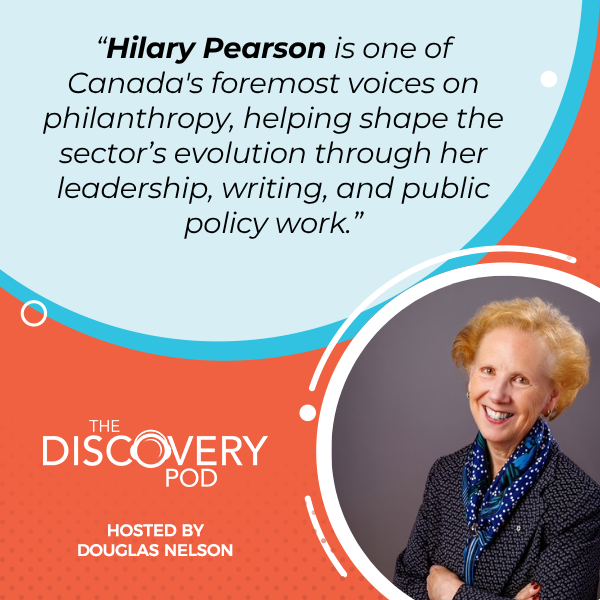
They say, “Don’t meet your heroes,” but in this episode, I got the chance to meet one of my heroes, Hilary Pearson. One of Canada’s foremost voices on philanthropy and in the social profit sector. Hilary is a Founding President of Philanthropic Foundations Canada and the Author of From Charity to Change: Inside the World of Canadian Foundations, published in 2022. For more than three decades, she’s worked alongside foundations across the country helping shape the evolution of Canadian philanthropy through her leadership, writing, and public policy work.
You can learn more about what she’s thinking on a day-to-day basis, on a weekly, monthly basis, at her blog at HPearson.ca. I encourage you all to check it out. In our conversation, we talk about the role of philanthropy, Hilary’s concept of relational philanthropy, and how that is shaping the change in private foundations in philanthropy in general in our country. It is a masterclass with one of the true masters of understanding and connecting the community here in Canada. I invite you to please enjoy my conversation with Hilary Pearson.
—
Welcome to the show, Hilary.
Thank you very much. Glad to be here.
Demystifying Philanthropy: What It Actually Means In Canada
Looking forward to a very broad, wide-ranging conversation on the state of philanthropy and the charitable sector in Canada, but let’s start with a basic that most people feel like they know the answer to but there’s a lot of nuance to it. What do we mean when we say philanthropy?
That’s such a good question to start with. Philanthropy is defined in the dictionary definition, love of humankind, but it has much broader definitions and people use it in different ways, I find. Philanthropy can mean the simple act of giving by individuals. It can mean the giving of funds by foundations. Most people are familiar with foundations, at least in a general sense.
Philanthropy can mean the simple act of giving by individuals. It can mean the giving of funds by foundations. Share on XWe can talk about some of the differences that you find among foundations. Certainly, philanthropic foundations are well known. It can also mean fundraising. In Quebec, for example, where I live. Philanthropy in French is the same word. It can be used to mean fundraising as well as fund giving. It’s important to be clear about the set of players that we’re talking about when we talk about philanthropy.
If you read enough on the internet, you’ll hear the concept of big philanthropy, which is supposed to be ominous and scary. I don’t think we have much of that sense of skepticism of philanthropy so much in Canada or maybe do we? You’ve probably heard the best and the worst of all of that.
That’s also a very good point. I don’t think we do have the same suspicion of philanthropy, partly because we don’t have the giant foundations that we’re seeing in the United States. That is becoming only more since 2016. We’ve seen fortunes being made in American tech, in particular. Now, we’re seeing AI foundations that are being started. These are massive foundations in terms of assets, and we don’t have those kinds of foundations in Canada.
We also have a perception of philanthropy that is generally more positive. I say that based on 25 years of working with foundations across the country. There’s good and bad in that. There’s good and there is generally a positive perception. There’s bad in that when you dig into it and you ask people, “Can you name a foundation? Do you know what foundations do? Can you tell a story about what a foundation has done in your neighborhood?” Very few Canadians could do that. Foundations are, perhaps in Canada, or perhaps benefiting from the fact that they are more anonymous. You don’t have the same big philanthropy ego that you might see in some of the American foundations.
One of the questions we often hear in our travels here at The Discovery Group, sometimes boards in particular, of organizations that have been primarily funded by the government that are now looking to raise funds to fill in some of the gaps that cutback in government funding has come in. They say, “We should go to foundations.”
One of my colleagues here asked with the warmest tone of voice she could possibly imagine, “Which ones?” They couldn’t name a single one. It’s this idea of, “If this is where the money is, we should go get it.” As you say, there is some cover in that. It also hides a bit the good work and the role of innovation that these foundations can play in supporting the sector in general.
That’s right. Certainly, I’ve encountered over the years repeatedly from people running foundations that they’re not averse to telling a story, but the story has to be about their grantee. It should not be about them. Quite often, I hear this modest statement, “It’s not about us. We don’t want to tell our story. We don’t want to be the ones that everybody knows about.” At the end of the day, the work has been done by the grantees. Our role is to be in the background, but to provide the funds.
At the same time, people are guarding their privacy. I have been known to say fairly often that when you are a private foundation, when you first register as a foundation with the Government of Canada, you get a designation as a private foundation, if you have been started by a family or by a single donor. What I will say to these foundations is, being a private foundation does not mean you get to be private. You do need to say something about yourselves.
Relational Philanthropy: Being a private foundation does not mean you get to be private. You do need to actually say something about yourselves.
I will say over the years, certainly in this last quarter century, that more and more Canadian foundations will understand that it’s important to have a website. At least giving some basic information about themselves as part of their accountability to the community. There’s a reluctance on the part of many foundations to be seen for various reasons. Partly to do with that sense that, “It’s not about us. It’s about our partners, our grantees.”
Also, because foundations don’t want to be seen too much. It goes back to the point you made earlier, “We’re going to go find money from foundations because there’s scarcity out there.” Governments are cutting back and donations seem to be stalling or even falling from individuals. What are we going to do? We’re going to have to go to foundations. How do you find those foundations? They haven’t made themselves easy to find.
From Charity To Change: The Evolving World Of Canadian Foundations
Almost like on purpose. Somebody I know wrote a book about them and told their story about the Canadian foundations. Your book From Charity to Change published in 2022, looked at the role that foundations play in development of our social sector and our community organizations and those foundations themselves. One of the things I said as we were getting started, I was probably one of the first people to get it delivered. It was pre-ordered. I was so looking forward to it.
If we were in person, I would be asking for an autograph, but one of the things that jumped out at me in the book was that as you did the interviews and you reflected on the journeys of a number of these larger foundations in Canada. There was a real pride that they took in their process of how they approached the work, how they professionalized and how they worked to build community and build investment. Not just their own investment and investment of other foundations and others, around particular issues.
It was a thoughtfulness that is not well understood, even within our broader charitable sector, our broader social sector, of how foundations approach that in it so you get to see it as a part of your career for a number of years at private foundations Canada. Were you surprised when they did that deep dive about how intentional foundations are in approaching their work or approaching the issues they’re seeking to solve?
I wasn’t surprised because I’d been working with them for a number of years. I did feel it was important to write a book-length account of how these foundations have changed, how they’ve evolved. The title, From Charity to Change, is a very deliberate choice. I wanted to talk about the evolution of these foundations, which in most cases did start with the traditional notion of charity. We will do good by giving back to our communities.

From Charity to Change: Inside the World of Canadian Foundations
We will give funds to organizations and we will build institutions in our community. That’s how you do philanthropy. In most of these cases, there was a pretty major evolution to a more, as you say, thoughtful and strategic approach to what good they can do. This speaks to the fact that, in my view, foundations have a unique role to play in, what I would call the philanthropic ecosystem. The philanthropic ecosystem includes more than just the foundations.
If you could think of it in almost a biological metaphor, foundations are just one element in a fairly large ecosystem that’s composed of people in communities themselves, charities and other nonprofits that work for communities. In communities, governments, certainly, and also businesses, we’re all part of this social ecosystem. Where foundations fit in is the thing that a lot of these foundations that I wrote about decided they had to think about very carefully.
What is our value added? What is our best use? We can respond to urgent needs every day. Every day there will be people asking us for help because the needs are endless. Indeed, over this past decade, I would say even, and let’s say since the pandemic in particular. There’s a crisis atmosphere for many charities. As a foundation, you could be sending out checks every single day. You could exhaust your endowment very quickly. What difference would that make?
Is there a role that foundations can play that is different from everybody else? That difference builds on two things. It builds on the fact that most foundations in Canada are built on the traditional model of an endowed fund. A donor will give a large amount of money, more than $100,000, say, and they will invest that money. The return on the investment is what they use to grant on an annual basis. It’s a pretty standard model. It’s been around for a long time. For 100 years or more, this is how the typical foundation has been structured and has operated.
Again, I say you could be handing out that money regularly, and the need would never end. The situation that you’re trying to address through the funds you’re giving might not change. In fact, it might get worse. To take an example, an example that many people use, think about a food bank. A food bank is there in the community to support people who are hungry. Alas, we’ve seen the increase in the number of food banks across Canada and the demand on those food banks. We’re hearing about it in the news all the time.
Foundations are just one element in a fairly large ecosystem composed of people in communities, charities and other nonprofits, governments, and businesses. We're all part of this social ecosystem. Share on XThe foundation could give to a food bank every year and never see the situation change. In fact, it only seems to be getting worse. What can a foundation do with its long life, with the fact that endowment gives it a chance to think about things from year to year? Typically, it’s not a fundraising foundation. It’s a fund giving foundation. It has this money. It can think about it and it can think about what the best use of that money is and that’s where the idea of change, remember, From Charity to Change, comes in.
You want to change the conditions that mean that people are going hungry. You have to think about where you can intervene in the system with relatively little money. At the end of the day, governments are always going to outspend foundations every day of the week. What can you do as a foundation with a relatively small amount of money to change a situation that seems to be very difficult for many people? Where is your best opportunity to make that change? That’s where these foundations that I wrote about have been so thoughtful.
The Five Core Roles Of Modern Foundations
In your book, From Charity to Change, you summarize the role that these foundations have for themselves as to catalyze, convene, create, collaborate, and challenge. These are to use the long life that they have and can elect to have. The unique position they have in society, the voice and the resources they have. As our society is changing, as philanthropy, as the sector is changing, are those still the roles now 5 years later or 5 years on from the publishing of that book? Is catalyze, convene, create, collaborate, and challenge still the role of private foundations in Canada?
I would say more so. Interestingly, when you have listed that set of verbs, you’re not mentioning fund. The fund, the amount of money that foundations have is the tool that they use to do the things that they are doing. Those verbs describe actions that foundations can take with the money that they have. It doesn’t exclude the fact that they are still granting. You could certainly include that verb to grant in that list.
The point here is, for many foundations that are thinking about making change, you go pretty quickly from being an arm’s length funder. Essentially handing out the money in a rather opaque way, by which I mean the choices that a foundation makes about who it’s going to give that money to are made behind closed doors. You hand out that money, you ask for a report, but you stand back.
You’re not directly engaged. Many foundations that want to make change understand that that’s too limited. They have to be engaged. How do you engage? Through one of those actions that those verbs describe. We’re seeing that thinking about the role of foundations accelerating. There is a change happening in the practice of philanthropy.
Relational Philanthropy: For many foundations that want to make change, you go pretty quickly from being an arm’s length funder, essentially handing out money in an opaque way, to being directly engaged.
A necessary one. As you said, if foundations just gave away their money to meet immediate needs, they would run out of money and probably not solve very much. How do they build capacity in the sector so that it can look after itself a little better, address root causes a little better or spend more time on that? The other role that I see for private foundations, which fits into my view on our sector, is that we should start more often from a place of abundance than scarcity and look for what’s working first before we jump into the pool of all the things that aren’t.
There’s a lot of problems to fix and they’re very real. Not diminishing the challenge. We get a lot more done when we start with what’s working and we start with abundance. Private foundations, in particular, represent that abundance because they do have those resources. They have that power of convening to help people formulate questions. Not only to finances, but are we even asking the right question? In the big change we’re seeing in the social sector broadly defined since the pandemic, the need is so great.
Public policy and public finances don’t permit the government to play the role that it has played in the past. There needs to be a new way. Organizations that we get to work with here at The Discovery Group, some of them are figuring it out pretty quick. Some of them are struggling with it. Foundations can play an important role in helping organizations better formulate the problem they’re solving. Am I on the right track there?
Shifting From Strategic To Relational Philanthropy
You are, but I want to address a change that I’m seeing in philanthropic practice that I would characterize as changing from what people call strategic philanthropy to what I’d like to call relational philanthropy. This doesn’t apply in all domains where foundations give money. In general, as a way of capturing a change that is happening, it’s interesting. Briefly, I described the traditional charity model. We give money to charities and they do their charitable thing. We’re not being strategic in deciding how we’re going to allocate those funds or responding to need.
The next step is being strategic, thinking, perhaps there is a role that we have and a goal that we can set and a strategy to get us to that goal. A fairly classic strategic planning approach, but applied to philanthropy so that you think about how you want to get to a certain place. Ideally, it’s a place where things are changing but you do that over a period of time. That’s strategic philanthropy but it’s been criticized and rightly as being top down, as being essentially, I don’t know the word elitist has been used.
It’s fair to say, especially when people in the community are thinking about or looking at foundations. They’re seeing people who are wealthy, who have privilege because they have money, and who can easily be associated with that idea of elitism. If you’re behaving in a very top-down way, then that is a fair criticism. It’s still very much in progress, so we can talk about the transition that I see happening butr where we’re going now is to this relational philanthropy.
What foundations have realized is we’re not the people who are going to be best placed to figure out what the solutions are. Even if those solutions are change-oriented solutions, in fact, even more so if these are change-oriented solutions. In other words, when we’re trying to figure out answers to complex social problems, let’s go back to food, food security. How do you resolve food security in a very complex environment with a lot of different players? How’s a foundation going to be able to formulate a strategy to make a significant difference in a complex problem like that?
You’re going to have to talk to people. You have to be involved in the community. You have to sit at a table with others, which means you have to build relationships with them. This is where the idea of relational philanthropy comes in. Rather than figuring it around your own board table or with the help of experts and advisors. A lot of foundations do reach out and ask for advice from people who have studied the problem for a while but that’s not necessarily building a relationship with those experts. It’s getting their advice, but it’s not building a relationship.
What I mean by that, as a foundation, you’re thinking explicitly about choosing and working with partners and you’re building a relationship with those partners. That also implies a period of time. That suggests a move away from the one grant to one organization for one year repeat model to a model where you’re working with probably a smaller number of grantees, but you’re fewer, deeper relationships, essentially.

Relational Philanthropy: Relational philanthropy suggests a model where you are working with probably a smaller number of grantees, but building fewer, deeper relationships, essentially.
You’re sitting at a table with them over many years, and you are trusting them to identify solutions. You’re supporting them in every possible way you can, using all of those verbs that you mentioned earlier. If it’s helpful to convene people in the community around a table, you do that as a funder. If it’s helpful to collaborate with other funders to support, to get more resources to the organizations in the community that seem to be having an impact, you do that. You can also collect and disseminate learnings from that and pass those around to others. There are many ways in which as a foundation you can amplify the learning that people can gain from working on a problem.
I want to touch briefly on that concept of fewer, deeper relationships, because it’s something we’re seeing a lot. When I have the chance to talk to boards about trends that we’re seeing in the sector. One of them is a phrase borrowed from international finance, but there is a flight to quality that we’re seeing a lot in the charitable space. The government’s, funders, private financials, but certainly individual donors, giving in those six figures and above, are looking for organizations that have a scope that is broader and a scale that is larger or at least flexible.
More and more of the larger donations are going to those organizations that have that scope and scale. There is a lot of opportunity for large organizations to do incredible, impactful things with that trend and do some amazing things. There’s also a consequence for smaller organizations. What we’re seeing in our work in travels through the sector is, the smaller grassroots organizations are doing pretty well. They’re connected. They know. Their scope and their scale are well-defined and often well-supported.
It’s the ones that are in that middle space that are struggling to articulate. While we could do more, but we don’t know what more is, or we struggle to define more and funders aren’t there. We’ll talk about the advantages in a second, but there is a reality. It’s causing some genuine scarcity on the part of some of those mid-sized organizations.
Navigating Financial Risks And Scaling Innovation In The Non-Profit Sector
That’s fair. It’s the classic step-up problem that you see in small business, too. An entrepreneur has a great idea. It starts out, gets some money, has huge success, opens a boutique and is a huge success. Decides to open six boutiques and over commits, overextends, and the money isn’t there. It’s a similar dynamic in the charitable sector. I don’t think that we’re exempt from that at all. Only because we have a purpose or public benefit purpose does not exempt us from the realities of how difficult it’s to get financing.
That step up is where a lot of or that set of change, you could call it, is where many small businesses fail and where many small charities might fail as well. It’s a dilemma for foundations. One of the things that’s been said about foundations is that foundations were the funders of innovation. I used to say this quite a lot. That was where you wanted to go to a foundation to get the money to support a creative idea. Governments and businesses, the other two major sectors, the for-profit sector and the government sector, are not interested in doing anything that risky.
When I say business, I’m meaning at this point, a larger business that gives money. Even small business, when it’s giving charitably, tends to give locally and to the grassroots. Where are you going to finance the ideas? Where are you going to finance the solutions that could turn into the game changer on a social problem? I’m not sure that foundations are any better equipped than anyone else to be the innovation funders. That might have been a misunderstanding of the best role they can play.
One of the things that innovation requires is that in that step change up from the initial idea to, let’s scale it, is ability to get more funding. There’s been an expectation in the past that governments would look to adopt projects and pilots that had been proven. The proof of concept was there and governments would then take over and they would incorporate it into public policy programming. That’s not true. That is not what is happening. Governments are not doing that.
There’s no receptor site for most governments. You can prove this would work and this would be better in the long term. The government is like, “Good for you. Anyway, next meeting.”
Exactly. That has been a frustration. foundations that have tried to do this are at this stage of feeling frustrated in being unable to take something further. They’ll step back, then they get criticized for not taking risks. That’s also a fair criticism. Arguably, foundations, more than any other type of organization in our society, can take a risk because they don’t have voters. They don’t have shareholders. They don’t have annual reviews. They’re not having customer feedback a lot of the time. They can take a risk and fail.
Arguably, foundations, more than any other type of organization in our society, can take a risk because they don't have voters. They don't have shareholders. Share on XThe idea of failure is now more accepted than it used to be in the philanthropic arena, mostly because people are thinking about that as learning. It’s not a failure. It’s, “We didn’t get to where we thought we were going to go. What can we learn from that? How can we share that learning with our partners as well as changing our own practice?” Fundamentally, the idea that foundations are the risk capital of the social sector, that’s a misguided idea.
Foundations are better at working with organizations that are going to be able to find their own strengths. Foundation can’t be replaced. They can’t create strength for the organization. The organization itself has to be able to demonstrate that it has something important to contribute and that it’s going to be able to do that. The foundation will be the supporter, the facilitator, the convener, a key advisor, basically. That is more the role that a foundation should play.
Thank you for that. There’s a lot to think about in that answer and the role that private foundations play. You mentioned earlier that there is a big transition happening. Let’s go to that transition. What are you seeing changing in the world of private foundations in Canada?
The Changing Face Of Philanthropic Leadership
Many things, and many things to the extent that I feel I must write another book about it. You can be the first in line to buy the next book when it comes out. Thank you. I am very intrigued by the transition that I see taking place and it has several dimensions. There’s a demographic change happening and this is happening right across our society. The generational change represented by millennials. By millennials coming into leadership positions.
By millennials, I mean people who are largely in their 40s. It could go as young as 35 or it could go to 50, but basically that age range. That is a very large generation. It is now coming into leadership. Certainly, seeing it in foundations. There’s been a lot of turnovers in private foundation leadership in the past six years, and certainly since I wrote my book. The people who are replacing the former generation of leaders are different in many respects. There aren’t as many of them drawn from the professional community.
It used to be that a foundation leader who was not a family member, say, was drawn from the advisor, the financial advisor or legal advisor who supported the family or the family office person who had supported the original decision to create a foundation. Now, you’re seeing more people being hired who are coming with community backgrounds. They’ve been running organizations in the community. That does make a difference right away. They’re coming in with a different perspective. They’re also coming in with new ideas.
This is what I’m exploring. I’m doing some interviews with new foundation leaders now across the country. I’m beginning to see where some of these differences are being expressed. When you think about millennials, their formative experience back in late ‘90s, early 2000s, was they were exposed to the world of the internet. They were connecting. They were networking through means that an older generation never had.
It was a positive experience. This was a good thing. You wanted to be connected and you were meeting people, learning things and being part of conversations that had never been seen before. The learning was exponential. I certainly saw it even in my work at Philanthropic Foundations Canada back in the 2000s. I could not have done what I was doing, creating a network across the country without the web, without the ability to connect.
That experience was a positive one. The next generation, like Gen Z, is having a negative experience because social media started in about 2010, and we know this. It has been in many ways very negative. They’re polarizing and creating mental health issues. It’s been something that young people can be afraid of. Not think positively about but Millennials come in with a positive view. That means that they’re more interested in being part of networks. What I’m seeing about these young leaders as they’re coming in is they’re immediately seeking out peers.
They’re immediately looking around and saying, “Who else can we work with? Where can we find mentors? Where can we find other people our age who are doing this? How can we collaborate? How can we do more together?” That is a change. That is definitely a change. There’s another aspect of the change, the transition. Many of these leaders are women. There’s a gender difference. That works with that millennial formative experience.
It’s difficult to make generalizations based on gender. I don’t think it’s fair or on age for that matter. I don’t want to be caught in the trap of saying, “All Millennials think this way and all women think this way.” There’s an alignment of both the millennial experience and the fact that women more than men tend to be thinking about how they can work with other women, other peers, other people. They want to be part of networks.
This old idea of the foundation as being essentially isolated, an island with non-transparent walls. That’s not at all what these new leaders are thinking about. That goes back to the idea of relational philanthropy. They’re much more predisposed to want to build relationships and to want to work with people in the community.
The changing face of leadership in the charitable not-for-profit space is one of my greatest sources of optimism for the role of it. Increasingly female, increasingly women of color, much more reflective of the face of Canada than it maybe was 50 or 60 years ago. Asking different questions, and asserting different standing. It’s not softer. You weren’t suggesting that, but it’s not meek. There is an expectation that and a desire to challenge some of the status quo that is so incredibly encouraging.
I’m not being neither female nor a Millennial, I take a lot of confidence and a lot of solace in seeing who is leading private foundations, who’s leading large charities. Good things are going to happen. Good things are happening. That change is something anyone who’s been in the sector for any period of time sees and I hope sees as a true advantage of where we are.
I very much agree with you. I don’t want to neglect the fact that in a family foundation, which is a different organization than most organizations. You might compare it, I suppose, to a family business. Certainly, the role of family is important. We are seeing this generational change on boards. Where a family foundation is being governed by a family and you’re seeing people in their 40s coming onto these boards. You’re also seeing an alliance developing between these board members and the staff leaders. That’s important. As a staff leader, you can’t try to change the way in which a foundation operates if the board is not on side with you. That would be true of any organization, board and staff leader.
It’s how you become a former executive director.
Indeed. Exactly. I won’t exclude the fact that has happened and can happen. Being the leader of a family foundation is a uniquely challenging role because you do have to work with the family. There is a dynamic in that family that inevitably where the personal and the professional crossover. As a leader, you as a staff leader, non-family, you have to be sensitive to that. You have to be able to manage it.
It does require diplomatic skills, communication skills, and relationship management skills. Perhaps you don’t need a nonprofit organization where you don’t have some of those tensions and dynamics. That might be in a public foundation, which is not governed by a group of people who are related to each other. It might be easier to become a change maker. I don’t want to minimize the obstacles sometimes.
Let’s leave the challenge of governing community foundations to an entirely different episode. As we come to the end, I get to ask my favorite question, which is, Hilary, what are you looking forward to?
Collective Brainpower: A Vision Of Hope And Collaboration For The Future
There’s so much. Can I have another half hour? I feel very energized and encouraged by these interviews that I’m doing and this research that I’m doing on the generational transition and the philanthropic transition. There’s a huge opportunity for philanthropy. I don’t want to minimize the problems. The situation, the context that philanthropy is working in is more complex than ever. I do feel that there’s a certain chaos, a turbulence to the environment that we’re in that is uniquely challenging.
The context that philanthropy is working in today is more complex than ever. There's a certain chaos, a turbulence to the environment that we're in, that is uniquely challenging. Share on XI’m a Baby Boomer, so I’ve lived a fairly long time. We are going through a period that is more unstable in my lifetime. Our prime minister has talked about a rupture. That rupture certainly makes itself felt across many domains like climate change. All the impacts of climate change could make you feel hopeless. We’ll never get in front of this, such as the wildfires, the floods. The chaos of our green environment can make you feel pretty negative.
I don’t feel that way because I do feel that there’s an opportunity for collaboration and pulling all of our brainpower in a way that we have not had previously. We are much stronger together. The fact that philanthropy, private foundations and leaders of private foundations are reaching out, talking to people in community and working with them means that we have a collective brainpower now that we did not have before. I feel hopeful about that. That is something I’m looking forward to seeing. I want to stick around for it. I’m prepared to exit stage left.
Hilary, thank you for that. Thank you for all that you do and that you have done. You do, through your writing and through your example, help to inspire the sector to be better, to be our better selves, to be more thoughtful and critical of the work we’re doing, to include more people and do even more great work. Thank you for being a part of the show.
Thank you very much. I appreciate the time.