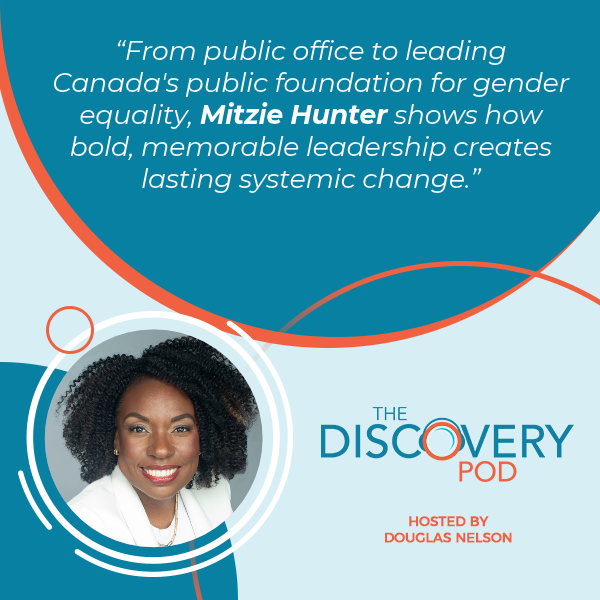
True progress toward gender equality in Canada requires bold civic leadership, flexible funding, and unwavering advocacy for vulnerable communities. In this episode, Mitzie Hunter, President and CEO of the Canadian Women’s Foundation, joins the conversation to share valuable lessons from her career across civic engagement, provincial cabinet leadership, and municipal politics. She discusses how public-serving organizations can effectively hold governments accountable and why trust-based philanthropy is critical for grassroots impact, including insights from the Root Change: Reimagine Gender-Based Violence Response Through Disability Justice research report published in partnership with Dawn Canada.
—
Listen to the podcast here
Trust, Boldness And Big Asks With Mitzie Hunter, President & CEO | Canadian Women’s Foundation
For this episode, I’m joined by Mitzie Hunter, President and CEO of the Canadian Women’s Foundation. Mitzie is a community leader whose career has spanned the private sector, the social profit sector, and government, where she served as Ontario’s first Black Minister of Education. All of that has been with a focus on building stronger, more equitable communities. As President and CEO of the Canadian Women’s Foundation, she’s leading a national effort to advance gender equality while drawing on those decades of experience in public leadership.
In our conversation, Mitzie talks about the vital role that the Canadian Women’s Foundation is playing in the conversation about equality and equity across the country, the transition from public office to social profit leadership, and her view on how to balance advocacy and service in a social profit organization. It is a wide-ranging conversation from one of Canada’s great thinkers about the role of the social profit sector. I’m pleased to share my conversation with Mitzie Hunter. Please enjoy.
‐‐‐
Welcome to the show, Mitzie.
It is so good to be here. I can’t wait for the conversation.
Me either. Some of our readers will know, and maybe my mom, tuning in in her kitchen, would know, but this is the second time we’ve had the CEO of the Canadian Women’s Foundation on the show. Much has changed, including who the president-CEO is. We’re looking forward to an update. There are a few organizations whose purpose has come into clarity for the general public more than the Canadian Women’s Foundation in the last number of months. For our readers who may not be fully familiar with your organization, what is the Canadian Women’s Foundation, and who do you serve?
Empowering Women And Girls Across Canada: Understanding The Canadian Women’s Foundation
I’m going to talk to my mom in her kitchen because the Canadian Women’s Foundation is for all women in Canada. It’s for the 52% of women, girls, and gender diverse people. We’re a public foundation that uses the power of philanthropic funding. We raise funds and grant those funds to grassroots small and medium-sized community-led organizations that are doing incredible work across the country. We have the benefit of providing funding to organizations in every province and territory in Canada.
Our main objective is that every woman, girl, and gender diverse person in Canada has what we call the power, safety, support, and rights to thrive now and for the future. When you think of the Canadian Women’s Foundation, it’s about a gender equal Canada and a just Canada where there’s fairness for women, girls, and gender diverse people.
We were originally founded by 8 fierce feminists, 4 of whom are still alive and with us. I get to benefit from their wisdom. What they saw was that in Canada’s philanthropic space, there was a gap. Only 2% of funds raised were going towards women. They wanted to change that. They wanted an organization, if you think of that United Way model, but focused on gender. Since 1991, when we first got going with the support of our generous donors and supporters through those years, we’ve been able to provide and move over $290 million to fund over 3,500 organizations doing this life-transforming work and programming in Canada.
From Public Service To Social Profit Leadership: Mitzie Hunter’s Unique Career Journey
That’s very impressive. There’s quite a wide breadth of organizations that you fund and causes that you’re supporting there. I want to talk about how you came to this role. One of the questions that we get asked in our travels here at the Discover Group is, how does someone become a CEO of a social profit organization?

Canadian Women’s Foundation: Our main objective is that every woman, girl, and gender diverse person in Canada has what we call the power, safety, support, and rights to thrive now and for the future.
I don’t know that the top-of-mind answer for any young person graduating from post-secondary education would be to follow the path that Mitzie Hunter followed. It’s not quite a straight line. After many years of being in public service, being a provincial cabinet minister, and being a prominent person in that public space, first of all, what drew you to public office? When you said, “I’m going to put my name down,” how did you come to that decision?
One of the joys of serving in public office is interacting with young people, whether in schools or in community-based programs. This is a question they often ask. “How did you become an MPP? What brought you into that space?” I would always tell them, “Do what you love.” I was volunteering and being involved in civic leadership and activities all the way from high school through university. When I started working, I somehow bolted on my ability to work with nonprofits and charities to my regular job.
There was an organization called Civic Action. I had volunteered for Civic Action for a decade. I was literally doing the work for free, and then I became the full-time CEO. I knew the mission. I knew the organization and loved it. I wanted to dedicate my time to it. It was while I was doing that that I was tapped by the first woman premier of our province in Ontario, Kathleen Wynne, to run in a provincial by-election. I thought, “I’m going to give it a try and see if I could be elected.”
On my first try, I was elected. I then ran in four straight elections and was re-elected every time by my community. There came a time, however, when I felt like I wanted to do more, and I ran for mayor of Toronto. There’s a statute that requires you to resign your provincial seat if you’re going to run for a municipal seat. I had to resign. It was a decision that I made, but I was all into this race. I ran my best race, but I did not become the mayor of Toronto. It gave me an opportunity to reflect and think about what I wanted to do.
Governments don't have all the answers. They need nonprofits and public-serving organizations who are close to the issue and close to the grassroots to come forward. Share on XWhen I thought about where my joy was in working, I wanted to make sure that I continued to have a life that had purpose and meaning. The Canadian Women’s Foundation was looking for a CEO. Our former CEO, Senator Paulette Senior, went to the Senate. She was appointed, so this vacancy was there. I thought about my passion for community, but on an expanded scale across Canada, serving the 52% of the Canadian population who are women. I jumped into the search, and the rest is history. I’ve been the CEO for over two years.
People ask me sometimes, “Do you miss politics?” I’m like, “I don’t miss the work because I feel like I’m still doing the work.” I’m heading Canada’s Public Foundation for Gender Equality, and I’m looking to change systems. I’m looking to get to the root issues of gender inequality in Canada, and that requires working with the federal government and across communities.
I’m doing that in every province and territory. I’m going there, meeting people, and learning the needs and how the foundation can support regions. It’s amazing work. That’s what has always driven me in my life, in my career, and in the choices that I’ve made. I feel great that I’ve had this opportunity at this time to stand out for women, girls, and gender diverse people and say, “We deserve to have equality in Canada. We’re not there yet. These are the specific things we need to do to get us there.”
That’s a very inspiring career journey and inspiring messaging there. When you were CEO of Civic Action, ran in the by-election, elected cabinet minister, and ran for mayor, coming back into the CEO seat of a social profit organization, what did that experience in public life give you or teach you that you brought into this role that you hold?
Bold Advocacy And Accountability: Lessons From Public Office
I’m so glad you asked that. I’m going to share this with your audience because I know many of them are interacting with governments. What I can say is that governments don’t have all the answers. They need nonprofits and public-serving organizations who are close to the issue and close to the grassroots of communities to come forward with bold ideas and bold action. Holding the feet to the fire is a real need in our democracy and in our country. There is a real purpose for nonprofits. Be less timid and be bold when you approach governments. Be clear about your asks, what it is that you need, why, and how much. Don’t be afraid to ask.
I love that message to be bold. When we work with organizations that are having conversations with the federal government, provincial government, or municipal governments, there is some residual cap-in-hand timidity that comes along with that approach. It’s good to hear from you who’ve been on both sides of that table, speaking your loudest, politest, professional voice, and being clear about what you can deliver. That’s very cool.
I want to add as well, because I remember an organization asked for my advice. They were going to be meeting with the provincial government for the first time. When I looked at their materials and what they had put together, it was factual. It had all the information, but I said to them, “Where are you? Where’s your personality and what you care about? Find a way to show that.”
“Be memorable. These meetings happen every day for hours on end. How are you going to be memorable?” I remember the CEO came back to me and thanked me for that advice because they did indeed put together a program that was engaging, memorable, and true to them and their mission. They felt that they broke through.
I love that question. “How are you going to be memorable?” That’s a great question, even a call-to-action for a lot of social profit organizations. This was not your first time leading a social profit organization. You’re leading the Canadian Women’s Foundation, raising money, and having conversations with donors across the country.
Navigating Donor Fatigue And Trust-Based Philanthropy
In this climate that we have, or this shadow we have of our neighbor to the South taking several steps backwards in a whole bunch of fronts, casting a bit of a shadow in some of the dialogue in Canada and some concerning things showing up in the public awareness, how has that changed the types of conversations or the tenor of the conversations you’re having with donors?

Canadian Women’s Foundation: I’m heading Canada’s Public Foundation for Gender Equality, and I’m looking to change systems. I’m looking to get to the root issues of gender inequality in Canada.
Donors recognize that it’s a time and a moment to step up, to be less cautious, and to make big investments in causes and initiatives that they care about. If not now, when? This is the rainy day. This is the time to open up and to work alongside organizations that are on the ground doing incredible work. The demand and the need for nonprofits and charitable organizations are so high. The issues are more complex. The needs are greater.
You think that we are in an affordability crisis. That’s hitting families and individuals in different ways. It is that time. By that, I mean you could be assisting someone with an employment issue, but they might need childcare, or there are housing requirements. There are healthcare needs. There are mental health and wellness needs.
Organizations, charitable organizations, and nonprofits are oftentimes providing a suite of services, whether or not it is in their primary mission and mandate, because in order to serve the community and meet the community where it’s needed, they’re having to be more flexible. Funders need to recognize that, come alongside those organizations, and put their investments into organizations so that they can do their best work.
One of the things we shifted in the way that we grant is we’re pivoting towards shared grant-making. We’ve literally put a pot of funds on the table. We have organizations that have been selected around the table and say, “You divide it. You share this amount.” What we’ve found is that organizations have completely risen to that challenge. We had an example where an organization put money back into the pot because they felt somebody else across the table needed it more. That’s trust-based philanthropy, trust-based grant-making, and feminist grant-making that we believe in at the Canadian Women’s Foundation.
This is the time. Canada is at a critical moment. We can see that in the leadership of our Prime Minister, Carney, who has put forward a plan for Canada Strong and Building Canada. What we say at the Canadian Women’s Foundation is that a strong Canada includes gender. It includes women. We are not only 52% of Canada’s population, but we’re 47 % of the labor market. This call to nationhood and to bringing everyone together must also focus and center on women and what role women can play in advancing Canada’s economy.
We talk about building the skilled trades cohort, for instance. It’s a great strategy. We think that’s the right direction, but we want to know specifically how women are going to play a part in that skilled trades agenda. We want to make sure that there are pathways into that particular high-paying, good-quality job because at the moment, it’s only 13%. Talk about gender equality. We want to see that grow at least to parity.
I have a niece who is nearing the end of high school in Alberta. Her goal is to have an all-female electricians company. She said, “It’d be super fun. It’d be like Ghostbusters every day. We’d make a lot of money.” Hopefully, Cameron will be a part of that solution.
Be less timid and be bold when you approach governments. Be clear about your asks, what it is that you need, why, and how much. Share on XI love that. I love your niece, and I love that we’re talking about it. Shout-out to her.
Whatever she chooses to do, she’s going to take on the world. I want to go back to that conversation with donors. One of the memes in our sector is that donors are tired. There are fewer of them. There is a bit of a ‘woe is me’ feeling about the state of philanthropy. There are things to be worried about, to be sure. There are also lots of reasons for hope. There are lots of great gifts continuing to be made at all levels.
As a relatively new leader in your organization, you are talking to people who perhaps have supported the organization or are maybe new to the organization. They’re reading the same headlines and hearing the same news that the rest of us are hearing. How do you, as CEO, approach donors that may be feeling that fatigue of, “We’ve been doing this. Things aren’t getting better. In some ways, they’re getting much worse.” That feeling of, “I support this, and I believe in this, but I don’t understand how my giving is going to make a difference.”
Imagine if you weren’t what the state of the world would be.
That’s a great response.
We’ve got to keep going. We’ve got to keep doing this work. We’re partnering together in doing this work. We’re not there yet, but we are making progress. We’re also pivoting to address new needs. We need our donors to journey with us and to be with us. One area that we look at for gender equality is equal pay for equal work. We know in Canada, every dollar a man makes, a woman is making C$0.85. A woman of color, a woman with disability, or an indigenous woman is making far less. We have to address that.
One of the progresses we’ve made over the years is that women are graduating at 60% of university graduates. It’s pretty incredible. It has exceeded 50%. Where we lag is in STEM. Science, Technology, Engineering, Math, or STEAM, if you put Arts in there, are areas where we need to see more women being comfortable in those fields. We’re not there yet. What I’m saying is that we’re making progress, and we can see that. We’re making sure that we’re showing up in areas that are required, but we’re not there yet. We need donors to come alongside and support.

Canadian Women’s Foundation: Donors recognize that it’s a time and a moment to step up, to be less cautious, and to make big investments in causes and initiatives that they care about.
There are donors. If you look at the donor-advised funds, there are a lot of funds in those accounts. Some of the family foundations have done very well in the markets over time. I feel as if moving some of that capital into the work of movements. For us, it’s about gender equality and supporting the organizations doing that work on the ground. It is important that we keep donors seeing the value of investing in community and putting that donation to work, being able to look at that impact.
A lot of our work at the Canadian Women’s Foundation is happening in the far North in Canada, in the territories. It’s remarkable and incredible that we’re funding organizations that are protecting cultural practices and supporting Indigenous and Inuit women to have economic livelihoods. That’s not just benefiting that one person. That benefits a family. Oftentimes, the whole community is connected to that. That’s what donations are being used for. It’s being used for its intended purpose to create that social change and to have that impact. Otherwise, what’s it for?
That’s a good question. It’s hard to lead into a conversation with a donor of, “What is all this money for? Let me tell you what you could do with it,” but I would imagine that you’re quite compelling in those conversations and doing a heck of a job. In refreshing my memory of the organization and talking to colleagues who know the organization very well, a question kept coming to mind.
Strategic Focus: Intersectionality And Feminist Grant-Making
Gender equality is a very broad, wide, long-reaching waterfront. Maybe you could share some of how you approach conversations with your board about what to take on. There’s nowhere you can turn where this issue isn’t relevant, poignant, and applicable in Canadian society. Everything everywhere all at once is a difficult strategic plan. Thinking about the conversation with your board, how do you choose where to focus?
It’s a great question because we can’t be everywhere and do everything, and we don’t try. The Canadian Women’s Foundation is part of an ecosystem of organizations that are driving the feminist movement in Canada. We’ve got LEAF, for instance, that does the legal aspect of things. There are research-based organizations. There are organizations like Women’s Shelter Canada that are focused on shelter supports and housing. There’s Ending Sexual Violence that’s looking at this issue of sexual violence in Canada, where it’s the only violent crime in Canada that’s on the rise. There’s more work that we have to do in that space.
What we do at the foundation to stay true to the mission and our founding purpose is that we are the philanthropic organization for gender. We raise funds through generous contributions from individual donors. I met a donor who has been giving individually for over 30 years to the Canadian Women’s Foundation. It’s so incredible.
Family foundations, corporate foundations, and any public source, because we’re the public foundation. We spend that down every year. We raise it every year and spend it down every year. We focus our dollars on what can drive what we call our theory of change. That’s every woman, girl, and gender diverse person having power, safety, support, and rights to thrive now and in the future.
Leaders must walk the talk. Our team members are always watching, so demonstrating that commitment firsthand is essential. Share on XIf we put a lens on who needs the most assistance or support, we see that intersectionality matters. Black women, indigenous women, women with disabilities, and 2SLGBTQIA+ need greater support to thrive. We target our efforts in that space. 1/3 of our funding is going into indigenous women and girls. We have a significant amount of programming invested in Black women and girls through a wonderful partnership.
I’m going to share the story here. Why not? When I was in my first year as CEO, I was meeting with our incredible multi-year donors. Multi-year funding is important. That’s how we grant. We grant in multi-year terms. We were checking in as a new CEO. They asked me what I noticed and what I was seeing. I talked about how thrilled I was to learn about a program that the Canadian Women’s Foundation was funding at the Scarborough Women’s Centre on gender-based violence and disabilities.
I talked about how incredible it was because the learnings from that program were being shared across other organizations. The funder said to me, “We are about to launch a major initiative on disability, and we want to include gender in that. Will you provide us with a proposal?” We quickly did the proposal because this was an intersection that we were addressing the best way we could, but we needed more investment in that.
When you think about women with a disability who also face gender-based violence, it is often some of the most vulnerable people that we have in our system. They don’t leave the abuser often because of worrying about the support that they need to get through, or a child with a disability. That complicates it for that individual facing that challenge.
We were able to join an announcement of over $30 million across Canada for various programs, including ours, funded by the Slaight Family Foundation. We are working in partnership with Dawn Canada on this initiative. What we’re discovering is that not only is it an area that is underfunded, but there is a lack of organizations doing this work, perhaps because it is an underfunded area, but the need is so great.
I’m thrilled that we’ve been able to partner with a donor to do this bold initiative, to have a national partner like Dawn Canada that can come alongside. We’ve released a research paper. It’s hot off the press. It’s called the Root Change: Reimagine Gender-Based Violence Response Through Disability Justice. It’s looking at some of the key findings on how disabled, deaf, women, girls, and gender diverse people are disproportionately affected by violence, and that these harms have extraordinary outcomes. We look at how we could shift that and what the needs are.
Reading through that report, getting ready for our conversation, the thing that jumped out at me is that disabled women are twice as likely to be victims of violent crime and four times more likely to experience sexual assault compared to non-disabled peers. I confess I had never thought about that before. It makes intuitive sense in reading that, but it was shocking.

Canadian Women’s Foundation: Donations are being used for its intended purpose to create that social change and to have that impact. Otherwise, what’s it for?
It’s very shocking. It needs to change. We have to change that across all systems that provide support to bring that awareness and to surface that awareness.
That is one example of how it is shocking and unjust. In the work that you do as CEO, you spend your days trying to do something about the many injustices that your foundation is involved in writing. How do you, as the CEO, sustain yourself through that? When there is so much to do, and there is so much wrong, and there is so much progress to be made, how do you, as CEO, protect yourself?
Leadership Resilience, Self-Care, And Looking Forward
I believe that leaders have to walk the talk. People have to see you. Our team members are watching. I encourage my team to take a break and recover after something intense that we’ve been working on. I need to do that myself. Relatively being new, in the first two years, it was harder to do that, but it is something that I remind myself of because others are watching me. My team members and colleagues are watching me. Other CEOs in the space are watching as well. It is having self-care and wellness and looking after your own mental health.
A lot of the issues that we face are incredibly devastating. The reality in Canada is that every 48 hours, a woman or a girl is killed in Canada. That’s Canada. That’s us. We’re working furiously at the root of these issues to provide a gender equal Canada where women, girls, and gender diverse people have power and safety. To do that work and to equip myself as a leader, my team members, and my colleagues, we have to remember that taking pause and self-care is important. To be able to demonstrate that is also important.
That’s wonderful advice for the readers and for leaders across the country. This is not work that resolves itself by the end of the next quarter or the next fiscal year. That long-term vision of self-protection and resilience is an essential part of being able to make a difference in the purpose that you’re in service to. As we come to the end of our conversation, I get to ask my favorite question. What are you looking forward to?
I am looking forward to the upcoming break to spend time with my wonderful nephew, who is going on six and is the most marvelous person, and the rest of my family. I’m thankful for where we are and that we have these wonderful, amazing lives that get to affect and touch people and change lives. The theme of my career and what I’ve done, whether it’s in the private sector, in nonprofit, in the social sector, and the government, is changing lives.
I look forward to recharging and then getting back to doing that with the work that we’re doing at the Canadian Women’s Foundation. We are about to launch a brand-new fund for feminist futures. That’s coming up in October 2026. We’re so excited about it because we feel that after twenty years of the work we’ve done on Girls’ Fund and Teen Healthy Relationships, it is time for us to use all of that knowledge and meet the moment for young people. I’m so excited about that, but before we get there, I’m going to take a break with my family.
Good for you. It means so much that you make time to spend with us here at the show to share the story of the foundation and the great work that you and your colleagues do. I also want to thank you for the great work that you do. You are someone who has been such an incredible example of service to the community, to the public, and to the Canadian Women’s Foundation. Thank you for all that you do for our social profit sector.
Thank you for having me and for listening.