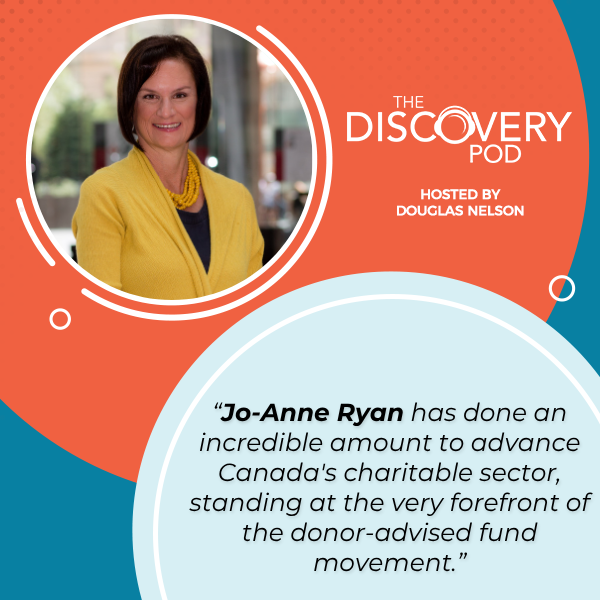
Philanthropy is undergoing a major shift across Canada as donor preferences evolve and strategic giving structures become essential. Navigating options like donor advised funds allows individuals, families, and organizations to maximize their long-term impact on the causes they care about most. In this episode, Jo-Anne Ryan, Vice President, Philanthropic Advisory Services at TD Wealth and Executive Director of the Private Giving Foundation, shares invaluable insights into the rapidly expanding role of DAFs in the Canadian charitable sector. She breaks down actionable strategies for board members and social profit leaders to cultivate DAF-friendly organizations, engage financial advisors effectively, and adapt to emerging trends driven by self-made donors and women in philanthropy.
—
Listen to the podcast here
Donor Advised Funds In Canada With Jo-Anne Ryan, VP, Philanthropic Advisory Services, TD Wealth
Every once in a while, and it happens quite a bit, and it certainly happened here, I have a conversation with a guest that I realized could take 3 or 4 hours, not just the 30 minutes that we’ve allotted for the recording and to share with all of you. It was a great conversation. I’m pleased to share this with you. I got to talk to Jo-Anne Ryan.
Jo-Anne is the Vice President of Philanthropy at TD Wealth. Jo-Anne helps individuals and families incorporate philanthropy into their financial and estate planning while also leading TD’s research on women in philanthropy. She’s also the Architect and Executive Director of the Private Giving Foundation, Canada’s first Donor-Advised Fund established by a financial institution, which has granted more than $1 billion to charities since its inception.
In our conversation, we talk about the expanding waterfront and the expanding role the DAFs play in the Canadian charitable sector. We talk about how board members and leaders of organizations can ask questions and prepare their organizations to be more DAF-friendly, working with advisors and their fundraisers to tell that story of how DAFs can benefit the charities that they represent.
Our conversation then pivots to an important issue, which is the emerging and expanding role of women in philanthropy across Canada, the research that TD has sponsored and been a part of since 2014, what is changing, and what will change. I appreciated Jo-Anne’s advice about how to understand the difference between women and male philanthropists in Canada.
It came down to some advice that we give to all of our clients and all of the guests that come on the show, which is to talk to your donors. It is a great conversation, one that I hope that you’ll enjoy from someone who has done an incredible amount to advance our sector. My thanks to Jo-Anne for coming on the show, and my congratulations to you who are about to know her wisdom.
‐‐‐
Welcome to the show, Jo-Anne.
Thank you for having me.
The Origin And Rise Of Canada’s First Bank-Established DAF
I am so looking forward to our conversation. We’re going to cover a lot of topics, Donor-Advised Funds being near the top of the list. Before we get into that conversation, tell us a little bit about the TD Private Giving Foundation, your role in its creation, and what’s going on there.
Back in the early 2000s, I was attending lots of conferences, including the Canadian Association of Gift Planners. We often had a speaker from the US talk about Fidelity and Vanguard, and how they were such a huge force in the US. They predicted they would come to Canada because we usually copy the US. In 2003, I put a proposal together, approached TD, and said, “We can be the first financial institution in Canada to launch a donor-advised fund.” It was a tough sell back then because philanthropy was considered a fluffy thing on the side.
Philanthropy was considered a fluffy thing on the side. Thankfully today, nobody in leadership would argue about the importance of philanthropy for our high net worth clients. Share on XThankfully, nobody in leadership would argue about the importance of philanthropy for our high-net-worth clients. We got it through. We launched in October of 2004. We were the first financial institution to launch. I was building it. Marketing said to me, “It’ll be a matter of time before competitors copy us. If they don’t, then you should be worried as to whether there’s a market for this.” Lo and behold, they’re all over the place. We were talking earlier about how DAFs are having their moment. We have over $15 billion in assets and growing.
In the Private Giving Foundation, I’m the architect. I’m also the Executive Director of the Private Giving Foundation. In fall 2025, we celebrated a milestone in the bank. People are always asking what your Assets Under Management are, which we call your AUM. I have to answer that, but I always say the more important number is what we have granted to registered charities. In fall 2025, we celebrated a milestone of surpassing $1.2 billion in Assets Under Management. Not long ago, we celebrated a milestone of being able to say that we have granted over $1 billion to charities since inception also. We’re a force. They’re growing.
There’s so much I want to talk about there. Let’s talk about those big numbers you shared at the end of your answer, particularly the Giving having granted $1 billion or more. When you go back to that, the end of one of those first meetings you had in 2003 when people may not have been opening the doors wide for you at the first mention of the idea, to skip ahead to 2026, the foundation has given away more than a billion dollars. Did you see the potential back then to get to that number?
I don’t know if I had thought of the billion-dollar number. I did see the potential that it was a growing area, and it’s simple and easy. When I was building it, I looked at the Fidelity model in Boston. Their minimum is $10,000, and that’s what we have done. Our minimum is $10,000, so it’s easy to get into. It’s accessible to many people. You can add to it.
The other big growth area is plan giving. As our donors are getting older, we have a dedicated person in our Calgary office focused on plan giving, Brooklyn Oliver. We are much more proactive in working with people with their wills who want to leave a bequest to the Private Giving Foundation, as well as having some very significant life insurance policies with the Private Giving Foundation, the owner, and an irrevocable beneficiary. There have been a lot of trends that have fueled this.
A lot of our wealthy clients are getting wealthier. That’s the reality. They have more money than they can spend during their lifetime. At the bank, we do comprehensive financial planning for them. They don’t want to leave everything to their kids because it’s too much. I love the Warren Buffett phrase, “You want to leave your kids enough to do anything, but not too much to do nothing.” It’s also very common in a meeting that they start bragging about how successful their kids are.

Donor Advised Funds: People are always asking what your assets under management are, but the more important number is what we have granted to registered charities.
We have another set of clients that have no children. Philanthropy becomes that legacy or that child for them as part of their estate planning. The makeup of the high-net-worth client has also evolved over the years. There’s inherited money and self-made. When you inherit money, it can still be very philanthropic, but we find that those clients or those donors want to steward it for the next generation.
In Canada, over 2/3 of high-net-worth clients are self-made. They have built a business themselves. They have made it themselves. They think differently. First of all, they made it. It’s their money. They can do whatever they want with it, including giving it to charity. If people have built a business in a particular community, they’re often very grateful to that community that helped to support their business, and they want to give back.
The other thing is we have many successful immigrants in Canada. They have done well. They’re very grateful to the opportunities that Canada has provided for them. They want to give back perhaps to their country of origin that may have poor living conditions than what they are enjoying here. There’s lots of different reasons why philanthropy is taking off. The donor-advised funds are a simple alternative to a private foundation. We still help people set up private foundations.
Why Donors Prefer Donor Advised Funds Over Private Foundations
Do you tell them not to do it first? Do you say, “Don’t do this thing. This is not as much fun as it looks.”
It’s a lot of work because you set up a charity. You have to worry about all of the CRA rules and everything else. The other thing people don’t realize is private foundations are not private because the T3010 is filed every year with the CRA. Everybody can go in and look at how much you have and what charities you’ve given to.
You want to leave your kids enough to do anything, but not too much to do nothing. Share on XYou can look at the Private Giving Foundation as a whole, and you’ll see thousands of dollars going to thousands of different charities, but you don’t know which fund. People like that privacy. They like the simplicity. They want to pick and choose their charities, for sure, but they don’t want to go to a board meeting or worry about any of the governance associated with running a foundation. That makes it simple.
They want to get their kids involved. In many of our funds, they could have adult children, and they get to pick and choose charities that they grant to each year. If the kids are small, they may be going through a World Vision catalog and picking a charity. It’s a way to get the family together and unite around shared values, which is becoming important to a lot of our clients.
You’re talking about some of the intergenerational transfer of wealth and what that looks like in bringing families together. One of the other things I’ve seen here in The Discovery Group in our work with clients and working with donors in the 2/3 who are self-made or acquired their wealth through running a business or starting a business is they sell the business or sell some portion of the business. Everything in their life is changing all at once. The advice is, “You should put some of this aside for charity for tax reasons. You seem like a good lady or a good fellow. Put some of this aside.” They do.
One of the things I’ve said to boards and to organizations who’ve been somewhat skeptical about donor-advised funds is, “Everything’s changing in their life. If you want them to make choices about philanthropy right now, you’re probably not going to like their choices. It’s not a time of great thoughtfulness and the flush of things.” One of the advantages of things like the Private Giving Foundation is that it gives donors the space to think about what matters most when it comes to their philanthropy.
We use the term donate now, decide later. The example that you’re using is that when somebody is selling a business, they are probably very involved in that transaction. Their accountant might suggest, “Make this donation by this date.” Not in a frame of mind to think about what that charitable legacy is going to look like, but they could get the donation in.
If people have built a business in a particular community, they're often very grateful to that community that helped to support their business and they want to give back. Share on XWhen the transaction closes, and they come up for air, they can start to thoughtfully think about what their charitable legacy is going to look like. We see it in December, too. That’s the busiest month of the year. People are shopping and going to parties. Even in December, being able to put some money in so you get your tax receipt for the calendar year. Next year, when things start to slow down, you can think about how you want to allocate those funds.
That’s a good example. You have been at the forefront of this movement in Canada. One of the pushbacks or some of the resistance that the donor-advised funds have encountered is that it is competition for charitable dollars. We inherit some things from the US. We did DAFs from Vanguard and Fidelity. This idea that it is a competition is very much part of the conversation in the United States, probably appropriately less so here in Canada. How do you respond when it’s positioned as these donor-advised funds are a competition?
There has been US research, which I would agree is the same in Canada, by a company called Chariot. They have a donor, and then that donor gives X amount every year. They’re a regular annual donor. If that donor sets up a DAF, then their support will double or triple because they’re building a thoughtful structure, possibly tax-efficient, where you’re building a charitable account. You’re able to give more than you were giving when you didn’t have any type of charitable structure in place.
There are some good forward-thinking charities that have jumped on the bandwagon. If you look at Plan Canada International, they have received a lot of money from us as well as many other DAFs. If you go onto their website, they have a whole educational component on their website about donor-advised funds. Even if you don’t have one, if you set one up, they’re going to benefit more than what they’re benefiting from you as a donor.
Some of the larger charities have more resources, like Plan Canada or SickKids Foundation, where they have dedicated staff to working with donor-advised funds. They’re not competition because you’re going to get a very loyal donor. That’s another thing. Mike Todd talks a lot in Vancouver about DAFs. I don’t know if you know him.

Donor Advised Funds: If a donor sets up a DAF, their support will double or triple because now they’re building a thoughtful structure where they’re building a charitable account.
He’s been on the show. Guess what he talked about?
DAFs. He says they’re recession-proof. We know the economy goes up and down in good times and bad times. In a recession, charities are bracing themselves for getting fewer donations. If you’ve set up a DAF, then you’ve already given the money away. Regardless of what’s happening in the economy, you still have money available to support the causes that are important to you.
Overcoming The Competition Myth: How DAFs Provide Sustainable Giving
Do you see organizations in your travels that are pushing back? Are you seeing that scarcity model or that competition model with DAFs?
There was a research report by the Canadian Association of Gift Planners. The authors were Keith Sjögren and Sharilyn Hale. It’s worth a read because they did research using Carleton University’s Master’s in Philanthropy Program. They interviewed DAF providers and charities. The complaint is more that the small charities don’t feel they’re benefiting as much. They’re like, “We’re sending lots of money to hospital foundations, universities, and large charities.” The small charities are not feeling the love as much as the large charities.
Our clients are across the country. They have every kind of unique interest. A lot of small grassroots organizations are clearly benefiting also. There’s a learning curve. There are still charities that need to understand them better, not just about what they are, but even how to cultivate the relationship. There’s a fear with charities that most of these donors are anonymous, so they have no way to reach them. Less than 1% of our donors are anonymous.
They can cultivate that person like they would cultivate any donor. In fact, maybe with more effort because they know they have money put aside in the donor-advised fund to grant to charities every single year. There’s still the fear that they’re anonymous when they’re not. There are very few. They can invite them for behind-the-scenes tours or whatever it is that they do to cultivate donor relationships also.

Donor Advised Funds: DAFs are recession proof. In a recession, charities brace for getting less donations, but if you’ve set up a DAF, you’ve already given the money away and still have funds available to support causes.
I first became familiar with DAFs when I was working in San Francisco as head of a hospital foundation. I realized that for a number of months of the year, Fidelity was the largest donor to the foundation. Everybody needed one. Everybody wanted to have one. It was new to me as a Canadian in that environment that this is where a lot of the gifts were going to come from. I always made sense of it as similar to earlier in my career when gifts of appreciated securities became a new thing on a trial basis and then made permanent.
Charities used to need to inform donors and teach donors about the advantages of making gifts of appreciated securities for tax advantages. Everybody had on their website the chart that showed if you do $100, there’s an appreciated security. There was a lot of education on the part of the charitable sector to encourage donors to give this way. Will we get to a point in the next 5 to 10 years where DAFs are another way that Canadians choose to support the charities that they care about?
They’re gaining in popularity. A lot of charities, whether it’s Giving Tuesday or whatever ask they’re making, should always have an option, like, “You can use your credit card, but I would like to make a pledge for my DAF or I’d like to make a pledge of a gift of securities.” Those should always be options. If the only option on a Giving Tuesday is, “Click here and make a credit card donation.” There’s only so much someone’s going to give on their credit card. They will give more from a DAF, or they’ll give more if they’re in a fortunate position, as many people are, of having large capital gains and their securities.
We know donors don’t want to give away stocks they’ve lost money on. Not tax-efficient, but that’s also not how they want to give. We talked about who tunes in to this show. We’ve got quite a variety of folks across the country tuning in. I want to start with board directors. I want to start with the readers who are sitting on large social profit boards or small grassroots social profit boards. They’re learning about DAFs or have heard about DAFs and maybe haven’t thought about how they apply it to their work as board directors. What questions should board directors be asking of social profit organizations when it comes to DAFs?
They should be asking if they are letting their donors know that they’re in business to accept funds from donor-advised funds. Forward-thinking charities are having events to educate. It could be educating donors and financial advisors. Financial advisors are playing a big role in incorporating philanthropy in financial and estate plans. I would even ask what strategy you have in place to let financial advisors know who you are, the work that you’re doing, and that you’re open to receiving money from donor-advised funds. Any development committee or fundraising committee needs to be aware of it.
The other thing is, when it comes to cultivation, when you’ve received a gift from a DAF, sometimes, I don’t know if it’s somebody very junior that’s sending the thank you out. I’m getting thanked and being treated like I’m the donor. I’m invited to all these wonderful events. That’s nice, but I wasn’t the one who selected the charity. The donor is getting left out. You have to pay attention to whatever system you have to who the donor is, who you are thanking, and what your cultivation strategy for that donor is also.
Here’s the second question. You may have started to answer it there with a simple tool or a way to think about this. For executive directors or CEOs, for whom fundraising is a vital part of their funding mix or the reality, what questions should they be asking of their fundraising teams when it comes to DAF?
They need to have procedures and processes in place to make it easy for DAF money to come in. Some of the larger charities have a special DAF email that they use so we can communicate a lot better. They need to look at every ask that they have for funds, whether it’s on their website, in a brochure, or on Giving Tuesday, and ensure that they’re asking for funds from DAF. If they want to go a step further, like Plan Canada or even Woodgrain Foundation, you want an event to educate advisors about DAFs as well as to donors. The more that there is education and people become comfortable with them, then the more money they’re going to see flowing from DAFs to their organization.
Key Barriers And Strategies For Charities To Become DAF-Ready
A couple of ways in your answers there to being ready or being open to receiving. What are the barriers that exist for organizations to be DAF-ready?
What happens is that because the charity does not issue a tax receipt when they get money from a DAF, it falls into a crack of not getting in some sort of category to be cultivated and thanked. A lot of the systems recognize donors when they issue a charitable tax receipt to them. They’re not doing that. They need to have a special process in place for donations that come in that are not tax-receivable because they’re still very important. You want to be able to cultivate that donor. Sometimes, it’s a systems thing that needs to be improved.
Maybe accounting is getting in the way of good relationship-building.
In fact, the Princess Margaret Hospital Foundation had me come in and talk to the accountants and the finance staff to make sure they understand what these are and that there’s a process in place to properly thank and cultivate these donors.
You do not need to issue a tax receipt. In fact, please don’t. Secondly, it should be treated as a donation. You’ve mentioned a couple of organizations that are doing it well. If an organization is new to this or waking up to this, where would you advise them to start?
Reach out to get to know the DAF providers that are out there. Let them get the message about what your organization is doing. Any type of professional advisor strategy is a good idea. That doesn’t take a ton of work. It could be a breakfast. Learn who the players are. Build relationships with the advisors because the financial advisors are playing such a key role. When you look at TD and our private wealth management, we have four pillars. They are building net worth, protect what matters, implement tax-efficient strategies, and then the last pillar is leaving a legacy.
For many people, that is a charitable legacy. Don’t underestimate the role that a financial advisor will play in helping their clients with a philanthropic plan and a charitable legacy. They’re everywhere. Make friends with financial advisors. Get them on board as volunteers. Invite them to events. Get them to invite clients to events. That’s a good way to open the path to understanding who is even talking to clients about donor-advised funds.
It’s a familiar path for many organizations because engaging advisors has been the pathway, best advice, or best practice for a stake-giving for years. Are there different conversations you’re having with advisors about a stake and DAF?
They all go hand-in-hand, but we’re finding a lot of plan giving is growing with our aging population. More and more, we’re meeting people who don’t have children. I had a meeting with a woman with no children. They want to put some structure in place. People are still going to leave large bequests to charities, but there are strong opinions about where they want the charities that are important to them to continue to receive funding on an annual basis when they’re not there. You know how hard fundraising is. It’s hard to start at ground zero every single year.
Charities are getting $60,000 to $70,000 a year forever and growing. Those are big wins for charities. It’s not financial advisors. It’s not about the tax receipt. We have very generous tax incentives in Canada compared to other countries, but that’s not the number one reason why people give. People give because they want to give back to their community, or they’ve been impacted, or friends or family have been impacted by a particular area.
Tax incentives are great, but that's not the number one reason why people give. People give because they want to give back to their community or because they have been impacted by a particular area. Share on XWe do educate them to do it as tax-efficiently as possible, because if you do it as tax-efficiently as possible, then you can give more and have greater impact. For financial advisors, many will stick with the tax and the vehicles. We’re moving in directions which are good for financial advisors where we want to help clients to develop a philanthropic plan that reflects what’s important to the client and create a mission and vision for your family’s philanthropy.
A bonus for financial advisors is that they get to meet the kids of the parents or the adults’ kids. That means when the parents pass away, if they have a relationship with the kids, there’s a high likelihood that the kids will continue to do business with them. You get to learn what keeps your clients awake at night and what’s important to them. You get to meet the next generation. For financial advisors, there’s nothing better than that. More and more are proactively working with clients on their philanthropic plans as well.
Unlocking The Power And Evolving Impact Of Women In Philanthropy
I want to pivot the conversation a little bit. There’s another part of your role or another part of your work that you’ve done as a contribution to the sector that I think is important to touch on. Since 2014, you have led TD’s research on women in philanthropy. There is a tremendous amount of research on the role that women are playing in philanthropy and will continue, not just Mackenzie Scott and others, although what a great story that is. What did you see that was happening that spurred you to want to dig in more and focus on women?
We learned early on in all of the banks that women make investment decisions differently than men. Women’s life expectancy is greater than men’s. The man would die, and within a year, the woman’s business would leave and go to another organization because that advisor had not cultivated a relationship with the woman. We started to do lots of work on women with a different experience. They ask more questions. They do more due diligence.
It takes longer to get a major gift from a woman or to sign them up as a client. In 2014, we said we know women make investment decisions differently than men. We suspected they also made philanthropic decisions differently than men. There was no Canadian research. There was a US, the UK, and Australia. We commissioned a report to research Canadian women in philanthropy. We hired a firm that did quantitative analysis. We did focus groups in six major cities with women philanthropists across the country and produced a report titled Time, Treasure, and Talent: Canadian Women in Philanthropy.
We do events across the country where we partner with charities. We have panel discussions with women philanthropists. A couple of years ago, we thought it was time to do another one. A few things happened. We had a pandemic. Also, when we did our first research, we said, “Get women philanthropists in a room together.” They ended up being a certain age and mostly White or Caucasian. We said, “We want more diversity.” Plus, in 2014, when you do focus groups, we jumped on planes and went and did them. After the pandemic, we didn’t have to jump on a plane to go talk to somebody.
We wanted more diversity. We missed Atlantic Canada and Quebec the first round. We made sure we had representation right across the country. We had representation in terms of diversity. We also wanted diversity in terms of people that supported healthcare or the arts and various different charities. We produced another report. We’ve continued to highlight and host women in philanthropy groups. I’m also on the advisory board of the Master’s in Philanthropy and Nonprofit Leadership Program at Carleton University. The last report had a section on women social entrepreneurs.
Women are growing in entrepreneurship, and there’s often a social purpose to their business. Rather than hire a research company this time, we submitted a capstone proposal to Carleton, which got accepted. We supervised four Master’s students who did that research. They did a huge paper. It’s very good and academic. We’re now going to slice and dice it, giving them credit for their research, but also interviewing some women social entrepreneurs. We’re going to release some stories and continue to dig into that growing segment also.
It’s fascinating. At the forefront of this work, what have you seen change since 2014 in the conversations you’re having now?
Women are growing. There’s work to do in terms of the pay gap. There’s still a pay gap. That’s why we’re seeing women move into entrepreneurship. Life expectancy is big. Women are inheriting a lot of money. Charities are waking up to the fact that they need a strategy for women donors, that it’s not a one-size-fits-all donors. Many have established different programs. It could be a giving circle.
Women crave the relationship. It could be with other donors, staff, or the board. They want to go on more of a learning journey, so it’s more than just the cocktail. They still like to go have a cocktail at an event, but they want to learn something. It could be health-related if it’s a hospital. They want to learn and grow together. Every giving circle is different. Some pool money together. They have different pitches where they’re learning. They vote and decide together where this pool of money is going to go. We’re seeing a lot of charities trying to figure out what they can do specifically for women.
I’ve heard you say before in the space of women in philanthropy that women often inherit twice.
From parents and then the spouse or a partner.
One of the things that we see a lot through our work here at The Discovery Group, working with clients, is a simple language thing. If you have a male donor and a female donor, and this is a gross generalization, at 70-plus, the male donor will more often than not say, “When I made my gift to,” and name the institution. It will be about a transaction between either him and his family or him individually. They name an institution. Sometimes, even in that same couple, women will say, “We made a gift to the people at.” There’s that sense of community and connectedness.
What I’ve found fascinating and have heard a couple of times with some work that we’ve been doing is that the language of how men and women talk about their gifts of a lifetime in their estate plans is different words. That’s so cool. I don’t know that there’s anything actionable in that, but I listened to you talk about it. I was like, “We’ve heard that a lot recently.” What does that mean for the sector, that difference in language and that difference in perspective?
They have to understand what makes their donor tick. For some people, it’s their name on a building or a wall. Other donors don’t want any public recognition. They want to build relationships with people that are doing amazing work and connect. It’s understanding your donor and making sure you’re customizing a cultivation or relationship plan that suits their needs also.

Donor Advised Funds: You have to understand your donor and what makes them tick. Customize a cultivation or relationship plan that really suits their needs.
Talk to the donors. We don’t have a neon sign in our office, but if we did, it would say, “Talk to your donors.” That’s great. I have so enjoyed our conversation. I’ve got a list of about another dozen that I was hoping to get to in our time together. As we come to the end of this conversation, what are you looking forward to?
Looking Ahead: The Future Of Accessible Tech And Donor Advised Funds
I’m looking forward to the explosion of DAFs and seeing the impact that they’re creating. The other trend with DAFs is with technology platforms. There are platforms out there that are going to make it easier to go on your phone and make a contribution to your DAF, or go on your phone and make a grant recommendation to a charity. We’re seeing a whole surge of different technology platforms that realize that they need to still make it easier for people to use technology to help them with their DAF. That’s going to help. The easier we make it, the more money flowing in and the more money that is flowing out of DAFs also.
DAFs for the masses. It’s coming. Thank you so much for making time to share your wisdom, your insight, and your experience with our audience.
It was a pleasure to be here. Thank you for having me.