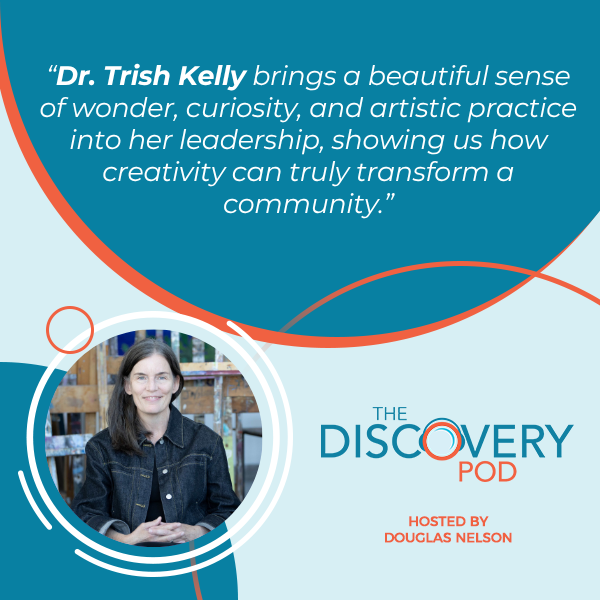
As post-secondary institutions navigate a rapidly changing landscape, leaders are called to think outside the box to secure a sustainable future. Leading Canada’s number-one art and design institution, Emily Carr University of Art and Design, requires a unique blend of creativity and strategic foresight. In this episode, host Douglas Nelson sits down with Dr. Trish Kelly, President and Vice Chancellor of Emily Carr University, to explore the intersection of practice-based education and organizational leadership. They discuss how the rise of artificial intelligence is shaping art and design education, the value of community-centered connection, and how institutions can preserve humanity in the digital age. Dr. Trish Kelly also shares invaluable advice for new presidents, highlighting why patience and trust are essential to driving meaningful change.
—
Listen to the podcast here
AI, Creativity, And The Future Of Art Education: Dr. Trish Kelly, President + Vice-Chancellor, Emily Carr University Of Art And Design
Introducing Emily Carr University Of Art And Design
They say never meet your heroes. I guess the context, it’s never having one of your heroes on the show, but we did, and it actually went really well. I am so pleased to share my conversation with Dr. Trish Kelly, president and vice chancellor of Emily Carr University of Art and Design. Trish has spent her career at the intersection of creativity, education, and leadership. She is leading Canada’s most respected art and design university.
Before stepping into the role of president, she held several senior leadership positions at Emily Carr, helping guide the university through a period of significant change and growth. She is also an accomplished art historian whose work has explored contemporary art, politics, and culture. At the end of Emily Carr’s centenary, she takes time to look back on our conversation and to look forward.
She discusses the leadership challenge of post-secondary institutions today, the role of art and design in preserving humanity in the age of AI, and the future of art and design at Emily Carr. It is a great conversation, a candid look at leadership, and one I am so pleased to share. Please enjoy my conversation with Dr. Trish Kelly.
—
Welcome to the show, Trish.
Thank you so much, Doug. It’s great to be here. I’m so thankful to have the opportunity to talk with you.
It is wonderful to have you on and to have had the chance to work with you and alongside you both personally and as colleagues here at the show over the last number of years. You have such a compelling story to tell about Emily Carr University. Let’s start there. Tell our audiences, those few who may not know about the incredible place that is Emily Carr University of Art and Design.
Emily Carr University of Art and Design is a public University of Art, media, and Design practice located in Vancouver. We are the number one art and design institution in Canada. I’ll just say we’re pretty proud of that fact.
Well earned. If you didn’t say it, I was going to. I’m glad you did.
I’m always willing to demonstrate our importance both in Vancouver and BC, obviously nationally, but also internationally.
Art, AI, And Preserving Humanity In The Digital Age
I want to talk more about the institution and about the university and your leadership there, places I want to start because I’m looking forward to the chance to talk to you. I talked to a number of colleagues and others about that, and I got to interview Dr. Trish Kelly. What should I ask her? One of the things that keeps coming up, and we hear it on this show, we’re hearing it in lots of other places, the emergence of AI, and this artificial intelligence has real implications for art and real implications for humanity.
I have this idea, the role of arts, arts education, is a part of the salvation of humanity. There is an anchor here in our humanness that cannot be replicated. How does the idea of artificial intelligence and LLMs show up there at Emily Carr and in the education that you’re providing to students today?
Certainly top of mind for everyone right now, but certainly for art and design institutions. I’ll say one thing that artists and designers have always worked with tools, both to explore and experiment, but also to thwart, to redesign, to reshape. In that way, I agree that artists and designers are really using and thinking about AI in a ton of different ways. Certainly, as a mechanism to understand what this means for society, for civilization, and for how we move forward in productive ways.
Artists and designers have always worked with tools, both to explore and experiment, but also to thwart, to redesign, to reshape. Share on XAs any educational institution will tell you right now, there’s a lot of worry about AI and what it might mean for job creation, for the economy, for those elements that we often associate with education. Is this going to help me get a job? What will that job be? How can I play that forward? Those concerns are for sure alive and well in every sector, but certainly in the educational sector. I would say, though, that I’ve actually given a talk which is titled, in a very cheeky way, art and Design Practice Saves the World. I’ll say that artists have always used practice as a mechanism to explore something. If you can explore it, then you can help to reshape it.
You can help to begin to make sense of and understand it in a way that is significant in some sense. At a moment where we’re really concerned that jobs will be replicated by AI or that we’ll no longer know the difference between truth and fiction because we will not be able to tell through our senses. I would say that creativity and practice-based education really help us understand what it means to ascertain something. It’s about experimentation, risk-taking, and curiosity. Those are skills that I think are going to be even more in high demand as we think about a world transformed through artificial intelligence.
I cannot say that I’m not worried and that there’s not a lot of change coming. I have a lot of faith in artists and designers and in art and design education more broadly, really helping to think through what is the importance of human impact. What is agency? How do we begin to think about practice-based education as a mechanism to really help us develop the skill set necessary to be able to navigate a changing landscape where AI is going to be so formative, I think, for the decades to come?
Reflecting On A Century Of Creative And Global Community Impact
Thank you very much for starting with that. A part of me hoped you were going to say it’s going to be okay. I understand it’s more complicated than that. The idea of exploration and sense-making, I think, is a really important concept for leaders everywhere. Certainly, there’s a lot that we can learn from art and design education. You at Emily Carr, let’s shift to the institution itself. You’re coming up on the end of your 100th year celebration of the institution. I’m curious, at the end of it, there’s the pomp and circumstance. There’s the remember when we were, and now we are, and preparing for the next. What did you learn as the president about the nature of the institution over the course of celebrating your centenary?
We’ve had three really dominant priorities as we’ve moved through the hundredth year. One of those is to celebrate. Another is to connect and to communicate widely what we’re doing. When I say connect, really talking about Emily Carr has an impact globally through the thousands upon thousands of alumni that we have really launched into creative sectors. Really thinking about, in celebrating our 100th anniversary, how we are finding ways to remember and reconnect with all of that global community that forms Emily Carr, but also use it as a mechanism to communicate more widely what we’re doing at the institution.
Also, what our graduates are doing in the industries that they find themselves in and in the transformative ways that they’re thinking about the impact and possibilities of cultural production. What I’ve learned through this process of the 100th year, and I will say it’s been quite a journey. I really have to give a shout-out to so many people who have been celebrating the stories of our alumni and our community members, and really also thinking through our history, which I think is another really important aspect of the 100th anniversary. Institutions are a complex beast. As we move through time, when these institutions’ leadership changes, the community changes over time.
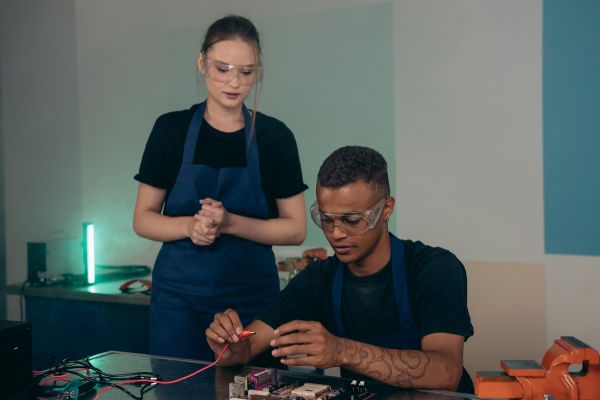
Emily Carr University: Creativity and practice-based education really help us understand what it means to ascertain something. It’s about experimentation, risk-taking, and curiosity.
It’s really important to have these moments to think back on what has been accomplished. Also, where are those places where we could hit harder, do more good, and expand? I would say that the 100th has shown us some incredible and important work that our community members have really put forward over the last century. It’s also been really inspiring to think about how much more work there is to do and how many more opportunities there’ll be to really be a leader and make transformative changes for the world around us.
In that process of connecting and connecting to lots of different audiences external to the university, how often do you hear, “I had no idea,” as a response to you communicating the role that ECU plays in art and design education and in the community?
I hear that all the time. One of my very favorite things to do is to take stakeholders on tours of our building. We’ve been in the current building we’re in since 2017, and it’s a purpose-built building on campus for art and design education. That means we have a ton of equipment and a ton of technology to really ensure we’re able to educate students in these very often very technical industries in important ways. I hear all the time, “I didn’t know you did that,” or “I didn’t understand that an art school would think about these things.” I’ll give a few examples.
We will just take visual art, ceramics as an ancient practice of writing, printmaking, and often people will come to a tour. I know what that is. I’ve seen that before we can see the printing presses. We can see the kilns. What they do not understand is that our students today are working in that space between the ancient and the very modern. Even a student working in ceramics will be exploring 3D printers as a mechanism to think through the forms that they might be making. A student in painting might actually be using virtual reality to understand what it would be like to be inside my painting in some way.
Our students are always mixing it up in this very productive way that is really, I think, not visible from the outside so easily. I’ll also say that there’s no area of the world around us that art and design institutions do not touch. For example, everything you move in your day that you move around is designed. The pen that you’re using, the headphones you’re wearing, the clothes that you wear, everything has some kind of aspect that is thought through by a designer or by a maker before you ever develop a relationship with it.
Everything you move in your day is designed. Everything has some kind of aspect that is thought through by a designer or by a maker before you ever develop a relationship with it. Share on XHaving toured people around the building or using it as an opportunity to talk about Emily Carr, our students are engaged in the healthcare sector, working on bringing design thinking into discussions around care for different community groups. Our students are working in all forms of industry that you can imagine and beyond. What I think they’re surprised by is the extent of technology involved in art and design education and the way in which it touches every factor of the world around us, every area, every different discipline that you might think of. There are artists and designers somewhere involved in that area.
I’m trying not to say I had no idea. There’s such power to that. People who sense that people understand what art and design are and then show them that it is so much more than what they thought it was. I would imagine it gives them a sense of wonder, a sense of goosebumps. That wow is the moment that you’re making those valuable connections for the university.
I often say when I’m meeting new community members, I’ll say that I have the best job in the world. I do mean that. I mean it for a few reasons. The primary one is that every day I get to come to a place where curiosity and creativity are in the foreground at all times. I get to take that and trade in that, bring those stories, bring that sense of what that can do to other audiences. I do not know.
That’s pretty special. I’m someone who has an art and design background myself, although through my educational path, I’m an art historian by training. That sense of what curiosity can really do in our world today? What does it mean, as an agent, to really bring forward an understanding of the world that’s different for you today than you had yesterday? That’s magic.
From Art Historian To Academic Leadership
I love it. You mentioned being an art historian. The first time that I had the chance to meet you, you said, “I’m an art historian.” I had the chance to walk around the building with you. I knew absolutely every detail about every single thing in the building. You’ve got a very good handle on the place. When you were doing your PhD in art history, did you decide you were going to be president of a university?
It’s a really funny question because I do not think that ever crossed my mind. I’ll say that what I realized, I do know every area of this institution. It’s such a privilege. I’ve been at Emily Carr for a while. I previously was the vice president, academic, and provost, which means you’re really involved in the internal operations. I find it fascinating and inspiring to work with our faculty and technicians who can take a piece of equipment and really bring something from it that you would never expect. This place is full of wonder every moment of every day.
In thinking through the power of that, like what that can do for me, it’s not that I ever had this moment where I really needed to be president of this institution to meet my professional objectives. It’s more than when you get a taste of this place, when you see what it can do, when you are inspired by the work that students, faculty, and staff put out there into the world, you know we need more of it.

Emily Carr University: Our students today are working in that space between the ancient and the very modern.
Whatever you can do to help. That’s how I see my role. Being a president of a public art and design institution, public art and design institutions are few and far between in North America. There are four in Canada, only one in the United States. Having an institution like this that’s accessible to students, that is publicly funded and publicly supported so that students, as they move through these spaces, recognize the social value of what they’re doing, recognize their connection to community.
You cannot really see that and not want to help to promote that. While I will not say it was early career ambition to be in the role that I’m in, I would say it’s a deep privilege to inhabit this role and to work with all the partners, both internal and external, that make this happen, whether in government, whether we have a whole community of donors and community supporters that work with us, all of them are pretty special.
One of the things I’m always curious about when I have the chance to talk to leaders is how they came into the role. There are, and we see, we’ve had this conversation on the show with lots of folks over the last couple of years. The leaders that come from outside, they walk through the door, I’m here, look at me. That’s not how anybody walks through the door, I hope, but they’re coming in from the outside, with that fresh perspective.
The alternative is that we’re seeing it more and more, particularly in academia, but also in other places in the social profit sector, where leaders are coming from within the organization. They have the institutional knowledge, they have the background, and they move into the senior-most leadership position. You were the vice president and academic provost prior to becoming the president. I’m curious, what was the advantage or what was the significance of being able to be of the place as you moved into the presidency?
Doug, I would say that for me, the advantage was institutional knowledge. There are times when leadership is almost healthy for an institution to nurture leaders from within, and there are times to bring leaders from without. Any institution needs a healthy mix of that over time to continue to grow and evolve. I also think institutions are temporarily rather grounded. Institutions are of a time. That, for me, means thinking about the 100-year history of Emily Carr, different moments when the institution needed different things from its leadership.
For me, coming in internally, coming into a new role, being the provost ahead of that role meant that I was pretty clear about the opportunities and challenges in front of the institution. That was a real advantage for me in pushing the institution forward in a healthy way. I’ll say that being internal also has its disadvantages at times. You’re someone who has already developed relationships at the institution. There’s a sense of how you will, or you will not, act in particular situations. The sense of expectations of the community around you can be a little bit difficult sometimes. Luckily for me, it was pretty seamless at Emily Carr. That’s always something to think about.
Navigating Institutional Change With Internal Leadership
One of the interesting things, and this isn’t a reference to your experience, but I’m really interested in your opinion on it, is that it can sometimes be harder for the internal candidate to represent a moment of change in an organization. If you’re out of the place and now there’s consolidation, there’s security, there is we need to coalesce, is where we see a lot of internal leaders coming in, moving into the senior-most position. I’m curious, what do you think you would have done differently, or what would have been different if you were coming to Emily Carr from the outside at the time you ascended to being the president?

Emily Carr University: What does it mean, as an agent, to really bring forward an understanding of the world that’s different for you today than you had yesterday? That’s magic.
Coming from the outside into an institution, there’s a lot to learn about community, about impact, and, of course, about operations. If you do not have a sense of that ahead of time, as you move into a new job in a new space, there’s a lot of learning that has to happen at a moment when the community you’re entering is very interested in helping you understand that in particular ways.
Institutions have lives, and these lives and these histories are hard to reroute or change over time. I think one advantage of coming in clean to an institution is that you have an opportunity to really see it differently. The disadvantage is that it takes a long time to actually make a change with that. It can take a long time. That institutional knowledge is something that you also need before you can move too quickly.
I do not know. It’s a great question. Again, I just go back to, I think there are moments where every institution needs both things. It needs something new and a new individual to move something forward, a moment where that institutional knowledge and a recalibration in relation to that a priori knowledge are really important.
If you could go back and give Dr. Kelly advice on her first day as president, what advice would you give yourself looking back after a couple of years?
The advice I would bring to day one is that you cannot solve it today. No, be patient. There is a sense of urgency. Right now, in the educational sector or secondary sector, there is an urgency to really think through what is a changing landscape. The sector is under review right now. The Ministry of Post-Secondary Education and Future Skills is very interested in how the sector is sustainable for the long term moving forward.
Regardless of what the issue of the day is, there’s always something that feels pressing and urgent and must be tended to before you can leave the building at the end of the day. While that is often true, I think it is also important to have a bit of patience and recognize that good decision-making and change management take time and also take community empowerment and connection and really need to be done in a way that brings everyone together.
I always ask that question because in my career I had a couple of opportunities to move into that senior role. Particularly the first time I had that chance, I was way too inexperienced. I believed I was ready, I think the evidence suggests otherwise, thought that urgency and impatience were the way that you move things forward. It was like a reflective learning after that didn’t work or after I’d moved on to the next role, that anchoring in where you are and understanding, particularly in an institution, as you said, institutions have lives. They are a thing. If you’re not anchored in that, you’re trying to change it, it can reject you.
That’s true. I will say, though, that maybe that sense of impatience is also connected to some of the challenges that I think every leader of an organization has. There are moments of doubt, there are moments of fear. Risk-taking is never comfortable. There’s something that I connect between patience and a trust in oneself that is usually our own worst critic and our own, the one that is going to be the most vocal in your own head around whether to take that risk or whether to move something forward.
It’s that relationship between patience and trust in oneself as a leader that really helps to ensure you’re moving at the right pace with the right team of people to ensure that you’re creating change in positive ways. It’s really scary to lead an organization to recognize that so many people are dependent upon the organization’s health and well-being to move forward. That’s a real responsibility. Tending that with care and with patience and trust and community connection is really important.
It's that relationship between patience and trust in oneself as a leader that really helps to ensure you're moving at the right pace with the right team of people to create change. Share on XIt has been such a privilege to get to see you navigate that and navigate that so well. One of the things that jumps out at me in post-secondary education in universities is that everyone, all the faculty members, all of the leaders who are academically trained, are successful because they have been skeptical. They have torn things, dissected things, and understood them and sought to understand. They do not take things for granted.
Leading A Culture Of Critique And Active Disruption
Superficial information does not land or does not stick, they’re critical. You’re the leader of an art and design institution. We’re not only taking it apart and being critical, but active disruption is also the point. The role of art is to disrupt, change, and hold up mirrors to challenging issues. All of those people congregate in your institution, or so many of them congregate in your institution.
You’re like, “Let’s go this way.” They’re like, “No.” That’s actually what makes them good at what they do. It’s not that I’m sure that’s frustrating some days, for the most part, as you said, it’s a place full of wonder. You understand that as the nature of the place. How do you think that leading people who are professionally critical changes the leadership challenge at Emily Carr?
Universities are acceptable places in general. Art and design institutions are even more exciting, is how I would frame that. That’s also its superpower. Students are trained in practice-based educational institutions, and art and design institutions train students through the process of critique. The student makes something, and their classmates and faculty talk about what they make.
Through that process, it’s an iterative process. They learn to make it better. Try again, do it again, think through it again. That’s amazing in so many ways. It is true that it teaches our students to be exceptionally critical of their own work, of the work of others, even of the management and administration of their institutions.
Maybe especially.
Again, I think that’s a superpower. I mentioned earlier that Emily Carr is a public post-secondary institution. That means we’re here for the public. Everyone who works at Emily Carr has one job, that is to support the success of students. In doing that, it’s also about helping that student question the framework around them, the boundaries that they face around them. It’s to help them navigate, to see new meaning, to find new pathways, to be creative in the world that they find themselves in.
On a day when I feel like that excitability or critique-based environment is a little bit honed in on my leadership team or me, I would say that I remind myself that this is how change happens. This is how accountability happens. It’s really important that we’re optimistic and have hope for our institutions. It’s also important that we hold our institutions accountable, and we demonstrate that accountability in our lived practices at the organization.
It's really important that we're optimistic and have hope for our institutions. It's also important that we hold our institutions accountable, and we demonstrate that accountability. Share on XYou’ve talked about the complexity of your place at your university. All leaders feel the complexity of their organizations, regardless of size. How do you know that you’ve had a good day? If it’s any given Wednesday, often the last one to leave, you’re closing the computer down. How do you know that it’s been a successful day?
The question of what success looks like at an institution that has so many components and parts that are always in times moving in contradictory or complex ways is an interesting one to think through. For me, I know I’ve had a good day. When I can really think about one action, meeting, or opportunity during the day, when I feel like a real connection was made that demonstrates the value of creative practice in the world around us.
Maybe it’s a conversation with a student as I’m walking out the door, maybe it’s a conversation with a stakeholder who really is interested in what Emily Carr can do or what happens in the institution. Maybe it’s a sticky problem that we’ve been dealing with. All of a sudden, someone says something that demonstrates a new way of thinking about that problem, or maybe an attempt to come at the issue in a different way that’s a little bit more relational.
The big wins for institutions are to really develop and demonstrate themselves over time. It’s not that any one Wednesday, typically at least, I’m going to get great news that some transformative decision has been made in whichever room that has implications for Emily Carr. I have faith that through all of those little moments of demonstration of creative practice, changing lives around it, really transforming, that’s when I know we’re doing the work we’re supposed to be doing here in a good way. For me, that’s what I find so inspiring about a place like Emily Carr and what I find so hopeful about creative practice in general.
Launching Into The Next Century Of Arts And Innovation
We are here nearing the end of your centennial, as we said at the outset of the conversation. One of the big parts of any look back, of course, is what’s coming next. I get to ask you, Trish, what are you looking forward to?
At the end of a hundredth anniversary, it’s a great opportunity to really launch into the next century. We’re thinking a lot about what that means for Emily Carr, what that means for students, alumni, or community members, different stakeholders, both again in the province and in the city, well beyond that globally. Thinking that through, what does the next century look like for Emily Carr? I’m really concerned about the impact. How do we demonstrate and measure impact, and how do we increase that in voluble, immeasurable ways?

Emily Carr University: Good decision-making and change management take time and community empowerment and connection, and really need to be done in a way that brings everyone together.
We have a few projects on the go that we’re really thinking about as the potential for that launch pad into the next century. Really, those are concerned with arts and innovation in a new way that connects to a changing world around us and ensures that artists and designers are helping us envision the future as opposed to just responding to it. There are different ways of thinking about what culture can do. Many people think about culture as a reflection of our society. Of course, artists and designers are often reflecting on the world around them.
At Emily Carr, we really understand creative practice as being formative for what society can do, what society can be. The projects that we’re engaged in right now are really about thinking about how to magnify impact, how to ensure that the innovation that’s happening in an art school really moves out to broader audiences. That way, we’re really thinking about a lab-to-market experience. If Emily Carr is the lab, how do we accelerate the impact that we have here to bring it to different audiences, different users?
You’ll be hearing in the next few months a little bit more about that in terms of, where we’re going, we’re really excited and really excited about taking what we’ve learned on this year long analysis of our first century and launching it into our next century in productive and important ways, not just for the students, faculty and staff of Emily Carr, but for all of community stakeholders and broader into local and global audiences.
That is something we’ll all be looking forward to. Trish, thank you so much for making time to be on the show. It means so much that you’re willing to make time for this and this conversation. Thank you for all the work that you do on behalf of Emily Carr and Emily Carr University students. It has been such a privilege to get to know your institution over the last few years.
You’re so kind. Thanks so much for the conversation. It’s been an absolute pleasure.