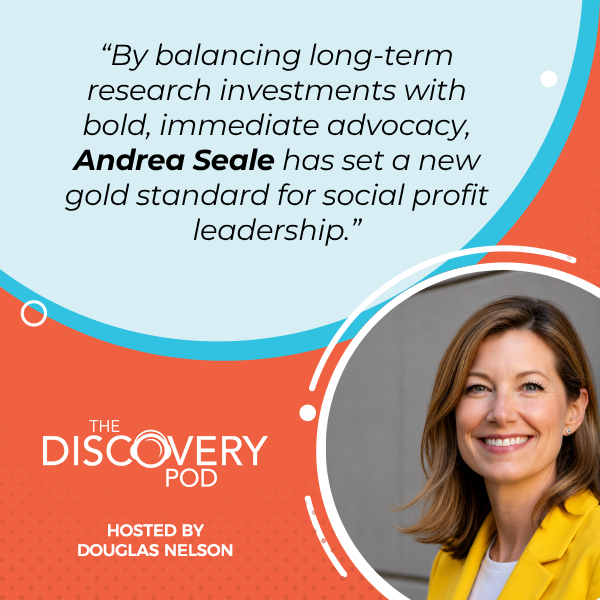
Navigating a complex healthcare landscape requires bold leadership, strategic clarity, and a deep commitment to collective action. As CEO of the Canadian Cancer Society, Andrea Seale has guided the organization through a transformative era to maximize its national reach and impact. In this conversation, Andrea shares how her team crafted an ambitious strategic plan aimed at increasing cancer survival, expanding prevention efforts, and improving the quality of life for millions facing a diagnosis. She offers valuable insights into balancing long-term research investments with immediate advocacy wins and building diversified, sustainable funding models. Tune in to discover how visionary social profit leadership can unite partners coast to coast to tackle one of Canada’s greatest health challenges.
—
Listen to the podcast here
Building For The Future With Andrea Seale, CEO Of The Canadian Cancer Society
The Mandate Of The Canadian Cancer Society
I’m joined by Andrea Seale, CEO of the Canadian Cancer Society. This is the second time that Andrea has been on the show. The first time was in 2019. She was a year into her tenure as CEO at the Canadian Cancer Society. What we talked about was very different. The world was different. Andrea has more than twenty years of leadership experience in the social profit sector and has dedicated her career to building organizations that contribute to a more compassionate, healthy, and just world.
Since joining the Canadian Cancer Society in 2018, she has led the organization through a period of transformation, all in service of the 2 in 5 Canadians who will be diagnosed with cancer during their lifetime. In this conversation, she talks about building a national strategic plan, connecting with essential partners from coast to coast, leveraging the scale and reach of her organization, and how to use the size of the Canadian Cancer Society to advance purpose and do more for Canadians facing a cancer diagnosis. Her leadership style, her approach to engaging her team, and her commitment to the cause that she represents are an inspiration. There is so much to learn from this amazing conversation with Andrea Seale.
‐‐‐
Welcome back to the show, Andrea.
Thank you so much for having me.
It has been many years since you’ve been on. Reading through the transcript, I was like, “What questions can I ask that I didn’t ask before?” One of the things that gave me a lot of confidence is that everything has changed since our last conversation. We had a global pandemic. Your organization has grown into itself and grown into its national mandate in a powerful way. I’m looking forward to the conversation and sharing a bit of that journey with our audience. As we get started, maybe quickly, what is the Canadian Cancer Society? Touch on some of the elements of your new strategic plan.
Thank you so much for having me back. I can’t believe the time that has passed since we last talked and how much the world has changed. Some of our fundamentals haven’t changed. We started in 1938. In a lot of ways, our mandate ultimately hasn’t changed much since then, trying to make a difference for people who are affected by cancer. Cancer remains the leading cause of death in Canada. Two in five people in Canada will be diagnosed. It’s something that remains at the top of people’s minds when it comes to health and health challenges that we can take on together.

Canadian Cancer Society: Cancer remains the leading cause of death in Canada. Two in five people in Canada will be diagnosed. It’s something that remains at the top of people’s minds when it comes to health challenges that we can take on together.
For our new strategic plan, we’ve worked on it over the course of about eighteen months, looking at the state of the world and the state of cancer post-pandemic. Healthcare in Canada was dramatically affected by the pandemic, and that has had an impact on people with cancer now and going forward. Maybe I could talk a little bit about our process with the plan.
I’d love to hear it. Eighteen months is a long time for a strategic plan. You must have talked to a few folks.
We talked to a lot of people. That was important because we have a lot of stakeholders who care deeply about what we’re doing. People would think about people with cancer, people going through cancer, and caregivers. That’s a community that we want to understand their needs and the impact they want to see from us. We have other groups like the cancer research community and our donors. We’re supported by the public and by donations.
Our staff is a large team of almost 800 people. We also have an active volunteer community. There are almost 20,000 volunteers who are involved in different ways in government and healthcare. There are many stakeholders who helped us think through what’s important for us. We enjoyed getting that perspective and doing an analysis of our own impact through the decades as well that contributed to it.
I’m looking at the cancer landscape in Canada, which is pretty complex. There are a lot of other cancer charities aside from ourselves who are all contributing in different ways. There’s provincial healthcare. It is figuring out, “Where do we fit? What unique contribution can we make? What unique contribution do we make today? What is the work that we want to do in the future that only we can do because of who we are and because of our history and our scale?” That’s what we wanted to crystallize in the course of creating the plan.
One of the things that jumps out both in the plan and how you’ve described how it was put together is that you’re not a niche player in the cancer community in the country. Knowing what else is going on and what everyone else is doing, it’s not like you’re going to find the cracks or the seams and set yourself into those cracks. You are setting the table for a lot of the cancer conversation, both at the research and care level, across the country. When you talk to such a broad diversity of individuals over an extended period of time, I’m always curious. Is there something you learned or an insight that you gained as CEO that was something different than you’d heard before or you were expecting to hear?
Shaping The Three Core Pillars Of The Strategic Plan
In creating strategy, the thing that we had in our mind while we were doing this, the leadership team for the board of directors, was that strategy is about making choices. That is such a hard thing to do when you are providing so many different services and can play so many different roles. When we were doing the consultation, we were looking for help making the choices, like help from our stakeholders and making the right choices.
Strategy is about making choices. That is such a hard thing to do when you are providing so many different services and can play so many different roles. Share on XWhat we did hear was, “Everything you’re doing is valuable and important. It all needs to happen.” That’s not unexpected because I know the work that the Canadian Cancer Society does is important and valuable. The big things we do and the small things we do. It reinforced how it’s the responsibility of the management team and the board to make those choices. It’s not necessarily going to come from public consultation. It needs to come from the leadership team of the organization.
We did get insights from all of our stakeholders, and a few things did rise to the surface. The number one thing that we heard is that if people are diagnosed, they want to know they’re going to survive. That progress when it comes to cancer survival, people are optimistic about that. They see that there’s been progress. They know more is possible, and they want that to be achieved. That became one of our core goals of the plan. We want to increase cancer survival.
Another thing that we heard from people is they want more prevention. They know that it makes sense to invest in prevention and try to stop cancer before it starts. That became a goal as well. Our last goal of the plan is to improve the quality of life of people who are facing cancer. That was also a clear message. More people are living with cancer because our treatments are getting more effective, but the quality of life is something that can be improved. We want to work towards that as well.
More people are living with cancer because our treatments are getting more effective, but the quality of life is something that can be improved. We want to work towards that. Share on XYou and your organization have done some tremendous work on the cost of cancer, like what it costs when someone in a family is diagnosed and what it costs an individual when they’re diagnosed. In our work here at the Discovery Group, we’ve come across a number of organizations using that as evidence of the importance of supporting people on a cancer journey.
That works. We produced a report. We published it. It was a very extensive economic analysis of the cost of cancer. In our Canadian context, where we have universal healthcare and healthcare paid for by government, it can be pretty shocking when people are diagnosed with cancer or with other diseases as well to realize how much is not covered, how much may come out of pocket, or how much of a financial strain cancer is.
One of the highlights of that report was that we found that for a person who’s diagnosed with cancer, it will cost them about $33,000 in their lifetime. That’s coming from things that aren’t covered by the government. Those are the cost of managing your side effects, some of the treatments or prescriptions that you might need that are not covered, the cost of travel, the time off work that people have to take, and the time off work that caregivers have to take, which is all the lost income. There’s a lot of need for more advocacy and strategies to support the financial impact that cancer has on people.
That report and a number of the points you made about the strategic plan do come back to the power of having the scale of the Canadian Cancer Society. In our work here at the Discovery Group, we work with a number of organizations that are quite large relative to the average in our social profit sector. It’s often a matter of articulating what the value of this scale is. Being big isn’t particularly compelling as a fundraising message or an advocacy message. What is the advantage? What do we get? How do we advance our purpose when we have a certain size that allows us to maybe have more flexibility or be at tables we wouldn’t otherwise be at?
Leveraging Organizational Scale For Long-Term Research Impact
Our scale is something that we value, and we want to keep increasing. What it gives us most, and we put this in our aspiration statement for the strategic plan, is that we want to be the most impactful cancer charity in Canada. That comes from a combination of the scale that we can work at, the places where we focus our effort, and the collective action that we can spur. We want to involve as many people and organizations as possible in the cancer cause. We want to be impactful by saving lives, improving lives, and driving that collective action against cancer.
Canadian Cancer Society: We want to be the most impactful cancer charity in Canada. That comes from a combination of the scale that we can work at, the places where we focus our effort, and the collective action that we can spur.
Your organization does such a great job of being evidence-based in a lot of the claims and a lot of the work. You’re contributing a lot of evidence to the cancer journey, the importance of cancer research, and the importance of cancer prevention. As CEO, you’re in it day-to-day. You’re talking to people and all of your essential partners on a regular basis. How do you measure that progress to scale on a day-to-day basis as CEO?
That’s challenging. What we want to see happen does take decades. The area of cancer research is a good example. The Canadian Cancer Society has invested more than $2 billion into cancer research in the last couple of decades. The big innovations that have happened decade by decade, going from the 1940s, where it was surgery, to the 50s, where there was radiation and chemotherapy, to the newer frontiers being immunotherapy and precision medicine. The timescale for seeing that progress is decades.
When we look back, we can see that the choices that were made to invest in research and the way that our peer review process has helped us identify what the promising areas are to support clinical trials that have helped to bring things into clinical practice, we can see the progress that has happened. Our goal is to make sure that we’re investing in what is the cutting-edge of tomorrow and using the experts from within the scientific community around the world to help us set those targets and make those right investments.
Research is one that takes a longer time horizon. Some of our advocacy work, though, is a much shorter horizon. We can see that impact on people immediately. We’ve been talking a lot about colorectal cancer screening, for example. We can see that younger people are being diagnosed with colorectal cancer. People born after 1980 are two-and-a-half times more likely to be diagnosed than older people. There’s something happening there that’s important, but our cancer screening programs across the country are only screening people at age 50.
We’ve been working with others and the colorectal cancer community to try to talk about lowering screening ages. Some provinces are starting to do that. We can see the immediate impact of advocacy issues on people’s lives and on the cancer experience. That’s a big part of our strategy going forward, too. We want to work at that systemic change level to be able to impact the whole population. Cancer screening is a great example of policy that protects the whole population when it’s done right.
Cancer screening is a great example of policy that protects the whole population when it's done right. Share on XIt surprises me not at all that when I asked about how you measure progress. All you talked about was purpose and the role of the organization. Anyone who’s had the chance to meet you over the last number of years knows that that’s where you would take that question. I want to be a little more precise in this. Around your leadership table, do you talk about, “We’re on the right track?” Everybody has the financial metrics in our sector, and I’m sure that’s a relevant consideration. When you’re together with your leadership team, how do you talk about making progress as an organization?
We focus on the wins that we can see on the horizon and then achieving them. We also focus on our relevance to people affected by cancer. The services that we offer, for example. We want to ensure that they’re meeting people’s needs. Tracking our metrics when it comes to the ways we’ve helped people and whether those are meeting their needs.
For example, our Wheels of Hope Program that volunteer drivers take people to their cancer treatments or the lodges that we run that give people a place to stay when they have to travel for cancer treatment. We want to make sure that the things we offer are meeting people’s needs. The operational metrics are important, too. Our fundraising metrics are critical.
Post-COVID, we made two major organizational investments that we’ve been tracking. One of them was on digital transformation. We made a lot of investment into digital systems that support fundraising, operations, and mission, and also a major investment into fundraising growth. We’ve been tracking our progress on those two fronts because they do drive our ability to do all of our mission work and our purpose work.
Diversifying Fundraising Strategy And Engaging Major Donors
Let’s spend a couple of minutes on that fundraising component because you have made significant investments in it. When we talked in 2019, fundraising was something that needed to get better pretty quickly. You used more elegant language than that, but it was certainly something you needed to prioritize at that time. You can go back to 2019. You were coming out of the pandemic. What is different now?
Probably our biggest difference is that we have a much more diversified fundraising mix than we used to have. The Canadian Cancer Society had a very big reliance on events as a source of fundraising. People want to be involved. Events are a natural way for different communities and different members of the public to be involved, but they are not the most efficient way of raising money. A lot of times, they have a life cycle that you can’t necessarily control.
The Canadian Cancer Society had been hugely successful with some events through the decades that were starting to decline, and not enough had been invested in digital fundraising, broader scale, monthly giving, and that kind of thing. Events and planned gifts were the core of our revenue prior to COVID. Post-COVID, it’s much more balanced.
Events are still a part of it, but what we call mass marketing, which is monthly giving or online giving, has grown significantly to be about a quarter of our revenue. Major gifts and corporate gifts have also grown significantly through that time. It’s much more balanced. It feels much more sustainable for us going forward than being overly reliant on a few big events.
As your fundraising program has changed and grown, and your organization has grown into purpose, how have your conversations with donors changed as CEO of the Canadian Cancer Society?
When you’re relying mostly on events for fundraising, you talk a lot about the events with people. People are engaged in the events, but they’re not as directly giving as when you talk to a major donor about supporting a project. You talk in-depth about the project, the program, or the goal that that donor has. We have donors who are more engaged in the programs, services, and research that they’re supporting than we’ve had in the past.
We’ve had to adapt a lot more to be able to do that successfully because, for major donors especially who want to be involved and who want to help shape the things that they want to support, we have to be much more responsive to that than in the past. That’s been a skill that we’ve had to develop in order to work with those donors.
It feels like a very long time ago when I was involved in the day-to-day of cancer fundraising. One of the biggest things that donors often come up with is, “We should get all of the researchers talking to each other.” On one hand, you say, “They do. That’s what publication and peer review is all about.” Once you’re inside the system for a while, they don’t talk to each other all of that much except through the peer review process or through the journals. As you’re bringing donors closer to the work that’s happening in the lab, how do you balance that need to educate the way research works and keep that excitement on the potential that research has?
That’s an interesting observation. We have seen that there are some areas of cancer research where there is close collaboration between researchers. Some of the competitions that we run, where we make funds available, incentivize people to work together by having multi-site team grants. People are incentivized by the grant-making process to come together, share their work, and collaborate.
We have seen other times where there isn’t a lot of collaboration. We sometimes have to do a little bit of research to make sure that we are going to invest in the right things in that environment. We’ve had an interesting partnership with the Lundin Cancer Fund. They are a Vancouver family who, after losing their father to glioblastoma brain cancer, have done a lot of fundraising and effort to create the Lundin Cancer Fund.
Glioblastoma is one of the deadliest cancers. There are no good treatment options. It is not well understood enough to know how to find it earlier and how to treat it. It’s a very complex disease. One of the first things that we did in working together was to bring together the whole glioblastoma research community in Canada and also with people from around the world. The question that we had was, “Where are the promising avenues within glioblastoma research? What does the research community see as those promising avenues? It is so challenging?”
That was an important process of talking together and having researchers share more with each other for us to even know where to begin. Coming out of that, we had a white paper of some of the things we all learned and shared back with the community. That’s going to influence what our grant-making program looks like. We’re going to be offering grants to that community, but they’re going to be better-designed because we’ve been able to hear more from them about what they see as promising and what they see as the biggest areas of opportunity.
What’s it like to be in that room with all of the brilliant minds focusing on brain cancer in the world? You fit as one of the smartest kids in class. I didn’t when I got to be in those rooms. You’re hearing all of this. What’s going through your mind as you’re listening to that?
I always loved science, but that’s not what I studied. I have a curious mind, but no scientific basis to be able to have deep conversations. In that room, and then it happens as well if I’m observing a peer review process of looking at rating grant applications, what I’m always struck with is that as complex as you understand cancer to be, it’s so much more than that still.
A researcher who’s studying glioblastoma is probably an expert in so many levels down into the nature of the disease. The smallest, most complex details are critical when it comes to any kind of progress in cancer. I know the public often has this sense of cancer as, “Where’s the cure? Why do we not have the cure?”

Canadian Cancer Society: The smallest, most complex details are critical when it comes to any kind of progress in cancer. Our approach to supporting research has to respect that simplistic, superficial solutions are not what’s going to cure cancer.
There’s a sense that there’s going to be some silver bullet for cancer or that there should be. The more time you spend with researchers and scientists, the more you understand that it’s incredibly complex. Our approach to supporting the research has to respect that simplistic, superficial solutions are not what’s going to cure cancer.
Unlocking Potential In Cancer Prevention And Advocacy
I want to pivot slightly to one of the other pillars of your strategic plan, keeping on the earlier theme of fundraising. One of the great mysteries to me, having worked in the social profit sector, grown up as a major gift fundraiser, and been involved in fundraising my entire career, is why it is so hard to raise money for prevention? I’ll leave it there. Do you have the answer why that’s so hard?
That is a good question. I have a parallel question. Why is it so hard to raise money for advocacy, too? Prevention has the most potential to change lives and make things better. It’s the same thing with advocacy. The systemic change is so critical. I don’t know. Why do you think it’s so hard?
What I’ve held on to for a number of years and seen play out in a number of fundraising projects that we’ve been involved with here is that no one’s grateful for the disease they didn’t get. It’s like, “If it didn’t happen to me or didn’t happen to my family, it happened to somebody else. Somebody should do something about that. It doesn’t affect me. I didn’t have this.”
That’s right. It’s not relevant the same way to you as if you were impacted by cancer. It’s a challenge, for sure.
One of the other things that was so resonant for me as I was learning about the cancer fundraising space many years ago was that there would be board members and other people who are organizing events or participating in the ride. Everybody needs to know that even if you haven’t had cancer, or it hasn’t been in your family, people should be giving to this. You and I could probably agree that they should. They don’t.
The number you use is 2 in 5 will be diagnosed. There aren’t very many people you need to tell about it as this new thing or this thing they should be aware of. Going back, even if they haven’t had it, they should probably be afraid of it, and they should give to it, but they don’t. It is an othering or an aversion. This is an awful thing we want to avoid for ourselves and for our loved ones. Prevention is like, “Somebody else should do that.” It’s pushing it away.
You do this every day. You talk to the folks involved in research, public advocacy, and public health in particular. The interventions around prevention are the least expensive, most effective, and benefit the most number of people. The math and the logic undoubtedly put the money into prevention. You can’t raise the money to do it.
It’s true. Back to when we did our stakeholder consultations for developing our strategic plan, when we asked the people who are closest to the information or the cancer space, prevention was number one. Our board of directors, for example, saw prevention as the number one thing we should be investing in. If you’re close to the issues, then that is obvious to you.
We see our responsibility to invest in prevention, even if it’s not necessarily the top choice of donors. We have enough donors who give to us without any designation that we can design our budget so that we’re investing more in prevention, even if it hasn’t been the first thing that motivates some person to give to us. It’s something that, over the course of our plan, we want to invest more in because it is so critical and isn’t going to happen without us being deliberate about it.
Let’s do advocacy.
Maybe I could say one other thing about prevention. One thing that we see changing a little bit in the prevention space is that a lot of prevention in the past has been about individual behavior. It’s guidance to people about how to reduce their cancer risk, like, “You should not smoke. Eat well. Reduce your exposure to carcinogens.” That’s a sense of personal responsibility, which is important.
Over time, the understanding has also increased about how our policies support that or don’t support that for different populations who are going to be more at risk. Social determinants of health are important and not something that an individual can take responsibility for. Thinking about how to prevent cancer has changed over time. There are some interesting new areas of research on the biology of cancer prevention.
Social determinants of health are important and not something that an individual can take responsibility for. Thinking about how to prevent cancer has changed over time. Share on XHow can we understand what’s happening at the cellular level of why cancer starts to grow inside the body? Can we understand that better? Can our ability from a medical point of view get us to that place and maybe have some prevention interventions that are not only about lifestyle or policy? There’s some promising scientific work that’s happening in the prevention space, too. We had a partnership with Cancer Research UK to support new science on the biology of cancer prevention. We’ve got a few big grants happening that are supporting some Canadian scientists looking into this.
Executive Evolution And The Power Of Collective Action
That is very cool. As we are coming near the end of our conversation, I have two last questions for you. One is, how is Andrea Seale, the CEO, different in 2026 than Andrea that our audience may have known as CEO in 2019?
In 2019, I was focused on bringing together the cultures of merging organizations. I was also personally fairly new to the cancer field and in learning mode about it. I’m still in learning mode about it because it’s a very complex space to work in. At the time, I was probably more focused internally. Now, I’m focused more externally.
I’m more focused on the process of the development of the plan, being in touch with so many stakeholders, and thinking about the role that we play in inspiring collective action against cancer. I’m more focused on the external relationships, partnerships, and the way that CCS can work in partnership with many others versus managing the organization and the dynamics inside the organization.
You do it so well. It is one of the advantages of longevity in a role, isn’t it?
It does take time to learn. We have such amazing people inside the Canadian Cancer Society. It’s a real privilege to be able to work with such a high-performing team. That also allows me to be more externally focused, too, and work with donors and work with partners.

Canadian Cancer Society: Our tagline is, ‘It takes a society.’ To take on cancer, it takes all of us working together.
What are you looking forward to?
We’re at the beginning of the strategy. I am looking forward to sharing it more and galvanizing more support behind the cancer cause, which I hope will come from this. If you’ve seen any of our branding, our tagline is, “It takes a society.” To take on cancer, takes all of us working together. I get energized by that sense of community working together. I hope that our strategy, which is all about a future without cancer, will galvanize more people, and that we’ll be able to make progress on our goals in survival, prevention, and quality of life.
It has been such a pleasure getting to have you back on the show. It has been even more of a pleasure to watch the tremendous progress that you and your colleagues have been able to make at the Canadian Cancer Society over the last number of years. It is an example of the work done exceptionally well in our sector. There is so much to learn from the great example that you and your colleagues have set. Thank you.
Thank you so much. I enjoyed the conversation.