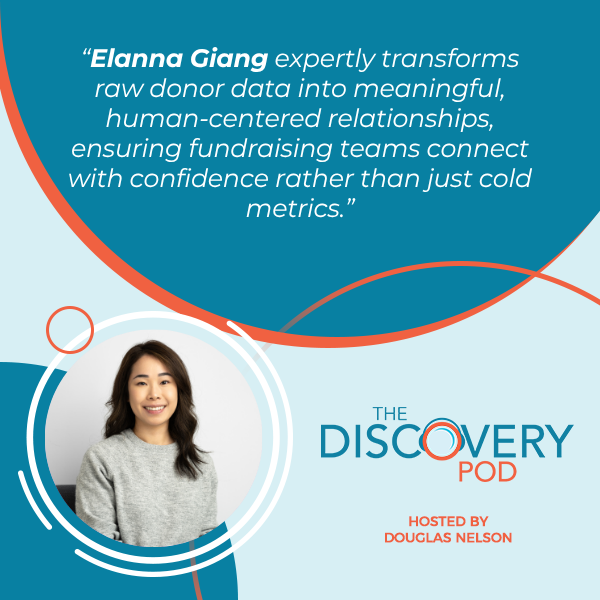
Nonprofit leaders often struggle to identify and engage the right supporters, leaving valuable philanthropic opportunities untapped. Building sustainable donor growth requires a grounded approach to prospect research that goes far deeper than net worth or basic online search results. In this episode, Elanna Giang, Director of Research and Analytics at The Discovery Group, shares actionable insights on how fundraising teams can transform raw data into meaningful relationships. She explores the practical applications and hidden dangers of AI in donor identification, why values alignment outweighs financial capacity, and how involving researchers in early strategy sessions empowers organizations to connect with confidence.
—
Listen to the podcast here
Donor Research In The Age Of AI With Elanna Giang, Director Of Research & Analytics, The Discovery Group
I am thrilled to welcome Elanna Giang to the show for a conversation about prospect research, the role of AI, and understanding those relationships that are closest to your organization and those that one day may be close to your organization. Elanna is a longtime volunteer and past board member of the Association of Professional Researchers for Advancement or APRA. Elanna is a strong supporter and advocate for prospect researchers in the philanthropic sector.
She has a keen sense of curiosity for uncovering strong values alignment between people and philanthropic causes. Elanna is passionate about facilitating positive social change within the communities we work, live, and play in. I am thrilled to add to this that she is the Director of Research and Analytics at The Discovery Group.
—
Elanna, welcome to the show.
Thanks so much for having me.
Why Prospect Research Is Vital For Non-Profit Leadership
It is so great to have you on. I have benefited from your wisdom and expertise for the last number of years with you as a vital member of the team and providing incredible service to clients. I want to start with the question that many CEOs and heads of fundraising may be asking when they see the headline for this episode. Why is prospect research relevant to the CEO or to the head of fundraising?
It’s important to ask when research is not relevant. Research helps us understand so much about the world around us and the people that we interact with. Having research is rooting us in something grounded, often verifiable. We hope it is verifiable. It tells us who we’re talking to, what we want to talk to them about and where that relationship can lead.
Research helps us understand so much about the world around us and the people that we interact with. Share on XOne of the things that always fascinates me in conversations with our clients, particularly as we’re getting started either with a campaign or a fundraising assessment is, “We need more donors. We need prospect research.” I know having grown up as a fundraiser. That is quite a broad category of things. When someone says, “We need prospect research,” what are the categories of activities they’re asking for?
Often, what they’re wanting to know is who the donors are. Whether those donors are known to them, or as you said, we need more donors. Figuring out who can give to them, who’s interested in them, or who’s aligned with them. When clients are asking for research, it’s helpful for us to understand where they’re coming from, what they’re starting with or if they have a strong donor base. Are they starting with nothing? Figuring that out is of course key. Figuring out how far along their relationships with their donors are will also help us determine what research is going to be of most value to them.
We offer a broad range of research services and that can go from quick profiles. Snapshots to tell you who that donor is, what they’re interested in. It also goes to the other end of that, where we can go very in-depth with what their interests are, where else they’ve been giving, and where else they’ve been involved.
We can also help organizations that are building their donor bases from scratch to identify new donors. That might be individuals, foundations, or corporations. We can help them find new funders, so we can help them build their donor base. By identifying individuals, foundations or corporations that are giving that are interested in their cause. They can reach out to talk about the work that they’re doing.
It could be the major gift fundraiser for me. I grew up with a major gift fundraiser but aren’t the best relationships the donors that are already giving?
I have two thoughts about this. It’s always great to be talking to the donors who are already giving. They’ve removed that wall. They’ve already shown that they’re interested in the work that you’re doing. It is also great to explore new opportunities. It’s always good to inject new life into something. I’m a strong advocate for both.
Donor Research: It’s always great to be talking to the donors who are already giving. They’ve removed that wall. They’ve already shown that they’re interested in the work that you’re doing. It is also great to explore new opportunities.
There’s ways to find those new donors. I often think or imagine an organization or a board member imagining the wealthiest person in town or wealthiest folks in town and say, “Why isn’t so-and-so giving? We should do some prospect research and find out how we get to that person.” Is that what you’re talking about?
That’s part of the equation. Capacity is a major component of fundraising. Interest is also a major component of fundraising. I would argue that it’s possibly much more important than capacity, what a donor is interested in or what they value, where their passions lie. It’s going to be a bigger indicator of the type of gift that they’re going to give to you or whether or not they’ll engage with your organization at all. When we are looking at new donors, I do like to qualify first based on their interests, their alignment, and then I’ll look at the capacity to determine where in your donor pyramid, if we want to use that term, where they’re going to fit in.
Measuring Success And Aligning Donor Interest With Giving Capacity
When you’re working with fundraisers or working with clients around developing this prospect research, how do you think of the outcome? How do you know that your work has been successful when you’ve done the profile, done the research and it’s presented? How is it successful?
When the person on the other end says, “Now, what do we do with this? What can I do with this?” You’ve identified these three things that they’re interested in, how do we build a conversation around that so that I’m engaging that donor in a way that’s honoring their interests and furthering their relationship to our organization.
That’s where a lot of the work with our wonderful philanthropy consultants comes in. Where they then take some of the data that we’ve provided through research or data points that are internal to an organization. They’re able to build a wonderful longer term fundraising strategy to then cultivate that next major gift opportunity.
One of the things I’ve come to appreciate about the work that you do is that intense focus on ensuring that the work and the product is a tool that fundraisers can use. This is something that people can put to work. It’s not just, “Here’s information. Pat me on the back. I found out some information.” Though, some of that is certainly deserving but what do you think about or how do you ensure that the work that you’re doing is that functional tool that clients or fundraisers can put to work?
Research is a tool. It can't answer a single question or give us a specific answer. It gives us a better understanding of whatever questions we had in the first place. Share on XWhen I start doing research, it’s always helpful to think about specific questions or to frame it in specific questions. I always think that research is a tool. It can’t answer a single question or we shouldn’t be using it to give us a specific answer. It gives us a better understanding of whatever questions we had in the first place. Asking where the donors are showing up, what they’re engaging in, how they’re engaging with specific philanthropic causes, where they’re giving their time, their money, or what they’re talking about.
Whether that’s on social media, whether they’re writing opinion pieces for various magazines or newspapers. Looking at those things to figure out what their energy and mental capacity is going towards and always thinking about how that information can be used in a fundraising situation strategy or to build that relationship. Everything else is noise. Being specific about the business purpose, which is in this case, fundraising.
That makes a lot of sense. You and I’ve talked about this a number of times over the last number of years, but it never ceases to amaze me the unflinching confidence that fundraisers have in prospect research to answer the big question. How much can this person give or how much could this family give? How do you approach answering that question?
I always like to tell our clients, context matters. Their relationship to you matters. Again, looking at those questions that I always look at when I’m doing donor research is, where else are they showing up and how else are they showing up? People are unpredictable, number one. That’s a fact that we all know. Our world is always changing and we’re always changing to understand that world that we live in. Also, to align ourselves with the things that are coming across our newsfeeds or whatever it may be.
How much a donor can give and how much they’re ready to give to you are often different amounts. Figuring out, 1) their relationship to you. 2) Their relationship to philanthropy is always going to be what I encourage our clients to focus on instead of looking for that one specific number of what they can give to you.

Donor Research: Capacity is a major component of fundraising. Interest is also arguably the major component of fundraising—what a donor is interested in or what they value, where their passions lie.
When we’re doing fundraising training and working with fundraising teams, one of the questions we ask people to understand is where their prospect or where their donors’ minds are at in terms of the size of their giving or how they view their philanthropy or what they’re capable of. Not based on what they have in their stock portfolio, but what they’re capable of mentally getting their heads around or their hearts around to make that donation.
The question we have them ask is, tell me about a gift that you’ve made that you’re particularly proud of. What spurred the gift, the answer will give you clues about how to steward that gift, but it also gives a sense of the magnitude and how they measured up what the appropriate gift level was. One of the things that is both always surprising and cool to me is that often what donors say to that question is, “That’s what I was asked for.”
There is some role for the prospect research to give that range or give some guidance in that and to help the fundraiser come up with that. Ultimately, it’s going to come down to the donor making that decision. The tool of providing a range or here’s how it connects to the project that you’re raising money for is particularly helpful.
The Pitfalls And Realities Of Artificial Intelligence In Donor Discovery
There isn’t such a thing as a podcast license, but if there was, we would need to cover off a topic in our conversation about artificial intelligence. Otherwise, we’d lose our totally made-up podcast license. AI is something that comes up a lot in our conversations with clients, and I know it’s something that you talk to clients about through your work. How is AI showing up in this world of prospect research?
I will say AI has always been part of the prospect research tools that a lot of professionals in this industry rely on to varying levels and different models. Not always the ChatGPTs of the world. We have always relied on some AI to facilitate the work that we’re doing. What we are seeing now, though, is AI is showing up everywhere.

Donor Research: How much a donor can give and how much they’re ready to give to you are often different amounts. Figuring out their relationship to you and their relationship to philanthropy is always going to be what to focus on.
If anybody’s used Google, for instance. You now have that Gemini pop up that you can never get rid of. You have that AI overview that you also cannot opt out of. I’m sure that’s the case for many other search engines. This is probably just part of human nature as well. Our first response when we don’t know something is you go to Google or you go to whatever it is that you’re doing.
If you come across a donor name or a donor makes a gift to your organization and it is a significant gift that spurs your or sparks some curiosity in you. Your first instinct is probably going to be to go to Google and type in that name to see who this person is. That’s what we’re seeing a lot. Some teams might think they don’t even need researchers. That you can just Google everything. I want to caution that this is not something that we recommend. It can be dangerous.
If I can share anecdotally, I will use Google sometimes. It’s good to get rooted in some context, especially if you’re not familiar with a donor. For this particular task, I was looking up a fellowship. I wanted to learn more about a fellowship that had been established. I typed in the name of the fellowship into Google, and the little AI overview popped up. I always like to look at it just to see, is there anything of substance in here?
What it told me is that the donor that established the fellowship had passed away, and that they were a founding donor to the organization that the fellowship was held at. Neither of those things were true, but it had pulled together a few different sources. It was basing that little summary on an obituary for a community member, where the family had said in the obituary in lieu of flowers, “Please consider making donations to this fund that was related to the fellowship.”
Different things completely, but AI can’t always tell or they can’t always differentiate those things. It gave me something that was very incorrect. If a fundraiser had used that information, who knows what would have happened. That conversation probably wouldn’t have gone anywhere. That’s something to be very mindful of. The other danger that we’re seeing with AI is it often can’t replicate the same thing twice when you’re talking about qualitative data. When it’s giving you those summaries, it’s always pulling from different sources.
The danger that we're seeing with AI is it often can't replicate the same thing twice when you're talking about qualitative data. When it's giving you those summaries, it's always pulling from different sources. Share on XIf I try to type in that fellowship name again into Google, that AI overview is probably not going to look the same because it’s going to be introducing new sources and removing other sources that it had previously showed me. That’s something that we need to be very mindful of. Google is a tool. It’s not the ultimate tool for research or for anything. To caution against other products or anything that relies heavily on artificial intelligence at this point.
The other use case that we’ve heard a lot about, and I know you’ve also worked on, is using AI to analyze the existing donor base at organizations. Some of the similar challenges come up that you mentioned in terms of some false leads and some potentially misleading information. How are you seeing clients that are doing that effectively using AI or using AI tools to analyze their own donor base?
The organizations that are doing it well are tempering their expectations with what those results are going to be or how they’re going to be using those results. It’s always a great idea to use analytics as a starting point for any strategy development or figuring out what your next steps are going to be in the short term. When you rely on them to tell you everything you need to know about a donor, that’s when it gets dangerous and probably it’s very ineffective.
It’s helpful in pointing you in a particular direction. It can tell analytics can look at a large amount of data and tell you which donors are increasing their giving. Maybe those are the donors that you want to segment for a tailored ask next. If you get a wealth screening done, it can tell you with some level of accuracy, which donors could potentially be giving more to you than what they currently are.
Perhaps you can consider including some of those donors into your major gift pipeline. Analytics can be helpful. I don’t think it can replace the real work that needs to be done by your fundraising team, which is talking to your donors, being strategic in those conversations and using the analytics to augment your fundraising strategy. Not replacing it.
It's always a great idea to use analytics as a starting point for any strategy development or figuring out what your next steps are going to be in the short term. Share on XThank you. That’s helpful. If our readers take nothing else from this, the tool that prospect research enables, whether it starts with AI or you’re working with the prospect researchers on your team or with Elanna Giang or someone outside of your organization. Ultimately, what it helps to do is structure a conversation with the donor. Whether that conversation is direct mail or a planned giving piece or a face-to-face conversation, this is about helping organizations connect with people and encouraging them to support the organization. We can’t get around the people.
No, unfortunately.
This is the neon sign that we don’t have in our office, it says, “Talk to the donors,” because that is the advice we end up giving in so many cases, particularly on campaigns as they’re getting going or programs that are looking to significantly step up. Go talk to your donors. That’s how you’re going to raise more money. Don’t worry about spending money on bus signs and Google ads.
Breaking Silos: Involving Researchers In High-Level Donor Strategy
Maybe do some of that, but what it comes down to is the number of people that you can connect with and your work and the work of prospect researchers helps create that shared language and that comfort for organizations to more confidently and more consistently reach out to their donors. One of the other pieces that you’ve underlined in the conversations with the team here, and I know I’ve seen you do it with clients, is making sure and advocating for bringing prospect researchers into the donor strategy conversation. Why is that so important?
It’s hard enough when you have your development advancement teams working in silos. Fundraising is a complicated and complex machine. You need to involve the people who are essential. I like to think of fundraising as a fact-finding mission almost. I think about a lot of these things in a discovery way. There’s an ongoing process of discovery and fundraising. Again, people are always changing.
Including the key members of your team as early as you can is only going to create a more multifaceted approach to understanding and engaging with a donor. If you have more people in the room who maybe some are more curious than others, that can only help build a more multifaceted fundraising strategy.
Donor Research: Fundraising is a complicated and complex machine. Including the key members of your team as early as you can is only going to create a more multifaceted approach to understanding and engaging with a donor.
One of the things you said at the outset that twigged me to ask this question was, you said that research starts with a specific question. That question isn’t as simple as just who is this person or who is this family? There’s specific information you’re looking for. I would imagine being in the fundraising conversation at the initial strategy conversations about these individuals helps to refine and sharpen what those initial questions are. Is that right?
I would say so. There’s also a lot of insights that other people may have that are being shared at those early stages of prospect identification or of a donor strategy. It’s good for a researcher to know all of those things so they’re not covering old ground, if we want to use that phrase. They’re understanding where the starting point is so that they can just continue to build on that. I also think researchers are great at refining some of those questions.
A fundraiser might think they want to know everything. It’s like, “Tell me where they graduated from elementary school. Tell me what awards they won in grade twelve. Were they the valedictorian?” Are those things important? A researcher can help refine some of those questions and keep the fact-finding mission narrow.
My vivid memory or my lesson that I learned when it comes to prospective researchers many years ago working in a faculty of medicine. There was a donor who was an alum who was an avid iris grower, and had been in competitions. Had won competitions and this is before social media, but knew that there were lots of photos that this person put into the world. It had been in the newspaper as this iris growing champion if such a thing exists. I was loaded up for this. Irises are beautiful.
I was going to ask about irises to get him talking because sometimes, particularly retired physicians aren’t the most loquacious individuals. I was ready. I went in and I said, “Doctor, I understand you’re quite a fan of irises, tell me about that.” He said, “How did you know that?” I said, “I saw that you were in the paper,” and he goes, “Did you do research on me before this conversation?” I said, “Yes.” He did not like that at all.
What I should have waited for was for him to talk about irises. The right question wasn’t, tell me about your irises. The right question was, what keeps you busy now that you’re no longer a family physician or a hundred other questions. That led with this information that felt like this golden ticket that I had to open this doctor up, I badly misplayed. It ended up being fine, but it sticks out to me.
When people want to know everything about a donor, I always go back to the awkwardness of sitting in that coffee shop and talking to that retired doctor and thinking, “I knew too much, or I showed that I knew too much, and it made it a little bit weird.” That brings me to a question that I’ve always wanted to ask you. You don’t know this is coming, so this is going to be a total surprise to you. When we’re working with campaign cabinets in particular, we’re presenting prospective research of individuals that we want to know, whether they know them and here’s what we know about them.
People are often a little surprised at how much we know or how much you can learn about a person. We only use things that are available through public sources. We don’t use private detectives. You haven’t gone through people’s recycling bins or anything like that. How often do you find something publicly that you’re like, “This is probably too much to share or this isn’t going to be helpful in a fundraising context?”
Navigating Digital Footprints, Due Diligence, And Ethical Research
It’s a very interesting question to ask because everybody is talking about their digital footprint and that’s something that didn’t exist many years ago. It’s a pretty new concept. I would say it’s not often, but it certainly does happen. In those cases, you have to use your judgment depending on what it is. Something that we’re seeing a lot, especially in recent years, is due diligence. It’s becoming a huge part of prospect research, especially when it comes to major gifts, naming gifts, anything that is very public to do with an organization and the gifts that they’re accepting or the donors that they’re working with.
Due diligence is a hot topic that a lot of people are thinking about, and a lot of organizations are thinking about their reputation as well as the donor’s reputations. When you think with due diligence in mind, almost everything becomes something that should be included, but you do have to balance the donor’s integrity or the donor’s right to privacy and with the organizational outcome that you’re looking for.

Donor Research: When you think with due diligence in mind, almost everything becomes something that should be included, but you do have to balance the donor’s integrity or the donor’s right to privacy with the organizational outcome that you’re looking for.
It’s hard. What are you going to do with tell me everything? That goes back to your earlier point about making sure you’re asking narrowed strategic questions that have a business purpose. That has something related to fundraising. If it’s a reputational research profile because someone’s going to be naming a classroom or naming a room in a hospital, that’s a broader reach. Making sure that it stays focused, that’s probably a big part of making sure that it’s ethical or it’s appropriate in any way.
Elanna, we sometimes ask on this show, our guests, if they had a magic wand. What’s one thing that would change about their sector, the broad social profit sector or specific to the subsector that they’re in? I’m going to ask you, if you had a magic wand and you could change anything about prospect research, what would you change?
I’m coming at this question as I had a very brief stint in major gifts fundraising. I’ve done a lot of work in research, both in-house and now as a consultant helping other organizations. The one thing that has not changed at all is the ability to reach out to some funders. That could be a very basic general inquiry about what they’re interested in funding. Is there a local contact that we could get in touch with who might be interested in having a conversation or meeting for a coffee or coming to the organization to learn more about the work that’s being done?
There’s nothing there. It’s like a little black box. You have the name of the organization or the funder. That’s all you get but we know that they’ve established this fund or foundation. Whatever it may be, because they’re interested in being philanthropic. Making that information more accessible is what I wish would happen. I wish that they would be more open to having those conversations.
Help us help you. How can leaders, CEOs or heads of fundraising, support prospect research and prospect researchers in their own organization?
As a longtime member of APRA, the one thing that we hear most consistently is researchers are often working in solo shops. Either they’re completely on their own. Sometimes it’s a very small team. They feel like they’re a little bit disconnected from a peer network. Sometimes those researchers can also be working in silos within their own organizations.
You don't need AI to do research and you don't need to invest in crazy analytics to understand who your donors are. You need to invest in dedicated researchers or research tools and fundraising strategies to connect with the people you're trying to… Share on XThey’re not aware of the current fundraising landscape or what fundraisers are coming up against in their day-to-day work. Investing in professional memberships, whether that’s APRA, AFP, or any other fundraising associations that are relevant to the work that you’re doing is a crucial part of having a researcher feel supported in the work that they’re doing.
Help them connect to a professional community of peers. That’s great advice. Elanna, in the context of our conversation, what are you looking forward to?
I wanted to say I’m looking forward to people reading this and realizing they don’t need AI to do research and they don’t need to invest in crazy analytics to understand who their donors are. They need to invest in dedicated researchers or research tools and fundraising strategies to connect with the people that they’re trying to raise funds from.
That is a great way to end our conversation. Bringing it back to the point of prospect research, the point of all of the work that’s happening in fundraising shops across the country. It’s to find ways to connect with people who are fellow travelers in the cause that our readers and our clients represent so well. Elanna, thank you so much for making time to be on the show. I’ve been looking forward to having you on and I’m glad to share your expertise with our readers.
Thanks so much for having me. This was a great conversation.