The social profit sector is undergoing significant shifts, demanding that leaders distinguish between what is truly important and what is merely urgent. In this final episode of season 10, host Douglas Nelson reflects on the core themes that have surfaced throughout the season, offering a roadmap for organizations ready to embrace transformation. By anchoring in abundance and rethinking board governance, leaders can move beyond scarcity and build for long-term impact. Join us as we explore how these insights can help your organization find its next gear and thrive in a dynamic environment.
—
Listen to the podcast here
Season 10 Reflections: 4 Themes That Will Shape The Year Ahead With Douglas Nelson, Host
Reflecting On Season 10: Core Leadership Themes
Welcome to the final episode of season 10 of the show. Over the past 43 episodes, we’ve had the privilege of speaking with exceptional leaders from across the social profit sector in every corner of Canada. While every conversation was unique, many of the same ideas surfaced time and again. We’re going to reflect on those themes that surfaced throughout the season, and hopefully they’ll add some food for thought as many of you listened to this at the end of the summer, thinking about the busy fundraising season, strategic planning season, and border treats that the next few months will bring.
Strategic Focus: Prioritizing The Important Vs. Urgent
There are four themes. The first is the number of times in our conversations leaders talked about the difference between what is important and what is urgent. The second theme is that the sector is being forced to transform, and it requires you to know who you are. Theme three. Many of our interviewees and the conversations went deep into the concept of anchoring in abundance rather than scarcity.
The sector is being forced to transform, and it requires you to know who you are. Share on XNavigating Sector Transformation And Abundance Mindsets
The final theme is that boards, governance, and strategy need a new mindset to meet the dynamic, changing environment in which so many social profits are operating. Let’s start with that first theme, understanding the difference between what is important and what is urgent. In our work here at the Discovery Group, we have the privilege of working with leaders who are new to their role or renewing their organization or finding that next gear if they’ve been in the leadership role for many years.
What comes through time and again is that the leaders who make the biggest difference are the leaders who focus on what is important but not necessarily urgent. At least set some time aside for what is truly important, what is going to impact the long-term success of your organization, versus just those things that are coming through your inbox or across your desk that must be dealt with.
When you think about something being urgent and important, of course you’re going to spend your time on it. What are you going to do next? Is it something urgent and not important? Is it something that’s not important and not urgent? Probably not. What we find time and again is that leaders who make time, whether on a weekly or a bi-weekly or a monthly basis, to think about and talk with their leadership teams about those issues, those concepts, those strategies that focus on what is important for the midterm and the long term of your organization that aren’t necessarily urgent are the leaders and the leadership teams that get the most done.

Social Profit Sector: The leaders who make the biggest difference are the leaders who focus on what is important but not necessarily urgent.
I think of my conversation with Jessica Dines at Breakthrough T1D. She kept coming back to the idea that they were building an organization for the long term, and they needed to think about their branding. They needed to think about their name and who they served and how they serve them, not just today, but well into the future. That allowed her to transform her organization from a primarily events-based organization that struggled during the pandemic to one where now 68% of the revenue comes from individual major gifts.
Focusing on what is important, not necessarily what was urgent, is what allowed her and her colleagues to get that job done. The second theme is that, of course, our sector is being forced to transform. All of the organizations in it. What we see here often is organizations seeking to transform, but what they mean by transformation is somewhat problematic or ultimately self-defeating. Transformation does not just mean more of what you’re already doing.
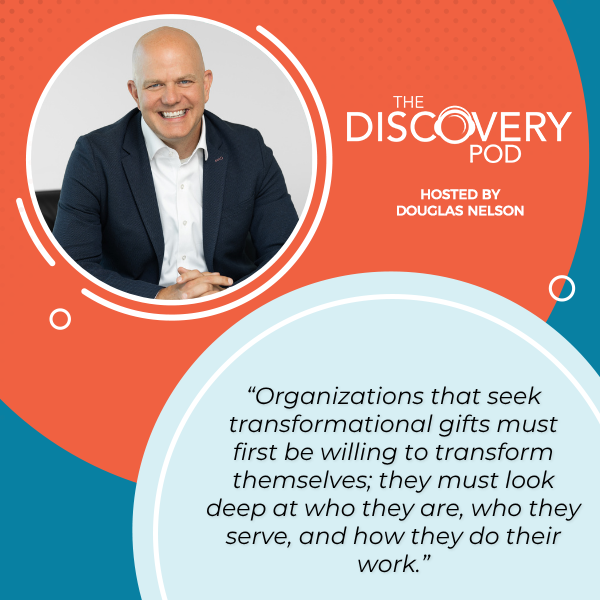
Serving more people, raising more money, buying more equipment, funding more scholarships. Transformation touches every aspect of your organization in terms of who you have on the bus, the strategies that you’re using to generate revenue, the concepts that you’re taking to the marketplace, the theory of change that you’re implementing through your programs. What we’re convinced of here at the Discovery Group, and it came through in the interviews pretty clearly, is that organizations that seek transformational gifts or see even significant gifts, especially from foundations and individuals, must first be willing to transform themselves.
The organizations that look deep at who they are, who they serve, and how they do their work are the ones best prepared for the pressures of transformation. Share on XThe organizations that look deep at who they are, who they serve, and how they do their work are the ones best prepared for the pressures of transformation. They knew who they were, so they weren’t questioning when the pressure to change, when the pressure to transform came from funders or those that they serve.
Abundance Over Scarcity
Fadima Jiwa, the CEO of Osteoporosis Canada, said it best. Her quote was, “The value of discomfort and change cannot be overstated. It often leads to those transformative changes.” She saw what needed to be done, knew it was going to be uncomfortable, and did what was important and transformative anyway. The third theme that we wanted to touch on is abundance over scarcity.
Audiences to this podcast know that abundance over scarcity is something we spend a lot of time putting out into the universe, advising our clients on working across the sector to ensure let’s start with what is working, let’s start where we are making positive change in the communities we serve and build from there, rather than always starting from the lowest common denominator or the area of greatest scarcity.

Social Profit Sector: Transformation touches every aspect of your organization in terms of who you have on the bus, the strategies that you’re using to generate revenue.
Guests over the season really rejected the scarcity thinking and instead focused on possibility, collaboration, and building from strengths. The sector does better work when it starts from purpose and possibility instead of fear and limitation. It sounds obvious when I say it. I’m sure it sounds obvious when you hear it or when you repeat it in other conversations you’re part of. Far too often in our sector, we see organizations starting from a place of fear and scarcity rather than strength, purpose, and abundance.
I’m reminded of my conversation with Dan Clement, CEO of United Way Canada, saying, “It starts with a framework of abundance, which then takes us into how we work together differently.” Understanding that change is a part of our day-to-day, doing it anyway, bringing people together, having the conversation about the change that needs to happen, and getting it done. Heather McDonald of the United Way of Greater Toronto also commented on this in a way that was particularly powerful. She said, “We are not waiting for the conditions to be perfect. We are making the conditions for our own change and transformation.”
The sector does better work when it starts from purpose and possibility instead of fear and limitation. Share on XThat’s centering agency within the organization to do what needs to be done to serve those that your organization is built to serve. A lot of leaders in this season acknowledged the pressure that organizations are under, but refused to let scarcity define their thinking or limit their ambition. This is something that defines our work here at the Discovery Group with all of our clients. What is possible? What is achievable? What is credible? What is the next step we need to take in order to get moving in the right direction?
Modernizing Board Governance And Strategic Partnerships
The final theme that I want to highlight is that boards, governance, and strategy need a new mindset. It is easy to say we need to change, no more same old, same old. We’ve talked on this show a number of times about striking down what we believe to be one of the most unhealthy phrases in the social profit handbook, which is noses in, fingers out for boards. We need boards who focus instead on uplifting the organization, standing shoulder to shoulder with management as partners in achieving the organizational purpose.
Sure, with and absolutely with the role of oversight as a big part of what they do, but not as separate from, distinct from, not noses over the glass peering in at the animals in the terrarium. Instead, being a day-to-day partner in celebrating and ensuring the success of the organization. That theme of rethinking governance came through a lot of the time, especially how boards engage with organizations during moments of growth and uncertainty, the role of boards when the CEO or executive director has left and they’re preparing for a new leader to come in, or as they are preparing for significant fundraising campaigns or capital campaigns that are going to change the way the organization operates for years to come.
Boards work best when they move from oversight alone to an active partnership and strategic engagement in the work of the organization. It is not enough to think about strategy and operations as the dividing line. Instead, it is more helpful to think about the shared purpose, the shared activities that will advance the organization. Angela Chapman, a good friend of the show, said, and Angela’s the CEO of the VGH & UBC Hospital Foundation here in Vancouver, she said, “One of the things we’ve done internally is have our board assigned to staff members and work directly with them. That’s so that they engage with the community and open up their networks.”

Social Profit Sector: Boards work best when they move from oversight alone to an active partnership and strategic engagement in the work of the organization.
She’s talking about how she’s getting her boards to fundraise there in that quotation, but the other opportunity that she’s talking about is that direct exposure of staff working side by side with the board in a shared purpose of raising money for the foundation. It shows that connection, that responsibility is a shared responsibility and a shared connection, not one of anonymous overseers watching the animals in the terrarium.
I also really enjoyed my conversation with Adam Starkman. He’s the CEO of Canada’s Children’s Hospital Foundations. It’s a bit of a long quotation, but I really want to share it because I think it’s worth thinking about in this context of how boards and strategy need this new mindset. He said, “We were very deliberate in identifying the core elements of our business that we needed to get rock solid before we started adding and taking on new initiatives. Only then, once we felt we had the right tools and infrastructure in place, did we start to recruit people and bring people on board, including recruiting new board members.”
Focus on the joy of being on the team and the great work that you and your colleagues get to do in this sector, and great things will come from that. Share on X“We are currently experiencing a really strong period of stability, and that’s helping us to bring new programs, new partners, and extend our reach.” A new way of working with the board, of working with partners, in the case of Canada’s Children’s Hospital Foundations, shows that when we think about where our strengths are, when we think about where the opportunity lies, bringing people together around a shared purpose is the way that we can be most successful.
Insights From Discovery Dialogues And Future Outlook
We also saw new ways and new senses of transformation in something else we did this season. Three of the episodes were dedicated to the Discovery Dialogue conversations that we held first in Vancouver and then in Toronto, looking at what it takes to get big things done in our sector. It is our privilege here at the Discovery Group to work with organizations every day seeking to get big things done, whether it’s in recruiting the right team, building the right strategy, or raising the necessary dollars to bring it all together.
Thinking in terms of the podcast, which is one of my favorite things to do, some of the most interesting conversations this season were about boards becoming more engaged, more strategic, more adaptive in this rapidly changing environment. We also heard from a number of organizations, and it came up on the podcast a number of times that some organizations are struggling to recruit board members.
One of the things I would urge you to think about, as a number of our guests suggested in the advice they gave, was to focus on the joy, the fun, the positive role that board members play. When we focus too much on the fiduciary responsibility or on that oversight role, we make our work and the work of our sector sound clinical and aseptic, distant from the human beings that people want to benefit and want to serve. Focus on the joy of serving on your board.

Social Profit Sector: When we focus too much on the fiduciary responsibility or on that oversight role, we make our work and the work of our sector sound clinical and aseptic.
Focus on the joy of being on the team and the great work that you and your colleagues get to do in this sector, and great things will come from that. We are so excited to look ahead to season eleven of the Discovery Pod and what it’s going to mean. I want to thank everyone who is such a consistent listener of the Discovery Pod, and the number of our audience is growing at a really astounding rate.
I’m so humbled, shocked, and surprised to know and to see the thousands of you that are tuning in to every episode. Thank you. We look forward to continuing the conversation in season eleven, continuing to highlight the great work that’s happening right across our social profit sector here in Canada. There is great work to be done. Onward.