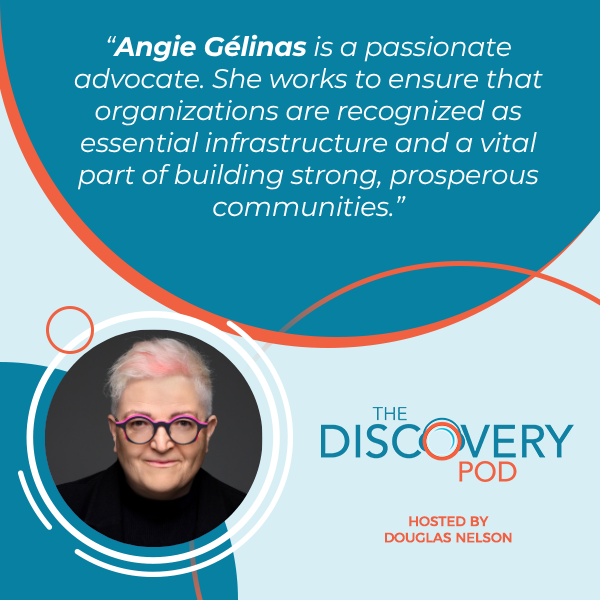
How can we shift the perception of the social profit sector from being seen as a charitable afterthought to essential civic infrastructure? At the forefront of this movement is the Nonprofit Chamber, which is driving groundbreaking research and partnerships to demonstrate the indispensable role organizations play in community development. Host Douglas Nelson is joined by Angie Gélinas, the President and CEO of the Nonprofit Chamber, to explore how data and advocacy can transform public perception. In this episode, they discuss the innovative “Invisible Anchor” project, which models the economic and social impact of nonprofits on local real estate, and delve into a historic partnership with the Calgary mayor’s office. Tune in to learn why the future of community building relies on treating the social profit sector as vital civic infrastructure.
—
Listen to the podcast here
Advocacy, Data, And The Future Of The Sector With Angie Gélinas, President & CEO, The Nonprofit Chamber
Base Camp For Alberta’s Nonprofits: Introducing The Nonprofit Chamber
I’m joined by Angie Gélinas, President and CEO of the Nonprofit Chamber in Alberta. Angie is a passionate advocate for the social profit sector. She still calls it the nonprofit sector, but we agreed to disagree on that. She works to ensure that organizations are recognized as essential infrastructure and a vital part of building strong, prosperous communities.
In our conversation, she talks about the work of the Nonprofit Chamber changing the conversation and the perception of what is the nonprofit sector, not just in Alberta, but across the country. Also, some groundbreaking research and partnerships that they’re doing with respect to real estate, municipal governments, and advocating on behalf of the sector in general. It is a great conversation with a leader who knows what she’s doing and building something special. It’s something that our sector should be paying more attention to. Please enjoy my conversation with Angie Gélinas.
—
Welcome to the show, Angie.
Thank you. Happy to be here.
Angie, very much looking forward to the conversation about the Nonprofit Chamber, the state of the sector in Alberta and its implications for the sector across the country. As we get started, some of our audience may not know what the Nonprofit Chamber is.
Glad to be here. First off, the Chamber began back in 2004, roughly, as the Calgary Chamber of Voluntary Organizations or CCVO. It’s a bit of a mouthful. Years later, in 2024, the organization changed its name to the Nonprofit Chamber. Who are we? What do we do? We are what I call a base camp organization for the sector in Alberta. I inherited a term or we use this term backbone organization. We’re too small to be anything’s backbone. It’s like, “How do we truly think about how we support the sector?”
It is a bit of a play on words in terms of, we’re pretty close to the mountains and we’re that place. We are that place that we hope organizations come to, leaders come to for three basic things, I would say. To connect and to build trust. Not only building trust through connection in us, but in each other so that you can start to think about how you work with each other.
As well as what we call knowing. We are stewards of data on the sector. We are probably stewards of the most data on the sector that we can publish in the country. We’re ahead of most. We have an amazing data sharing agreement with the government of Alberta. We’re getting behind the notion that if we can help our sector understand information in their own sector, it helps them make better choices and it helps decision makers make better choices. Again, we focus on connection and knowing.
Non-Profit Chamber: If we can help our sector understand information in their own sector, it helps them and the decision makers make better choices.
We work around how we help the sector thrive. For us, as a base camp, we got back into the business in 2025 of capacity building and doing leadership development. Both as senior leaders, but also we did leadership development around what I call digital confidence. How do we in this time of our existence where we as CEOs are not, nor can we be, experts in AI and technology? We still have to make choices about it. How do we do that? We’ve done some training around that, then there’s just speaking.
How do we help our sector come together in a more coherent manner? It’s extraordinarily broad. You know that. The sector is sports groups to dance groups, housing groups, homeless organizations, food banks, etc. It’s extraordinarily varied. We work to find some of those key communications that work for all of us that can get to decision makers. We’re about influencing decision makers in a big way.
It’s impressive to see the profile you’ve built since that name change in 2024. Angie, one of the questions I’ve been excited to ask you getting ready for this is. We talk a lot about the social profit sector. This is conversations with social profit leaders. You use and we use it because it’s a positive definition of the sector. Not a negative definition. We are a social profit. This is the advantage. This is what we produce. Nonprofit is conventionally what the sector is understood to be.
We can have that debate when it’s just the two of us because probably nobody else wants to listen to it. What I am interested in is what the sector is because we talk a lot about it. As consultants working across the country, we see what’s happening in the sector. Every once in a while, someone will pull on my coat and say, “Where is this? What is this? What is this thing?” Angie, what is the sector?
Defining The Indispensable Social Profit Sector
That’s such a great question. I’m going to go back to it. I’m going to take a little tangent. In October of 2025, I was in an Imagine Canada gathering. They presented some research that they had completed in the summer of 2025. I’m sure the presentation was 45 minutes long. I remember one thing, but I heard it and it’s all I could think about. When Canadians were asked if they or someone they knew had interacted with a nonprofit that year, 41% of them said they had.
I would argue it’s 100%. They just don’t know. They don’t know what the sector is. Even people perhaps adjacent to it might ask you the question, “What is this sector?” Our public doesn’t understand what the sector is. You can’t care about something. You can’t advocate for something. You can’t fight for something like you do for education or health care, if you don’t know it exists. Back to your question of what the sector is. I’ll speak specifically in Alberta.
Non-Profit Chamber: You can’t care about something, you can’t advocate for something, you can’t fight for something like you do for education or healthcare if you don’t know it exists.
The sector in Alberta is made up of, depending on how you officially count, 26 to 30,000 organizations. Almost 300,000 employees, people who work in a sector of which 78% are women. We cover everything from daycare, eldercare, hockey, soccer, dance, homeless foundation, and some of the ones I mentioned earlier. The majority of nonprofits in Alberta are sport and recreation nonprofits. I’ll be off on this a little bit. I apologize, but I think they make up roughly like 45%. It’s huge and people don’t know it.
People don’t know that the place they’re going to, where their parents are being cared for is a good chance it’s run by a non-profit. They don’t know that their ballet school is a non-profit. We just don’t know that. This is going to sound very contradictory. There’s non-profits who don’t think of themselves as non-profits.
I see it every day. Helping organizations realize that they’re charities or that they’re non-profits and not extensions of government or not standalone individual organizations with their own legal structure.
It’s amazing. Not to keep throwing stats, but 57% of nonprofits in Alberta have no staff. Another high number have five or fewer. It’s an extraordinary community-based sector that at times feels invisible. Yet our key message from the minute I started here and certainly before me is that it’s a sector that’s indispensable and people don’t realize how much they interact with it.
The Invisible Anchor: Mapping The Real Estate Impact Of Nonprofits
It is such an important message to be able to communicate that the sector is everywhere. It’s a hard message to get out. One of the interesting projects that you’ve undertaken there at the Nonprofit Chamber is the invisible anchor. Looking at the role that the social profit sector plays in real estate. Maybe share a little bit about that because I am so keen to hear the results of that because given what I do for a living, I get to see lots of places where lots of organizations are based. It’s a lot of real estate.
This is the first time I’m going to talk about this publicly with you because we got the funding confirmation in June. It was something we’ve been working on for a while. We’re just working with partners now on our agreements. The thesis is, it was born in not a small way out of this Imagine Canada piece of data. I came back and went, “How do we demonstrate to Albertans how frequent they engage with nonprofits?”
As serendipity would have it, we had a conversation with someone at the Alberta Real Estate Foundation. We had a conversation with this amazing company out of Edmonton, RUNWITHIT Synthetics. They are indigenous-led and women-led, international organization that models data in ways that no one else is doing it. We’re partnering with them. We’re going to start in Calgary and Edmonton. Our aim is to test this thesis that nonprofits who own, operate, lease, steward, and maybe in some cases squat, in facilities and have an impact on the market.
Not just an impact on the community, but on the real estate market that developers and planners don’t understand. As nonprofits, we feel we make a difference. We feel like we have a presence. We don’t have data to back up that feeling. I’m very much a, “Let’s just stop with the feels.” There’s enough of that in our sector. We need the evidence to show. This is the beginning of what I hope will be an evergreen project where we’re not just mapping where the sector is in the market.
We’re creating, called an engine, a dual synthetic information engine. I always do this. I know you can’t see me, but for some reason, I’m going to get a black box. They’re going to give me a black box and I’m going to be able to play with it but they’re going to build this model for us. We can go, “Here’s what we have now. What might this look like based on all of these different parameters ten years from now? What happens if we turn out the lights in this neighborhood on all these non-profits? Can we then create scenarios about what happens in that neighborhood?”
Eventually, I hope, not sounding a bit too like big brother, like, how do we map traffic into these organizations and the impact on the community? Often, when we hear about nonprofits and facilities in neighborhoods, we hear about challenging ones. We hear about Sheldon Chumir here in Calgary and the safe injection spot.
We don’t hear about all the others like the community association, the baseball place, or the dance place. All of these places that bring their communities together. This project aims at testing that thesis. Is the sector the invisible anchor? It’s like in the mall. You used to have Sears. I’m dating myself. You used to have the Bay and Neiman Marcus. They’re like your anchors. Is the nonprofit sector anchoring neighborhoods that we’re unaware of?
Navigating Government Advocacy And Human-Centric Dialogue
That first question we’re talking about is, what is, or who is the social profit sector or the nonprofit sector? This invisible anchor project is, where is the nonprofit sector in Alberta? That’s very cool. I want to transition to another topic that I’ve been so interested in how you and your organization have approached this. I grew up as a fundraiser. The advice that my colleagues and I often give to organizations when they’re thinking about fundraising exclusively, not government contracts, but fundraising, is that wherever politicians are, philanthropy isn’t.
The credibility that organizations seek should be on its own right. It should have its own merit. It should be the community of people that brings it around. Its community leaders, board members, and donors. That may sometimes include people who hold elected office but aren’t a target for your fundraising initiative by any means. Walk your own path, particularly when you’re raising money and particularly when you’re raising significant dollars. At the Nonprofit Chamber you walk a different path, and this is not because we disagree. There is real adjacency that you’re bringing or inserting the sector into the public political dialogue.
Before we get into the details of that. What is that like to show up on a Tuesday morning? Is it, “Put on your armor?” Is it, “Make sure you got fresh baked cookies so everybody will think?” How do you come through the door? How do you prepare for going through the door in those advocacy circles with government and elected officials?
I’ve been doing this a long time. I also have an experience. I was a deputy minister in a provincial government back in Saskatchewan. When we think of advocacy, when I think of advocacy with the government, it’s about showing up and remembering that there are people that I’m talking to. They’re not the ideology I’m talking about. They’re humans. I have to show up with that respect, understanding and clarity.
Advocacy with the government is about showing up and remembering that there are people that we are talking to—they're not an ideology, they're humans. Share on XI have to show up time and time again in a way that builds trust. For us, at the sector, that’s about always having good data. It’s about always having information that we can give that certainly can be questioned, but it’s not questionable. Building those relationships, both at the civil servant level, as well as the elected officials. At times, in any government, they aim to be on the same path. Sometimes they diverge. As entities working with both, you have to figure out how to work that.
“Left hand, call the right hand.”
At times. I’m fortunate, we’re fortunate that we’ve been building strong relationships. We understand that no matter who is in government, we work with the government. As polarizing as it can be in the media, we live in a country where democracy does work. We respect that people got elected and are here. We’re going to work with them as best as we can.
That doesn’t mean we’re not going to point out when there are policy choices or choices that are being made that we think impacts the ability of the sector to thrive or to accomplish the goals that our communities are asking for. We will bring that forward, and we’ll talk about how we solve that or how we solve that. It’s a great question. I don’t ever feel like I have to put my armor on. Given the volatility here, politically, it sounds like a surprise, but they are people.
I find when we sit down, whether it’s with a minister or with a deputy minister or executive directors, they want to try to figure out how the sector can continue to do well. I don’t agree with all their policy choices. It’s not my place. It doesn’t matter. I’m here as an individual and then I’m here as an individual representing the Nonprofit Chamber, who represents the sector. To try to get governments to understand what we do and to help us make that. I totally agree with you. I come from a fundraising background as well. Unlike you, after I went through a period, I went, “I don’t want to do this. This is too hard.”
It’s the fun part, Angie. It’s the most fun you can have.
I know but I agree with you. You don’t think of the government as your philanthropic partner. They’ll come in and support many causes when you can show that you can stand on your own and you can bring community with you. If they’re your sole idea of where you’re going to find money, you’re not. It’s not going to work.
Stitching The Safety Net: The Calgary Mayor’s Office Partnership
You’re not going far. You said in your answer there, governments. One of the unique things that you and your colleagues have initiated is a memorandum of understanding with the mayor’s office in Calgary. In the scope of government, if you want something done, you talk to your municipal leaders because that’s where the good work happens or the work that affects people most. Right at the forefront of social services, in particular, which is such a big part of our sector. Tell us a little bit about that memorandum of understanding. I’m curious. How did it come to be?
It was born initially in Mayor Farkas’ campaign materials. He did a whole piece in his platform around the importance of the social sector and the not-for-profit sector.
That was his background, right?
He had spent time as an executive director of a non-profit, Glenbow Ranch. That’s one of his experiences. It was most recent, so it was very real to him. He included the non-profit chamber in his platform. He named us as having a close relationship or that he wanted a close relationship. When he won the election, we gave him a month or two and maybe longer. I can’t remember. I wrote a briefing note and said, “Let’s help you live up to what you said you’d do.”
You don't think of the government as your philanthropic partner. They'll support causes when you show you can stand on your own and bring community with you. Share on XI’m not asking him to do anything that he hadn’t said. He welcomed it so warmly, then we started talking about, “What does it look like?” We had an event planned, which we had to cancel due to the situation here in Calgary, with our lost child Parker. Our plan is to sign the MOU officially in public in September 2026. One of the things that’s important to note about the MOU is it’s an MOU with the Mayor’s office.
That was something we spent a lot of time talking about, is that this is not an MOU with the City of Calgary. It’s with the Mayor’s office because it’s one person. We see it as an opportunity to provide advice to the mayor and to welcome invitations for the sector to sit at tables that we’re not normally at. That’s one of the key things he and I have spoken about. That we don’t get asked to sit at the table on economic development. We don’t get asked to sit at the table necessarily on the financial planning for the city, but we should be.
We have perspectives on it that can help. The mayor is very focused on the two millionth citizen coming to Calgary. We’re going to hit two million, possibly before 2030. What does our world of Calgary need to look like? We’re very much of the mind, the social sector, the nonprofit sector, if we’re not in good shape, that two millionth person is not going to do well. The MOU on paper is a little vague, which is not surprising. It does include the opportunities. It does say we’re going to provide advice. We are going to look for ways to help the sector in Calgary understand the processes, and we’re going to be invited into tables that perhaps we haven’t been to.
We’re just out right now with an RFP looking for an individual contractor to support the work. We’ve got funding from a donor who is like, “This is amazing.” The Hws Family Foundation. I said, “We need help.” I don’t want it to just sit on paper on the side of someone’s desk. We’re going to hire someone to help us do that work. At the same time, I’m excited. We’re going to work with nonprofits who already have strong relationships with the municipality.
This is not to replace any of those relationships. It’s to help, I call it stitching together the net. Meaning, if the mayor has five different meetings with five different nonprofits, they’re all coming in with their specific piece. We can help the mayor see the broader picture and where they all fit in and do the same thing likewise for the nonprofits who are doing that. It’s additive and it’s not been done anywhere. If it sounds like I’m making this up, I probably am a little bit.
Beyond Fundraising: Shifting Public Perceptions To Raise Hope
It’s interesting. The reciprocal nature of that to help the organizations themselves understand how they fit together. As well as municipal governments and the mayor’s office or the province in other conversations. That incredible example of the work of the Chamber answers that bigger question that I know you spend a lot of time with. How do we start this shift in the perception of our sector in the general population? How do we move past cost per dollar raised? The other perhaps negative stereotypes of the sector, how do we shift that perspective? How do we do it, Angie?
It’s a long game.
I was hoping for a simple answer, like, “All you have to do is three steps to change the perspective.”
Here’s step number one. Find yourself a big city mayor who talks about the sector also as civic infrastructure. That is a great place to start. I cannot say enough about the frequency that he talks about the sector in this way. He doesn’t just talk about it in front of us. He talks about it in front of the Chamber of Commerce. He talks about it in front of businesses. That is a start. Realizing, frankly, you used the stat X amount per dollar spent. The public doesn’t care about that. They don’t even understand that.
it’s time that we figure out together as a sector, how we start to shift the perception of the sector as it relates to the public, which is why I say it’s a long game. We’ve been working on politicians, elected officials, corporate investment officers and on boards. I’m not sure it’s working. I’ve been in this sector a long time. I don’t know that the public understands any more about what we do than they did 30 years ago.
In fact, they might even know less because, 30 years ago or 40 years ago, so much of non-profits and volunteerism were being born out of faith-based groups and churches. We’re seeing less of that. While we’re trying to struggle with how we shift the perception of the sector, we’re also combating. We’ve got fewer volunteers. We have fewer people engaging with us. Those people were our champions in the community. They were the sector voices in the community. We’re struggling with that. I’m not answering you, how do we change it?
We change it, we stop thinking about changing one person at a time and try to think about how we shift this to a little bit of a movement. How do we shift this to a movement? That movement is not about raising money. It’s about raising hope and raising expectations about what our sector can do in our communities. Opening it up so that people go, “Look at the amazing things they’re doing.”

Non-Profit Chamber: That movement is not about raising money—it’s about raising hope and raising expectations about what our sector can do in our communities.
Too often, when the public hears about us, it’s because we’re asking for money. We’re canvassing. It’s giving Tuesday. It’s this. It’s that. It’s the end of the year. It’s tax season. All great. However, what if we started talking primarily about the amazing things that get done in your neighborhood because of nonprofits?
I love the perspective you’re sharing there. There is so much value in that one. The Community hears from us when we talk about the sector being burnt out, disrespected and true or not. That is not leading with strength. Positioning the sector as weak and lesser than is a tendency. If people would only understand how hard this is, then they would get it. That’s not the way human beings work. As you and your colleagues do on a regular basis, it is holding up the examples of the organizations that are doing it well.
It’s holding up those collaborations, those networks of organizations that are addressing a problem in a community or addressing a specific issue across many communities and leading with our strength, leading with our successes as examples of what is possible gives that hope. The more we can do that, the more people are going to pay attention because the general population of all of us are looking for evidence that it’s going to be okay. There’s lots of great work happening in our sector.
I appreciate that. You were right, the public is looking for evidence that it’s going to be okay. Us showing up, leading with we’re tired, overworked, overwhelmed are all true things.
I’m not arguing that.
Also, everyone else. We’re not the only ones. The way the world has shifted over the last couple of decades, we have a population that is the most stressed they’ve ever been. We have young people feeling despair at a level that we have not seen. We need to be an antidote to that and we are. We just don’t talk about it or demonstrate it and what I would say, in a real citizen connected way.
We have a population that is the most stressed they've ever been. We have young people feeling despair at a level that we have not seen. We need to be an antidote to that. Share on XIt is a long game. It’s generational but there’s an appetite for it. I feel like the sector, whenever I talk about it in one-on-ones or whatever, initially when I started in the role, I was a bit worried that I’d just sound like Pollyanna. People are like, “No, we do.” There’s an urgency to it. Together, we’re laying some groundwork of what that might look like over the next few years.
Holding Contradictions: A Vision For The Future Of Community Building
You’re doing it. It shows up in the communications and the convening that you’re doing as an organization. It’s impressive. For readers who haven’t paid attention or haven’t come across the non-profit chamber, I encourage you to look into it. There is a lot of hope that comes out of that and a lot of great hard work that is in evidence through what you’re communicating and how you’re communicating. The whole concept brings me to my final question for you, Angie. What are you looking forward to?
There’s so much, honestly. It’s an amazing thing. I’ve said this a couple of times at our convenings. The most amazing thing about being human is that we can hold extraordinary contradictions. I can look around and go, “The world is on fire. It is like nothing I’ve ever seen.” It scares me. It scares me for my grandkids. It scares me for my friends. It worries me. At the same time, I can hold extraordinary optimism, which is how I feel these days.
Our world around us in the sector, organizations and good people adjacent to the sector want to see change. They want to help us make change. I’m super excited about this real estate piece and understanding it. We’ve got two things, the mayor’s MOU and the real estate piece, of which I can’t tell you how they’re going to turn out. I can’t. What a great place to be in to go, “We’re trying something new. We’re trying something that helps the sector.”
I can’t sit here and give you a cynical reply like, “It’s going to turn out this way because I’ve seen this before.” I don’t have that. That excites me. We, as an organization, on August 5th and 6th, we’re relaunching our new membership program, which is aimed at reducing barriers for people to join the chamber and helping them understand that it’s your voice we need at the chamber. Join the chamber. Shape the sector. That’s my call.
The more people that bring their voice to us, to our convenings, the stronger the legitimacy we have when we’re going out and talking about the sector. We would never purport to talk for the sector. Again, we’re too small for that but we will talk about the sector. We will bring the sector together. I’m excited. I’m excited about that. We have a great team that’s engaging with our members and our sector. We’re looking to do our best to support members across Alberta. Not only in Calgary.
Part of our change in name was to see if we can take what we’ve been doing for decades, which is our policy piece, which is always provincial in scope from inception, and how do we help nonprofit organizations outside of the big cities realize we’re working on their behalf too. I’m excited about how we go down that road, too.
It is so impressive to watch. I am so appreciative of the work that you and your team do every day to advance the sector, to tell the story in a different way, and to make the connections that you do. Thank you so much for being on the show.
Thank you so much. It was great.