In the social profit sector, solving the world’s “knottiest problems” requires more than just good intentions—it demands true social profit innovation. But what happens when proven, life-saving solutions exist, yet never reach the millions who need them most?
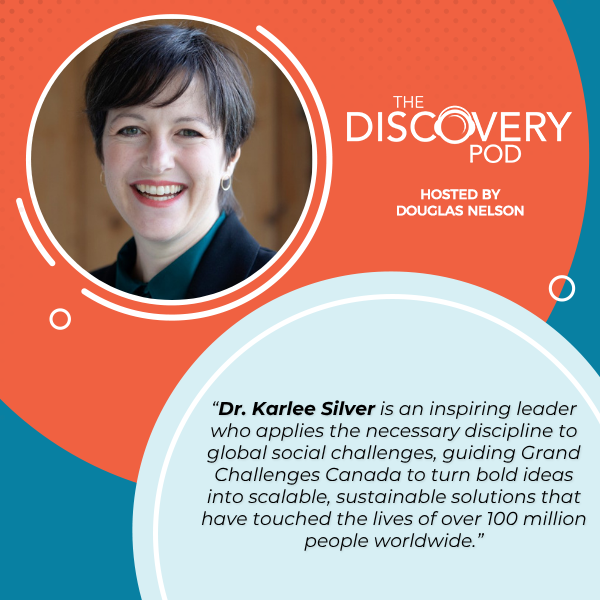
In this episode, we sit down with Dr. Karlee Silver, President and CEO of Grand Challenges Canada, an organization that has marshaled over $500 million to support game-changing ideas, touching 100 million lives globally. Dr. Silver challenges the conventional view of innovation, defining it as a broad spectrum that includes social and business ingenuity—not just technology.
Discover their unique platform approach, which focuses on identifying critical barriers and mastering the discipline of making the best next investment to move an innovation along. From attracting “unusual suspects” like an Argentine car mechanic who developed a life-saving birth tool, to building a nationally owned “Uber ambulance” system in Tanzania, learn how Grand Challenges Canada systematically de-risks bold ideas so they can achieve massive, sustainable impact at scale.
The advice and conversation can be applied to social profit organizations across the country and the globe, offering a blueprint for redefining what social profit innovation looks like.
—
Listen to the podcast here
Redefining What Social Profit Innovation Looks Like With Dr. Karlee Silver, President & CEO, Grand Challenges Canada
I’m joined by Dr. Karlee Silver, President and CEO of Grand Challenges Canada. Karlee’s been with the organization in many different roles since its inception, and this organization has secured more than $500 million to support innovations in low and middle-income countries, strengthening relationships with partners and funders around the world. To date, Grand Challenges Canada innovations have touched the lives of more than 100 million people around the world.
In this episode, she talks about the learning curve of building a platform of innovation, de-risking that innovation so that others can join the journey, and the discipline of making the best next investment to move an innovation along. Her stories are about innovations solving global challenges and addressing global issues, but the advice and the conversation can be applied to the work of social profit organizations right across this country. Please enjoy my conversation with Dr. Karlee Silver.
—
Welcome to the show, Karlee.
Thank you so much, Douglas.
It is a great pleasure to have you on the show. From afar, looking and learning about Grand Challenges Canada, the unique way you approach problems around the world, I think, can inform a lot of the work that happens in our social profit sector here in Canada and beyond. Really looking forward to sharing that and sharing the great work that you and your colleagues are doing there. Let’s start with the hard question right off the top, Karlee. Tell us a little bit about Grand Challenges Canada and how you do your work.
Grand Challenges Canada’s Mission And Definition Of Innovation
That’s great. I’m excited to talk about it. Grand Challenges Canada is really focused on one big problem, that is where you are born still shapes the chances of living a long, healthy life, and too many proven solutions that can address this fact actually never reach the people who need them most. What we do is we find really bold ideas, and we back those ideas and support them to move from a proof-of-concept stage through to real-world impact at scale, and we do it against very specific challenges.
One thing I want to say off the top is many people think of innovation and they think of AI, and they think of digital, and they think of like really shiny objects. I think it’s really important to make sure that innovation is seen as a really large spectrum of new ideas. It’s social innovation, it’s business innovation. It for sure includes science and technology, but there’s a lot of it that has to do with translating what we know to be good practices into real solutions.

Social Profit: It’s important to recognize innovation as a broad spectrum of new ideas—social innovation, business innovation, and, of course, science and technology. Much of it is about translating what we already know to be good practice into real-world solutions.
My head goes to a number of questions based on that. You said, “We know the answer,” that, “There are things that we know that are available that could help people that aren’t able to reach those people.” I’m going to ask you second about the mechanism for how you change that. First, how frustrating is that?
I don’t know if it’s frustrating or it’s actually really hopeful because when I move through the world after doing this work for many years, when I move through the world and there are a lot of challenges that we see out there, I actually feel really fortunate that on a day-to-day basis. My main job is finding people who believe that tomorrow can be a better day than today and have the way to get there, and that our whole point is how do we back them to do that? I don’t think it’s frustrating at all. It can be frustrating what stops them from getting to those outcomes, and that’s what a lot of our work is about. We’re plugging away on that, too.
More than plugging away. You’re offering a very unique, very long-term approach to a lot of these big problems facing humanity. Walk us through that approach. You identify these areas, and then what?
Identifying Critical Barriers And Attracting Unusual Suspects
I think even on the problem identification, we spend a lot of time doing it. It’s not just any old problem that will do. It’s what are really critical barriers that are between where we are and where health or social challenge needs to get to. Defining that at the right level is actually part of the skill of doing this work and doing it well. We’ve had some really good ones, and we’ve had some that have been not so good at being able to define that challenge. You do that really well, though. The first part we do is to essentially let a thousand flowers bloom, put out a competitive call for proposals worldwide and ask for how people would address this critical barrier from whatever vantage point that they come to.
You do it well. A Grand Challenge can really attract people who have never been thinking about this problem before and attract them into it from their own perspective and their own skill. One of my favorite examples of how far you can reach is in a maternal and newborn child health call for proposals, Saving Lives at Birth. We actually had an Argentine car mechanic who came up with one of the most brilliant ideas that he actually saw by looking at a YouTube channel on a party trick of, “How do you get a cork out of a wine bottle with just a plastic bag?”
That he extrapolated into, “How do you get a baby that is stuck in the birth canal out of a woman in a way that is much better for the baby and the woman than forceps or vacuum?” really cool things. That’s our ideal, is we find really unusual suspects out there that bring brand new ideas to the table. We give them a bit of money and a bit of time and we let them test their idea. They come back to us, a year or two years later, and they say, like, “Yeah, it really worked,” or, “No, it didn’t really work at all but we’ve learned all these different things and we’re going to go try something different.”
Those are amazing too. Failing fast, failing cheaply, that’s all part of our game. For the ones that really work, we then start looking less like a granting agency and much more like an impact investing shop. Our team works with those innovators to figure out what are the capacities they need to build for their team, where does the solution still need development and how are they going to test it and get it through regulatory approval if needed, and then what are the actually viable paths to scale and sustainability, imagining that this solution works.
How do you start testing those rather than just hoping if we do it perfectly, put all the data out there, that it will come, the right person will see it and buy it. Unfortunately, that’s not the way the world works. We walk through innovators over a period of time in order to help them come up with scalable and sustainable impactful solutions that graduate from our platform are going concerns long after our last dollar is spent.
Thank you for that very vivid imagery and your example of the Argentine car mechanic. Before we get to the impact investing, which I promise we’ll come back to for our readers, what I’m curious, what really piqued my attention as I was getting ready for this, was how do you identify the problems? One of the truisms of our sector is that the social profit sector is often dealing with the knottiest problems of our society or of our globe, because if there was a straightforward for-profit solution, it would have been found.
In the Canadian context, if the government had a solution, they would fund it and it would be solved or probably for more than we thought it was worth, but they could figure it out, government does good things. We’re left in-between space where the solutions aren’t obvious and sometimes defining the problem is what gets in the way of organizations coming up with those solutions. How do you know you’re not treating the symptom, designing around the symptom versus the problem that’s at the core of the issue?
Defining Critical Barriers And Consulting Frontline Workers/Experts
This is where some of the art is. It’s not something we do in isolation. The processes we use to define these different challenges can include a lot of different voices. The most recent challenge we’ve identified is the largest challenges in health as a result of climate change. The main input for that was the world’s largest survey of frontline healthcare workers from all over the world, who told us, “What are they seeing at their primary healthcare clinics as climate change is becoming worse and worse? What are they identifying as the biggest problem?”
That’s where our starting point was. There’s a refinement again to make sure that it’s not too specific, it’s not too high-level, it’s not too near-term, it’s not too far-term. The main thing we’re trying to find is something that is a critical enough barrier that if you remove it, you’ll actually have a free or a more improved path to your solution. Examples of this in the past have been like often, when we think about the huge burden of mental health illnesses the world over, there’s a big problem that exists with actually people seeking care and receiving care at the time of need.
There’s also a really large problem with the fact that we wait too long, we wait until mental health issues are issues rather than intervening early at the time when we know most mental health issues start developing in young people, late teenagers, early twenties. We have a challenge right now that’s specifically focused on how do you promote mental health and prevent mental illness in that critical period of youth, that we know if we can get that right, we’re actually preventing a lot of problems rather than necessarily trying to treat them.
We wait too long. We wait until mental health issues become crises, rather than intervening early, when we know most challenges begin developing in late adolescence and early adulthood. Share on XYou mentioned that you work with others to help identify these issues that you take on. What does that look like?
Yeah, so as I mentioned, the large survey could be one. We did that with the Geneva Learning Center. We have done some in the past where we engage a series of experts around the world who voice in what they think the critical challenges are and then there’s like a voting and consensus process that goes underway. Many of these have been very structured to make sure that you’re getting voices from different levels of society.
We hosted the Indigenous Innovation Initiative for about eight years, and in some of the processes of evolving that to the Indigenous communities here in Canada, it was evolved into something we called the three-stranded basket and it wove together experts, so that would be like your academics or your doctors.
It wove together youth because it was a youth-focused challenge, and it wove together community support staff who were actually surrounding youth at all moments and so could observe the biggest challenges from a different perspective. As the name implies, you’re essentially weaving those three perspectives together in order to come up with very simple problem statements.
Are the solutions ever more complicated than the problem statement?
Some of the most impactful ones are the most elegant. At least on the surface. One of my favorite ones to talk about at the moment is essentially an Uber ambulance, and it was developed and started being developed in 2013. If you put that in context, Uber only started coming to Canada in about 2012. This was in Tanzania, where there was no Uber at the time, and it was still a very nascent thing here in Canada as well.
I remember early days with our investment committee getting this proposal from one of our team members saying, “We think we should deploy community drivers to help deliver women at the time of birth to health facilities with their cars, instead of trying to get to buy more ambulances in a system.” Tanzania only has about 30 ambulances for the size of population that’s the same as Canada. Trying to figure out how can you actually have emergency transport services when you’ve got that limited amount of resources.
Fast forward, that started in one little area. It is now a nationally owned solution that supports about a thousand women every month being transported to facilities. It’s a hotline, so it’s the equivalent of our 911, it’s 111, and when anyone phones that from their phone, they get dispatched right into a nurse who then can figure out what is the need of that person, that woman who is giving birth or maybe just has given birth, make sure that the transport has the right supplies.
Once the delivery is made, like literally the person is delivered to the healthcare clinic for maybe delivery, the government will pay that driver just as Uber would pay the driver. Really cost-effective, it’s using the resources in the system better, it’s owned by the national government and provides emergency care immediately. That’s one that when you think of it, you’re like, “Why didn’t we use that more here too where we don’t have ambulances and some of these things that we take for granted as the only way to do things?”
You do have a flair for great imagery in your examples. Let’s talk about the social impact investors. The working with partners and colleagues to define those problem statements, putting out a call to action, evaluating, a process of evaluation, what you’re going to do, you make those initial investments, they come back a year or two later, “This is working,” or, “We think this could work,” or, “We’ve got something here,” what happens next?
The Shift To Impact Investing And De-risking Innovation
Our amazing team then gets paired up with innovators and figures out what is the next step where we can take this solution and also the team, the humans that are behind it, give them the capacities and the opportunities and things they need in order to get to the next level of their journey. We will work that up, make sure that we can fund pretty much anything but buildings, and so it might be marketing research that they need to do, it might be actual clinical research, it might be hiring more team members with different capacities than they have, strengthening their board.
There are all sorts of different things that our team would look at to figure out where on their developmental journey are they and what is the best next use of funding. We will use grants, we’ll use equity, we’ll use loans, we’ll use debt, anything that is needed in order to strengthen the position of the innovator to grow their solution but also to start attracting others on board.
We’re really comfortable with taking risk, we’re okay if things fail, but part of our job is as innovators move through our system, how can they, how can we de-risk them so that others who maybe can’t take as much risk can come in and start also supporting them because it takes a village to get innovations up to an impact, and so we’re happy to start that village, but we’ll need to pull other others in at along the way. That process, innovators will come back. We have some innovators who have been with us over several rounds of funding, so it’s not a one-and-done, but it also is always designed that they’re stronger when they leave us than when we found them.
I really think there’s so much value in unpacking that concept of best next investment required. Whether it’s in the social profit sector here in Canada or the work that you and your colleagues are doing around the world, that sense of, “This is where we can this is going to make the biggest difference next.” You have had experience of seeing a lot of those best next investments. What are the characteristics of knowing this is the best next investment?
I think some of it is what it’s not. It’s not something where if you put that same that money in, you’ll have impact during the period of time where that money’s flowing, and then the minute the money is done, the impact stops. That is not what it is. How do you make investments into things that actually can last beyond or take the organization or the solution in a different direction to make it stronger? That’s why often, when people think about successful businesses and they think about innovation as part of that, it’s usually like 10% to 20% of an average business is spent on innovation.
We could get into that as to whether Canada’s doing that, but that’s what we’re trying, that’s what is a best practice. Part of that is because you need to try new things, you need to make sure that you’re still evolving. What we provide is that ability for organizations or people, entrepreneurs, to actually make those investments that if they work out, they are going to change the inflection point of your organization.
You need to try new things; you need to make sure that you’re still evolving. Share on XHaving been around this as Grand Challenges is evolved, how do you stay open-minded? I would imagine you see, “Oh, that’s not going to work,” or, “Yeah, that’ll work,” or, how do you as a leader stay open-minded to these moments of inflection that you’re making investments into?
Yes. That’s great. I think at my heart, I am a hopeful person, and so I think I don’t need that much encouragement. I’m also just like really delighted every time people come up with ways to address the problems in the world. I think that is shared by most of the organization in terms of like genuinely wanting to see these things succeed. I would also say, though that I’m also positioning it as, it sounds like maybe one person or a few people are making a decision. This goes through like the innovators who get through our process go through a lot of due diligence.
They have to show a lot of data as they get further into the process. At first, it’s just ideas and a way to test it, but they need to show evidence that it’s actually on the right track, they need to show if it’s a revenue-generating thing, they need to show revenue and or how that’s possible. Our investment committee is made up of a really diverse number of backgrounds of people, including those who come from private equity, those who have scaled innovations in the past, those who are clinical minds, and the questions they ask around that table are challenging.
There is an element where we’re constantly going back and forth between, “Is this a risk?” It’s always got risk, but, “Is this a risk that we should be the ones absorbing and allowing that risk to essentially be dealt with over the next few years, or is it too big of a risk that it’s never going to happen?” That’s the judgment call that’s always being made.
The Organizational Ethos: Operating As A Platform, Not A Fund
I was struck by the distinction that you make between being a platform, not a fund. What does being a platform mean in the Grand Challenges context?
We’re a platform because essentially, we can put a lot of different offers onto this. Our whole platform is designed to find and support and address Grand Challenges through innovation, but the way we do that has evolved over the last several years. Essentially, we keep solving the barriers that are just ahead of the most promising innovations that we support. What we were doing a few years ago doesn’t look the same as now, but our ethos and what our mission is remain the same.
Why differentiate it from a fund is while we hold a lot of money, we’ve just closed $200 million from the federal government, the Global Affairs Canada, and that we will essentially leverage about $2.50 or more per dollar that we received for the next five years’ worth of spending for us, but we are impact first. While we do design some to come back for commercial returns, that is not a massive amount of the work that we do or wanting to grow that actually as we get into more mature innovations it’s more and more possible to grow that, but we’re not a classic fund that is essentially time-bound and then spent and investors are expecting returns on.
You mentioned that ethos that’s carried with you from many years ago. Tell us a little bit about the origin story of Grand Challenges Canada.
This is one where I think you talk to different people and you’ll get different stories. The one that I’ve been brought up with, let’s say, is that our founding CEO, Peter Singer, wrote an op-ed after being involved in shaping the Grand Challenges in Global Health for the Gates Foundation. His op-ed essentially said, “What if we took a Grand Challenges approach? What if we used innovation to address some of the international development, the way we spend international development in Canada, as a way to get better outcomes and actually spark more economic benefits in both Canada and in low and middle-income countries?”
Some really far-sighted bureaucrat saw the op-ed and pitched it up the chain in government, and it found a champion in the late Jim Flaherty, the who was Minister of Finance at the time. It happened to be 2008 when oil prices were high and so there was a little bit of money left in the coffers. They protected about $200 million and strategically put it outside of government in order to bring some competition and to bring innovation into the space. Made sure that we could take risk from the get-go and weren’t confined by the government’s terms and conditions.
The Grand Challenges Canada was a custom-made organization, independent board of directors and everything sitting outside of government, but 100% at first was funded by the Government of Canada in order to fulfill this mission. We were left to our devices for a few years, probably in case it blew up and didn’t go anywhere. Over the last little while, because of the impact we’ve had and being very proudly Canadian in what we do, we work very closely with the Government of Canada on its policies and making sure that when they’re trying to test things out, we can be a testing ground for some of the things that are harder for them to do within the system.
You’ve been a part of Grand Challenges Canada for its whole life. Were you there at the beginning?
Yes, since a month before it started, I was the first hired as a consultant to help scope the initial Grand Challenges we would work on. At the time, I couldn’t really even sign a three-year cell phone contract and somehow I’ve lasted many years here.
Coming from an academic background, stepping into this space, what initially appealed to you about coming in and, “Let’s see what we can do here?”
I was really interested in the solution-oriented work. My phd was very basic science. I learned a tons of things technically and the work I was doing I found fascinating, but to do that in the long run, I would find it very hard to stay motivated. I did some research afterwards in Toronto with Kevin Cain, and he was really focused on a whole set of questions around, “Why do some people respond to an infection in one way, in a very serious way, possibly even death, and others are fine or might have a sniffle or two? What dictates that?”
While we’re very good at treating the bugs or the bacteria that come into our system, we’re not very good at turning on and off our immune system in order to prevent those really bad outcomes from happening.” The mechanics of that and finding out why and how and what possible, only got me so far and what I was really fascinated about was like, “How could we actually be really solution-oriented?” That’s what drew me to this around the time that I was looking to figure out what I’m going to do with my life, this organization was starting up. I chanced into working with them and it’s been here ever since.
As it’s grown, you’ve grown along with it. How is your view of these Grand Challenges or these big intractable problems changed over your time there?
I think that I’m more and more drawn to some of the challenges that are shared worldwide that aren’t actually ones that Canada’s like checked off its list already, but Rwanda and Laos and somewhere else is still like really struggling with. That’s why we’re zoning in on things like mental health, like climate and health, like areas that we haven’t addressed here fully either. We don’t have the full picture.
I think there’s some really powerful ways that in the last little while, Canada has welcomed people who have come from all over the world and are really linked in to economies and to communities all over the world that means that Canada’s at this interesting point of the innovation we could support, not only has a huge amount of potential to address in a very context-specific way challenges all over the world, but also has the relationships and the paths that they can be exported elsewhere.
I just see this possibility of that’s going more from, “How do we address some really serious health challenges?” to, “What’s the bigger role a platform like ours can actually play in a connected society where everyone needs to thrive if anyone is going to thrive?” What are the types of challenges that are remaining? They’re not like, “Here’s a one-shot drug we have to develop or one-shot vaccine,” like there are very few of those types of challenges. They’re complicated, they take a lot of people power, there’s a huge intersect with the possibilities around AI now, and all of that leads to this messy world that we’re going to have to keep building, though.
One of the things in the work that we get to do here at The Discovery Group with leaders that I find so fascinating is how different leaders find that balance between urgency and patience. Solving these urgent problems as you’ve described and the examples that you’ve shared through our conversation, and then recognizing that it takes time to develop the good questions, to develop the answers, and then what are we going to do about it? How do you think about that balance between patience and urgency?
Reflecting back, years ago, it was very much like, “Here’s the promise. We’re going to go do this stuff.” Now I’m able to say like, “We’ve reached over 100 million people with the innovations that we’ve supported.” That is translated into 30 million lives improved and over 100,000 lives saved globally. Underlying that is obviously a lot of data collection that we can understand exactly what our impact has been.
In that first instance where we didn’t have those results yet, because the time hadn’t elapsed, we developed a modeling approach, actually, so we could model out what the impact is likely to be if we take some assumptions. The impact of innovation is always in the future, so it allowed us to make decisions more confidently now, when you have to invest in innovation, knowing what the trajectory might be and what are the places that we could help innovators solve for. “How do we make those assumptions true so that that impact could come true?” There’s actually a lot of we have a whole process of how to do that that brings a level of discipline behind that exact question.

Social Profit: The impact of innovation always lies in the future, which allows us to make more confident decisions today—especially when investing in innovation, understanding its likely trajectory, and identifying where we can help innovators solve key challenges.
I was looking forward to our conversation. I thought, “I’m going to ask a lot of questions about de-risking because that is something that a lot of boards are dealing with and leadership is dealing with.” We missed it because we missed our window on that. Maybe we’ll have to do this again. Hopefully, we’ll get to do this again. Before we wrap our conversation, Karlee, what are you looking forward to?
Future Frontier: Helping Systems Adopt Innovation
I think the biggest thing I’m looking forward to now is our next frontier is all about how do we as a Canadian-based organization that has a huge track record of funding innovation help systems that are already at scale be open to and take up innovation to make what they do more effective. That’s a big challenge. I thought for the last few years if I looked around enough that we would find the people already had sorted that out and we could just work with them. Didn’t happen. We’re going to step into that place and hopefully lay the table for a different set of partners and innovators to come in and help solve that with us.
A Grand Challenge all in its own right.
Exactly.
Karlee, thank you so much for sharing the great work of your organization and some examples and a lot to think about for our readers in terms of how they think about identifying the problem and moving from those problems to what is the next best investment. Thanks for being on the show.
Appreciate it.