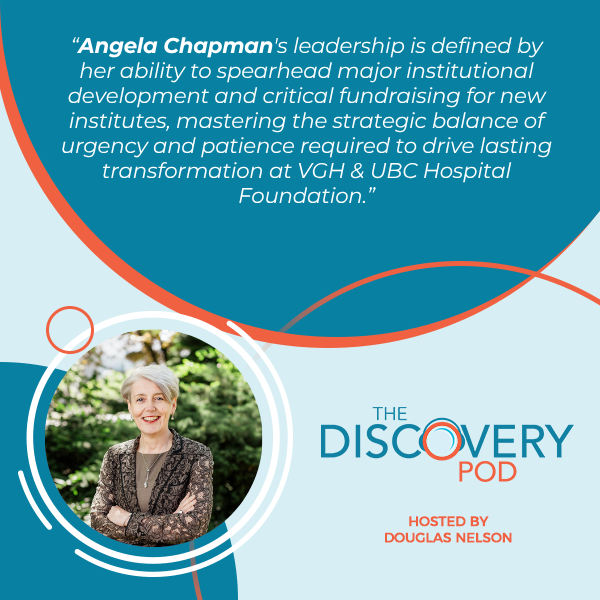
Is your organization truly ready for the big leap? While every leader desires transformation, many are unprepared for the complex commitment it truly demands. In this powerful conversation, two top-tier leaders who have successfully navigated monumental change—Angela Chapman, President and CEO of VGH & UBC Hospital Foundation, and Deb Lester, CEO of Covenant House Vancouver—share their candid stories. They delve into the distinction between simply wanting change and being strategically prepared to get big things done.
From spearheading a $65 million capital expansion and doubling bed space to leading major institutional development and fundraising for new institutes, Angela and Deb reveal the essential ingredients for long-term momentum. Discover the crucial steps: having a clear “why,” aligning your entire organization to a “North Star” strategy, and balancing necessary urgency with the often-whispered P-word: patience.
Tune in to discover what it takes to get big things done and set your team up for genuine, lasting transformation.
—
Listen to the podcast here
Preparing For Transformation: What It Takes To Get Big Things Done – The Discovery Dialogues Vancouver With Angela Chapman, President & CEO, VGH & UBC Hospital Foundation And Deb Lester, CEO, Covenant House Vancouver
What It Truly Takes For Organizations To Achieve Transformative Change
For this episode, we have a special one. It was recorded at our first Discovery Dialogues event in Vancouver on March 5th, 2026. It was a great evening, nearly 120 people in the room. It was an event centered on a question that we believe sits at the very heart of this sector. What does it truly take for organizations to achieve transformative change?
Often organizations say they want change, but aren’t fully ready for what that requires. That tension can quietly undermine even the most ambitious efforts before they even begin. At The Discovery Group, we have the privilege of working alongside leaders navigating complex and rewarding work every day. We also hear how heavy that responsibility can feel and how often leadership can feel isolating.
That’s part of why we created The Discovery Pod. To bring those real conversations forward, to share the honest stories, challenges, and lessons that help leaders feel more connected and more prepared for what’s ahead. Most importantly, let’s anchor in abundance. Let’s anchor in what is working rather than those ghosts of scarcity that hold so many organizations back.
At the Discovery Dialogues, I was joined by Angela Chapman, President and CEO of VGH & UBC Hospital Foundation, and Deb Lester, CEO of Covenant House Vancouver. In this episode, they share candidly what it means to be truly ready for change. They reflect on the challenges of transformation, how they’ve navigated them, and what it takes to move transformative work forward. Let’s get into it.
—
I’m so pleased to be here hosting this first Discovery Dialogue. It is great to have so many friends in the room for this great conversation about what it takes to get big things done. We were thinking about who we could have on this panel, on this recording, to talk about big things, what they’ve done, and what they’re doing. We were pleased. We had a very short list.
At the top of that list were Angela, from VGH & UBC Hospital Foundation and Deb Lester from Covenant House. They’re here. Isn’t it great to see them? This is so much more fun than doing it in the little room that Kirsten makes me sit in to record the show. We’ll have a quick conversation. We’re going to have questions at the end. When we get to the end of the show, you raise your hand. Kristen will bring a mic to you. You can ask that. Let’s get into it right away. I’m going to start with you Deb first. What has transformation meant for your organization in the last couple of years?
This is fun. Thank you. It’s great to see you all here. Covenant House Vancouver’s been through incredible transformation. If you’re not aware of what we do in the city, we support young people who are at risk of homelessness, who are homeless, or at risk of being exploited. There was a decade-long dream to increase impact in the city.
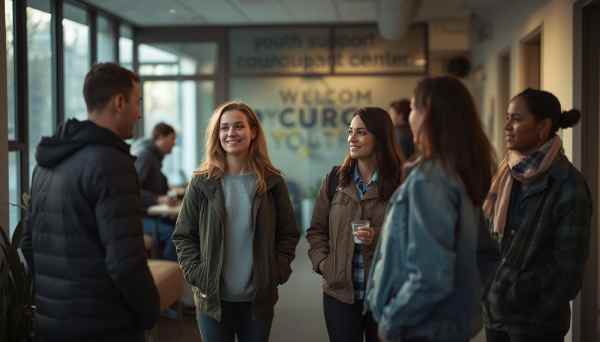
Transformation: Covenant House Vancouver has undergone incredible transformation. We support young people who are at risk of homelessness, experiencing homelessness, or vulnerable to exploitation.
That dream took place, as I said, over ten years. It was a $65 million capital expansion to build spaces and programs in the city to increase impact. That was the why. As it resulted, we’ve got two buildings on Draykin Seymour and one on Pender. That capital expansion was completed in November of 2024. We were able, with that expansion, to increase our programming.
If you’re not aware, we have a full continuum of care. Right from our outreach and our drop-in services all the way through to transition to independent living. Our goal was to complete the continuum. We added two new programs into the continuum. We also expanded our bed space for existing programs. We doubled our bed space with the capital expansion, with those buildings.
Before the expansion, our staffing was at about 179 staff members. We have 400 and counting. When you think about transformation, in 2020, we served 86,000 meals. We are at 160,000 meals this 2026 and counting. With that expansion, which we’re going to talk about, all of the work and all of that transformational thinking, the operationalization of that. That goes into it.
It’s not only building the buildings. It’s also what happens afterwards. How do you grow into the spaces? How do you right size the organization, all of your systems, and everything to keep up with the pace of growth? As I said, we’re at the end of the capital piece, but there’s a lot of transformational growth happening.
Angela, anyone who’s been on public transit knows that there’s been some big changes at your place. Other than a great new brand, what has transformation meant for VGH & UBC Hospital Foundation?
Spearheading Impact Investment And Attracting Support For New Institutes
Everybody knows a little thing called COVID. Starting from that period of time, we were in our first five-year strategic plan. We’d identified that one of the things we wanted to do, growing to the size that we had, was do an impact investment. In 2022, after much time spent planning for different kinds of scenarios. In 2021, the land across the street from VGH became available with a long-term care home on it.
We purchased that land with a plan to redevelop the site in support of our Vancouver Coastal Health partners. Just by way of explanation of our mandate, for those who may not know it. VGH, of course, with the VGH+, UBC Hospital, G.F. Strong Rehabilitation Centre, Vancouver Coastal Health Research Institute, as well as Vancouver Community. It’s a very broad mandate.
Some of the other things that have transformed quite strikingly. We’ve attracted support for the creation of two new institutes at Vancouver Coastal Health. The Mohseni Urological Institute, which is part of our $65 million urology campaign. We started off with a goal of $35 million and got $65 million. The announcement in June 2025 of a gift from the Dilawri family for the creation of the Dilawri Cardiovascular Institute. Those are two major initiatives that have transformed what we’re doing.
It sounds like there’s a lot more to come.
Just a little bit.
One of the things that we think about transformation, and we hear it if you’ve listened to the show. You’ve been on the show. What does change look like at your organization? Transformation always means big change. Big can be subjective within organizations and different kinds of leaders at different times in their leadership journey. I’m curious, what’s the difference between wanting big change and being ready for transformation? Have you seen the difference in your past experience, Deb?
Transformation Is The Strategy Towards A North Star
We’re at the heart between government and the business sector. We see what the needs are in the community. The more is always there. the more, in a lot of ways, is the heart of what that change might be. the transformational change, what comes into that is the strategy. The more isn’t a strategy, but the transformation is the strategy. It’s how do you align towards that North Star.
What is your why? How and what. How’s that going to look? How do you lead a team through that transformation? The more sits at the heart of it, but you need that operationalization of it all. It’s just to look at all that needs to go in your goals, your objectives, and then moving everything within that direction. We’ve certainly seen that at Covenant House and all of the change. The why was wanting more impact for young people. How do we make that happen? There was a lot of planning that went into, obviously, all the different components of that.
Angela, one of the things you’ve done such a remarkable job at your foundation is avoid it more as the only strategy while raising a lot more money. The more is certainly a part of it. How do you make that distinction between being ready and purposeful?
You said it well. In fact, that’s what I wrote down. Start with your why. That is where it has to begin. I made reference to our strategic plan because it becomes that North Star. Such an important part to taking that time because it is through these conversations with your Board, with your staff that you coalesce around that vision of where you’re headed.
There’s such an opportunity in that process to bring people along on a journey. As a CEO, you get hired because you have a vision of where things need to go. You’re evaluated by your Board on that all the time. The real challenge, at least for me personally as CEO, is bringing everybody along. For me, the tool of that strategic plan has been critical to that and taking the time to do that.
As a CEO, you’re hired for your vision and measured by it—but the real challenge is bringing everyone along to make it real. Share on XOne of the hardest things for leaders, particularly first-timer new CEOs. You see where you’re going. You see what the plan is. You probably see further down the road than your colleagues, whether they’re on the Board, your colleagues on the leadership team, or within the organization. How do you balance that urgency that you feel, the opportunity you see with the sometimes whispered P word of patience?
Are you asking me?
There’s a few people that work with you that roll their eyes there.
Do I have patience? To me, honestly, patience is forced upon us. You work in healthcare. You don’t have a choice. You have to be patient. A couple of different reasons for that. Some of it is just the complexity of it and the planning of it means that you have to be patient. It’s ironic that you’re saying this. I’ve had some discussions with people in government. That’s the word that has been coming up a lot. “Just have to be patient.” The balance, you’re right. We have to go forward. My team will know this. We turn around and go, “What’s our plan B? What’s our plan C?” Patience is balanced with more planning.
How To Keep Showing Up And Pushing While Being Told To Be Patient
There is that. You can be patient, but you can’t be quiet. You can’t stop moving. It can be hard to know where in the field, where in the conversation. Particularly with the government, that you should be standing or where you should be pushing. Particularly people saying, “Be patient.” You’re like, “I’m not going to go away.” How do you keep showing up and looking a little patient while you do it?
It’s having allies. To me, that gives me the ability to stand up and express what it is that’s needed when I’m being told to be patient. Whether that’s people on my team rallying or whether it’s my Board rallying, that to me has been critical.
For me, the urgency and the patience, you need both. The urgency is your call to action. What is it that’s creating whatever it is that you’re working on? It’s almost the tension between both of them. You’ve got to have a mix there. Your patience, as you said Angela, is your resilience. It’s how you are going to stick with whatever it is you’re working on through the different gateways that you’re going through, the different challenges and barriers. It’s incredibly important.
I’ll just add one more thing to that. You would feel exactly the same. It’s remembering the need. We’re doing this to solve a problem. What is that problem? If this doesn’t happen, then what?
Knowing why when people are saying, you’re going to keep talking because you know you’re there to solve that problem. One of the other things about transformation in the sector, looking around the room, knowing I’ve had this conversation with several of you. The changes in organizations take time. It takes genuine patience.
You see that it’s going to take a long time as a CEO. Sometimes, Boards don’t see as far. Sometimes they do. Sometimes management teams are wanting to execute. They’re focused on what’s right in front of them. It can be hard to keep the sightline high enough to be contributing to that long-term goal. How do you approach maintaining that momentum both with the Board and with your team over the long haul for the transformation in your organization?
It’s bringing the Board along with you. When you have that for your vision. It’s the rationale, the why behind it. If we’re talking about the Board specifically, it’s bringing them along for the entire journey. The team is the same. Everybody handles change. You know through change management that change happens for everybody at different paces and speeds.
It’s a lot of listening, bringing everyone along, and meeting everybody where they’re at. For the Board, they’re doing their due diligence in terms of risk. When you’re looking at your plan, as you’re putting it together. You’re flipping over all those rocks to make sure that you’ve got it all covered. You put them at ease and bring them along on the journey.
There’s an element that I’m not sure if I’m going to find the right words for it. It’s the empowerment of your people as well. Obviously providing that guidance, that North Star coming back to whatever it is, the strategic plan, the goal. Once that’s been conveyed and you know what’s embedded, empowering people to then take it forward in their way too.
One of the things that I’ve noticed in conversations and the work when I had a real job and getting to do the work that I do. You’re thinking about these issues related to change, both the immediate, medium, and long term, all the time as a CEO. Many of your colleagues on the leadership table are thinking about it quite a bit. Certainly not all the time, because they’re running the day to day. They’ve got specific responsibilities.
You’re bringing your Board together four or five times a year. Some of you, unfortunately, bring your Boards together a lot more frequently than that. That laugh was pain. You’ve got people who are fellow travelers who care a lot. They want to contribute. They want to add value, but they’re not thinking about it all of the time. How do you anchor your constant thought about it? You then realize you’re having to bring along people who do support but may not be paying attention and may need you to repeat things a couple of times?
That word patience that we used earlier is a big one. It’s across many different areas. Again, it’s thinking about where people are at in the change. Making sure that they understand the why, what the North Star is. listening to where they’re at and where are the hurdles, where are the barriers. I see it as my role is to figure out what those are and to remove those. As Angela was saying, let them do the work that they’re the experts in to move the vision forward. meeting them where they’re at, but then moving everybody in the same direction around that. Everyone’s at different stages at different times.
It’s just communication, right? Lots of communication, trying to keep people as close as possible, as aligned as possible. One of the things that we’ve done internally is have our Board assigned to staff members and work directly with them. That’s not on Board work. That is so that they engage with the community and they open up their Rolodex if anybody has one of those anymore.
Make introductions and all of that. It’s that having those additional lines of communication. One of the things that is difficult, it’s a lot. The job of CEO, running your organization, building donor relationships, managing all of those relationships on the Board. It’s a tall ask then to say, “To have a effective Board, you’ve got to meet with them all regularly.” It’s pretty hard to fit all of that in, so find other ways.
Leading Transformation As An Internal Vs. External CEO Hire
Both of you are so incredibly successful in the roles that you hold. You came to the CEO of your organization slightly differently. Angela, you’ve been there as the Senior Vice President and stepped into the role. Deb, you came back to Canada to do that. I’m curious. I’ll start with you, Angela. Coming into the CEO role from within has a lot of advantages, some unique challenges. In this context of transformation, you know how the organization is, which can make it easier and sometimes in some ways a little harder probably to lead that transformation. How did you approach that?
In some ways, COVID happened. I became the CEO in January of 2020. In a sense that created a burning platform right from the beginning. It is an interesting challenge. Looking back, as an incumbent, and I guess I’m only speaking from my experience. I don’t know if this would be true of every incumbent. I feel like I was a lot more conservative than I would have been if I had been brought in from the outside.
I felt as though I was hired for reasons of continuity and had to maintain some things the way that they were. That’s been my biggest lesson. If I were to do it over again, team and the audience, maybe try to move a bit faster on a vision. Again, COVID changed everything. It’s hard to say what I would do in that context.
For me, coming in, there was great change in the organization. The capital expansion was still on. I was getting reacquainted with my country again very quickly. It was about stabilization and listening and learning. As I came in and listened to where the organization had been, where we were, and where we were going.
Like you, I question whether, would we have moved faster on certain things? When I look back at it, I thought it was very necessary for all of us to hunker down. We talked about the great growth all around from programs to staffing to all of those pieces. It was just important.
I’ve rarely heard CEOs say, “I regret not moving more quickly.” I have heard, “I regret moving as quickly as I did. I wish I had in hindsight.” You’ve been through the change. You’ve changed in your leadership teams. You can say, “We could have done that faster.” When you’re in it, you need to take that time, take that deep breath, be persistent and patient at the same time. How has leading this transformation in your organization changed your leadership style?
Patience was at the core of just making sure that you do have that in spades when you’re leading transformation. Just making sure that you’re listening to everyone. You’ve got to go slow to go fast as we were talking about stabilization and that. Leading people along, again, is the change management piece. For me, watching the transformation, different areas of our organization, and the readiness at differing times. Making sure for a large organization like Covenant House that we’re looking at all of those different pieces. I learned a lot through that process as well.
Patience is at the core of real transformation—listen deeply, move deliberately, and remember: you have to go slow to go fast. Share on XI’d like to think that I’ve become more patient and thoughtful through the process. I certainly know that I’ve learned a lot about how my communication style affects others. I’ve become much more aware of that. Those have definitely been insights. It’s expanded my whole what I draw on for. It has, obviously, like any experience. These last few years have given me a whole set of new experiences to draw on to act differently or take different action.
You can’t help but change your leadership style as you’re changing everything around you and changing the organization you’re leading. Thank you for sharing that. One question I’ll throw in that I know isn’t on their notes, because I just thought of it. In the room, we’ve got leaders at very different stages of the transformation in their own organizations.
Many people manage change within their organizations at different paces. Both of you are still in that transformation in your organization. I don’t know that it’s ever done in organizations that are successful. You’re still in it. What advice would you give to a colleague in the room here, or one of our readers, who is starting the transformation as the leader in their own organization?
Your team is where it’s at. It’s the team, as Angela said, that’s going to move the vision forward. It’s the investment in your culture, in just being there to support the team. They talk about how we know in terms of culture and strategy, a culture is where it’s at. For any organization, that is just a number one priority. It’s the people that you are serving that are going to move the vision forward. Making sure that they have the tools to do their work. I see our roles in helping to remove those barriers by being aware of that.
Start with your people. Who’s around you? Who can make this happen? Communicate with them. Try to be as clear as you can. Try to ensure that you’re building together a vision. Not just imposing it, but building that together. When I look back in 2021, that whole aspect of culture, you cannot start to run until you get that culture right.
Can I ask you a question? You bought a building, a big one. You go into the meeting. You come out in your next leadership team meeting the next day. “Folks, we’re going to buy a building.” How did that land? It is such a big step. It’s so uncommon in our space for a hospital foundation to be doing that. How did you break the news to folks?
One of our very funny doctors has a saying. Dr. Saul Isserow always says, “It was an overnight success that started in 2016.” Something like that, some joke like that. This is an example of that. As a Board at a Board Retreat in 2018, we began thinking about an impact investment. That started the ball rolling. There was a task force formed. We began conversations. We did financial modeling. We imagined we were going to lease the land. We started to plan what the building was going to have in it.
All of that work was done when this amazing opportunity landed in our lap. From the summer of 2021, for nine months, it was like birthing a child. We were intensely involved in negotiating for the purchase of that land. There were different layers of knowledge about what was going on within the organization. Everybody knew that we were pursuing this as a plan, the whole idea of impact investment. The level to which some staff were engaged, obviously, in purchasing the building was enormous and others was much less.
They were okay with it?
It’s the “What next?” That’s the big question for all of us.
Looking Forward: Plans For Increased Impact And New Institutional Development
Speaking of what’s next, those of you that have been on the show or as you read on know the final question. What are you looking forward to?
We’re in a perfect place right with the capital expansion done. We’re looking at, as I said, our internal infrastructure. We know that homelessness in our city is on the rise. We know the toxic drug crisis is the number one cause of death of young people. For us at Covenant House, this is the time for us to continue to be part of the solution in our community and to serve more young people. With the spaces that we have, these are spaces that send the message to young people that they’re worth it and that we see you. We’re looking forward to increasing our impact, being part of the solution, and to serve young people as best we can in the community.
Such a wonderful mission. For us, lots of big ambitious plans. In those ambitious plans, which are about fundraising. We are a foundation. Our primary focus is fundraising. We see ourselves as trying to help VCH, our great partners at Vancouver Coastal Health. The real visionaries about how we’re going to change, say, brain health. How are we going to change cardiovascular care? How are we going to change all cancer care?
We are a foundation. Our primary focus is fundraising. Share on XWorking with them to come up with great visions about the transformation in that care. Investing in people and investing in their ideas, that’s something that gets me very excited. Secondary to that is space. That’s the whole program around our 900-block development. I am very excited about that. Just personally and professionally, being involved in something like that.
It’s been a new frontier for me. There’s been a ton of learning. It’s very exciting. There are a lot of big hurdles to cross too. There’s also something very rewarding in, I was going to say, tilting at those windmills. That would not be the right metaphor. Attacking those windmills is something rewarding in that.
Everyone in the room and everyone reading, both Deb and Angela brought it back to the why at the start. I know that’s what so many of you take into your workplace every day, every Monday morning, anchoring in that why. Sometimes, that why turns into “Why am I going back on Tuesday?” For the most part, it is relating to the purpose of the organization and the people that you serve. You are both such incredible examples of the work done well in our sector. I’m so grateful for you being a part of The Discovery Pod. Anybody have any questions?
First of all, thank you to all three of you for facilitating this conversation. I’m very honored to be a part of the audience. I’m learning a lot. Both of you have given exceptional examples of what it’s like to bring a team forward through transformation and change and the resistance you can face through that. As a new leader in my agency, I would love to hear an example of a time when you had transformation or change imposed on you and the internal resistance that you experienced from that?
I’ll speak more broadly about it. Often, it all comes down to values as well. For me, I’m trying to think of a time where I had the resistance, but it’s understanding the why. If the why wasn’t clear, seeking that clarity, and then obviously making sure always that there’s a values alignment as well. I would speak more broadly around that. Maybe not understanding clearly what the vision is. That’s why communication is so important and that change management principles.
You’ve got me thinking about so many moments in my career. I’m not sure this is the best. I’ve got a few different ones in my mind. I was working for a business school. I was the head of development and alumni for a business school in Australia. I picked up my whole family, moved to Australia for this job. That’s a context piece when you’re dealing with major change.
There was a decision that I wasn’t part of making, which is often not in that leadership position, but having it imposed on me. The school would be wound into the other business school. It’s a very strange setup, but at the University of New South Wales. That was the campus it was on. It was jointly owned by the University of Sydney. What had happened was University of New South Wales had built very similar programs in its other business school. They’re going to basically amalgamate the two business schools.
That faces you with the dilemma that that means two directors of development and alumni. Do you want to then go and fight for that job? My dean was leading this change and thought this was very important that this happened. He was the instigator of that change if you like, very much the leader’s decision.
for all the right business reasons, it totally made sense. for me personally, I did not want to be battling my peer for the job. you’re faced with the dilemma of whether or not you go with that. I made the choice to go for another job. I don’t know if that answers your question. I have many others. You made me end up going down memory lane on a whole different trauma.
Thank you.
The Necessity Of Planning For Operational Sustainability Post-Capital Expansion
My name’s Gil Yaron. I am the executive director of a mission-based nonprofit. My question is this. You spoke about these large capital expansions that you’ve both made. We’re at a point where we’re also looking at transformational change. My concern is around when you build this, how do you sustain it? When you are thinking about these types of projects, how are you also planning for the operational component? Keeping people employed, acquiring the goods that you need to feed all the additional people that are going to be occupying these spaces, that kind of thing.
It can often be overlooked because we think about the capital expansion as the buildings, the capital. It’s then what happens afterwards. Forecasting out when you’re looking at whatever that change is, whatever that growth is. That’s part of the transformation. A part of that plan is putting all of that in place and trying to forecast. What is that going to look like?
In our case, it was expanding on our continuum of care. We were going to add new programs. With new programs, you need the staff and all the other pieces, our facilities team, our food services team, and all of those pieces. It’s incredibly important to do that modeling and that forecasting. We had committees on a lot of the expansion looking at that so that we could be prepared. No even frontload in terms of what the team was going to need.
I think about our philanthropy team. How hard they worked in forecasting what was going to be needed as we worked through the fundraising part of that. The afterwards as well, trying to gear up for that. It’s incredibly important. That was a big part of the success. A huge part of the success is forecasting that. As I said, we finished in November of 2024. We’re still working on the expansion. It’s all of those internal pieces and forecasting. Your question is incredibly important.
If a Board and a CEO doesn’t have that sustainability plan, they should all be fired if they haven’t seen that far ahead. In our case, going back to 2020, one of the things that was clear was, we have a revenue model that is largely based on restricted giving. Operating revenue is a huge issue. That became a major focus of that first strategic plan, and continues to be a focus.
What happened in those years was we did a good job on that. Thanks to our community giving team. Thanks to diversified revenue streams that we have. We are very much outpacing our growth in terms of expense, which is where we want it to be. That gives us a lot more margin to think about having grants in the future.
For the moment, it’s just a big cushion for us as we do this big major project. The other thing is when we bought the building and we negotiated a lease for that space. We did all of that good financial analysis to make sure that we had more than enough. It was very good legal advice, financial advice, all of those things to make sure that this is sustainable.
One of the big challenges within your organization, there’s the dollars and cents that you’re both talking about and the need to plan. The other thing is often the capital project feels like it’s the end of the race. You cross the finish line and you’re done. It’s just the start of the next race. One of the challenges of leadership is framing that as the opportunity, celebrating that as a win. “We get to run this next race,” rather than, “I know you’re tired, but keep those shoes on. Have a juice box. It’s going to be a race.”
As leaders, that is a real challenge because you have to celebrate those successes. They are successes. You need your team. You need your Board and your donors, especially your funders, to feel like they’re contributing to this success. You got to go back to work on Monday. It’s about making sure you’re animating that space and taking advantage of that capital project.
Many of you in this room I know have had donors ask you directly across the table, ”You’re going to build this, how are you going to pay for it?” The Chinese Canadian Museum, everybody wanted to be a part of that and saw it as an important thing. Right before they’d say yes to make a donation, “how are you going to pay for yourself?” Melissa learned not to roll her eyes at that question. It is very real. As leaders, you definitely need to have an answer to that question.
The Transformation Of Leaders And Supporting Team Wellness And Retention
Rowena with the New School of Fundraising. I was just wondering if you could speak to your own transformation as leaders, particularly in the times that you’re dealing with. If you’ve seen a shift in what your teams have needed with wellness, health, leading to hopefully more retention of fundraisers, as fundraisers move around a lot. There’s a lot of focus on wellness and their well-being. There’s a lot of pressure on us. I was wondering if you could speak to what you’ve seen, your own transition as leaders, and how you’ve been supporting your teams through the changes.
When I think about the evolution of my own journey, I know I always tried to remember how things made me feel when I was going through change. All the different positions that I had right from the front line to when I went into leadership. I always maybe hold some of those pieces close and remember that. One of our pillars in our new strategic vision, which we’re calling the Journey Home, is on our people.

Transformation: One of the pillars of our new strategic vision—what we call the Journey Home—is our people. That’s where it all starts: with our people.
As I said, that’s where it’s at. It’s our people. We all come into these roles from our outside lives and bring them into the jobs that we have. That can be very challenging. We wanted to send the message to our team that they’re incredibly important to us. That work is never finished. How do we always look at the landscape of what our community of our workforce is potentially going through? How can we put everything in place to support them and to listen?
We do a lot of rounding through the organization. I go and I round with the teams. We have 24/7 operations, so all the shifts. I’m there on the weekends, the night shifts and that to give the team an opportunity to speak with myself and other leaders. Our town halls that we have. Lots of different mechanisms to celebrate the work, to give the team the chance to speak with us, and make sure that we’re hearing from them.
Having had the chance to walk through Covenant House with Deb, I don’t know how she makes any meeting on time. Around every corner, somebody’s, “Deb, hi.” They’re wanting to connect with you and tell you good news. Deb knows everyone’s name, exactly what they’re working on. It feels good just to be with her. I’m with her. I like her a lot.
She is the cool kid in school.
Angela?
I’m not the cool kid.
That wasn’t the question.
On that, I’ve embraced over the last couple of years I want to go to work. I want to have joy. I want to have fun. I enjoy the time I’m spending with my people. I’ve got a great leadership team. If there’s any transformation, it’s just having that faith that for me, that is the way it should be.
Final question.
Meghan Neufeld, Executive Director of Baby Round. You both talked about transformation being guided by the why and strategic direction being the North Star. I’m curious how you integrate lived experience or use your voice into a transformational process. Ensuring that people who are closest to the problem or to your why are being heard or consulted.
If I could start with the buildings, in the design of the three buildings in Vancouver, we had our youth voices that helped to inform the design. We call it a trauma-informed approach. In the work that we do, we look at all the different components of just the buildings and the spaces themselves. Again, so they could send that message to young people that they’re worth it and raise the bar for what youth services should look like. We were informed of that right from the beginning.
We have a youth advisory council or panel at Covenant House. They help to advise us on any type of programming or anything we bring to them. Bringing the other voices of young people in the organization to whatever it is that we’re looking at so that we can always ensure that we hold that at the core. We have a lot of other mechanisms for young people to also lend their voice to what they’re experiencing so we can best adjust and pivot as we need to.
It’s an interesting question for us because as a foundation, we raise money for our partners. The beneficiaries are the ones who are delivering those services. I’m just thinking about a lung program that we supported, Legacy for Airways Health. They have a patient advisory group. Patients are involved in advising on research, a whole number of different things. I see this played out with our partners a lot.
For us, the core relationships that we manage as a foundation are close in. Obviously, the beneficiaries are patients and clients. The close relationships would be with the physicians and also with our donors. Ensuring that we hear their voice in different ways, in advisory groups, having them on our Board, and having the community on our Board. Those are different ways that we would take that in.
Thank you very much. I know there’s more questions. Hopefully, you can ask them as we continue to circulate after this. I want to thank all of you for coming. Those of us at The Discovery Group, they get to work with you on a regular basis. We thought the idea was we’d bring all of our friends together. Allow them to meet each other and feel as good about the people they meet as the people that we get to work with. It means the world that you’re here. It means the world that we get to do our work with you, for you, and in support of you and your teams. Thank you so much.