Are you looking to transform your organization’s financial future and embed philanthropy into its DNA?
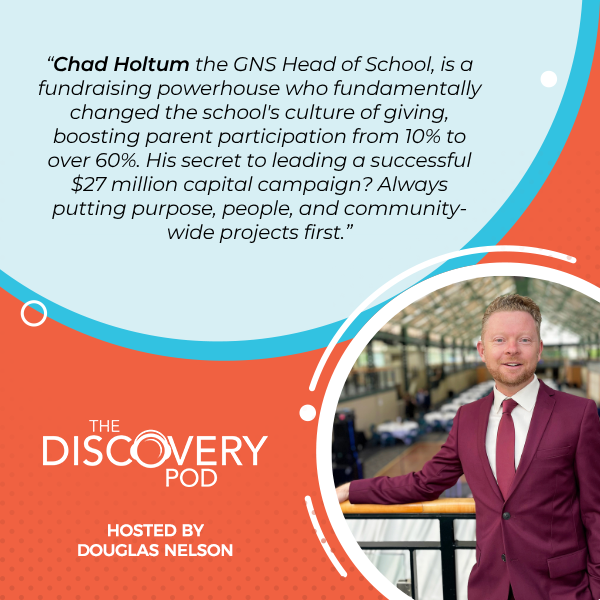
Today, we sit down with Chad Holtum, Head of School at Glenlyon Norfolk School (GNS), to uncover the secrets behind their monumental fundraising success. Chad shares the journey of transforming GNS’s parent participation in annual giving from a modest 10% to over 60%, culminating in the successful completion of a $27 million capital campaign.
Whether you are starting a fundraising program or planning your next multi-million-dollar initiative—like GNS’s forthcoming $30 million Momentum Campaign—you will gain actionable lessons, centered on three core elements: purpose first, person by person, and projects that benefit everyone.
Discover how a clear “why” and a commitment to authenticity can turn fundraising into a celebration of community pride and a powerful mechanism for lasting transformation.
—
Listen to the podcast here
Building A Culture Of Giving With Chad Holtum, Head Of School, Glenlyon Norfolk School
Chad Holtum’s Role And Key Successes At GNS
I’m joined by Chad Holtum, Head of School at Glenlyon Norfolk School in Victoria, British Columbia. With more than two decades of independent education and six years leading GNS, Chad has played a key role in growing enrollment, strengthening a cultural philanthropy, and guiding major initiatives that have transformed the school’s campus and community.
In this conversation, we talk about his transition from being a teacher to doing enrollment and head of advancement, and ultimately head of school for the last couple of years at GNS. Chad shares the elements of building a cultural philanthropy, starting with the purpose of education and the kids first, building that cultural philanthropy person by person, family by family, and ensuring that you’re building from a place of projects that benefit the entire community. It is a lesson from someone who has been there and achieved something very successful. He shares a little bit about what that ambition for the school and for the kids at GNS will look like in the months and years to come. Please enjoy my conversation with Chad Holtum.
‐‐‐
Welcome to the show, Chad.
Thanks for having me.
It is always a big day for me when I get to interview a head of school. I sit up a little straighter. I feel like I’ve been invited into some prestigious space. I’m in my best behavior. I want to show well, so I am sitting up straighter.
I appreciate that.
Our readers can’t see it, but I hope they can feel it.
I hope your blazer’s on right and your tie’s on straight. That’s important.
My number one uniform is ready to go. For our readers who don’t know, tell us a little bit about Glenlyon Norfolk School and what brought you there originally.
We fondly know it as GNS. We’ve been here in Victoria since 1913. We’ve had a long history here in Victoria. We’re a co-ed day and boarding school, predominantly day students. Over 90% of our students are local students, and shy of 10% of our students come from 21 different countries. They either live in homestay arrangements that are housed here with our family. That’s what’s a bit of a difference maker for us. We have two boarding houses, which form part of our boarding program.
Incredible story about the evolution of the school. Our readers are interested in the role that philanthropy plays in organizations. I want to get into that. For our readers, one of the privileges of getting to know Chad, whom I’ve gotten to know over the last couple of years. Anytime you talk to anyone in the independent school system anywhere in Canada, they know Chad Holtum. They’re like, “You know Chad. He’s great.” What you are known for is being the enthusiastic leader of the school and connecting that to philanthropy in a powerful way. I want to go back a little bit in your history. How did you become the symbol of fundraising for independent schools in Canada?
That’s going too far.
Take us back. You started as a teacher. Let’s go from there. You graduated. You’re teaching. How did you come to GNS?
I graduated from UBC with a Bachelor of Education. I should preface that by saying both my parents were teachers, and they taught in the public school sector. I went in to be a teacher. I’d already finished a commerce degree earlier than that. I was looking for a job. At that time, and this was the early 2000s, there were not a lot of teaching jobs. I applied for and looked at many different options. There was a little private school on Vancouver Island, and it was looking for a teacher and an admissions director. I thought to myself, “That sounds interesting. I have no idea what that means, but I’d love to check that out.”
I went over to Vancouver Island, where I’m from. I’ve never heard of this school before. It’s called Lakeside Prep. It’s a very small school. They said, “You can teach, right?” I said, “Yes. I have my teaching certificate.” They said, “Great. You’ve got a commerce degree.” I said, “Yes.” They said, “That’s interesting. Can you recruit students? Could you run an admissions office?” I thought, “I can try. Let’s give this a go.”
I ended up starting to teach. This is after I spent a couple of years as a TOC, Teacher On Call, in the Vancouver and Richmond school districts. There were no roles. There was no opportunity for me there. I took this job in admissions. That’s how my journey started in teaching and admissions in the private independent school sector.
What did you teach?
My kids find this a riot. I taught Information Technology 8, 9, and 10. I taught typing. We used to teach kids typing the home row. I taught career and personal planning. I even taught a PE class, which was a good time. I taught Grade 8 Physical Education. I was a Jack of all trades. The joke was that I taught in the mornings, admitted kids in the afternoon, and drove the school bus in the mornings. It was a very small school, but I learned a ton about schools, education, and more of the business side, if you will, of running a small, private, independent school.
From there?
From there, I was in Vietnam, recruiting students. It was a small boarding school. It’s the school I started out at, called Lakeside Prep. I ran into the head of school at Queen Margaret School in Duncan. He came over to my table and said, “I’d love to talk some more with you.” I ended up moving over to QMS. I spent a couple of years in admissions, and then they offered me the deputy head of school position.
It was there that we didn’t have an advancement office. We didn’t have philanthropy, but a lot of those skills are transferable. One thing’s important. You need to like people. I loved working with the parents. I enjoyed being in the school with the kids. I love the environment and the energy, so I thought, “This is interesting. I should explore this. Let’s see what this looks like.” I spent six years there.

Building A Culture: We didn’t have philanthropy, but many of those skills are transferable. One thing is important: you need to like people.
That’s great. You’re from Ladysmith, if I remember correctly.
Well done.
You’re very close to Duncan there. What pulled you down to the island?
When I left Ladysmith as a kid, I ended up going to get my Commerce degree at the University of Guelph. I moved off the island. I came back to Vancouver to work, and then I moved back over to the island to get that first teaching job at Lakeside. I spent six years at Queen Margaret School, and then Shawnigan Lake School asked me to consider coming there. I moved over there and spent five years at Shawnigan, doing a little bit of both. I was working in the enrollment side of the school, getting excited about what philanthropy looks like inside an independent school. I learned a lot there.
Coming into GNS as the Leader of Advancement for the Wonder Campaign or to build toward the Wonder Campaign. Was that the first experience you had where you were pretty much exclusively focused on philanthropy?
Launching The Wonder Campaign And Culture Shift
Yes. I came to GNS as the Deputy Head. I was doing many different things. One of them was looking after the advancement side of the school. It became apparent a couple of years into that role that the school wanted to rebuild its junior school campus. If anybody’s ever seen the junior school at GNS in Victoria, it’s the only junior school on the ocean in Canada. The board at the time wanted to go hard and go deep into what it would look like to reimagine that campus. We realized that we needed to focus on philanthropy. That was the launch of the Wonder Campaign, which was a $27 million campaign.
From a school that wasn’t raising millions of dollars every year, that was a big jump at the time. There’s the grown-up, “I work at the school. This was considered responsible. We’re going to be successful.” We’ll assume you’ve already said that. What were the nerves like for you as the advancement leader who was going to be charged with leading a $27 million campaign in a community that hadn’t done anything even close to approaching that before?
It’s very true. When I came to the school in 2013, our parent participation in the annual giving program was around 10%. The school was maybe raising a couple of hundred grand a year on the philanthropy side. Now, in our annual giving programs, over 60% of our parents give to the school. We had completed a $27 million campaign.
It was an interesting journey because I did not have a background in running a capital campaign before. That was not part of my past. I also had two kids in the school. I was balancing being a dad, deputy head, the fundraiser, and having that presence within the school community. It was a bit tricky. I was very fortunate that the board was supportive. In particular, the chair of the board was supportive. He wanted this to happen. We worked side by side. I felt like I had a partner in being able to drive that campaign forward.
Shout out to Chris Denford. A great campaign leader. People who come to this work and some of the younger folks in our sector come into fundraising as this is what they chose to do. They’re seeking to be fundraisers. Those of us who may be slightly older and a little bit more mature found our way here. In your story that you shared, you found your way to advancement.
One of the rules that comes with that is that to be a professional fundraiser is to be somewhat set back from the individuals you’re raising money from. You want to have a professional strategic advisor relationship with a lot of these individuals. What’s always fascinating to me in the independent school sector is that your kids are in the school. Your kids are in the same class as the donors. In your case, you’re also the deputy head. You have the authority of the school that you carry with you into these conversations. How did you balance that? How aware of those many hats were you as you went through any given Tuesday?
There was a very interesting start to it. The number one thing I learned in those early days was that it was all about education. What happens is that a parent in an independent school looks at the tuition, as you do, and says, “I paid this tuition. Why do we need the philanthropic piece to come into play?” I knew that early on, so I went with a group of our families and tried to start the conversation. I was explaining it and being super transparent with, “These are the fees. This is what we need to do. This is what it could look like if we had a strong philanthropy program.” Once I had a couple of the families understand that, all of a sudden, a bell went off. It was like, “This makes sense.”
If you looked at the parent participation by grade, once I could get those parents on our side, then the ball started to move. We went from 10% to 16% to 28%. We knew we had to get over 50% to change the culture. That was the goal. How do we change the culture of philanthropy here so that it’s not a black hole? It’s working towards something that benefits teaching and learning, and it’s going to benefit your kids in this environment.
Keeping that purpose at the center of the conversations. How different did the conversations with prospective donors become from starting at 10% and getting to 50%? Did that change how you were able to start those conversations or what you heard back from families?
The 50% Participation Challenge And One-On-One Engagement
Absolutely. There was one donor in particular, when I started to open up the philanthropy program, I don’t think he’d mind. It’s an alum of ours. They have a foundation. I went to them and said, “I’m new. I’m excited. I want to build a culture of philanthropy.” His name was Nick. He said, “Chad, how many of your current parents are giving to the school?” At that point, we were at 16%. He looked at me and said, “Call me when you hit 50%.” I went, “Challenge accepted.”
I went to say, “We have to change the culture. We’re only going to do that once we pop over 50%.” Once we did that, that family came in and supported the Wonder Campaign. We were able to get that momentum, and we were able to change the thinking of our other families to say, “This is a part of being a great independent school.” Great independent schools have strong philanthropy programs, and people could see that.
Great independent schools have strong philanthropy programs, and people can see that. Share on XThe pride they have in the school is expressed through their philanthropy. They see the role of philanthropy and creating a school to be proud of.
I get lots of people who ask me that question. They’re like, “How do you go from 10% to 60%?” My answer is always the same, which is one by one. We still have it. Every new family gets a meeting with me at the beginning of the school year. They’re not long. They have a chance to come in here, learn about the school, the IB program, the history of the school, and the culture of the school. Also, we have a chance to say, “This is why we have a philanthropy program at GNS.”
Much of successful philanthropy in any kind of organization, whether it’s social service, education, or healthcare, is about defining that margin of excellence. The role that donors play and the role that their gifts play is something like, “Here’s what we could do without philanthropy. Here’s what we’re able to do when our donor’s step forward, invest with us, and give.” In an independent school environment, I am consistently pleasantly surprised.
Defining that margin of excellence is pretty clear. It seems obvious. It’s like, “We want this margin of excellence for our school. We want this for our kids. We want our kids to be part of a community that has this.” The barrier to explaining the role of philanthropy is a little lower than in other places. People have already made a very large contribution through their tuition. How do you present that opportunity, or how do you define, “Thank you for your tuition. Here’s your receipt. It’s not a tax receipt. Here’s evidence that you’ve paid. Now, let’s talk about your philanthropy.” How do you make that transition?
It has evolved over time. When people are starting an independent school of philanthropy, sometimes, they would call me and say, “How did you start even to move that ball?” What I wanted to do is find projects that benefit all. What are projects where we can move the needle? Maybe it’s professional development for our staff and our teachers. How do we enhance teaching and learning? Maybe it’s enhancing the gymnasium for our athletics program or enhancing our music program areas.
It’s focusing on how this benefit kids, and then we’re able to drive that forward. It could be as simple as enhancing professional development opportunities. We have a wonderful donor who funds a significant portion of the school’s professional development because it’s going to make the educational program better.
I love that direction. We have other donors who are very forward-facing on the space side of it. It’s the third teacher. They’re like, “I want the space to be inspiring. I want the space for kids to be engaging.” We can work on that together to make that space even better. It’s tapping into the donor’s passion and then being able to deliver on it. If you say you’re going to do it, you need to do it.
It’s about tapping into a donor’s passion and delivering on it. If you say you’re going to do something, follow through. Share on XI want to spend a couple of minutes on your transition to head of school. To tie a bow around this part of our conversation, you’ve come back to three important lessons that I think our readers can take from this, whether they’re in independent schools or any kind of organization. How do you go from 10% to 60%? How do you raise $27 million? How do you prepare for this big next campaign we’re going to talk about in a few minutes?
You started with a purpose first. It’s about education. It’s about students. How do you do it with the people? It’s one by one. It’s having a conversation with the people, the individuals, and the families. It’s talking about their specific role, what matters to them, and how their philanthropy can make a difference, and then identifying those projects that can benefit everyone. It’s a broad, campus-wide, community-wide priority as a starting point to build that sense of collective action.
For anyone reading who needs to start a fundraising program or to significantly elevate a fundraising program, Chad’s advice is purpose first, person by person, and projects that benefit everyone. It’s great. Having had the chance to spend some time at GNS and with some of your donors, they talk that way, too.
Transitioning To Head Of School During COVID
That is a shared value of the volunteers that you have that are supporting your fundraising and supporting this next campaign. It’s very cool. Wonder Campaign is super successful. You run into a bit of a global pandemic thing, and in the midst of that, you get a new job. What I’m curious about is going from deputy head, leading the campaign, and then there’s a day in the calendar where you’re the head of school. Walk us through that morning.
It was COVID. The schools were closed. It was a good time. In March 2020, the schools all shut, and we went remote. We went online within two days. That was in March 2020. The teachers were phenomenal. The staff was phenomenal. We were able to transition into that space at record speed. We started delivering the curriculum right away. That ran right into the summer. I took over on July 1st, 2020, when we were in full COVID.
There are a couple of interesting moments there. One, I’m an internal. I had an element of credibility, I believe, in those early days. People knew who I was. I’d been here for seven years prior to that, so people knew. It was also a very rock and roll time. We needed to provide an element of stability. The first thing I did on day one was create a COVID task force group. A member of our board happened to be an epidemiologist.
It’s a wonderful human to have on your team. I brought her into play. The board also put together a support transition committee, which was wonderful. They came on board, and we worked together to figure out what this was going to look like as the regulations kept changing. If you remember back then, there were rules. We couldn’t be within six feet.
We were measuring the desk and how many kids we could get in the classroom. Two weeks later, we can cohort. Everything can cohort. We were like, “That changes everything.” Off we went again. It was a real time to bond the team and build trust with our parents, our students, and our staff. It was not your typical easing into the head of school role. However, it was a wonderful time to pull together as a group and lean on each other.
Do you remember the first time you sat at the desk?
I do.
What was that like? You would have spent lots of time as the deputy head and as a leader of advancement in that head’s office. What did that feel like?
It was interesting. The head of school I learned a lot from was Simon Bruce-Lockhart. He was head of many different schools in British Columbia, such as Mulgrave, GNS, and Shawnigan Lake. He said the day he retired, he grew two inches because the weight was so high on his shoulders. I would say yes, for sure. I feel that, but I’m so fortunate that I’ve got such a partnership with the chair of the board of the society and the chair of the foundation. Also, the senior leadership team here is phenomenal. I feel incredibly well-supported. I feel like we’ve built this dream team. We’ve been working at it for years.
I’ve never felt alone. A lot of people say when you get to the headship, you feel alone. There are days, for sure, when I feel like, “Oh my goodness,” but I’ve never felt alone. I’ve always felt incredibly well-supported. I would feel a little bit of angst, for sure, but tons of excitement about what we can do next with this school. I want to be part of that history of growing, enhancing the teaching, enhancing the learning, and doing what’s best for kids.
A lot of people say headship can feel lonely. There are certainly difficult days, but I’ve never felt alone—I’ve always felt incredibly supported. Share on XOne more question about this. As the staff leader of the campaign, you are a champion of the role of philanthropy. There’s an element, when done well, of also being a cheerleader for the school and for donors in general. There is greater weight to being head of school than head of fundraising. Sometimes, that cheerleader role doesn’t fit with the leader of the organization role so much. How did you find that transition of how you show up on any given Wednesday or Monday morning as you moved from that champion of philanthropy to head of school?
One of the benefits of having your kids in your school is that you get to see it through so many different lenses. I’m so fortunate. I say this to my wife every day. We are so lucky that our kids are part of this experience. I’m talking highs and lows. There are some things that they’re talking about, and I’m like, “I don’t want to hear it.” There are other wonderful parts that are so incredible. One thing I start our assemblies with all the time is that I love this school. I love what we do for kids. I love the way that we work with our families. I think it’s a very special community.
You’re right. Moving from running the campaign to being responsible for 185 staff and 750 students and being part of the culture was a bit of a shift. However, I was already in it, so I knew the responsibility that came with it. That was one of the things I wrote in the letter to the board when I applied. It was that my family and I understood the commitment that it takes to run an organization like this. That’s important.
People say, “When do you ever get a break?” I’m like, “There are breaks, but this is not a job. This is a lifestyle.” This is an everyday part of it, and you have to love that. You have to love being part of it. When I’m away for spring break, I miss it. I wanted to come back. I was like, “Let’s get this open. Let’s get going again. Let’s get the athletics, the model UN, and the debate going. Let’s continue to hone the IB program and all the wonderful things we’re doing.”
You’re still the head of school when someone approaches you in the grocery store.
It happens all the time.
I would imagine there’s not a lot of going to the grocery store in your sweatpants and flip-flops.
Especially in Victoria. This isn’t Toronto. This is not a major center in Victoria. There are 400,000 people. We’re a well-known organization here.
One of the things that struck me about the culture at GNS in particular, and any of our readers who are in independent schools or have worked in independent schools know, is that they’re all very unique. We are all unique, and that is what makes us the same. There are very distinctive cultures. At GNS, there is this connection to legacy, to where we’ve come from. You mentioned the original founding in 1913.
In Western Canada, that counts as an old school. There’s that connection of legacy that’s paired with such a consistent message about where you’re headed in the future. It’s balancing the past and looking ahead to the future. Maybe you could talk about how you connect that to the leadership of the school, but also to what that means for the conversations that you have with donors.
It’s an interesting history in the sense that you had Glenlyon, which was an all-boys school, and then Norfolk College, which was an all-girls school. They merged in 1986. There are different alums from different generations. In 1986, you had GNS, so there is this wonderful, rich history that goes back a very long time. You introduced the IB program when we brought it in 1996.
We’ve been running the IB diploma program for a very long time. It’s an important part of our school. We then went into the middle years IB program and the primary years IB program. It all has different stages as it goes along. One of the things that’s neat about it is that we have 3rd and 4th-generation students in the school.
One of the statistics I love to share with our families is that when I came to GNS in 2013, I asked, “How many alumni children do we have in the school?” I was curious as I was looking through the admissions data. We had sixteen, and we were about 660 students. With 750 students, we have 66 alumni children in the school. The alums are very supportive. They’re sending their kids to have this experience that they had. That’s an important piece of the story.
It sets up some nice fundraising conversations, I’m sure.
It’s super helpful.
Planning The 30 Million Momentum Campaign
Let’s pivot to that, looking forward. You mentioned the Wonder Campaign focused on the junior school on the beach. It is a beautiful campus. For anyone who’s been there, you know. If you haven’t been, drive by. It’s amazing. You’re looking at the senior school. Tell us a little bit about the preparations you have for the Momentum Campaign.
When we started this years ago, we recognized we needed to do both campuses over the course of time. The decision was made at the board level. It was like, “Let’s do the junior school first,” which was a smart play. Another little shout-out to Chris Denford. We started to work on that, but we also realized while we were doing that that the high school needed a rebuild as well.
Soon, we will be in front of the Ninth City Council in the City of Victoria. We’ve applied for a rezoning application to recreate the zone here that will allow us to build a new high school and an athletic center. It’s a much larger plan than that. Over the course of time, it will replace every single building on the property, less one. It is less the main theater, which is Denford Hall. Outside of that, it’s a very comprehensive plan over the next 20 or 30 years. In the short-term, what we’re hoping to build once this moves forward is our new senior school building and athletic center. We’re underway with that planning.
For any fundraisers or anyone who’s had to raise money for a capital project, what they heard is $27 million that was completed in 2022.
Correct.
In 2026, you’re in the leadership phase of a $30 million campaign.
Correct. This next one needs to be $30 million in order to push us there. We’re hopeful that, should the rezoning process go forward, we’ll be in a position to move forward with more of a public phase of our campaign in the fall of 2026. That’s our plan. With any luck, we will launch this moment campaign in the fall.
The key to success there goes back to what you said earlier in our conversation. It’s purpose first. The reason why you’re doing this is about education, the students, and what you can offer to those students and their families. You’re going to do it person by person. The culture at GNS of having a conversation with people is strong.
All of my colleagues here at The Discovery Group have heard me say this. We don’t have a neon sign on our wall in our office, but if we did, it would say, “Talk to your donors.” People are like, “Why isn’t it working? Why aren’t people giving?” It’s because you’re not in front of them enough. Go talk to your donors.
That’s a big part of the culture that you lead there with the advancement team as well. What advice would you have for someone who is coming into an organizational leadership role and needing to remake the campus of their school or remake their organization? What advice would you have for someone starting this role?
It goes back to the education part when you have the conversation. What’s the why? There’s more than one. There’s the why of the campaign, the why of financial aid, or the why of endowment. I remember sitting with a donor a couple of years ago. I said, “There are a million different things to support. I would never suggest that you not support other organizations. We should support them all. They have good causes.”

Building A Culture: It always comes back to education and the conversation around why. There’s the why of the campaign, the why of financial aid, and the why of the endowment.
“Why I’m suggesting you may want to support what we’re working on is that we believe in kids. We want what’s best for our students and for lots of different students in our community. Whether you want to support financial aid, capital building, or professional development, we have the ability to make that happen. We’ve proven it. Here’s what it looks like.” I would say one-on-one, 110%, and also being clear on the purpose and the why. Your donors will come along with you.
The beauty is that if you’re in a predominantly large day school, as we are, our donors come here every day. I can catch them in the parking lot. Be present. I walked into the dining hall to see one of the families I wanted to touch base with. It wasn’t difficult. I didn’t need to book a meeting. I booked one after, but I’m having that conversation. We have a wonderful relationship, and we’re going to continue to do that. On the boarding side, sometimes, you have to go to them or be strategic when they’re in town. I know it’s a lot of time and a ton of work, but that’s the only way that you’re going to be able to explain the why.
When you say it, it sounds simple, but it is challenging both in independent and other parts of the social profit sector. It’s challenging sometimes for organizations to articulate their purpose or to articulate it so consistently through the specific lens that donors are looking at it. I appreciate the advice there to do it, as well as the authenticity that comes through in both this conversation and the conversations you have with donors. As we come to the end of our conversation, I want to ask you my favorite question. What are you looking forward to?
I am excited about what this new structure, this new building, and this new capital plan we have is going to do for teaching and learning. I am so excited to see what the design labs, the social spaces, our social-emotional counseling, and our university guidance would do. I am excited about all of the incredible things, like the athletic center, the arts and service, and how this enhances the IB program and our experience.
I know we’re going to do it because I’ve seen it at our junior school. I’ve seen it in action. I know that it’s going to make things better as we drive forward. The key to all that is to make it fun. We have to make it fun. Engaging with donors in a way that makes things interesting and we have a little bit of fun along the way is how we continue to drive it forward.
That’s great. Thank you so much for taking the time to be on the show, and thank you for the great work that you do there at GNS.
Thanks for having me.