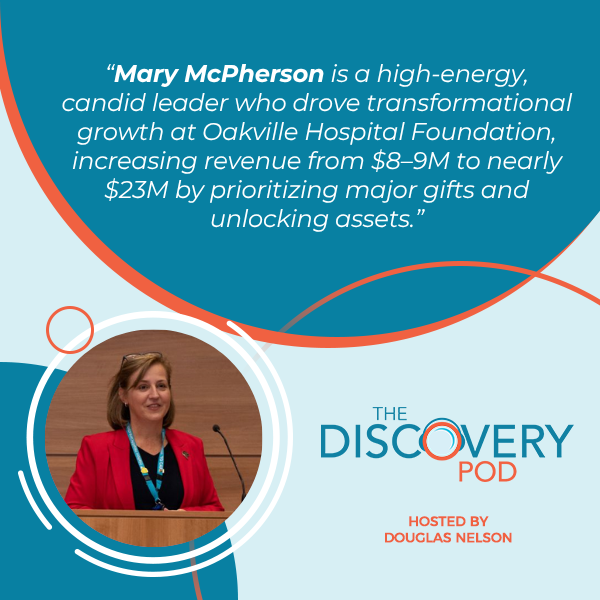
In an era where healthcare demands are outpacing traditional capital and public funding, philanthropic organizations must evolve—and fast. The Oakville Hospital Foundation is doing just that. Join us as CEO Mary McPherson shares the blueprint for their massive revenue growth, transforming from a post-campaign slump of $8-9 million to nearly $23 million annually. Discover how a strategic pivot to Major Gifts and innovative approaches to Planned Giving became the engine of their success. Mary discusses the vital importance of authentic donor conversations, a “no BS” team culture, and a pioneering method of “unlocking assets” to build sustainable, long-term funding for clinical excellence, research, and technology, proving that a margin of excellence is always within reach.
—
Listen to the podcast here
Transforming Healthcare Philanthropy With Mary McPherson, CEO, Oakville Hospital Foundation
We’re joined by Mary McPherson, CEO of Oakville Hospital Foundation, which supports Oakville Trafalgar Memorial Hospital, one of Ontario’s leading community hospitals. Mary is an award-winning fundraising executive with more than 25 years in the charitable sector. She has built a reputation for scaling philanthropy with precision while staying deeply connected to purpose. Under her leadership, the foundation has doubled revenue, expanded major and planned giving, and launched a transformative $150 million equipment campaign.
In this episode, Mary talks about leading the organization in the post-campaign environment after the new hospital opened and the challenge of creating urgency and identifying priorities with her healthcare partners. She shares insight into what it takes to lead a community hospital foundation, gives guidance on building the culture and the team, and the excitement that comes from being the head fundraiser of an organization on the rise. Please enjoy my conversation with Mary McPherson.
‐‐‐
Welcome to the show, Mary.
Thank you for having me. I am so glad to be here.
I’m looking forward to sharing the story, the progress, and the daily operations of Oakville Hospital Foundation with our audience, having had the chance to get to know you and your organization a little bit. For our audience who may not be aware, tell us a little bit about the Oakville Hospital Foundation, who you are, and who you serve.
I could talk about this all day. We are part of Halton Healthcare. We are a community hospital located in what Oakville calls a town of 250,000 people. Halton, which is the region we are in, a little bit West of Toronto, is one of the fastest-growing regions in Ontario. Halton Healthcare is the hospital that we serve. We are situated here at the Oakville Trafalgar Memorial Hospital. Our bylaws are set up so that we serve Halton Healthcare, which has three sites.
It’s about fifteen sites, but three large sites. Which is the Oakville Trafalgar Memorial Hospital, the Georgetown Hospital, and the Milton District Hospital. We work to raise funds here in our community. We raise in the neighborhood of about $23 million a year. The hospital has been around for about 70 years. We’ve been around for about 40 years. We have a phenomenal board of about 22 individuals, 3 from the hospital and the rest from the community. It’s an incredible place to work. We have a great hospital relationship. It’s a very philanthropic community.
When you see all the stats from Stats Canada, you see that Oakville and the ten people who live here are philanthropic people, and they want a strong social network. They want a strong United Way, a strong hospital, a strong food bank, and a strong mission. They are keen to support hospitals at all. We work collaboratively with our colleagues here in Oakville. It’s an absolute pleasure to lead this organization.
It is a remarkably special place. This town of 250,000 people, which is no town at all. I know there’s been a lot of growth in the community. How have you seen your foundation growing alongside the community of Oakville?
Community Expansion And Foundation Growth
It’s been quite amazing. The building I’m sitting in opened a couple of years ago. For hospitals, it’s relatively new. The older hospital was one that was right in the middle of Southeast Oakville in the community. It was quite old when it moved. It moved up to this very large site of 50-acres. There was a lot of pushbacks in the community that the hospital was moving so far away from its original site. What the hospital knew when they bought the land that the community didn’t know was how quickly the community itself would physically grow.
It’s been quite a transformation since we opened the doors years ago. When they started the campaign, they were raising about $4 million a year. At the height of the campaign, they were raising about $16 million a year. When I got here, it was post-campaign. We did a couple of things in the campaign that we all laugh about now.
The person who had the job before me is a very good friend of mine, and we all laugh about it. There were a couple of errors that we made in messaging. We didn’t know. We talked about when we built our hospital, and it opened in 2015. That was the end of the story when it was the beginning of the story of a brand-new building and new exemplary healthcare here in Oakville.
When I got here in 2017, we were raising about $8 million or $9 million a year. We have COVID in between. In 2026, we’re going to hit pretty close to $23 million. We’ve seen significant growth from the community and significant support and investment from the community. That has been because of the healthcare that this place has been able to deliver.
It’s something that we see quite a lot in our work here at The Discovery Group. Organizations, particularly if it’s been a long capital campaign, and you’ve raised the money, and then it takes years to build, and you open. The opening of the hospital is seen as a finish line. For some, it is, but those of us in the know or in the biz here know that that’s in fact the next starting line.
I’m curious. You’re coming in at the end. You’re at this next starting line. You’re rearing to go as the new CEO, and ready to build. You’ve got a hospital partner, a board, and probably some members of your team who are like, “We need to chill out for a little bit and look at what we built.” How did you approach that as a leader coming into the organization?
Reinvigorating Post-Campaign Fundraising Strategy
It was an interesting time because not only did the foundation and our donors think that we were at the finish line, but the hospital did as well. It was such a huge project to go greenfield, build a brand-new building, get it up and running, and move the operations while the hospital is open to a new site. It was tremendous. People were tired, and they were like, “Thank God that’s over.”
What we realized is that it’s not over at all, and that we’re starting. Things are changing and becoming larger. When I got in here, I did a couple of things. We did a revenue review to figure out what we are doing well and what we are not doing well. Campaigns are a different beast from the kind of fundraising you need if you want significant growth. Significant growth is in major gifts, building that up, and planned giving.
Campaigns are a different beast from the kind of fundraising needed for significant growth, which comes from major gifts and building them up. Share on XWhen we did our revenue growth, we were punching a bit on the lower weight in planned giving. Our major gifts were good, but it was all campaign-focused. We did what we needed to do at the time. We did a lot of real estate fundraising. It was like, “If you want to put your name here, this is what it will cost. If you want to put your name there, this is what it’ll cost,” as opposed to thinking about it a bit differently, which is investing in the community.
We did a couple of things. We did a digital audit. We did a revenue review. We had some frank conversations with the team because a lot of people had been here a long time. They saw them, and they were tired. I had to get everybody reinvigorated in what the new would look like and what excitement would look like. We completed some of those things in 2018 and ‘19, and then lo and behold, we had the pandemic. That shifted everything. That’s a whole other episode. I won’t get into that.
We also had a great board. We’ve always managed to have a strong board, and we’ve always managed to have a good relationship with our hospital. We see ourselves on our board and in our organization as servants. We are serving the hospital. We are here to help them get what they need to get in order to move their mission forward.
With strong hospital partners that started to look at not only equipment, the building, and the bricks and mortar, we started thinking about the organization in a different way. We started to think about it in terms of our assets. We started to think about it in terms of the growth of our clinical programs. How could we support research? How could we support technology that by 2020 or 2021 was changing every three years at a minimum? We started to support programs in a different way. We started to support the organization in a more regional way.
For example, the mental health program, which serves our entire region. All three sites are situated here in Oakville. How do we build a sustainable fund that is going to support that program over the next ten years? They see significant growth from the post-pandemic mental health echo that we are seeing. We started to look at things a little bit differently. Honestly, I do think the pandemic helped us turn the page a little bit in a strange way. We started to look at each of our revenues.

Healthcare Philanthropy: We see ourselves, both on our board and in our organization, as servants. We serve the hospital, helping them get what they need to advance their mission.
We think about our organization as everyone is here to support the major gift fundraising. It’s not that the major gift teams are more important. It’s not that those people are more important. It’s not that those donors are more important. The truth is, in a shop that grows, and if you want to have that significant growth. It’s the major gifts, the transformational gifts, and the planned giving. Those are the ones that are going to drive the revenue.
You can have a million galas and direct mail. You can have all those things, and they’re all important parts. We changed the organization and how we think about revenue and how we think about each other. That was a little bit of a different shift because you have to get the right people on the bus. You have to get people who want to work as a team or as a group. We all rise, and we all fall. We are ride or die in Oakville Hospital Foundation, driving revenue.
We see, and I’m sure we’re the same as many shots our size, that 85% of our revenue comes in from 2% to 3% of our donors. What is the stewardship that we need? It’s a different kind of stewardship than, “Here’s your plaque that’s up.” It’s impact, growth, and investment. It’s how we took your money and how we used that asset in a way that makes sense.
Strategic Asset Unlocking And Sustainable Funding
We also had a board transformation during the pandemic. It was a little bit like we had been saving all this money for a rainy day. One of our board members said, “I think it’s raining. Why do we have all this money locked up when the hospital has all these needs?” Part of my role has been to look at our assets and try to unlock them in a way that makes sense for donors, the hospital, and our board. Our board is all about that.
When I report to my board every month, it’s not only about how much we raised or what we are working on. It’s what I have done to move the assets forward and how I have grown the pledges receivable, our bequest intentions, or all of those things that are raised now, but realized later. It’s how we are looking at the actual financial assets that we have to make them work for the organization, where the hospital needs that money, and how we do that.
Part of my role has been to look at our assets and try to unlock them in a way that makes sense for the donors, the hospital, and our board. Share on XCan you give us an example of what unlocking those assets for the hospital might look like?
We’ve done a couple of things. One thing we do every year is we call up our donors who have endowment funds with us. We talk to them about their funds, whether we could draw down more, whether they are interested. Whether they want to guard the principal, and where their interests are. We’ve had a couple of donors who have come forward and want to draw down more for the priorities that they see are important.
For example, we’re doing a lot of work in our emergency room. A lot of our donors see that as important, so they’re drawing down as much money as they can. We had one family that asked us to wind up their endowment, which is a whole other episode on how you do that. We’ve had that. We’ve also done things like growing funds and investing money, but we’re not endowing it.
I’m not a CA. Hopefully, I’m using the right words here. We are taking money, for example, from our mental health fund. Our goal was to start a mental health fund and grow it to $10 million. We invest that $10 million in a way that we want to draw down about $1.2 million a year for the next 10 years. That gives our mental health team a spending of about $1.2 million and a runway. We know they have $1.2 million coming in every single year.
What kind of programs can they build over the next ten years to expand their programs? What investments do they need? That fund won’t be here forever, we don’t think, but we’re trying to make that money work for us. We brought the donors who make significant investments in mental health, and they sit on a council. The hospital has a long say, but they weigh in. They talk about what they’re hearing in the community, and buy into what the hospital’s doing. We’ve done that for education, research, and mental health.
Thank you for sharing that. It’s such a great example. One of the things that I see in my travels is what I’ll call a concern. It could also be called a lack of creativity. in terms of the conversations that organizations are willing to have with their donors. That idea of building a $10 million fund to give certainty to your hospital partners to build something of significance and impact is a powerful donor story. I’m sure the donors respond to it quite well, particularly as you keep them engaged along the way. Rather than, “We need to raise $10 million, put it in an endowment, and allocate 4% a year,” it’s a very different donor conversation.
If you look at health care, and I can’t speak for the whole country. In Ontario, there are more of us. We’re sicker. We’re fatter. We need more healthcare. The capital hasn’t kept up the physical number of buildings and beds. We treat patients differently. Not every patient is treated in a bed. Sometimes, they are treated at home.
We have to be flexible in how we can grant the money to the ways that the hospital needs to expand their deliverings and their offerings to ensure we have the healthcare we need. The gap is growing bigger. Demands are enormous in Ontario. The cost of building anything has pretty much quadrupled since COVID. I’ll give you a quick example of that when we built this brand-new building.
There are 564 beds in this building. We added another floor, which is another story, that can be built out later. It’s a huge hospital, and our campaign goal was $100. They want us to fit out that eighth floor. That was approved in the Fall Economic Statement here in Ontario. That’s 111 beds we need to add. We’re building a little mini hospital right on top of our hospital. Our share is $50 million for one floor. It was $100 million for the whole building and $50 million for one floor. That’s how it has changed.
You and I both know that sounds like a bit of a deal. It’s only $50 million. I know one of the things you do very well is address the need for frank conversations or authentic conversations with donors. None of our donors, whether they’re in Ontario, Alberta, British Columbia, or anywhere else in the country, thinks that $100 million is going to solve healthcare. It’s one large philanthropic gift away from being able to be fixed. If that were true, it would be done, and we would be on to another set of problems.
When donors are actively engaging and giving very generously are when hospitals and their partner foundations are able to articulate the specific way in which philanthropy can create a margin of excellence. This is the difference that donors can make in the experience of people in this particular condition or particular community.
I’m curious how you sustain that conversation with your hospital partners. The need is so great that you could be raising money for anything and everything. Which would make it very difficult to raise money from your donors, particularly in your major gift model. How do you work with your hospital partner to make sure you’ve got the certainty and specificity necessary to engage donors in the priorities that you undertake?
Margin Of Excellence And Donor Transparency
We have an incredible relationship with our hospital partners. We have frank and candid conversations with them on a regular basis. Our hospital president is on my board. She actively participates in donor conversations, the good, the bad, and the ugly. She’s very comfortable coming when people are angry. She’s comfortable coming when people are happy. She’s transparent. They are all transparent. I can get anyone on my phone in five minutes that I need to talk to, a donor, or help us with some of those difficult conversations.
Our transparency continues with our regular updates and meetings. We’re always no more than a week away from talking to them about the next thing. They understand the limits to philanthropy. They also understand the passion here in Oakville. They understand what people want to see changed. It’s something like hallway healthcare. Your donation isn’t going to fix it in Ontario. It’s a bigger system issue, and that’s not going to fix it. We’re very open and honest about that, and our donors respond to that.
Donors are smart. They understand. They know that one hospital isn’t going to fix everything. It’s like, “Here’s what we can do with your money. Here’s what we can do now. Here’s what our commitment is to you.” We have a strong stewardship program, which is something we built post-campaign, where impact is shared on a regular basis. It’s not all sunshine and roses. Sometimes, what we have to report is not what they want to hear, but we’re like, “Here’s what happened, and here’s why.” Donors are forgiving. At least you’re transparent with them.
That was my experience when I was enrolled as a fundraiser and as a CEO. Particularly if you’re funding research and if you knew the answer, it wouldn’t be research. Sometimes, you don’t find what you’re hoping to find through the work, or the researchers don’t. Going to donors and being able to say, “Here’s what we thought we were going to find. Here’s what we found, and now, here’s what we’re going to do next.”
I have found a great willingness for donors to make that next gift to support the next step. Rather than being upset that the initial project wasn’t successful. Mary, I want to go to another thing you touched on, which is making sure you had the team for the structure and the model of your foundation. What does it take for someone to get a gold star from you as a member of the Oakville Hospital Foundation team?
It’s interesting. When I got here, there were two people in my second-in-command, who were my chief development officer and my chief operating officer. When I got here, what I realized is they were in the wrong roles. I switched their titles, their jobs, and their offices.

Healthcare Philanthropy: We have a philosophy of empowering people to be their best selves. We aim to remove barriers and create a working environment that supports them, but on the flip side is accountability.
It’s like an ABBA-style switch where you switch partners?
Yes, we switched partners. We did a lot of work. In the Enneagram, I’m eight. I’m very blunt. I’m a quick start. I move fast. I think out loud. I talk fast. Some people aren’t used to that. They’re not used to thinking out loud and solving problems. We have a philosophy that we want to empower people to be their best selves. We want to remove barriers and create a working environment that works for them.
Leadership Philosophy And Team Empowerment
On the flip side of that coin is accountability. You have goals, key performance indicators, and numbers to make. You’re expected to do that. It’s not a shot for everybody. For us, we like A-type people. We like people who are fast thinkers, problem solvers, and people who think for themselves and come to you with a solution.
When I got here, we did some coaching with me, my chief development officer, and my chief operating officer. Those are two of my favorite people on the planet. We have a wonderful relationship where we can tell each other, “Don’t say that. Say that louder. Stop talking now. Say that more.” We’re very honest. We also think differently, and I like that. We’re like a little triangle. We think differently.
We decided to build the office that we wish we’d worked in when we were 25 years old and when we were working mothers. It’s tough to be a woman working. You have kids and daycare. We decided to build an office where we were very flexible about flex time, comings and goings, where you worked, and where you chose to work. We don’t care as long as you make your numbers, hit your goals, be at the meetings you need to be, and collaborate where you need to collaborate.
We assign everybody roles. There was a thing a couple of years ago. Sheryl Sandberg had that thing about Lean In. We call it pushed in. Sometimes, we push people in, like, “You’re going to do this. You’re going to chair this. This is you now. Take it and run with it.” We have conversations when people join the team about what we’re like. We’re frank about the working environment.
If you do well, we reward people. We grow our own talent. We believe in management training. We believe in professional development. We believe in candid, honest conversations. We believe in rewarding people properly. We believe in paying people what they’re worth. We believe in promoting from within and making sure that you get the opportunity to shine in front of donors. We have an all-in, all-win philosophy. If we all hit the goal, we all hit the goal.
We don’t want competition from ourselves. We have enough competition out there. We want one cohesive team. We built with that philosophy, brought people in, and trained people up. We have a high retention rate and a phenomenal team. You can see it. When I got here, it was $9 million, and we’re going to hit $23 million. We have a goal next year of $25 million.
I have no doubt that we’re going to hit that. We have a strong belief in succession, so we are grooming the next group of leaders. We promoted two people to vice president. We have them. We send people off for formal training. The biggest part is that we are very candid with people. We are no BS, straight-out. We look everywhere for solutions with the team. We find it works quite well for us. It’s so far, so good.
Having had the chance to spend a little bit of time in your offices, I can confirm for our audience. That’s exactly what it feels like to be in the Oakville Hospital Foundation. There is energy and commitment. There is not a lot of wondering. There is a lot of action. It is impressive. How do you, as the CEO, sustain that level of energy, that all-in, all-win mentality? That must be hard, some late Thursday afternoons after a committee meeting?
I’m a very high-energy person. My husband’s retired, and he’s happy that I’m not. I have a lot of ideas. I’m an idea factory. I talk a lot. I move a lot. Interestingly, our hospital CEO, one who came in 2023, Melissa, is exactly the same. We’re little peas in a pod. I have an amazing board that supports me. That’s a key thing. My board understands their role to hire, fire, evaluate me, and be a sounding board for me.
We have some of the best board members I’ve ever had in my life who are not afraid to be blunt and frank with me, but always coaching me in the background. I don’t drink coffee or tea. I am naturally high caffeinated. I hope it continues forever. I exercise a lot during the week.
I have a very healthy family life outside work. When I leave work at 8:00 or whatever time I leave at night. I turn my phone off, and that’s it. I have a great team behind me. It’s a lot of fun. Sometime in the pandemic, they had to tell me to take a week off because I was here, 24/7. Everyone was like, “Too many ideas. Time for you to go home.”
It turns out, “If you’re not tired, we are.”
They were like, “You need to take a vacation now.” It’s a lot of fun to work here. It’s a high-energy hospital, too. There are a lot of changes and a lot of things going on. That drives me.
One of the hardest things about that high-energy culture is sustainability. Something that we hear on the show and certainly in my work with other CEOs is sustaining that momentum. It doesn’t sound like sustaining your momentum is the challenge. How do you make space for people who may need a cup of coffee every now and then, or may need a period of time for reflection before moving forward?
Since I am the way I am and I’m high energy, we bring coaches in and do a lot of professional development here. Once a year, we do a team thing where we use Enneagrams and Kolbe, and we talk about where everybody is. We say, “Not everybody is me.” Suzanne, who’s my chief development officer, is completely different from me.
Sometimes, it’s a problem where people are like, “I’m going to go to Suzanne. I need to think about this a little more. I’m going to come to you because I need a zest of energy. I’m going to go to Mandy because she’s a little more analytic.” We know and understand what each other is like. We encourage people to put their hands up if they need a break or they’re like, “I need to work at home on Thursday. It’s too much.”
We tell everyone, “You are the CEO of your own portfolio. Create your week in a way that will make you successful and calm by Friday when you go home to your family.” I don’t know if that helps, but we do a lot of talking about that. We’re very candid. They’re like, “I know you want to move forward quickly with this. I’m going to need a couple of days to think about it.” I’m like, “No problem.”
That candor goes a long way. In organizations where the leader or even the leadership team isn’t sharing with the rest of the team, or is waiting until everything is fully baked before sharing it outside of the CEO’s office. There’s surprise. People react with surprise. We’re not children, so surprises aren’t fun anymore. It doesn’t allow organizations to move forward.
I know you’ve done a lot of work inside your organization on what you call streamlining. How do you make things move more quickly? How do you reduce friction more efficiently? Going through that process, what have you learned that maybe our audience can take and apply in their own organization?
Streamlining Operations And Retiring Legacy Programs
There are no sacred cows. We’ve had to have hard conversations about things that we’ve done that we’ve always done that we stopped doing. For example, we had a gala here that went on for 38 years. It was a great gala. It raised tons of money, but that was not the direction we were going. It was taking a lot of staff time.
The people who were running the gala were getting tired. The cost per dollar was crazy toward the end. It’s not that it wasn’t a great event, or that we wouldn’t bring one back at one point, but it was time to retire it. We were very open and honest about it with the committee. Our last gala had a disco theme. We called it Doors Closing One Last Time. By total fluke, we did it in November of 2019.
It was true. The doors were closed.
Ours was a bit of a fluke that way. It is always surprising to me how hard it is for people to stop doing things. We all do things that we do for the sake of doing, and we’ve always done. When we say to people, “You don’t have to do that anymore,” it’s very difficult for staff to stop doing things. We did a couple of things to try to challenge that. We brought in the green lean machine, the whole process. We did that to go through some of our processes, and we got rid of some that way.
Generally, it is surprising to me how people hang onto things. Every year, when we do our budget, we have a word that we refer to think about the whole year, and as you’re doing your planning for your business plan and your budget. In 2025, our word was abundance. It was the abundance mindset like, “We can get there.” In 2025, we went from $17 million.
Our goal was $20 million, and we’ve hit $23 million. It was the notion of, “The gifts are out there. The donors are out there. You can do this.” There’s the thinking of their abundance. In 2026, we went to prioritize. Every week, do you think to yourself, “What am I going to prioritize, and what am I not going to do?” It is difficult to get people not to do things, especially A-type people. That’s what we’re working on.
There are no sacred cows. We’ve had to have hard conversations about things we’ve always done but eventually stopped doing. Share on XI hear it very frequently that organizations are going through a period of change. There are activities, whether it’s a gala, a way of tracking something, or a KPI that used to be important, that everyone realized was disconnected from performance. You’ve got to let go of it. You can come back 3 or 4 months later and find that someone’s still tracking it because they’ve always done that. It’s like, “You don’t have to do that.”
It’s like, “We don’t need to know.”
One of the things that we found to be helpful for organizations, particularly when it’s leadership teams that are having that. It’s spending a lot of time on what we’re saying yes to. The device is to write down what you’re going to say no to. Everybody is very bold on a retreat. They can be very bold in a one-hour weekly meeting even, but their courage shrinks when they get back to their desk to say no to it.
The organizations that we’ve worked with that are most effective at moving through change keep that focus on what we’re saying yes to. The readers will have noticed through the course of our conversation that you continually emphasize the growth, commitment, and partnership both with your hospital and your board.
What you’re saying yes to is very clear, and it makes it easier. It makes it simple but not easy for members of your team to say no when it’s so clear what they should be saying yes to and what they’re committed to doing. That pairs nicely with that abundance mindset that you were talking about. How do we help our teams to focus on what is most important and what is going to grow our organizations to help us achieve our goals. Rather than anchoring in the scarcity of, “I’m not going to do that anymore.” The noes get a lot easier if the yeses are clear, in my experience.
An interesting thing about our growth is that we haven’t grown our team that much. When I got here, we were 20 or 21. Now, we’re 24, but we have a couple on mat leave. We haven’t grown the team significantly, but the work we do and what we do every day has changed significantly.
Through all of this change, the growth, revenue, and strength of the partnerships, there’s a lot to be proud of, but what are you looking forward to?
We’re very excited at the hospital, and I think across all healthcare, that there is a lot of stuff going on with AI, the way people are treated at the hospital, the ability to treat more people, maybe not in a hospital setting, and how we as an organization can support that. Home care technology is exciting. Prior to this, they were run almost as three separate hospitals. Now, they are run as one Halton. All the clinical sites have merged. With that comes a lot of opportunities for fundraising in different areas we haven’t done before. We’re excited about that.
I’ll touch a little bit about our sister foundation, the Georgetown Hospital Foundation. We are working with them. Our boards have an agreement. We have a management agreement. Our team is managing the Georgetown Hospital Foundation as well as the Oakville Hospital Foundation. We’re still two separate entities and two separate boards. It’s been a great experience going in to see how other people do things, how we can streamline some things, how some things can’t be streamlined, and how we can find some efficiencies.
There are certain things that we can do or ways that we can duplicate things to make things faster. That’s something we started in September 2025. We’re excited about what that’s going to look like because our Georgetown site has been granted a huge chunk of land. At some point, that’s going to be a new hospital in Georgetown. There’s lots of excitement on the horizon about that as well.
You are an example for others to follow, both in your energy and your achievements. I’m so grateful for you making time to be on the show.
Thank you for having me. We are big fans of you. It’s always great to hear from people right across the country, ways they’re looking at problems, and ways they’re thinking about things to challenge us and make us all better. Thank you.