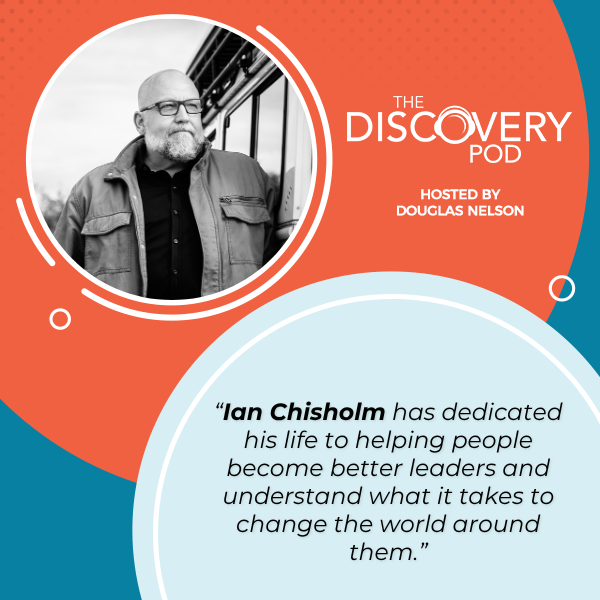
In today’s fast-paced world full of unnecessary noise and grind, mentors are expected to give the breather everyone desperately needs. Douglas Nelson is joined by coach, social entrepreneur, and leadership practitioner Ian Chisholm, who explains why mentorship requires silence and calmness. He discusses why mentors should create spaces where everyone can learn with intention, purpose, and gratitude. Ian also talks about the service-first mentality, the Cinderella moment, the Athena signature, Zugunruhe, and other powerful concepts that make mentorship an essential stepping stone towards becoming a more empowered version of yourself.
—
Listen to the podcast here
Quiet Champions: A Way Forward For Mentors In Turbulent Times With Ian Chisholm, Author
I am joined by Ian Chisholm, founding partner of Roy Group and author of Quiet Champions: A Way Forward for Mentors in Turbulent Times. Ian has dedicated his career to helping leaders strengthen their character, presence, and ability to guide others. Through his work as a coach, social entrepreneur, and leadership practitioner, he works closely with leaders to explore the idea that the most important work they will ever undertake is the work they do on themselves.
In our conversation, Ian talks about the journey of building the Roy Group, the incredible importance of mentorship in times like these, and why I believe that every leader in our social profit sector should read this important book. This is a great conversation with a master of his craft. Thanks to Ian for being a part of it. Please enjoy my conversation with Ian Chisholm.
—
Welcome to the show, Ian.
Thanks very much, Doug. Great to be here.
Ian, I read your book, Quiet Champions: A Way Forward for Mentors in Turbulent Times, and I was thrilled. I felt like it was a book written for me, and as I made my way through it, it read like a book that I wanted to give and have given to several other individuals in my life, leaders that I had the opportunity to work with, who really do embody that spirit of mentorship that comes through in your book.
I am just thrilled to have you on the podcast to jump in, answer some questions that occurred to me that are in the margin of my copy of the book, and to share this message with our audiences because I think it is so important. The first question really is the way here at the show, a really hardball question. It is coming right down the middle. Why mentorship?
I am just such a believer in the idea that nobody likes a know-it-all. Really? They do not. It is such a turn-off, and we all know it. What I do really like is the idea that a person can be a citizen of the world and pay attention to lots of things that are happening. If there is one thing that really draws your attention over time, and this is something that you really do know more than most people because you have been paying close attention to it for a long time, then you would be somebody who has really clear thoughts on one thing.
For me, in retrospect, that has just always been mentorship. It is just the thing that I notice happening in the community. My favorite TV shows have a strong mentorship theme. My favorite books have a really strong mentor character. It has to do with growing up in Saskatchewan and seeing the relationship between our neighbors and the generations intersecting, where Scott Carson’s dad was a mentor to my dad, my dad’s dad was the mentor to Scott Carson’s dad.
There is just a topic that has fascinated me for a long time. It is something that I think is a free resource in the community and in the world. Of course, it takes effort and time and probably some money too to pay for coffees. In essence, it is something that we can generate with some discretionary effort that I think is a massively effective force in a world where, particularly right now, it feels like Death Stars are being built in every corner of the universe. We’d better pay attention to the forces that actually make things better.
Death Stars everywhere, and we are all on Alderaan. That is the last Star Wars nerdy reference.
Probably not. Not if I can help it.
One of the things that really grabbed me about this concept is that you are someone who spends your time and is dedicated to your life to helping people to be better leaders, to be better at the work that they do. You chose mentorship, which is about being of service to others and having that connection to others. Rather than a traditional leadership book, this is “Here are the things that you need to do to make yourself better and to be better at what you do, to be better at your practice,” which there is value and certainly lots of space for that thinking and that work.
Embracing A Service-First Mentality
You are starting with, “This is how you can make the people around you better.” It just so happens that through that process, you are going to make yourself a lot better, more effective as a leader, and more grounded as a person. Talk a little bit, and maybe we are going back to Saskatchewan with this answer, but that service-first mentality that comes through both the personal narrative that is in this book and the advice that you are giving to leaders who are reading it.
In many ways, it was just logistical. There was a logistical need to write this book because when Roy Group, our company, works with organizations for many years, we have focused on the next generation of leaders from the organization. We would get to what my team and I call the Cinderella moment, where a young person, somebody of high potential, who is why they are on the program, pulls us aside and says, “I just wanted you to know I am really enjoying this. This is really the kind of leader that I want to become in the world.”
I just have to tell you, it is not the way the top table is acting.” At that moment, the footman turns back into a mouse, and the coach turns back into a pumpkin, and the fancy dress is gone. It is over. The magic is literally over. We spend a lot of time working with the senior team. Our line is, “We do not want to become mentors to your top talent. We want you to become mentors to your top talent.”
How hard is that to get that message through?
I am a little bit cynical about this. What is really hard is going to an SLT, a Senior Leadership Team, and saying, “You need to keep practicing and working on your leadership skills.” They do not believe that they have arrived. They have got the fancy office. They are a big deal. We just went with that. We said, “Obviously, you do not need to do leadership development anymore,” tongue in cheek. “This is not about you. It is for the kids.”
“We just need to give you a streamlined version of this, and there is a book, and we want to lift you up into what might earn you the word mentor, but the vast majority of our efforts will be with you on the kids.” They like that. Somehow, that just gets through any of those things that get in the way of a senior leader wanting to continue to work really hard on themselves. They end up working really hard on themselves. The secret is out, thanks to this podcast.
It is reframing to put them in that growth mindset or into a curiosity mindset about what they can do to help others, because that is what being a leader is. You help other people.
Mentorship is a natural extension of one’s leadership.

Mentorship: Mentorship is a natural extension of one’s leadership.
We did a live event recently for the show. One of the best parts of the entire event was that the best boss, one of my strongest mentors, came. I had invited her, and we talked maybe once a year, not even that frequently. Eileen McIntosh came to the event, and I was supposed to be doing hosting duties, moving everyone around, and talking. It was a great feeling in the room. I spent a lot of my time introducing Eileen as the best boss and my mentor. My mentor, my best boss I’ve ever had. She said, “If I were your best boss, I would tell you to go talk to other people now.” I read your book, so does that mean that I can put mentor in my LinkedIn description?
You are funny. You know that I have a rule about this. Something that we are very clear on, and there are a few words that meet this criteria, but we really believe that the word mentor in particular is a gift word. It is something that you cannot call yourself. It is something that other people will choose to use that word to describe the role that you have played in the story of their life.
If you buy that conviction, that is just an arbitrary constraint in language, but if you buy that, all the right people in the world get hungry to earn that word. To me, it turns on all the right people, even if some of them then go to LinkedIn and take the word mentor off their line. Just show, do not tell me, show me that you are that person in the story of people’s lives.
Why Mentorship Requires Calm And Quiet
That concept of a word, I think, is really powerful, and it is something that you earn from the people that you are providing service to, that you are in service to. That is a really powerful thought. It runs right through the social profit sector, and the servant leadership concept is a big part of it. As I read through the book, I thought time and again about the examples of the mentors in your life that you shared and the moments of mentorship. The mentors were not shouting. They were not standing at the front of the room.
It was often on the side or on the weekend, “You do not know how to do this. Let me help you figure this out.” As someone who was really all in reading this book and wanting to get better at this, wanting to be better at this, one of the things I took away was that mentorship is quiet, which is often the opposite of what people think a leader needs to be, standing in front of the room. How do you see leaders balancing the quiet and the loud?
It is interesting, Doug, at the book launches, we did a very simple, but very cool little exercise where we asked people to get into groups of four with people that they did not know. Three other people they had never met before, and each had the chance to share the story of someone whose name they would use, of someone who has been a mentor to them, and to just talk about what the characteristics, what the attributes, what the behavioral norms of those people are.
Of course, the pattern in general was that these are people who created space for me. You cannot create space for other people if you are taking up all that space yourself. It is that simple. It links in the crux of the book is this pattern, what we call the Athena signature. It is somebody who is very highly aware of themselves. They fully accept that the way they conduct themselves will create an atmosphere inside other people and can send a story this way or that.
A mentor cannot create space for other people if they are taking up all that space for themselves. Share on XIn combination with that really high level of awareness, their discipline with their focus, all of their focus is drawn to the experience of somebody else. When you are with somebody who is very aware of themselves, but does not need to talk about it, instead, they are prepared to create all of that space for you and to find out what your experience of being a leader is, whatever that is. Of course, that is the pattern that is woven through all of our stories about mentors.
Aware of oneself without being full of oneself.
A good one. That is it.
Was there a particular moment for you where you realized you had made that transition? Is it something you observed in yourself, maybe in a mentoring moment, or just that you had switched from that striving, eager leader, which can be very effective and certainly have a lot of success, to being that quiet influencer, having that self-awareness to be able to offer that to others?
That is still very much a work in progress. Interestingly, you bring that up because I think in many ways, I wrote this book for myself first and foremost as a real declaration to myself of this is the leader that I would like to become. I have not earned that word nearly enough as I would like to going forward. I am still on the side of trying to lead well, trying to get things done, and trying to make life better for my clients and my team. This book is a bit of a guidepost into the future of “This is the way I would like to age.”
You have earned the gift word, but you would like to earn it quite a few more times.
Just started.
The Role Of Gratitude In Mentorship
Just started might not be generous enough to you, but for our audiences, for leaders who really resonate with that concept of being of service to others and wanting to support the next generation or support peers through a mentor-like relationship. What is the first thing that someone needs to do to get started?
As with so many things, it is noticing what your appetite is, and it is not good or bad. It just is. In the book, we talk a little bit about this German idea of Zugunruhe, which is something that normally gets talked about with migratory animals, that there is just suddenly this appetite or these changes start to occur to get somebody ready for the journey ahead.
There is an inherent Zugunruhe that is in us all, where we realize, “We have worked hard, our days have been busy, we have done good stuff.” Now there is this other appetite that, in addition to our own story, we would actually genuinely like to help the stories of other people unfold in the best way possible. It is a very important aspect to pay attention to. It is built into us. I actually think it holds the community together, and the levels of unpredictability are soaring right now.
It begs the question, “Is there a level of uncertainty that our brains cannot handle?” Will we ever kind of hit a day where we just detach and go, “This is totally out of control, I do not know what is going to happen here.” In that context, I think anything that holds us together in community, mentorship being one really powerful strategy to do that, becomes increasingly important. The more people who notice that appetite in themselves, I think they should go with it.
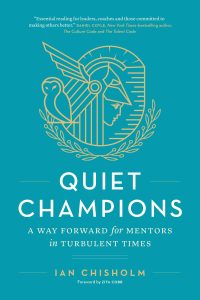
Quiet Champions: A Way Forward for Mentors in Turbulent Times
One of the thoughts I had throughout the book, which has really stayed with me, was the role of gratitude. Having grown up as a fundraiser and getting to spend time with professional fundraisers through my work and CEOs who are in front of donors asking for money, gratitude is something that has a lot of resonance. The concept of giving back, which mentorship certainly falls into that category. What would you say is the role of gratitude on the part of someone who would be the mentor?
That is interesting too. In many ways, this entire book was my gratitude for the people who have stepped up in that way for me. That is why I did not just write a book. I hope I did not just write a business book, but I took the time to share some stories of people who were just exquisite characters. They were all in there, right?
Yes. There are some laugh-out-loud moments, like the absurdity that this is like the grown-up thing that Ian is doing now in this conversation. The way you tell the story is so charming because you are often the butt of the joke in the way you tell the story.
No, it is so important. To go through the mental exercise around being, even if you are starting to enter that arena of mentorship, to take stock of the people who stepped up for you. Really make that list. If you can, let those people know. Absolutely to send them a note to say, “I just need to tell you that of all the people in my life that helped shape me this way and that, you have been a mentor to me.” I just think that doing that exercise and realizing how old you were when they stepped up for you, and then doing the math and saying, “How old are you now?” It’s very similar. Guess what? That bell you just heard ringing is for you. You’ve got to get in there.
Finding Success In Mentorship As A Practice
The other concept that I want to spend a little bit of time on is mentorship as a practice. The deliberateness that people can take, that leaders can take to this. It is not something you do as a one-off or once every six months, “I need to do a mentoring thing now.” It is a practice, and because it is a practice, it is something that you get better at. You can improve as you go through it, which was really encouraging to me. What is your advice to the audiences of this show or readers of your book? What do they need to bring to the idea of mentorship as a practice? What is the mindset they need to bring to it for it to be successful?
I would say two things. Your questions are great. You are making me think of places I have never been before. Number one is seriousness, and I do not mean seriousness with a stern look on your face. I mean, the way the French use the word serious, like it is the Tour de France, and you can tell in the morning tent who is going to win the leg today because of the way he showed up at breakfast.
Bring some serious attention and intention to any time in your schedule, you are showing up that way for somebody else. That is number one. Take it really seriously, no dabbling, be serious about this role that you are playing. Number two, do not do it alone. What a great combination. The practice is all about the people with whom you are learning how to do it. That goes against our mental model of mentorship, as “I am the protégé, and you are the mentor. That is the entire bubble.” That is not true. I should be introducing you to other people who need to meet you.
Mentorship is all about the people with whom you are learning how to do it. Share on XYou should be talking with other people who are playing the role of mentor to find out what is working for them. Maybe we all need to meet each other and have those kinds of conversations. Mentorship so clearly comes from the realm of community. Education might borrow it. Business definitely borrows it. The government might borrow it, but this is so old. This is fundamental. This is how we develop as humans, as having adults other than our parents take an interest in who we are becoming is as old as the hills.
I appreciate that frame. One of my takeaways from the book, I know you have done work with Sandy Richardson at Victoria Foundation, and we have had the opportunity to work with her and her team as well. One of the things that she has done so incredibly effectively and consistently over time is convening the community, bringing people to the table. She will bring the table, she will set the table, she will handhold everybody to come to the table and start the conversation, and she is really a servant of what comes out of those conversations in many really important ways.
I admire her and other leaders that I have had the chance to work with who do that so well. What you describe is that convening community foundations across the country can do, or organizations can do that within smaller communities or on a national basis, bringing large groups of people together, disparate groups of people together. Your concept of mentorship is at a one-to-one level.
One of my takeaways from that and one of the things I thought a lot about was that convening lots of people has safety because you might invite, not everybody is the perfect person, or not everybody is willing to play along. If there is safety in numbers, and you can have a good conversation, and even if it does not turn into anything, the conversation itself has value.
There is a deliberateness to that that social profit leaders do on a regular basis when they are bringing people together, even when they are bringing their boards together. On a one-to-one basis, it feels riskier to me. Thinking that there is a, I guess you do not get to pick and say, “You are going to be my protégé,” but it is definitely a two-way street. That awkwardness or that resistance that some leaders may feel to step into that convening on a one-to-one basis. What advice would you have for people who are hesitant at the end of the high dive?
Many mentorship stories do happen in a one-to-one setting because what was being talked about was confidential or sensitive or high stakes, or just the ease of it. It is easier to arrange a meeting with one person than it is with four. In the book, I talk a little bit about MIT’s program. In 2000, right about the time that I was in way over my head as a very young CEO in Scotland, MIT was starting its venture mentoring service, and they really believed that the one-to-one dynamic was not adequate.
They are very good at providing a young entrepreneur with a team of three or four. Sometimes it is just two. That is what shows up. Again, this whole constellation of mentors around a young entrepreneur. There is something very true about that that I also think reflects the way mentorship happens in a lot of indigenous societies, where this whole generation is on board for you and the things that you are doing for our community.
If you want to talk to Auntie Ellie, then you go do that. If you want to go talk to Uncle Joe, go talk to Uncle Joe, talk to Ellie and Joe together. They are all together accessible so that you can become who you need to be in the world. We could emulate that more and have it not be such an intense do-or-die one-to-one conversation that needs to be productive.
Paying Attention To The Ratio Between Attention And Intention
That productive, I am going to skip down my list of questions because we think in leadership, and we think in, if you are managing a team or leading an organization, leading a board, things have to be efficient, or that is a word that we unfortunately use quite a bit, probably too much. We want to be productive, and you remind readers that focusing on outcome and output in every conversation is not the goal.
It is often about creating a space and leaving that space open rather than filling it with next steps. I am really curious, as someone who was also a young CEO and had the experience of learning by stepping on every rake in the front yard, “Make this productive, make this effective, keep this going, pace, pace, pace, do not forget the pace.” How did you come to see that need for space, and I guess space and quiet, but that space in these mentor relationships?
That has been a journey, and I feel like I am just starting. In my own practice of leadership, one of the things that I am working on is just paying attention to the ratio between attention and intention. There is no right answer. If I am left unchecked, if I do not pull myself back a little bit, I will just go all the way with intention, productivity, achievement, success, what needs to be done. There is a lot to do. People are counting on you.
You got to run, you got to run, you got to run. There is so much joy in my life with the help of a mentor who just dared me to pay attention to attention and to know that that is really important for a leader to do. He tells the myth of a gardener. The first gardener wants to put this tree in his backyard and so digs a hole, puts it there, and steps back. It is not right.
Digs another hole. He spends a whole day trying out versus the other gardener, who just sits in his backyard and notices how everything kind of interplays with each other. At the end of the day, he goes out and digs one hole and puts the tree in exactly the right spot that it needs to be. The difference between efficient and effective is something that mentors really need to pay attention to. Mentorship is not efficient.
When it is done well, you have all the time in the world for somebody. They phone late at night, they phone early in the morning, something that was scheduled for an hour overspills because it needed three, not efficient. No clear learning objectives set out at the beginning, none of that stuff that we get sucked into. It is a cult, but it is effective. I am the person I am because of the mentors who stepped up and burnt some time with me. I am so glad they burnt that time with me.
When mentorship is done well, you have all the time in the world for somebody. Share on XIt was one of the parallels that I saw that I took from the book was that mentorship is inefficient, and that we need to focus on attention versus intention. It is something that I wish for all of the leaders that I have the opportunity to work with. One of the things that I often say to people is, “You have more time and more agency than you think.”
Often, the answer to the rush to go faster, to do more, is to stop. That is where you can see where the tree goes. That is where you can see what is actually the most important thing that you need to be spending your time on. The give back that mentors get is hearing yourself give the advice that you need to listen to yourself. It is often so much easier to see in others what they should be doing than it is to look in the mirror and go, “You know what I should be doing?”
The Right Time To Become A Mentor
Maybe I know, but I do not want to do it, or I am feeling some. If someone is new in their role as an executive director or a CEO, a first-time CEO in the social profit sector, their steep learning curve, everything is coming very fast. As that starts to slow down, it is about that 18-month, 20-month range where you feel like maybe I am going to be able to do this job. Is that when they should start looking for the opportunity to be a mentor?
It has been interesting talking with my kids about exactly that point. Classically, that is a nice way to talk about you and me. Classically, I think people work really hard. Supervisor, manager, leader, and then mentor.
We both did it. We both started in over our heads after being CEOs to support other leaders.
When I talk to my kids who are in their 20s and 30s, it is very interesting that they are over and back on this line all the time. There are a lot of young people, maybe because they are looking at just how turbulent things are, they know that they are going to need a practice of leadership, regardless of what their job title is. My daughter Rose serves as a clerk, doing admin work at a law firm in Montreal. A deep practice of leadership. She told me the other day that she is not even on the website. They did the new website.
They’d better put her on the website.
I get it. They want to highlight the lawyers. Anyway, I thought it was very big of her, but that has nothing to do with how deep her practice of leadership is in her community. She is over and back on this line of mentorship. She is also a really talented musician, and sometimes she is in the role of mentor, and sometimes she is learning from somebody. It has all become a little bit more fluid.
That gives me hope.
Me too.
Why The World Needs Mentors
The mentorship is not a stage of life, but a practice, and you certainly touch on that in the book. Everybody that are tuning in is going to rush out and buy your book. That is not just my advice. I am just sure of it based on the conversation we had. What do you hope that people take away from the book?
It sounds pretty highfalutin, but just that the world needs them. Their community needs them. We are going to need to get through some of these things all together, and that practice in your life of really showing up for other people, highly aware of yourself, but focused on what their experience is, would, interaction by interaction, steer more stories towards a much finer end. That is the message.

Mentorship: The world and its communities need mentors.
You have mentioned turbulent times, and I assume that they will still be turbulent by the time this podcast airs. I have not checked the newspaper. Maybe everything might have been fixed. Despite the turbulence, I know you, and we are both inspired by the people we get to work with, and that shows up in doing the good work anyway. What are you looking forward to?
I guess now that I am in my mid-50s, my attention is being drawn towards where I could make the biggest difference. To not have that just be a matter of the heart or trying to think it through, but in my gut, what should I be spending my time doing? We have definitely got a few projects. One is an incredible organization in South Africa called Colombo Leadership. It was an offshoot from the work that we did in Scotland twenty years ago, and they have scaled up to such a degree. They are in all five provinces of South Africa and at a really critical point in their history.
I just have all kinds of appetite to help them however I can. A similar project at the north end of the island is the Namgis Community Foundation, based in Alert Bay. I just have all kinds of time for what they are doing in their community and the difference that they are making happen. More and more drawn to these projects that make a very big difference by inviting people’s finest selves to make their finest contribution. That is probably going to fill up the years ahead.
It is really powerful. Those of us who have the privilege of getting to see these great stories and to meet these phenomenal people who are changing the communities that they live in and that they are members of. Part of our obligation is to tell more of those positive stories because the world is unbalanced, and it may feel a bit unbalanced if you just stay in the news.
As you are sharing and as I see every day in the work that we get to do here, good people are doing exceptional things to improve the world around them as mentors, as leaders, and as members of the community. Your book is such a strong reminder of the power and the potential of any one person to change the world around them, to change the people around them, and to support the people around them. I am so grateful that you took the time to write this book and especially to be on this show.
It means the world to me that you like this book so much. That makes me so happy.
Everybody should read it. Ian, thank you for being on the show.