In a world where public funding for healthcare often covers the essentials but leaves a gap for transformative growth, how can philanthropy become the true catalyst for change?
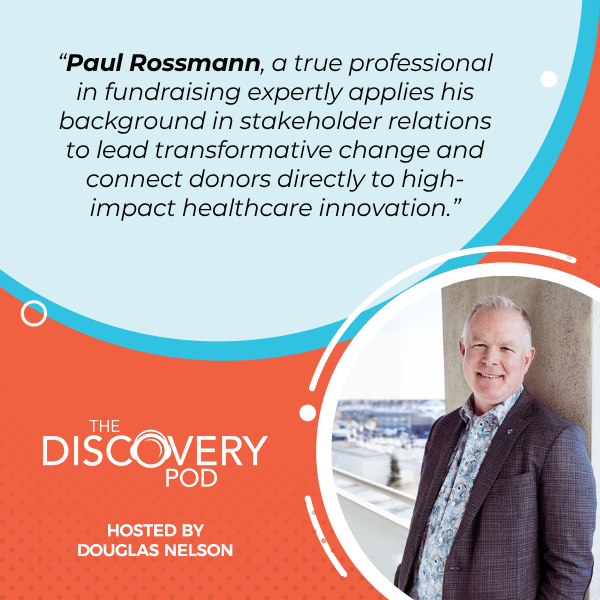
Today, we connect with Paul Rossmann, President and CEO of the Calgary Health Foundation. Paul leads one of Alberta’s most significant healthcare fundraising organizations. He reveals how his team is strategically bringing together donors and clinicians to drive profound improvements in patient care and outcomes. Paul discusses his journey from financial services to post-secondary, and now into the rewarding, high-impact world of major gift fundraising in health. He shares the secrets to fostering a culture of giving—one grounded not in transactional asks, but in genuine, long-term relationship-building. Learn how the Foundation is prioritizing opportunities based on where they can achieve the biggest impact and why donations are essential for funding the innovation that goes ‘beyond the daily operation of the healthcare system.’
If you’re interested in building a successful social profit organization, or if you simply want to understand the powerful link between community support and cutting-edge health delivery, you won’t want to miss Paul’s candid insights on leadership, collaboration, and his ambitious plans for growing the Calgary Health Foundation to secure a better future for healthcare in Calgary and beyond.
—
Listen to the podcast here
Connecting Donors To Healthcare Innovation With Paul Rossmann, President & CEO, Calgary Health Foundation
We’re joined by Paul Rossmann, President and CEO of the Calgary Health Foundation. Paul leads one of Alberta’s most significant healthcare fundraising organizations. He is bringing together donors, clinicians, and community partners to transform how care is delivered across Calgary and beyond. His leadership is grounded in a deep belief in the power of people coming together to create transformative change and in building the trust required to make that change possible.
In this episode, Paul talks about creating a culture of giving, a culture of philanthropy inside the Calgary Health Foundation and in his organization. The role of his CEO in creating that culture and starting and supporting that culture, the transition from post-secondary fundraising into healthcare fundraising, and his ambitious plans for growing the Calgary Health Foundation over the coming years. It is a great conversation filled with real candor and insight into what it takes to build a successful social profit organization. Please enjoy my conversation with Paul Rossmann.
—
Welcome to the show, Paul.
Thanks for having me, Doug.
Paul, the Calgary Health Foundation is an organization that I’ve had the privilege to be around and support in various ways over a number of years. I’m thrilled to have you on as CEO. For some of our audience who may not know, tell us about the role of the Calgary Health Foundation and who you serve.
Calgary Health Foundation Overview And System Scope
The Calgary Health Foundation has been around for many years. It was initially formed through the amalgamation of six different foundations and was named at the time the Calgary Health Trust. The foundations that were rolled into the Calgary Health Trust at the time were four hospital foundations, one foundation that was supporting Carewest, which is a long-term care operator in Calgary. As well as two regional health foundations. It is quite a large group, a disparate group of foundations.
We support four acute care sites in Alberta for rather large hospitals, as well as Carewest, the long-term care sites, and some other secondary care sites around Calgary. It’s healthcare in Calgary broadly. We also support research. The Alberta health system is structured perhaps differently from some other provinces. Our hospitals don’t have research institutes per se. The research institutes are very much part of the University of Calgary. Although, there are agreements and collaborations with the acute care sites. We also support research through the research institutes at the University of Calgary.
Whenever I’ve had the opportunity to talk about the Calgary Health Foundation to people outside of Calgary and even some in Calgary. Their question is, “How do you prioritize with all?” Those hospital’s foundations got pushed together. It’s been several years. We can say the dust has settled. Maybe you see it differently. If the dust is settled, how do you prioritize across such a wide mandate?
Prioritization Across A Broad Healthcare Mandate
It’s a work in process for sure. A lot of the priority continued to be with acute care. It’s the four hospitals. Something that surprised me when I joined the Calgary Health Foundation was that it was operating like a granting foundation. Historically, maybe one of the challenges was that there wasn’t enough prioritization. That’s part of the work that is in front of us.
The work that we’re doing now is that prioritization because our success is going to be based on having compelling fundraising opportunities based on the interesting impact that we can have in healthcare delivery. We prioritize now by impact where can we have the biggest impact on patient care and outcomes in Calgary.
One of the questions every hospital foundation CEO hears probably too many times in the course of a week is, “What’s the government doing? Shouldn’t the government pay for that?” How do you approach that? Particularly in Alberta, healthcare has been under quite a bit of change in the last couple of years. People are asking, “Shouldn’t the government do this?” How do you respond?
Philanthropy As A Catalyst Beyond Government Funding
We do get that question all the time. The way I respond is that healthcare is a publicly funded service. It is the job of the government to fund healthcare. For the most part, the base level of care that is offered by the healthcare system is pretty good in Alberta, and elsewhere in Canada, I would say. In a publicly funded system, there’s a scarcity of resources. They can’t fund all of their replacement equipment and leave alone other transformational ideas that clinicians may have. The role of philanthropy is to be a catalyst for those innovative ideas.
We can fund pilots. We can fund things that are beyond the daily operation of the healthcare system. In many cases, there are examples of how donor funding has resulted in better care and better technologies than would have been available under the status quo. The status quo is pretty good. The medical staff is doing an amazing job with the resources that they have. The population is aging. The population is growing. Technology is improving and expensive. The demand is increasing at a pace that can’t be funded entirely publicly. Where we can find opportunities to fund those innovation is impactful.
Do you find that donors are open to that conversation about innovations or that margin of excellence that their donation can play?
Absolutely. It’s very motivating for donors. Otherwise, if the question is, “Why shouldn’t the government pay for this?” The answer to the question is, “The government should pay for it.” What’s the role for donors? They’re open.

Healthcare Innovation: If the question is, “Why shouldn’t the government pay for this?” the answer is, “The government should pay for it.” So what’s the role of donors? It’s open.
If I were ever asked, “What’s something that you’ve learned about Paul that surprised you?” My answer would be that he didn’t grow up as a fundraiser. It’s because your instincts always are, in any conversation we’ve ever had, “We’ll just go talk to the donor. Go sit and have the conversation. Go share a meal and ask them the question. Have the conversation.” Straightforward relationship building is the hallmark of a true professional in fundraising. Take us back a little bit to that transition before you became a fundraiser. What were you doing?
Before I was a fundraiser, the first part of my career was in financial services. I worked for the credit union system in Alberta. I worked not for a retail credit union, but for a credit union central. It is what they were called. It’s a wholesale bank essentially that acted as both a liquidity manager and an industry association for credit unions in the province. It was a cooperative environment, which meant that, as an industry association, we didn’t tell credit unions what to do. We consulted with them about how we might represent their interests. It led through influence rather than through authority.
I did that for many years. I was with that organization, and then I joined Mount Royal University as the VP of Advancement. The skill set that I had was all in stakeholder relations. The portfolio in Advancement was marketing communications, government relations, and alumni relations. I had done all of that, although I was doing member relations rather than alumni relations. The part of the job that I felt was the biggest stretch and scared the hell out of me initially was fundraising.
I found it to be daunting from two perspectives. One was maybe the incorrect perception that I had about what fundraising is. It was about squeezing money out of people who maybe didn’t want to give it. That’s not what it is, I learned. Also, quite frankly, I was intimidated by some of the donors whom I met, who were making seven and eight-figure gifts, and came from a world that was so different from mine.
I found that to be intimidating. I quickly learned in that role that fundraising was the best part of the job. It’s major gift fundraising in particular. I had the opportunity to meet these folks, who were incredibly generous and put on their pants one leg at a time like the rest of us. They were wonderful people whom I had the privilege to get to know over time and to build relationships with over time. That’s how I first got into fundraising.
Was there a moment when you were starting those conversations? From that thing you feared to that thing that you embraced, was there a moment you realized, “I can do this or I’m getting the hang of this?”
I think of one in particular with a donor at Mount Royal, who had been a long-standing donor. I called him. I met him at an event. My predecessor was at that event and introduced me. I phoned the donor and started calling donors to ask them what their experience had been as a donor to the university. I found that to be an easy conversation to have. “I’m new here. I don’t know about the university or your experience. Can you tell me about it? What advice would you have for me?”
I was shocked at how people spent the time to have that conversation with me, and in a way that was helpful. I could think in that circumstance, as I was explaining to that donor some of the things that we were working on. In my mind, it wasn’t fundraising. I wasn’t going to ask him for money, but he made a major gift that was unsolicited. I thought, “That was easy. This is just about having a conversation.” That relationship continued for years.
In fact, I found in Calgary that many donors to post-secondary are donors to other sectors, including health. I’ve had the benefit of being able to continue relationships that started elsewhere because they are donors to both organizations. Those relationships have resulted in seven-figure gifts by being genuine about their relationship, engaging with them, not being transactional, staying in touch, and getting to know people.
Building relationships can lead to seven-figure gifts by being genuine, engaging rather than transactional, staying in touch, and getting to know people. Share on XYou mentioned having conversations with similar or even the same donors in that post-secondary role. As CEO of the Health Foundation, how are your conversations with donors different between those two? Do they view their philanthropy and post-secondary differently than what they’re bringing to the conversations at the Calgary Health Foundation?
I don’t know that the conversations actually are all that different. Donors, in my experience, are motivated by some personal story that they have. In education, they wanted to have an impact on the university and typically wanted to help students in some way, or research programs, but I was working for a university that wasn’t very research-intensive. It was more about student experience and student outcomes. There is typically a story behind why they were interested in supporting that. Likewise, in healthcare, there’s a story.
Shift From Transactional Fundraising To Relationship-Based Giving
What I found, talking to the same people, but when I was in a university setting, the stories they were telling me were stories that were relevant to post-secondary. Only when I landed in healthcare did I find they started telling stories about how they had had experience in the health system. Either things went well and they were grateful and wanted to give back for that reason. In certain cases, things didn’t go so well. They wanted to make it better for other people. There’s always a motivation behind why donors want to give.
Taking the time to have the conversation to let them share that with you is a big part of it.
I’ve been quite surprised at how people share quite personal information about their own healthcare situations. Those discovery conversations are pretty easy. When people understand that I’m with an organization that is raising money to support innovation and healthcare, it’s amazing how they volunteer their own stories of their experience in healthcare. The job of a fundraiser is to try to connect the dots.
If they had experience in this related to cardiac, they say, “We did some work in cardiac or we’re doing some work in cardiac.” They connect the dots around what their interests are and what we’re trying to accomplish. Those conversations never start as a solicitation or even an overt cultivation. It’s an exploration of what their story is and what we are trying to accomplish. If we can connect some dots for them and have them be interested in supporting us, it’s a pretty easy conversation to have.
Going back to my earlier comments about my perception of fundraising, I found that often that donors are inviting proposals rather than us quickly moving to put a proposal in front of them. The fundraisers who are more transactional and want to ask for money quickly, you can often get money from a donor, but it may not be what they are capable of if we find the right fit for an initiative that has the impact that will be most meaningful for them.

Healthcare Innovation: Donors should be invited into proposals, not rushed with them. Transactional fundraising may secure gifts, but true impact comes from finding the right fit—where capacity, purpose, and meaning align.
One of the things that is very true in fundraising is that surprises aren’t welcome. Jump scaring donors with solicitations may inspire a gift, but it’s not the gift that could have been or the gifts that may repeat even. Your focused so much on the one-to-one relationship, or you having one-to-one relationships with many donors comes through. I’m curious how that focus on the one-to-one relationship applies to organizational leadership and working with your leadership team. How do you approach bringing that group of people together?
We’re an organization of about 50 people right now. We’re growing. It’s small enough that I can know everyone. I’ve made a habit of meeting with every final candidate for every position before they’re offered the position. I meet with them. I’m not interviewing them. My intention is to get to know people. Also, I’m interested in culture. I’m interested in fit from that perspective. People appreciate that opportunity.
It gives me an opportunity to explore or to share the mission of the organization, what it is we’re trying to accomplish at the Calgary Health Foundation, and also what our aspirations are for growth, because we do have those aspirations. We can do more of this. We are doing more, which is sharing the business plans with the entire team and having people understand what it is we’re trying to accomplish. As an organization, we’ve been successful in raising money, but it’s not just the fundraising part of that.
Everyone has a role. Fundraising is a team sport. Part of what we should be doing is helping people see their role in the impact that we have. I would like the IT people, the finance people, and the marketing people all to understand the things that we’re fundraising for and the impacts that we’ve had and to feel proud about that work.
We’re being successful in that because, as I’m meeting with people, even in those areas, and finance and IT, before they’ve joined the organization, they’re asking questions about the mission of the organization. Increasingly, they’re saying why they want to join this organization. They’re not people just looking for a job. They are looking for a job at a nonprofit that will have an impact like what we are having in the community. They’re joining us with that alignment around our mission that is going to be incredibly helpful going forward.
It speaks very much to what I’ve heard you say in other contexts about the importance of culture in an organization. You’ve given a good example of what the CEO can do, or any CEO or senior leader can do in the organization, in meeting with people before they join the organization. It’s that transparency. What’s the business plan? What are we here to do? There are ambitious goals and high expectations. That team approach counts for quite a lot. Are there other parts of the culture that you, as CEO, are hoping to develop that you have less access to because you’re not around the water cooler all the time?
Building Organizational Culture And Breaking Down Silos
We have bold growth aspirations at the Calgary Health Foundation as an organization. Historically, and still, we’ve had extremely successful lottery programs. The philanthropic programs, the fundraising programs, weren’t as developed to the point that more of our net revenue is coming from lotteries than from philanthropy. We identified pretty quickly. In fact, I joined the organization because of the opportunity to grow and to have a greater impact on healthcare in the city.
Another aspect of culture that is going to be important for us to meet our growth aspirations is collaboration. Even an organization as small as 50 people can have silos in it. It’s important for teams and individuals to be working together to help each other be successful and to be focused on the things that will enable us to grow the most, so that we can maximize the impact that we can have.
Even an organization as small as 50 people can have silos. It’s important for teams and individuals to work together, help each other succeed, and focus on the things that will drive the most growth so we can maximize our impact. Share on XIt is such a remarkable opportunity that you and your colleagues at the Calgary Health Foundation have. You represent all of the adult acute care that happens in the city and in the region. Collectively being able to tell that story and engage the community seems like good work, and there’s a lot of it to do.
There’s a huge opportunity for us to be doing more. Our philanthropy programs historically haven’t been as robust as our lottery programs have been. As the only charity supporting acute care in adult sites in Calgary. If philanthropists want to have an impact in that space, we’re the people who can make that happen. It’s a great spot to be in from that perspective.
You mentioned the transition from Mount Royal to the Calgary Health Foundation a little earlier. Looking back, I know it’s been a little more than a year in the role as CEO. Is there something that surprised you about that transition of moving into that CEO role in the health philanthropy space?
Nothing surprised me. I anticipated the differences. In a CEO role, I’m reporting to a board rather than to the president of a university. It’s different. It takes some getting used to. In the previous parts of my career, I was always within an organization and had one boss. Now I have a board that I’m reporting to. That’s a different environment. It’s the way I expected it. The change to the health system was welcome. Universities are wonderful places, but they come with their foibles as well. Universities nationally have struggled with budget funding.
It’s very difficult to grow a philanthropy program when budgets are constrained every year because every budget cycle is a fight for resources. Especially when all of our income is regulated. Either it’s a government grant or tuition. There’s not much we can do. If you raised $1 million for student awards, it goes to student awards. It doesn’t help the bottom line of the university and doesn’t help fund the operations of the fundraising team. Maybe the one thing that was a realization, but it’s a welcome one. We need to fund our own operations here. We own that.
Funding Operations, Growth, And The Future Of Philanthropy Leadership
It provides great flexibility. If we want to grow and we can fund that growth, then we can fund that growth. We have a board that’s incredibly supportive of that growth plan, but we need to make sure that we’re prudent in how we are growing so that we have enough unrestricted revenue to fund our operating costs. That’s different in a university. The money is being raised and is being spent, and the operations are funded internally, essentially.
As the CEO of a health foundation, it’s more of a business. We’re not a department within a university. We need to run this organization like a business, which means we’re looking at revenues and expenses. Those things have to balance. We need to be able to fund our mission in a way that adds the impact that donors expect.
It is more business-oriented. In our environment, we’re not a unionized environment. Most post-secondaries are. That was also a substantial change. The politics are different. Universities have their own breed of politics. Here in a health foundation, we’re not delivering any services. We’re funding programs that acute care sites and long-term care sites are delivering.
Paul, you’re mentioning the need to fund your own operations. I had such a distinct flashback as you were walking us through that to my first CEO role. I can even picture the elevator doors closing as I was going down from the sixth floor to the first floor. It was my third or fourth day of work. I was realizing, “We have to raise all of the money to pay all these salaries.” It had never occurred to me before.
Having led a fundraising program at a large university and then moving to a health foundation, it seems very obvious now. That first week, it was a traumatic splash of cold water in the face. “How are we going to do this?” I realized by the time the elevator car got to the main floor, “This place has operated for 50 years without needing to worry about that. They’ve figured it out before. We’ll figure it out.”
It’s yours to screw up.
Yes, it was fine. I do think I heard the term unrestricted revenue both for the first time and thousands of times more in the first month in a health foundation than I ever did in a university. The need to fund operations is top of mind.
Not that the universities don’t appreciate unrestricted revenue, but they don’t need it to the same extent as any kind of foundation that has to fund its operations. Here in Alberta, our foundation doesn’t receive any operating grants from the government. We have had free rents. We no longer have free rents. We’re paying full freight now on all of our costs.
You have much nicer offices now.
We do, but we’re paying for them. Again, that comes down to the plan, which is to grow our business. We wanted to be in a place that was close to donors. We also wanted to create a space where staff were happy and wanted to be. Space is important from a cultural perspective. On the point of having to fund operations while your trip in the elevator might have been somewhat scary as that realization set in. It’s also incredibly liberating because the control is yours.
If you’re successful at being able to raise enough money to grow, then you can grow. There are no obstacles that are getting in the way of that. I would far prefer to be in a situation where we can write our own story. We can make our own destiny by doing the work that’s required to fund it. I’m convinced that if we do good work and can show impact on the health system, we’re not going to have a problem in funding our operations.
If you’re successful in raising enough money to grow, then you can grow. There are no obstacles standing in the way of that. Share on XPaul, what are you looking forward to?
I am looking forward to the opportunity to grow our philanthropy programs, to grow our team, and to show the impact that that is having in the health system. I’ve been here at the Calgary Health Foundation for two years and almost a year in the CEO role. Timelines are long. The things that are opening now in hospitals, programs that are opening, in some cases, that money was raised years ago.
We’re starting to see, in the short time that I’ve been here, money raised for projects that are a bit quicker in terms of turnaround. We’re hearing patient stories. We’re seeing the impact that it’s having. That’s gratifying. It’s gratifying to me. It’s gratifying to the staff. It’s great to see the relationships that we have with physicians and their healthcare providers and the impact that they’re having. What I’m looking forward to is the success and the feelings of gratitude to be able to be part of that.
Paul, it has been such a pleasure watching you as you have moved into that CEO role and the tremendous difference you’ve made in the organization in that first year. I can’t wait to see what comes next and what comes over the next 3 to 5 years. It’s going to be impressive. I appreciate you making time to be on the show.
Thanks, Doug. I appreciate the opportunity to chat with you. Thanks for all your support.