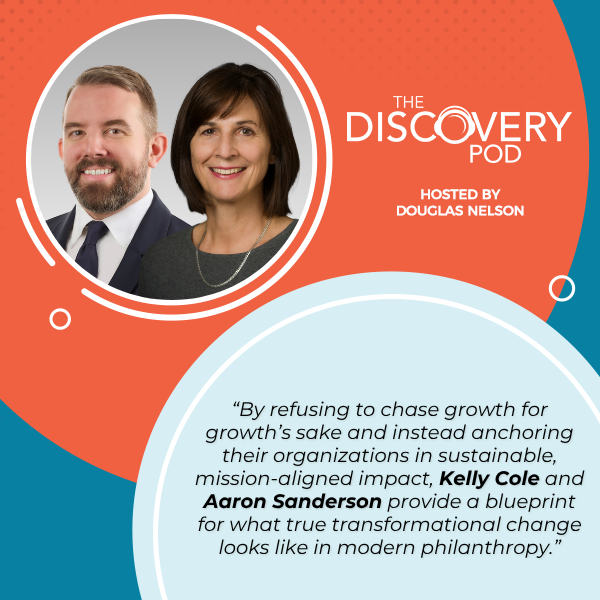
Achieving transformational change is a universal goal for nonprofit leaders, but it requires more than just scaling programs or ambitious growth plans. In this episode, we dive into what it actually takes to navigate organizational shifts, build alignment, and sustain momentum. Join us as we sit down with Kelly Cole, President and CEO of Sunnybrook Foundation, and Aaron Sanderson, CEO of Kids Help Phone Foundation. They share their candid insights on leading through transformation, managing board expectations, and the discipline required to move big ideas forward. Whether you are leading a community-based nonprofit or a national organization, discover how to avoid the “trap of more” and stay grounded in your mission while evolving your impact.
—
Listen to the podcast here
Preparing For Transformation: What It Takes To Get Big Things Done – The Discovery Dialogues Toronto With Kelly Cole, President & CEO, Sunnybrook Foundation, & Aaron Sanderson, CEO, Kids Help Phone Foundation
Welcome to the show. For this episode, we have another special one. This conversation was recorded live at our Discovery Dialogues event in Toronto. Centered around a question we believe many leaders across the sector are asking right now. What does it actually take to achieve transformational change? Transformation is not only about scale. It is not reserved for the largest organizations, biggest campaigns, or even the most ambitious growth plans.
Whether you’re leading a national organization or a community-based nonprofit, the reality is the same. Transformational change is something for all of us all. At the Discovery Group, we have the privilege of working alongside leaders at every stage of that journey. Some are building towards significant expansion. Others are rethinking long-standing systems, cultures, or approaches. Across organizations of every size, we hear many of the same questions. How do we bring people with us?
How do we sustain momentum? How do we stay grounded in our mission while navigating change? For this conversation, we are joined by Kelly Cole, president and CEO of Sunnybrook Foundation, and Aaron Sanderson, CEO of Kids Help Phone Foundation. Together, they reflect on leading through transformation, building alignment around a vision, and what it takes to move big ideas forward. No matter the size of your organization or where you are in your own journey of change, there is something in this conversation for every leader. Let us get into it.
—
Welcome to another edition of the show. We are here at the Center for Social Innovation in Toronto. Our Toronto home for the Discovery Group. Our topic is preparing for transformation, what it takes to get things done. Our guests are Kelly Cole and Aaron Sanderson. Kelly Cole from the Sunnybrook Foundation and Aaron from the Kids Help Phone Foundation, welcome.
Thank you. Happy to be here.
Thanks for having us.
Decoding The Anatomy Of Organizational Transformation
This is going to go so well. I am just sure of it. As we said at the outset, the theme of this is about transformation. Maybe I’ll start with you, Kelly. What has transformation meant for your organization over the last number of years?
We have been on a long journey, as you know. Some of the things that I want to share are things that have taken time to build. I do not want you to think that it started and was accomplished overnight. When I was first recruited about five, or five and a half years ago, the hospital was wanting to build a big building, and that started their ambition, and they thought about how much money it was going to require to build a massive, $4 to $5 billion type building. This was taking us into fundraising that we had not done before.
At the same time, they were thinking about their research and innovation agenda and wanted to transform it. Again, very significant ambition. It was very exciting. What we came into was an organization that had, it was very entrepreneurial in the way that I categorize it. It was having some really great years. It was not sustainable, kind of ongoing delivery at a certain level. They had not done a campaign for about twenty years, and even the last campaign, I am not sure we would have defined it as comprehensive.
It was a big undertaking and a big shift for the organization, and the board knew what they wanted, the hospital knew what they wanted, but of course, they did not know how we were going to get there. The initial phase was really around working with the leadership team. Aligning with the board around a growth plan and figuring out where we need to fill in gaps, where we need to grow, where we need to add, how we focus, how we pick the right things, how we ensure that the board understands what those right things are, and get them all down on paper and get everybody aligned. What happened over the five years was that there were huge cultural shifts. Greater collaboration across the team, across divisions.
There was greater collaboration across the hospital between the fundraisers and the hospital, shifting to data-driven decisions, shifting to a major gift team that could go out on their own and raise money with hospital leaders, not needing the CEO to be the front of every major gift solicitation. It was a big shift. It was not that nothing was happening. It was just that there was a shift to really get the team thinking that way. There was a lot of this change that was happening. The other really big thing, and you just cut me off when you need me to start.
If you're not sure the resources will be in place for you the following year, it is really hard to make commitments to communities that you serve. Share on XI know better than that.
Two other really substantial things happened at that time. One was from the get-go. The CEO of the hospital is Dr. Andy Smith. He and I were fully aligned. He really bought into what we had to accomplish together. He knew that we would not be successful without him and the whole hospital behind us. He was just a constant champion of the hospital and foundation. One team, Team Sunnybrook, was fully aligned. He just constantly is there talking about the foundation. That has permeated through the whole organization, board, executive leaders, programs, all the way through.
That is a significant difference for us in how we operate. The other thing that came later in the growth plan, not in the initial part, was later in the growth plan, we started to work towards understanding our unrestricted revenue flows. I am sure everybody can nod and take that in and say, “Yes, how do you grow when you have limited dollars?”
We spent time figuring out what our unrestricted sources are, how we grow them, how we create sustainability in our organization around our unrestricted funding, how we create a strategic reserve fund, and then how we bring the board along in that journey to understand and not say, “Let us spend that money, let us hold that money. Let us figure out how we’re strategically using that money.”
That has been a very good success story for us and has supported us in the growth of our campaign. It went on further. I will not go into all the details, but really, getting everybody geared up, we need unrestricted. Where does that start? Where does it end? How do we think about it for major gifts, community giving, and any parking revenue? Contributions coming off of our major gifts, etc. There is a lot to be unpacked around the source of funding for unrestricted funds. I just really wanted to stress. I am going to stop there.
That is great. There are a lot of follow-up questions that I could think about. Aaron, what has Transformation Med Kids helped phone over the last couple of years?
Scaling In The Eye Of The Storm
My answer is similar, but it is at a different scale. We’re at a different level of maturity at the organization. I will take you back to January 2020 when I started. Of course, only a few months later, we were deep into the middle of a pandemic, which had, of course, different impacts on different organizations. One of the things that happened to Kids Help Phone was that we experienced an explosion in demand for our services. We had over 250% growth in demand for services almost overnight. I was like three months in. All of the plans for the year were really out the door.
At the point in time at the organization, even in 2019, largely we were raising what we needed for the year and then starting from zero at the top of the year and doing the same. That has a major impact on the way the organization plans, how staff think about their roles, and the programs that they lead. If you’re not sure the resources will be in place for you the following year, it is really hard to make commitments to communities that you serve, when you’re really not sure what the future holds for you.

Transformational Change: At that moment, with the best information that we had and a lot of grit, we kept going.
Not only did we have the demands of the pandemic and need to rise to the occasion in terms of the funds that were needed to sustain that service volume, but we also needed to shift the way that we were thinking about our fundraising so that we could have more multi-year planning. We did two things at the same time. One was to scale rapidly in terms of our fundraising success so that we can continue to meet the demand for even just the labor hours, for example, for our counselors.
The other thing was thinking more multi-year, and it was an interesting process where we asked our colleagues, “If you had all of the resources that you think you could deploy for the greatest degree imaginable for this program area, what would that look like for you?” It was really one of the first times anyone had asked them to dream about that because it just did not seem like a possibility. This is the scarcity model that you were talking about, Doug. We got ourselves together with our funding opportunities. We had a reason to talk to donors about making a multi-year commitment and started to grow from there.
I remember there were some very tough conversations along the way where we, the whole executive team on the Zoom screen, turned to me and said, “Should we start laying people off? Should we stop hiring? Should we be in a hiring freeze? Do you think you can continue to keep up?” At that moment, with the best information that we had and a lot of grit, we kept going. I am just really grateful that we were able to accomplish both of those things at the same time, which took a lot, but it also catapulted us into a new level of maturity as an organization.
Talk a little bit about any changes in your job recently? Just a little shift.
That changed in the campaign that we had. It was a successful $300 million goal. We raised $333 million by the time we were done with that campaign. From the start of the pandemic area time all the way through to the end of 2024. The board had been engaged in a conversation around succession planning and also asked themselves a really good question. If we are fundamentally different as an organization based on the growth that we’ve had over the course of the last, at that time, about 3 or 4 years, how might we govern ourselves differently?
What do we need to change about the way that we’re approaching the organization? After a lot of careful consideration, we moved towards a strategy where we have a two-entity model, a Kids Help Phone Foundation and Kids Help Phone. It is not the traditional model where you would see a hospital-hospital foundation. We have a shared services approach where we have the same HR team, the same IT team, same marketing team.
We’re sharing from those departments. A lot of collaboration continues to happen amongst the coworkers, but we now have our own foundation, our own board set up for that work. That launched on January 1st. It has been an amazing journey. When do you get an opportunity to do that, where you’re not starting from scratch either? We have a group of donors who were committed to us again over multiple years, and we’re only a little bit of the way in and learning as we go.
One of the things that is really fascinating to me about that story, Aaron, is that you were designing this model, but you did not have the job yet.

Transformational Change: Do the plan, get your annual plans, understand your KPIs. You have to have a pipeline that maps to it, but then believe in the activity and the work. Believe in your organization.
It was really interesting. It worked out. In the end, that is great. Listen, all of you will probably say something about the places that you work, but Kids’ Help Phone is a very special place. In fact, I met some of you today who have spent time there previously, which I think is really fun, and I want to hear about your experiences during those times. I knew that this was the next most important thing for the organization.
I knew that I had a good fighting chance for the role. I also fundamentally knew that if I did not get it, there was not going to be a job for me. Come January, I will have helped launch the ship and then cheered from the dock. It worked out. It was about November actually, that we had secured, I had secured the role, come January 1st. Here I am.
Breaking Free From The “More” Trap In Fundraising
You were not on the dock. You were driving the ship at that point, yeah. One of the things that happens a lot in our sector, we were talking about transformation, it can often just mean big, let us do more. If any of you have had a not perfectly or well-facilitated board retreat where the board says, our new plan is to triple or double, we just need another million or two dollars in unrestricted revenue, and looks at you as the head of fundraising and goes, “You’re good for that?” That more can be quite a dangerous phrase in our work. I want to ask the two of you to think about transformation as a big change, but how do you avoid the trap of more? How have you avoided that so far?
I am not sure that we’ve avoided the trap of more. We have delivered more. I would say that managing the board’s expectations on what that growth might look like. That came through strategic planning, really laying out for them, what does this look like in the first few years? Keeping the board attuned to, we’re here right now. Over the next three years, we’re going to go from 55 million to 90 million, and we’re going to get that sustainable. That is what we’re going to deliver on year in and year out.
Here are the key things that are going to get us there. Do not let the board distract you is a very big point. There were a few times when the board would start to say, “Why are we not doing this?” Stay focused. This is what we’re trying to accomplish. You still have to deliver. This is my point. You still have to deliver on the numbers. They were seeing the progress in numbers. I guess having a little bit of faith in the leadership and the team to deliver, and understanding the direction that we were going in. You still have to, in those early days, deliver.
Do not let the board distract you. Share on XWe kept talking about our campaign model, which is to build up to the hundred-million-dollar mark, which we achieved this year. For the campaign, because our campaign’s a billion dollars, layer in these transformational gifts to fulfill the billion dollars. It is pretty scary to sit and think, “We need this transformational gift. We need one of them over the $25 million mark to land. These gifts take like 2 to 3 years to make. It is just a constant education, and they’re very private discussions.
They’re not sharing with everybody what is going on with the 3 or 4 transformational gifts that you’re working on. You’re constantly saying to the board, “Trust me, we’ve got five in play. We’re moving forward. We’ve presented proposals. We’re in a gift discussion. We’re documenting. One is coming, I promise you.” That whole unrestricted model includes some of the money coming off of the transformational gifts, the contribution to the unrestricted.
You’re building up to deliver, your costs are increasing, you’re managing your unrestricted, but at the same time, you’re thinking about things like, “What if this one does not end?” I would just say, I’ve always believed in the process. I’ve always dug in and said, “Do the plan, get your annual plans, understand your KPIs. You have to have a pipeline that maps to it, obviously, but then believe in the activity and the work, believe in your organization. We did a lot of homework in those first three years, the market study, all of those things, and they led to the change, and the numbers follow.
If you're setting targets that are not anchored in the impact, you're kind of hooked from the start. Share on XConsistent pressure over time. The trap of more was that, so you’re both talking about these 5 to 6 year transformations of your organizations, and Aaron, in your first example, you were talking about, can you do more to meet the need during the pandemic period? How did you approach that?
There is a discipline around this, but for what? When we presented, when we did the work of establishing these multi-year funding priorities, we totaled them up. They were well over 300 million. We said to the board, here is based on what we know as good fundraising practice and what we can see in our pipeline, we think 300 million is the goal to go for. We described that as we never wanted to question where we would put one more dollar. Good thing we did it because we surpassed our goal. We knew where to put that money. We were not scrambling. There was a conditioning and our board to think about what is the impact that we want to have and then let us set our goals against it.
That matters because the first thing that happens when you walk out of that room, and you’re setting those targets, is that you need to explain why to the people around the table that are going to help you get it done, the amazing team at Kids Help Phone Foundation. It is the first question out of the donor’s mouth when you sit down with them to ask them if they would consider giving. If you’re setting targets that are not anchored in the impact, you’re kind of hooked from the start.
The Art Of Balancing Urgency And Strategic Patience
Both of you in your answers demonstrate a little bit of this, like for those of us in the room who grew up as fundraisers, as major gift fundraisers in particular, there is this urgency that we feel to execute and for the coming up with about two months to go in the fiscal year, the high rev really kicks in. I found that during the transition from being a full-time fundraiser to being a leader of organizations.
It took a while for that rev to wear off, and some of my colleagues may say it has not worn off at all. I am hoping you can share how you balance that need for patience because a lot of the transformation you’re both describing takes time. You’re talking 5 to 5.5 years for Kelly and Aaron, you’re talking about 6 years. How do you balance that patience with the urgency of the work and the urgency of the goals that you have in front of you?
I think about pace a lot. Pace does not mean that everything is moving at the same speed. Pace means that you’ve chosen which things need to move slowly and which things can move quickly. Different parts of the business, different fundraising channels, and different projects are all going to move at different paces. It is a trap if you say they all need to be done by next month. You’re going to be unsuccessful in that, most likely. We talk about timelines for some of this work.
There are limiting factors. You can only move so fast as your culture will enable you to do that. You will only move as fast as the alignment that you have with your board. You have to not just set targets based on ambition alone. Ambition is great. If you’re not thinking about all of those factors that will enable you to be successful and the different sequencing that you need to have based on resource allocation and culture, that is really where I think success can come from. I would just build on that and say that talent matters.
One of the very significant changes that I’ve seen in our leadership team is that they have gone from being leaders of portfolios to leaders of the organization and seeing the impact that they have across the organization. Of course, they’re still leading portfolios and delivering, but they’re also very mindful of what’s happening across the organization and can think about how to advance my portfolio. What’s the timing of that? Do I need to pull back a little bit because we need to focus here? That talent to drive, like sometimes you have to pull back in a certain area to allow for new talent to come in before you’re ready to keep it moving forward. Talent has a big component to it.
One of the things that I think has been really remarkable about the Sunnybrook story is that the investment in that talent has happened. Before, it was critical that everything was falling apart. You were investing ahead of the urgency because you knew that was what was going to be needed to get from where you were to where you wanted to be.

Transformational Change: Pace does not mean that everything is moving at the same speed. Pace means that you’ve chosen which things need to move slowly and which things can move quickly.
We really did a great job of understanding what is foundational to building platforms straight across the organization that lifts up. Not surprisingly, our board was saying we need to get out, we need to spend way more on brand, we need to be out. Yes, we do, but not yet. We need to get our story, we need to get our people, we need to get our colleagues on the hospital side in play. We’re going to keep building and growing and developing on the marketing side, but it is just one example where you’re picking and choosing as to where to invest your time and attention. The CEO, like any of the leaders and all my leaders are sitting here, but all of them, you have limited time.
You cannot be focused on everything, and you have to decide. We knew that if we did not deliver on the major gift portfolio as a starting point, as an example, we had to have that in place. Even on the knowledge systems, we did a three-year roadmap. Said, “Let us hold back on CRM. We’ll do it this year because we need these other tools in place. We need to fix business processes, etc.” All of that planning and the importance of it and trying to make it as apparent to the board as you’re doing it is really key.
Speaking of boards, how did you maintain that alignment or alignment with your board when they suggested that bus shelters are the answer to raise a billion dollars? A couple of other things, maybe a billboard or two.
Navigating Board Dynamics And High-Stakes Strategy
All of our strap plans were heavily engaged in developing first our growth plan, which was three years, and then we redid and did both our campaign plan and our three year strap plan, which seems like a lot of planning, but it really worked out extremely well. Getting their engagement in that, we do board strategy dinners, and we take a bit of a different approach. We broke them down into smaller groups so we do not do the full board. They have an understanding going in that we’re all talking about this topic, and here is the same reading material, and now we’re going to have a much more in-depth conversation with a smaller group of board members.
Allows them to get to know each other better, and allows them to participate more. It is partly an education awareness tool. We used to have one board strategy session that was all based around, should we do a capital campaign or a comprehensive campaign? Most of our board members did not know what that meant at the beginning. They were like, “What are we talking about?” It allowed us to really go deep on how you campaign and what’s important and what’s going to be important for us. They could get their heads around the strategy.
By the time you iterate with them and bring it back. By the time we would start in September, we got to January, they were like, “This is it.” They were a part of it, they were embedded in it, as well as the leadership team. It is just, do not forget that they have two months between meetings. It is repetition over and over again to remind them that this is our strategy. “Remember, we said we’re going to do this, here is this.” It is laddering up to something bigger.
Aaron, you were describing a process that sounded quite board-led in terms of looking at what was the best way to organize the governance of Kids Help Phone. As a senior leader in the organization, as a person on point for hopefully being able to get on the ship at the end of building it. How did that feel as you were guiding or stewarding or watching? What is the right verb there?
It is a great question. The senior management team was deeply involved, and we had some strategic advisors. At one point, we had done some financial modeling, and I was sitting in the boardroom and having Deloitte ask me questions about why I believed these might be true. It was just going through the rigor of we’re going to make a big decision that’s going to be sort of life-changing for the organization.
We want to make sure that we have the best thinking from not just bottom up, but also top down. The board was interested in how they might need to reformat the governance for the organization, but they really came at that as half of the equation. It was really collaborative to go through the process. Now, what we find ourselves in at this stage is that about half of the board team for the foundation are those directors who were part of the decision previously, and about half of them are new.
When we talk about alignment, it is a really interesting conversation because some people do not have that history, and some people have gone through it like quite an extensive process to examine that. We have these two perspectives at the board table around what’s possible in this fresh new environment, and some expectations from the other half around what we expected to be true. When we talk about alignment, it is also alignment amongst the board directors as well as that with management.
From VP To Visionary: Evolving Your Executive Leadership
Both of you have described what are very significant changes in transferring as leaders, transforming the organizations that you lead. How has leading that transformation changed your leadership style? Does any of Kelly’s team want to weigh in on it?
It has definitely changed significantly between my previous job and my current job. I would say it took me two years. In some ways, I look back, and it took me a while to figure out what’s different in this that I need to really understand. If you engage with your leadership team on an annual basis and you engage with your executive team, in my case, the board, and you listen to them, and you use your campaign council very effectively, you can have that conversation as you go through a performance review each year and think about where is my organization at?
That is probably the fundamental change I would always be thinking about, “What do I need to be doing? What am I doing? What am I working on? What am I moving?” I started to think, “It is not me individually. What should the CEO be doing? What does the organization need from me right now? What’s shifting?” Those people around you will guide you so effectively. The executive committee of the board at one point said, “You’ve got your leadership team in place, you’ve got your plan, they’re working through, you need to get out.” COVID, somewhat over at that point, but not. You need to start pushing out. What does that look like? With each year that push out has gotten stronger, and now it is media and events, and how are you showing up?
What are you doing for the organization to lift the whole organization up, those kinds of things? It is a real shift in where you spend time, allowing your leaders to lead. They can come in and take over responsibilities that you used to have. Use your campaign counsel because he has led before, and he is a good sounding board. He is also a good social worker. You can say, “I am really nervous about this if I take my eye off.” He knows the team. He can say, “They’ve got it. Good for you, Kelly. Get out of it.”
That’s great for our audience. She is pointing at me. Thank you, Kelly. Aaron, what has that change been like for you?
The Promise Of Future Impact And Visionary Goals
We had a conversation, and actually, we even had a moment. I am smiling at my coworkers here. We had a conversation about whether we were going to live into this trend, this vision for transformation that we have, and it would feel very different. I should be doing different things. You should be doing different things. We also need to recognize that there are things that we really love. I love fundraising. I love spending time with donors. It is a joyful thing in my day.
Also, I might have to do less of it because that might not be the job that we want the CEO to do in this new format. I quite frankly said to my two fantastic colleagues here, “You may need to remind me of that. You may need to ask me, is this something that you should be doing, or is this something that I should be doing?” We even had a conversation about that. Permitting others to help remind you or guide you.
Truly, this is a form of support, as well as you trying to shift your mindset because that group of donors still knows me, but it might be time for them to be engaging more with someone else on maybe a day-to-day basis, so that I might do some more of the work on setting up the governance, for example. That shift has been hard, but it’s exciting. It stretches you in different ways, I find that really stimulating. You should call upon the other people very transparently in your life to help you make that shift.
I was going to just add that I am thinking about your transition, and it was such a change to go from being a vice president and working for the president of an organization to being the president of a foundation and reporting to a board. I remember a colleague of mine, Ted Garrard, I am sure many of you know, he said to me, “When I was going into the position, 33% of your time is on board.” I said, “Do we have that many meetings?” He is like, “No.”
You’re on the phone, you’re doing one-on-one, you’re constantly in your office thinking about who needs to know what, how do you move them, how do you think about them, what connections are you making, all of that. Just keeping them at the forefront, making sure your chair is fully prepared, knows what they’re doing, knows how to support you, chairs of all your committees. He was just really good at driving that home. That is a huge part of having a board.
In our work at the Discovery Group, we often ask CEOs, how much time are you spending on the care and maintenance of your board? The answer is usually 25% to 40%. In some cases, 60% or 70%. Those are tough jobs in organizations going through tough times, usually. That 25% to 40% is very consistent. We’ve asked over the course of our work, we’ve asked more than 1,000 board directors that same question. What percentage of your CEO’s time do you think she dedicates to supporting the board? The answer is not higher. It is significantly lower.
A board member, or a committee chair, will usually say 5% to 10%, and a board chair will usually say, “It’s maybe 20%, maybe a quarter. The board chairs tend to have more sense. If you think about it, why don’t they understand how hard I am working? It is that they think you’re only spending 5% of your time talking to them, and you’re like, “No, this is 40% of my day. This is two days a week.”
There is a real difference, and there is a lot of value, and a lot of what Kelly shared is an example of showing the work to your board of what it means to do this. This is what we’re doing and repeating it over and over again, not for a pat on the back, but just a reminder that the weight of the world we are moving is very heavy, and we’re doing it together. I am spending a lot more than 5% talking to you all. Say it nicer. We’re going to draw to the end. Got one quick question. If you give short answers to this question, then we’ll get to the questions from the audience. Aaron, what are you looking forward to?
I am looking forward to it a lot. I am looking forward to living out this year as a new entity, and we’re learning lots every day. More than anything, I should, and I do believe that this is the thing that we needed to do to really advance the work in this next phase of our organizational trajectory. The need is so clear. I do not care what organization you work at, you probably have experienced the youth mental health crisis in some way personally in your life or in your circle. That is the promise of the Kids Help Phone. We’ve done the work that we needed to do to be able to be positioned to be more successful and more rapid in our response to the crisis. I cannot wait to see that start to unfold.
That is wonderful. Kelly?
Very similar. Just think about the impact of what this campaign is going to do, and really look forward to A, personally putting the shovel in the ground for the new critical care center. Also, one of the big gifts we announced was around clinical trials, and just really excited to see what that is going to mean for Sunnybrook, but also for all of Canada.
There is nothing better than seeing a donor or a volunteer, and I enjoy both when they realize the impact that they’re having. We’re starting to see that with some of the volunteers, one of our cabinet members was very instrumental in the gift and building that relationship. They’re just so proud of the work that they’re doing. That is fun.
That is wonderful. Thank you both so much for being a part of the Discovery Dialogues here in Toronto. Thanks to all of our audience. We’re going to move to Q &A, but first, a round of applause for our panel, please.
Unpacking Impact: An Audience Q&A Session
Thank you. Aaron, I heard talk about impact. I love hearing talk about impact and how that is what started things, and then you determined your fundraising goal from there. I wondered if you could just talk a bit about how you define the impact or the impact objective of Kids Help Phone.
That is great. One of the really beautiful things about Kids Help Phone is that there was already a culture of measuring everything. The data was already there, and the culture of making data-informed decisions. What are you struggling with? How are we going to adapt to that? How are we preparing the clinical staff? One of the things that we hear from our counseling colleagues is that they love being part of Kids Help Phone because you are at the leading edge of your practice. As issues emerge, we react to that, and that is where the training and the professional development come in.
It was already in the mix that we were doing that work. We just had not applied the thinking to how that would extend to a particular program area or service. What would it mean if you had all the funding that you needed over a multi-year period to see the fullest expression of this program have the largest impact? They were already familiar with the impact measures. It was more of a budgeting exercise and thinking about pacing and scale. All the ingredients were there, but we just had not given them the license to do that, dreaming over a multi-year period or thinking fully in abundance. The work was not to try to find a way to measure the work that we’re doing. We did that already really well, which was very enabling to the whole process.
I have a structural question on governance. I have a staff member right now. I am a big supporter of Kids Help Phone. Kathy Hay was on my board. I am at Mental Health Research Canada. I have a staff member right now who worked at Kids Help Phone in its early years. You might be too young to remember. At that time, the foundation was separate from the core operations. At that time, they amalgamated a number of years later, and now they’ve separated again. I am just wondering about the pros and cons of having it as one model versus two, and obviously, an organization that has gone from two to one to two. There is different thinking, different leadership, et cetera, different priorities, I guess, around that.
Aaron, maybe I can push that to you, because I am sure when the idea was to launch this foundation, there were people around who were like, “We already tried that.”
We did that a while ago. We have also kept up relationships with our former directors, and even two of our founders are still living, and they sat down with us in the boardroom and talked about when they made the decision to amalgamate, what the context was during the time. I am actually I will not say who, but there is an organization that reached out to me recently, where they spoke on Monday with their whole board, me, and their board to talk about this idea that they’re contemplating right now, whether or not they want to spin out a foundation.
My advice to them, from what I understand, is not to do it. There are very specific contexts within that stage of your organizational growth. Kids Help Phone actually did not start as a registered charity itself. It was actually the Canadian Children’s Foundation, which already had a charitable license, that was funding this programmatic work. Even then, it was a different model. After that, they amalgamated into one, then split out into a foundation. When they made the decision to amalgamate those two, it was at a time when the organization was struggling, struggling to get by.
The resources were not abundant. The work that was required to sustain the two entities and the governance behind them was not delivering a benefit to them that they felt was right for their stage. We’re at a different moment now in the organization’s history. There is more sophistication around that. When we thought about the governance needs between clinical expertise and innovation and technology research, as well as fundraising.
We’re starting to demand a lot from the board, and we thought we learned how far we could go when we had a stable of volunteers through our campaign cabinet that were active in our fundraising work, and thought, “With all of these ingredients, maybe now is the time for us to contemplate a two-entity model.” It just really matters where you’re at in your life cycle as an organization, what you want, what your ambitions might look like, and then think about what structure would support that.
The details matter a lot, for sure. I would say that one way to ensure it will not work if you’re going to two is if the goal is to make fundraising somebody else’s problem. We’ve seen that happen a couple of times, which is very good for our work, good for our business, but not very good for the organizations. Whether it is two, whether it is one, the idea that philanthropy is at the core of the operating entity and the foundation needs to be an important part of it. You cannot subcontract fundraising down the hall to a newly spun-out foundation. I have not seen it work.
Big Impact Lessons For Smaller Nonprofits
I am thinking of some of the folks in the room who are leaders of much smaller organizations. What does it take, if you could distill everything that you’ve learned and everything that you do, into just what are the few actions, like what does it take to get big things done when you are the CEO and the chief fundraising officer and the marketing officer? What do you think are the few things that you have the same ambition for, right? You want to get things done, but you’re working much more nimbly. What are the few qualities or actions that you would recommend focusing on?
Every organization requires a vision for where you’re going, a belief in it. The CEO has to believe that it is feasible, it is possible, there is a pathway. You can show them the pathway of what we’re going to go down, regardless of the size of the organization and what you’re trying to accomplish. It has to be realistic and grounded in the data pipeline. In my early days of fundraising, I just heard my boss in my head saying, “We need to know where the money is going to come from. We do not have a path.” All of these things, it really is, do we have the vision? Do we know what we’re trying to accomplish?

Transformational Change: Every organization requires a vision for where you’re going.
For sure, I mean, back to your comment about the two boards, that alignment with whatever your organization is, whether you’re reporting up through one structure or two structures, that alignment around what you’re trying to accomplish and being able to articulate it back to the impact, what are we delivering on at the end of the day? If you do not have that, you’re just going to flounder. You hear it, lots of organizations, I am sure you know that some of the healthcare organizations in other provinces have these very unique structures around trying to figure out what their funding priorities are.
All of that, it is just really important. When you know what you’re trying to accomplish, even when it is $10 million, I have a specific idea of what we’re trying to do, how we’re going to get there, bring in the volunteers around it, the elements are still very much the same. Maybe, to our earlier question about how you spend your time, you’re going to adjust your time as CEO because you’re going to spend more time, maybe doing the actual fundraising, that is the thing.
Fundraising For “Unsexy” Causes: The “Teddy Bear” Dilemma
I started fundraising. I was the CEO of a small organization, de facto fundraiser. I was doing great until sick kids walked in with a teddy bear, and I did not have a hope in hell. Later on, I had a kid who was sick, and I was so grateful for that. Your cause is like you have this amazing hospital, and you have amazing mental health, which you’re right. I do not know anybody who does not know somebody in their life where their youth does not had a mental health issue in their youth. What is your advice for some of the sort of harder issues, like the purpose economy, injury, or social planning? Those kinds of organizations that are critical infrastructure for the system, but are not showing up with a teddy bear.
I am going to go back just a little bit. I was formerly at the university, but both the university and the hospital, there are definitely elements within our fundraising that are, let us say, less sexy, less interesting, less appealing, great cause. It is harder. The volunteer component is so significant. Who are your champions? How do you get them to help rally around what you’re trying to accomplish? A lot of time is spent figuring out who really cares. I do think that it is much harder work. I’ve worked in a couple of organizations where our databases were, I say, rich, but we had phenomenal databases.
It was more about working around how I prioritize my time to get the maximum out of this group of individuals. I’ve also worked in organizations. I worked for a small hospital foundation, where it was really about how to identify a donor and how to spend time. It is way more work for sure in the identification stage, but your volunteers, your frontline people, as we use obviously physicians, grateful patients, that thing, but understanding, finding out who is interested in what we’re trying to accomplish, and then building from there. Because without that, it does not matter how much money they have. You’ve got to have passion first.
You have to have passion first. Without that, it does not matter how much money they have. Share on XThat is well said. I very purposely, when I left SickKids, went to a much smaller organization. I went to War Child Canada. Still, children are a theme throughout my entire career, but part of that was learning for myself. Am I as good as I think I am? I am not behind this giant brand where we have surprises every day. That definitely was not the case at War Child. There is a degree of difficulty.
I think your storytelling needs to be really tight and believe those that show you that they’re passionate because and believe in their potential to whether they’re raising the money for you or donating it themselves and then really understanding the profile of those people that your cause resonates with and getting really darn good at finding out how to pinpoint those others that might be out there that would feel the same. I remember finding emails for folks and emailing them and saying, “I know you have a passion for international development, and I want to talk to you about this issue.”
That is how I was getting my first meetings at War Child with people who had no history with the organization. There’s probably some comparables in there for you. It is twofold. It is exactly what you said, finding those who are passionate and who are already behind the organization, and dialing up that relationship to see what the results might be, and then really getting specific about the profile of those that you know the cause is resonating with.
Those are both great answers. A very specific tool to think of or take away that I’ll leave you with, and happy to talk about after. One of the challenges of building a donor base for an organization that has not been involved in philanthropy is that we have this instinct to teach, to explain. If we could just explain, if people just knew, they would give. Those of us who’ve spent our lives in fundraising know that is absolutely not how it works at all.
You cannot educate and fundraise in the same conversation. One of the ways to shortcut that is to talk about your organization and your purpose through a donor lens, through the eyes of your donors. You can say, “Our donors enable us, and then you can start to educate. Lead with the fact that it is a normal thing for good people to give good money to your organization. Lead with, our donors enable, or because of our donors, we have been exploring, or working with the folks that are critical to your organization.”
We’ve identified an opportunity for donors to play a really significant role in, and then talk about that. Put it through the lens of philanthropy. It shortens some of the education, and it certainly opens up the conversation to be about giving sooner. You’ll avoid that situation when you tell somebody about the great work of your organization, and they sit back, and they go, “Good for you.” That is the end of the conversation. That is the end of our time for the show. Thank you all so much for being here. Let us get one more round of applause.