Transformational change within the social profit sector is not an overnight success story. It requires a strategic plan, deep internal alignment, and courageous preparation long before the public celebration begins. In this episode, host Douglas Nelson joins senior Discovery Group team members Jen Rose, Christoph Clodius, and Ainsley Dowle to unpack key insights from their recent Discovery Dialogues. They explore the critical role of listening, the necessity of repeating the vision, and why effective leadership is often about empowering your people to execute. Whether you are leading a large organization or a small team, this discussion provides the framework you need to move from ambition to action.
—
Listen to the podcast here
What We Heard: What It Takes To Get Big Things Done With Jen Rose, Douglas Nelson, Christoph Clodius, And Ainsley Dowle
Introduction: Themes Of Transformational Change
You have heard me say it before, but it is especially true. We have a special episode of the show here. Over the past couple of months, we’ve hosted the Discovery Dialogues in Vancouver and in Toronto, bringing together CEOs from across the social profit sector for conversations about leadership, strategy, and transformational change. While each leader brought a unique perspective, several themes emerged time and again.
The critical role of a strategic plan, the preparation required before transformational change can happen, the importance of building internal alignment, and the reality that transformational change requires the change to be a big change. Joining us are three of our senior team members, Jen Rose, Christoph Clodius, and Ainsley Dowle, who participated in these conversations firsthand. Together, we will unpack the key insights that emerged, explore what stood out most, and discuss the conditions that help organizations move from ambition to action, pursuit to transformational change.
—
Welcome, team.
Thanks for having us, Doug.
We have the opportunity around the office to, what did we hear? What are we learning from clients? What are we seeing? It is rare that we have the chance to bring together clients all in one room, put a couple of them on the stage, and ask them what it takes to get big change done. I was really excited to have everybody there.
It was such an exciting moment and something we had never done before. I remember just right before the event was starting in Vancouver, looking over at you at the office, and you looked more nervous than I had seen you. I asked what was going through your mind, and you were worried if people were going to come to our party, and they sure did. It was such a warm and really incredible experience to be part of and to see everyone coming together, and so excited to hear the conversations.
Thank you, and I was very nervous. I was having flashbacks of being in junior high and what if, what if. I will not even have a party because I do not want people to not come to it. It was a great feeling. The two events actually had a really unique culture to them. We were asking similar questions around transformational change. Jen, one of the things that really stuck out for me, and I know for you, leading our governance and planning group, was that all four of the participants in the two dialogues talked about the role of a strategic plan.
The Process Of Strategic Planning
They did. I was so excited to hear in our clients’ words what we are trying to explain in terms of the value of the strategic planning process. What I heard was really not talking about just the plan itself, which is a very valuable tool, but what came through strongly with all, through all of the conversations, was how important the process is in bringing everyone along.
How consistently do you have to repeat yourself? It was Kelly Cole said, the board only comes together every few months. Your role as CEO is to repeat, repeat. Even if you’re tired of it, they’re probably just starting to get it. That reminder that those of us who are working within these organizations are working alongside these organizations, are in it every day, and our leaders, our board members, are not. It is also true for folks in the organization. Ainsley, I am interested in your perspective on this.
Strategic plans are only as good as the people who actually execute them. Share on XThe idea that around a leadership table, the plan is something that is alive, and it is something we’re talking about, that transformational change is really big. Sometimes, below that level of senior leadership in an organization, everybody’s just getting on with their job. We heard from a couple of the participants the importance of bringing the whole team along, and we were curious what your reflections on that were.
Bringing Your Whole Team Along
I was just thinking that when you said, Kelly was talking about you have to repeat, repeat. You have to do that for your team members as well, because even though they are living and breathing it, it depends on what their involvement level in the activity is. If it is a campaign, their department might not be as deeply entrenched as another one. For an organization, you are all headed towards the same goal. It is so important to consistently reiterate that end goal and how everybody plays a role in it. That is where leadership plays a role in embodying that for everybody.
Christoph, one of the things I was sitting on the stage and hearing leaders talk about was the importance of repeating the plan and bringing everyone along. I was thinking, what is it they’re not saying? Was there anything you picked up that maybe was obvious to those of us in the room, but wasn’t exactly what was coming out of the microphone?
Investing In Culture And People
Not to contradict my wonderful colleagues on the strategic planning side, but plans are only as good as the people who actually execute them. That really came through for me fundamentally from a staffing, from an HR perspective, from a culture perspective. It was Angela who pointed out that you really need to empower your people, empower your staff, because it is fundamentally they who do the work. They need to buy into the vision. They need to do the work. They need to have the cultural pieces in place. Investing in culture, investing in your people, getting to know them, particularly in a place.
It was Deb at Covenant House Vancouver who talked about this. Being so service delivery oriented in a facility that runs 24/7, basically, there are lots of people involved in lots of different ways, and they need to have lives outside of work, fundamentally as well. Checking in with your people, investing in culture is really quite a significant piece fundamentally. As they evolve as leaders, the teams evolve, and the organizations evolve fundamentally too.
The Hard Reality Of Decision-Making
Don’t you guys think it was interesting that these exceptional leaders we had on the stage, they were all talking about their teams and how important it was to engage them? Doug, when you’re asking what they did not say, they were not talking about the really tough role that they need to play as leaders, and that is in decision-making. At the end of the day, it comes down to their call a lot of the time. They are all such beautiful servant leaders that they ignore that part. That is one of the hardest parts of this work.
They ignore it. Yet they are also really adept at developing others in doing some of that work. Kelly spoke at great length about taking her teams, getting her teams to understand that they’re not necessarily just leaders of their work, leaders of their portfolio, their organization-wide leaders. They need to contribute from a very holistic perspective across the organization, no matter what that organization might look like fundamentally. Elevating everybody’s sites allows them to elevate their sites fundamentally, going from an inward-looking strategic planning piece to meeting with donors, speaking with government, speaking with health authorities, speaking with hospital leadership, speaking with program partners, whatever that might look like on the external side.

Transformational Change: True leadership means moving beyond your specific portfolio and stepping up as a holistic, organization-wide leader who elevates everyone’s sights.
Really communicating. What I heard come through really strongly is that they were clear, they had clear visions and a clear understanding of where they saw the organization heading, but they listened so intently to those who are affected by the services, the young people that are going to be part of those services, the healthcare, the quality. Their adaptability was really remarkable in terms of how much they integrate the learning from their teams and their boards and the people they’re serving in everything they do.
To me, that was one of the unspoken pieces, was that the goal was clear. Here is the outcome we’re driving to, and all four of them had very clear goals and a really clear ability to articulate the transformation they were seeking to create for their organization. They were really listening for the next step in a lot of the cases. Listening to the team, listening to the boards, listening to the essential partners.
They did not need to be right for each step, as long as each step took us closer to the outcome that they had said and that they had agreement on. It is possible to be a leader and be so far ahead. You’re inspiring people, and you’re leading them into battle, but you do not want to end up like Frank the Tank in old school, where nobody else is behind you when it comes time to go streaking.
For many reasons, you do not want to be like Frank the Tank.
One thing about the strategic plan, the way they talked about strategic planning was not as a checklist. There was a clear understanding that the strategic plan is a framework for decision-making. It needs to be something that you’re using through deep uncertainty and many different scenarios. They all talked about understanding that the context is going to shift, but the strategic plan really brings you back to that ability as a group to make decisions in an uncertain context.
That is something you talk a lot about with our clients, which is that strategic plans are a tool. Tools have a job to do, and you need to design your strategic plan to accomplish the goal you set out. That framework for decision-making during transformational changes is really a centerpiece of most great strategic plans.
That plan acts as a guide. The holy grail answer. There is a reason to go back to it. I do not know, Jen, if we’ve crossed 100 already this year, but the number of times we hear, we do not want a strategic plan that’ll just gather dust and sit on a shelf. That is one of the most powerful analogies that I think we have in the most frequently repeated analysis we have in our sector. I always think nobody wants that. Multiple organizations have that.
You don't want a strategic plan that will just gather dust and sit on a shelf. Share on XIn order to activate it, though, we’ve already touched on it, but I do not think you can underscore the quality of relationships that these leaders are building. The relationships that you’re building along the way, that communication only happens, your team only feels comfortable to share what’s most important to them, or the board only feels comfortable to really lean into those deeper strategic explorations when you’ve spent the time, and you really dig into that ongoing preparation. When you get to the moment of the strategic plan, you have a team that has a culture strong enough to really explore those tough questions to do those big things.
That is a great pivot point to look at the second theme that we identified, which is around preparation. A lot of these, all four of the individuals that were leading these changes, when there was a press release, it sounded like, “They just did that overnight,” or they must have been working on that for a couple of weeks. What we heard were the years that it took organizations to find themselves in the position to successfully scale transformational change. I am curious, Ainsley, you’ve been a part of a number of organizations, and you work with a lot of organizations through your role here at the Discovery Group. How did that sense of preparation or that theme of preparation land with you?
Preparation And Timing
That is the most important part. You just said that we celebrate the end moments. The transformational moments where the campaign closes or a big gift has come in, construction breaks ground. Before that is where really the most important work is happening. You’re building trust within your team. You’re creating alignment. You’re strengthening culture. You’re building that readiness years and years and years before any of those celebratory moments come.
When we’re working with our clients, that’s what we really lean into is if you want to get there, you have to start here. We talk a lot about picking and choosing where to begin because you cannot do everything all at once. It becomes an exercise in not what to do and what not to do, but more about prioritization and properly calibrating that prioritization. Much of the work is happening before you’re actually ready to celebrate it.
One of the lessons that came through, and certainly Aaron Sanderson from Kids Help Phone Foundation, underlying this, but the not every part of the organization needs to move forward at the same time. It is often some organizations, depending on the nature of the change and how directly it impacts different groups across the organization. Some will move forward in both their understanding and their activation of this transformational change.
Ultimately, you cannot move forward in any meaningful, sustainable way, or it will not last if you have not moved everyone forward at least some of the way. It does not have to be everyone moving in lockstep, but you do need to make sure that everyone has taken steps and appreciate that at times one group may be ahead of the change while others are a step or two behind.
It is so important to move at the same speed, but they were also so genuinely rooted in the purpose. That preparation is tied to the deep listening of the need on the ground. It came across all four of them, like really understanding and doing that work to know what the innovative solution is going to be, what the change is going to be, to really impact young people or people struggling with health challenges. That really came through strongly for me that those were their words. It was such a genuine commitment to purpose that helps in that ongoing keeping up the momentum as you move in that preparation.

Transformational Change: A great strategic plan isn’t a rigid checklist—it’s a dynamic framework designed to guide your group’s decision-making through deep uncertainty.
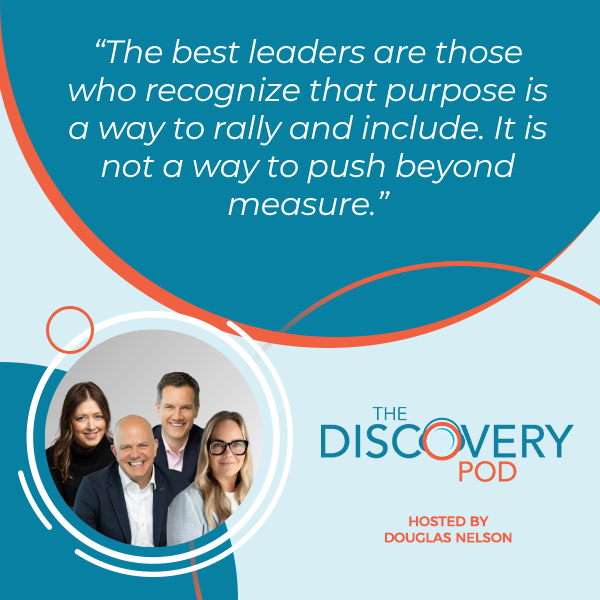
That acknowledgement that change is hard and it is hard to pursue. There is a reason why we’re doing this, there is a reason why we’re doing this together. The best leaders that we have a chance to work with across the spectrum are those leaders who recognize that purpose is a way to rally and include. It is not a way to push beyond measure.
Just to pick up on that, that theme a little bit as well in terms of transformation. What I found really striking with all four leaders was their own reflection on their own leadership, their own leadership journeys, and their own changes. We’re talking about change management, we’re talking about transformation. They themselves have gone through very significant journeys in the current roles that they talked about and elsewhere.
Some of them were very open and very honest about some of the very vulnerable moments they’ve had in their career that has brought them to where they are today, as well as listening to themselves, picking up on this listening thing, picking up on the listening piece around how they themselves make decisions and bring others into the decision making process, how their job looks different in the context of the organization that’s evolving and changing. It is a very iterative process that is both inward-facing and outward-facing when dealing with teams, oneself, an organization, and lots of different personalities and constituents involved fundamentally.
One of the things I really loved about the format of the dialogues was that it was a way to have a conversation that we do not typically have, or you would not have at a conventional conference. There was a rawness to the experience. It was a very intimate experience where mistakes were shared, and challenges were shared. One of the third themes that I want to spend a couple of minutes on is the overwhelming sense that internal focus was incredibly important. It was not a matter of having this great grand ambition and then inspiring your team and your board along with your donors all at the same time.
All four leaders talked about the intense, intricate internal work that it took to advance our organizations and get them ready for the change that was going to happen in their jobs. Christoph, when you’re doing searches for CEOs and executive directors, often the boards are like, “We’ll let her land on the ground. She has got at least six weeks before we expect everything to be ship shape.” Listening to what we heard from those four very successful leaders, how does that connect to what you hear from hiring committees for CEOs who are keen to hear their CEOs set the world on fire right out of the gate?
One of the interesting pieces that I heard was a little bit about pace. In hindsight, perhaps the panelists thought that they could have gone faster in the changes that they’ve made. In fact, what they did right was moving at the right pace fundamentally. Something I talk with a lot of committees about, a lot of EDs about, is really setting pragmatic, realistic targets, thinking really critically about an onboarding process that sets up this person for success. Realizing that the culture of an organization, the team, the people, the vision, the strategy, all these things that we’re talking about fundamentally add up to a really cohesive fundamental organization that needs to be shepherded in the right way.
Reflecting on what we heard in the discovery dialogues was about listening again, to be really thoughtful about what it is that both what we’re looking for and the direction fundamentally we’re going in. If there are any inconsistencies, if there’s anybody that is going off on their own, if there’s some board members or team members who do not necessarily appreciate or understand the vision, the direction, or the strategy, identify those things early to unite the group, unite the process, whatever that might look like fundamentally.
If you want to get there, you have to start here. Share on XIdentifying them early and allowing space to work on them. What I think it was Angela who said, you know, in hindsight, maybe we could have moved faster, but no, that’s where you want to be. You do not want to be saying, “In hindsight, we should have gone slower.” That means you’re doing it right when that’s your thought coming out of it.
It was Aaron who was talking about it very deliberately as they were talking about the structure of the organization. They were talking about some of the changes that they were going through, the transformations at Kids Help Phone. It should feel different. Again, it’s that piece around culture. It’s that piece around reflecting what it is that we want to do, what we want to be when we grow up, fundamentally. This is going to look and feel very different. Accepting that. Coming back to change management, different people come along with change, and accept change in different ways at different times. Being very thoughtful about that, being very deliberate, with intention fundamentally is very important.
Even in that, being comfortable in discomfort that Aaron was talking about, I thought it was really powerful when we were designing a process that separates the society, the work of Kids Help Phone, and spinning out the philanthropic foundation. He said, “I was a vice president at Kids Help Phone Foundation.” I did not actually have a job anymore, and I had to be on the dock and had to be okay that it was possible the ship would push away from the dock, and I would not be on it.
Everybody hears him say that like, “He’s so great.” Maybe that self-awareness is probably why he got to be the captain of the ship that moved away from the dock. A really good example of the self-awareness of what it takes to be in these situations, to be leading these kinds of changes. It is not the hopeless, hapless self-sacrifice. That does not get you there. Really that using your best professional self and understanding that this internal change, the focus on the change internally is a necessary prerequisite for that external transformation.
That self-awareness, every one of those four leaders that we had on stage, like that was shining through in all of them, is that they knew who they needed to be today, what the organization needed from them later. They had the foresight to change themselves for that. Also, tell their team members to call me out if I am not there.
That’s a great point, Ainsley. They all had that self-awareness. One of the things they did not say, we have ascribed it at a couple of points in this conversation. There’s been a reference to them being servant leaders, but that is not how they talk about themselves. It is one of those things where, like, whenever you’re in our work, when someone tells you, “I am actually really smart,” or “I am actually a really kind person.” You’re like, “Why do you feel the need to tell me that?” Sometimes when people say, “I am a servant leader.”
I am like, “We’re going to need to check against delivery on this.” It really stood out to me that none of the four leaders labeled their leadership. They were so clearly showing up as their authentic selves, trying to do their job, learning, and acknowledging that they were making mistakes. There was no way on the highway that came through. It is hard to imagine any of those leaders implementing that in any context within their organization. We focused internally, and then it was the conversation about how you take that change as CEO?

Transformational Change: Real organizational preparation means recognizing that you can’t do everything at once; sustainable success requires prioritization and careful calibration.
You’ve led this change, led your organization to this change. Now it’s happening, or you’re in the final push to make it successful, and it requires a very different CEO to show up on Tuesday than was there on Monday, which is why we need to be externally focused. We’ve built the engine, we’re on track, here we go, and needing to be externally focused. Anyone in the group, feel free to join in here. Who, what did you hear about them making that transition? I heard a deliberateness on the part of at least a couple of them.
I heard them say that is when you really need to trust your people. Reflecting back on all of the good prep work that was done to create the space to achieve the goals, now you need to let them fly. Having the faith or the confidence that you’ve put the work in and the team is ready. There always comes a time when we have to take a bit of risk and go for it, but they all prepared properly. That is what increases confidence when you’re actually rolling it out.
One thing that really jumped out at me for all of them in some ways, and again, they did not explicitly say this, but these were new challenges, these were larger challenges, the scale and scope were very different in some cases. Sometimes an international move, sometimes an organization develops, you know, going in two different directions, some significant capital projects. All of them, to varying degrees, had done similar things before, but they really pushed themselves.
They really stretched themselves. Again, that vulnerability, that openness to share the lessons learned, I found very compelling because we can all take inspiration from that in people pushing themselves. I was talking to someone earlier today about this very fact. Sometimes people see more in us than we do ourselves. They were both given the confidence and have the confidence to really stretch themselves and get out and do some great things.
Behind the scenes, I think they are great staff, great boards. The fact that they can really pull together and unify what are surely some disparate, challenging conversations going in some different directions at times. All that happens behind the scenes. They do not talk about that on the podcast stage, but we know that they’re facing these challenges and are able to do that with great positivity, the ability to listen, and grow from there. I found that very compelling.
That is what makes them and this work human. Deb, I think, is the one who said, “We recognize that our team is made up of real people who have real lives outside of work.” Acknowledging that and figuring out how to support them will inevitably strengthen the team and help you reach your goals. That continual listening and checking in is so important.
Moving From Ambition To Action
I want to go to the last thing we identified. It is almost so obvious. It was surprising how profound it came across in both conversations. In order to seek these transformational gifts, to seek and build towards these transformational moments, organizations first must be willing to transform themselves. That is the internal focus. The other thing that came through all of them was that the ideas have to be big. They cannot be incremental. They cannot be more. That concept of ours is big enough, really, and stuck with me. I’ve taken it into a number of conversations with clients subsequently. Do you feel like this idea is big enough? Is there another way to push it? I am curious, again, how that landed with you.
Big change requires big aspirations. Share on XIt is also, are we courageous enough to engage everyone in dreaming about what that could look like? I thought it was so great when Aaron said, “We just never asked ourselves if we could dream that big.” What would it look like if we really were financially sustainable enough to address the problem on the largest scope? Having the courage to have those conversations, to dream up what it will look like, particularly when you’re playing such an important role in that intersection of government and business and the social profit sector, is being asked to solve such complex problems. It really takes that courage, and all of the leaders that we spoke to, I mean, and all of the leaders that we’re working with are all taking those big steps to do big things.
It does come back to some degree as well as the philosophy of abundance, looking at things from a perspective of abundance. A lot of the questions, after the podcast, came from audience members who may have been in smaller organizations that think, “We do not have your resources. We do not have your scale. We cannot do that.”
Big is a relative term fundamentally, but that aspiration, looking at things to build like that, I think, I cannot remember who said it, maybe it was Aaron, more for what? What is it we want to build towards? What are our aspirations? You can still have big aspirations and be a smaller organization, but think critically about what that might look like, what you need to achieve that, because big transformative things are not just at the scale of larger organizations. We can all do it in our own way.
That’s really great. Were there any big surprises from the conversations?
It was not a surprise because I did expect this from such strong leaders that we invited to participate, but I was still impressed and amazed by just the confidence that they had that was paired with humility, and that’s such an important and delicate balance. I was not surprised because I expected it, but it was so lovely to see. We had such an incredible group of guests and speakers. That, to me, is what makes the work that we do and the work of the sector magic.
With that, I mean, those are the paragons really of what we talk about, emotional intelligence, ability to reflect, have a sense of humor, be humane, ego, and adaptability. Pairing that with the ability to do all that on stage and come across that while you’re being recorded for a podcast in front of people, that’s hard to do. I should not have been surprised, I do not think, based on who we had there, but just the warmth in the room, considering that these were large rooms filled with people that did not necessarily know each other, that really came across quite strongly.
It was really inspiring. As people were talking about their challenges, there were so many nodding heads in the room. As people talked about the learnings and that day that you show up and it’s really hard or that hard conversation you’ve been putting off, today’s the day you’ve got to have that conversation. There was such a sense of fellow travelers with a shared experience in both of those rooms. It was really inspiring and quite humbling. I was proud to be a part of it, and I was proud to know the people who were participating in these conversations, both in the audience, certainly as the four individuals we had on stage.

Transformational Change: Aspiration and big, transformative thinking aren’t just for massive organizations—every team, no matter its scale, can embrace a philosophy of abundance.
Doug, I have a question for you, though. As the host of the show, as the person on stage asking questions, was there anything that surprised you in the moment that may have caught you off guard?
The ease with which the conversation became one of candor. It’s what we were hoping for and the pre-conversations we had with the guests. They wanted to do well, and they were asking lots of questions. What showed up was just four really great human beings talking about a real journey that they and their colleagues had been through. It is not a surprise, but it was so hard to get any of them to take credit for anything.
They were like, “You did a really good job.” I didn’t know I was there, but mostly I just held the door open for this great team and this amazing board. They meant it right. They didn’t. It did not have that false quality of, “Do not look at me. Please applaud.” They were very there. It was really authentic. I was surprised. I do not know. It is tough. I was really proud of how genuine the conversations came together.
The feeling in the audience. You were on the stage, Doug, you did not get to experience how it felt to be standing in the audience and the warmth and excitement that everyone had to be there and to be part of it.
Really cool. We should do more of these. Somebody talk to Kirsten McInnis on our team to make sure we do a few more of these in the next year. As we bring this conversation to a close, as we do, we always want to end with what are you looking forward to, Jen?
I am genuinely looking forward to more of this work. We get to show up at moments of transition with our clients when they are working through difficult moments along the trajectory and honing our practices so that we can help move them forward faster is such an honor.
Ainsley?
You don't need to be right for each step, as long as each step takes you closer to the outcome. Share on XI’m really looking forward to more in-person work with our clients. All of the work that we do with them is energizing. Getting together in person really creates that environment that makes the work fun. We need reminders that this is fun. As Jen said, we get to do this work. That’s what I’m looking forward to.
I cannot put it any better than that. I am not going to try. I am just going to say I am very much looking forward to the next Discovery Dialogues. Now that we’ve got some live podcasts, a lot of people said that they appreciated coming to their first-ever live podcast recording. Putting that aside, as Jen said, the warmth in the room, the ability to act as conveners in this great community of social profit, volunteers, staff members, donors, supporters, whatever that might look like. We’re all involved in the sector in various ways, and being able to gather for such meaningful, open, warm conversations is really quite profound and moving, so I’m looking forward to working with both.
Me too. What a wonderful way to celebrate our sector, to really underline the commitment that we have here at the Discovery Group to focusing on the abundance in our sector rather than staying anchored in the scarcity. We had four great examples of that, and my thanks again to those guests for being a part of it. Looking forward to doing more of these Discovery Dialogues and looking forward to getting back to work with the three of you. We’ve got a lot of great work to do. I look forward to that every single day. Thank you for being a part of the show.
Thanks, Doug.
Thanks. See you soon.
Onward.