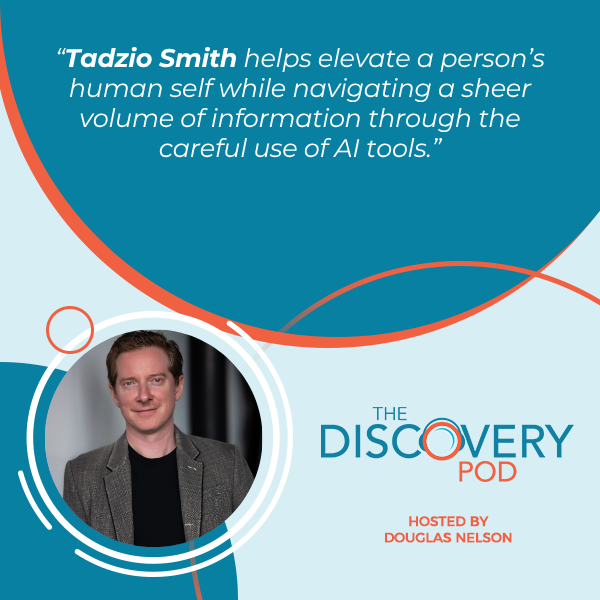
It is quite ironic to use AI tools to help human skills, but one company out there is doing exactly just that. Douglas Nelson sits down with Tadzio Smith, Co-Founder and CEO of Rapport, where they tap into the human side of AI to increase the emotional intelligence and people skills within organizations. He explains how technology can help build more timely and effective human interaction to prevent burnout, improve collaboration, and boost productivity. Discover why humans still have a great place to work in today’s highly digital world because of their authenticity and clarity.
—
Listen to the podcast here
The Human Side Of AI: Strengthening Culture And Leadership In Nonprofits With Tadzio Smith, Co-Founder & CEO, Rapport
Welcome to the show. I do not think I have been in a single conversation with a senior executive of any social profit in the last few months that has not had a question around artificial intelligence. Boards are asking, teams are asking, what is our AI policy? We wanted to share something that we found that we thought was interesting, and something really positive that put the human heart at the center of the conversation around artificial intelligence.
Beyond the large language model, the death of the em dash or the creation and renewal of the em dash, or how we can create more AI-slop donor letters. We wanted to share something that we found we thought was really special, which put the heart of our work at the center of this AI technology. It could be something worth exploring or at least a way to talk about AI in a new way with your leadership teams, with your whole organization, and of course with your board.
I am joined by Tadzio Smith, co-founder and CEO of Rapport. A company that uses AI to help build skills that matter most at work, including trust, communicating clearly, and creating sustainable team performance. He has led multiple AI product startups, with Rapport being his third AI company. In this conversation, Tadzio talks about the transition from being a professional opera singer to a technologist to co-founding Rapport with Van Jones.
We explore the friendly side of AI, how technology can support more timely, effective human interaction to prevent burnout and build and sustain a culture. This is a look at what is possible from the bright side of the moon. A look at building from abundance when it comes to artificial intelligence. Please enjoy my conversation with Tadzio Smith.
—
How Rapport Elevates People Skills Within Organizations
Welcome to the show, Tadzio Smith. It is so great to have you on. This is going to be a special episode. Typically, we are talking to CEOs and founders of social profit organizations across Canada. We are going to be talking about a really interesting tool that I believe holds a lot of promise for leaders in social profit organizations to connect with and build the culture within their own organization, and to talk a little bit about more of that. I am so glad to have you here. Tell us what Rapport is and what is the problem you’re trying to solve?
Thanks, Doug. I’m excited to be here, and thank you to everyone who is tuning in. We are building AI to increase the emotional intelligence and people skills within organizations. We are in a really intense moment that does not always allow us to fully appreciate how difficult it is to work together right now. This is actually felt quite acutely in the social profit sector. I have a really great co-founder. He has been a social entrepreneur his entire life.
He is more known in the US than in Canada, but his name is Van Jones. You might know him if you watch CNN. He has a framework that he likes to talk about the workplaces that we’re in right now. He calls them 3D workplaces. These are often distributed. People spread across different locations and time zones and screens and are diverse across age groups, gender, race, and geography.
Workplaces are also increasingly divided and not just by politics, but by stress, overload, or all the issues that can really turn a Slack channel into a conflict zone immediately. This is the first time in human history that we’re asking people to work together that might look different, love differently, vote differently, and pray differently. On top of this, you’re doing this over Zoom, you’re trying to manage a team, and you do not even know if the people you’re talking to are wearing pants. It is a really difficult environment to lead in.
I find it best not to wonder about that last one.
We need technology to really work on our human skills, our emotional intelligence at work, our ability to navigate each other successfully, and get through these times. That is what we focused our technology on building.
That is really cool. One of the things associated with the report that really jumped out at me is the idea that when AI makes everyone smart, EQ becomes the moat. Maybe you could help me understand or unpack what that means.
It is a really interesting time with AI, and everyone is grappling. I have been fortunate to be working in AI for about ten years. I have seen really different iterations of this technology. The things that we have been training people to do, think, the past 10, 15, 20 years, it has all been about, let’s get our kids in STEM. It turns out those areas AI does really well. There is this fundamental question that we’re all asking, which is, where do humans fit in this new world?
There is a really great place for humans in this new world. I really do work alongside this technology, but I think the skills or the human premium shift. Organizations used to have ways of hiring people, which is you look for those societal indicators that this person has a really high IQ. They went to the right schools. They got the right degrees. They got the right grades. All that can be rethought right now. The new skills are how well people read other people.
How well do people navigate conflict, build trust, and collaborate under pressure with all these new tools? There is a race right now for all these organizations to start using AI, and soon everyone will have the same AI. It comes back to the differentiator being the people. Those are the skills that I really love working on, building those people skills. No one is really developing those at scale right now. I see the future of the workplace as these are going to become increasingly important.
There is a race right now for organizations to start using AI. But the differentiator remains in the people. Share on XThere is a lot there, including a phrase I have never heard before, which was the human premium. That’s the moat that we as humans have against the robot overlords. Do I have that correct?
Exactly. It’s interesting, you look at, there has been a lot of talk around organizations, laying people off for AI with AI. One of the organizations that we have been doing some testing with, McKinsey & Company, recently announced that they were laying off 25% of their employees in their HQ type environments. They’re trying to have a one-to-one ratio with AI agents and people, but they’re also increasing by 25% the population that is dealing with clients. That is more of the people-focused skills. There is a really incredible future. I just think that for humans in the workplace, I just think that what we do is going to change a little bit.
That is really cool, and it reframes what success looks like. What I hear a lot in my travels through my work here at The Discovery Group, from our clients and from CEOs across the sector, is that every board is asking, “What is our AI strategy? What is our AI strategy? Including last week in a conversation, a board member said, “How many people on our team are we going to be able to lay off because of AI?”
Shrink the team. The CEO said, “We’re going to be able to spend more of our time on the donor-facing human connectedness.” That is what we are building this for. It is not about getting smaller. It is actually about growing our organization and growing our capacity to build relationships. I felt like I was at the perfect point in a Hallmark movie where the music would crescendo.
I was like, “Yes, that is exactly what we need to be focusing on.” I want to come back to report in just a second, but you have well established your credentials in AI, saying that you’ve been involved in it for ten years, and many of our audiences may have been, “Has it really been around for ten years?” How did you come to find yourself in this artificial intelligence field and build up to Rapport?
It was an unusual path, and my life has been filled with them. I used to be a professional classical musician. I was an opera singer. Even that was a bit left field, to be honest. When I was in high school, my best friends were musicians, and they needed a singer for a band, and I volunteered, and I had no idea how to sing. I started taking singing lessons, and the singing lesson of the teacher happened to be an opera singer.
Over time, she said, “Your voice is really suited to opera. You should think about it.” I was not interested in opera. I started to listen to it. I thought, “What an incredible challenge.” Three degrees later, I went to New York, did my master’s, started a career, sang at Carnegie Hall and the Get Center, and traveled. I did that professionally out of school for about eight years. I just got tired of being poor. I thought I should get into technology.
Not the social profit sector, but technology. You made a good choice there.
I could really use some health insurance, but the one thing that drew me was that I was really interested in entrepreneurship, as well. Being an opera singer or a classical musician is actually very similar to being an entrepreneur. You are an independent contractor, and you’re always auditioning. I felt suited towards it. My first company was an organizer of a startup to help singers and actors in places like Victoria, where I grew up on Vancouver Island, access the best professionals in the world.
It was an online coaching platform where we had coaches from New York. We had the 70% of the Broadway casting directors, we had the leaders from some of the great music schools like Juilliard and McGill, and you could log on and actually get feedback from them for a really affordable price. I was trying to solve some of the problems that I had good in growing up or some of the problems I had trying to start my career in opera, and doing that on Vancouver Island.
I would literally send my CD of myself to different schools and say, “What do you think?” Try to get feedback. That was my transition into technology. From there, to be honest, I got lucky. About ten years ago, I got hired to lead a product at a company that was starting to use AI in the applicant tracking process. I got introduced to that technology. I led a product at an AI company that was using AI to help customer service agents be more empathetic in real time.
There was a different AI world. We had to build our own models and tag the data. Now all these things come out of the box with these new frontier models. I have seen it through different iterations of the technology. There have been these different points in time where AI was like a really big hype. This is definitely a moment where the technology is living up to the hype. It is a different world.
Bridging The Gap In Work Environments
It’s very cool. For our audiences who are leading organizations that have tuned in to us as far as, obviously, opera to entrepreneurship, to AI, to Rapport, they’re along for the ride here. Someone says, “I want to learn more about Rapport. I want to focus on what it can do for the culture of my organization to develop the people in my organization.” How does Rapport answer that question?
We see this as a really critical problem right now, given the environment we’re in, but every organization spends so much effort trying to define what its culture is. How people should lead or collaborate, or treat each other. There are value statements, there are missions, there’s training, there’s leadership frameworks, expected behaviors, etc. We find there’s often a gap between what you define to them and what people actually experience day to day.
Your culture lives in training decks and value statements, but whether that shows up when a manager runs one-on-one, that’s a different story. We see two reasons for that gap. One is that organizations do not have a continuous signal of what’s actually happening. Often relying on surveys, maybe once a year, and hoping that nothing breaks in between. Moments that matter. The manager is about to have a difficult compensation conversation, or a teammate needs to navigate conflict.

Human Side: Your work culture lives in training decks and value statements. Whether that shows up when a manager runs one-on-one is a different story.
Usually, they’re just winging it, trying to maybe go to ChatGPT now and get some generic advice. They do not have support that’s grounded in the company culture, and then what’s actually happening on their team. Those two gaps traditionally have been treated as separate problems. You have this sort of like surveying and then coaching. That is why neither of us feels solved.
Survey tools collect the signal, but then they leave it to someone else. Everyone has run those annual surveys. You’re like, “What do we do about this?” Are we even asking these questions? Turns out no, by the way, if you do not, if you’re not able to take action on survey data, it’s actually much better just to not do surveys. That’s a big problem.
It’s also not much of a solution.
That’s right. We’re really trying to treat those two things as an integrated product, Rapport, both combined active employee listening and AI coaching at the same time. The coaching is grounded in a company’s cultural materials. Just really short, just so I can visualize how it works. Rapport integrates into the tools people use at work, whether that’s Teams, Slack, or email. It checks in with you a few times a week. It’s really fun.
It’s often emoji-based check-ins, like, “What are you doing? What do you need? What’s going on today?” It takes 30 to 60 seconds. From that, we get this really great signal of how people are doing. It listens, and it learns about each person and each team, the organization, and over weeks, it understands the patterns. Who’s trending towards burnout? What does team energy look like? What are the barriers that are coming up? It can coach people.
It can coach managers before they go into a one-on-one about what’s happening. It can coach teammates. You might be going into a tough conversation with someone you do not know. How do I go about that? It can know the preferences of your coworker. He really likes feedback, direct to the point. Here is how we do that in our company culture. It gives people the support they want in the moments they need it. It’s really exciting technology. I love building it. It sounds counterintuitive, but it creates more human workplaces, which is what we want. We want people to bring out their humanity more at work.
Four Building Blocks For High-Trust Teams
That real-time understanding of what is actually happening in the organization. You mentioned the coaching, and I think it’s really important to emphasize this because this is what I found to be, like I’ve said, cool enough times already in this podcast, but really fascinating to me was that coaching is really based on four behaviors that act as the building blocks for high-trust teams. Can you talk a little bit about where that source of coaching information comes from?
There are a number of areas where the coaching information comes from. It does come from a lot of the research that our chief scientist, Dr. Peter Coleman, runs at Columbia University. He has got a great lab called the Difficult Conversations Lab. It also references, for example, a company’s frameworks, their cultural materials, and also how people are doing and what their preferences are. It’s really important if you’re going to go into a conversation with someone.
If their dog died last week, my dog did, and I’m really still crushed by it. It’s going to actually be really important for people when they’re talking to me at work to maybe take that into consideration that I might not be in a great space today, based on what I have been going through. All these things actually really matter in terms of how you coach people to communicate with each other.
There are these key ingredients to high-trust work environments or high emotionally intelligent work environments that we’ve gleaned from the research that are baked into not only the coaching, but the product. Just to share some of those, actually, you do not need Rapport to implement these things. There is a lot of research on these high-trust environments, but there are four that I think are really interesting that you do not even need our software to do. You can implement it on your own as well. I could go into all four.
Please tell, what are those four?
One of the things that turns out to be really interesting is what is called the power of initial conditions. What that means is that when you begin interactions, how important the first few minutes are, and you can see this in all kinds of settings, whether that’s in hard conversations, the emotional tone of the first couple of minutes turns out to have this huge impact on how the entire conversation goes.
For anyone who has gone through marriage counseling, with Gottman’s highly interesting research on this. They can predict with over 90% accuracy whether a couple will get divorced in five years by how the first three minutes of a tough conversation go. That is mind-boggling. It turns out, these initial moments that often, at the beginning of a meeting are often considered throwaway, turn out to be massive. Overindex on how interactions start, really give that, be intentional about that. It really does pay off. That’s one of the first stories.
The initial moments of sale, which are often considered throwaway, turn out to be massive. Share on XIn creating clarity and connection. What was one of the other ones that really jumped out at me, because the idea of being supported by technology to enhance connection may be hard to get your mind around initially, but it kind of makes sense. The technology may help clear away some fuzzy thinking and really allow you to focus on the person that’s in front of you.
That’s a great way to put it. We’ve really seen that leaders have to be great at both, as you said, creating clarity and sort of task-focused leadership, being able to set goals and understand what people are doing with that. Also, that caring side of leadership. It is usually leaders who are good at one thing. We have all had those managers who are great at one of them.
They might be really personable, but they’re really not that good at driving results, or they’re really good at driving results, but they seem not to care about it at all. You really need that balance. One of the tricks that comes up in the research is that this does not come naturally to people. It’s just asking the right questions on a regular cadence. Just asking, in every one-on-one or every meeting, certain things, certain questions that are devoted to clarity.
Are simple things like, “Are you clear on your top focus this week? What’s one thing slowing you down this week?” More things on the connection side, “How’s your energy today? Is there anyone on the team you’d like to thank or recognize who can actually build those skills for leaders and create the conditions where they can show both clarity and connection?
I really like this show. We’re somewhere in the mid-300s in terms of episodes of talking to leaders about what it takes to be successful in the social profit space and the tools that are required in my work at The Discovery Group and in my career before moving onto the consulting side. There are leaders where this just seems intuitive, like they really get it. I could think of some of the single-skilled managers I had growing up.
Can Clarity And Connection Be Taught In Leadership
As you were describing that, I was thinking of their names and decided I’m probably not going to share them on the show, but I assume they know who they are. Anyway, but also I’ve had leaders who really did have that clarity and connection. It is something that I see in really effective organizations today at the level of the board and the level of the CEO or the head of fundraising. It seems almost intuitive for some folks. Is this a skill that you think can be taught?
It is interesting because those people’s skills, you’re right. When you look at the great leaders, most of them, over time, are quite often really high in the people skill emotional intelligence department. Traditionally, that takes years to develop. We have been thinking of ways that we can really speed that up. There are little things in the product that we do when people check in, and our technology notices that maybe someone’s struggling a little bit. It will actually ping the leader and just say, “Now is a good time to reach out, and here is a way to start that conversation.”
We do not want to tell them how to have the conversation. We do not want to do their job for them. We want to build the skills, but we can catch those moments that are hard to catch in digital environments. What’s funny, Doug, Rapport asks questions. A lot of the questions are about clarity. It might pop up at the end of the week and say, “What was one thing our team should continue to do next week?” It’s really great information to capture. You can know what is working really well on a team, what is not working well on a team, because it’s not just spoken in a meeting.

Human Side: We want to build the skills, but we can catch those human moments that are hard to catch in digital environments.
The data is captured. It can be analyzed. You can see trends. Can see, “This is working really well in this department. Why don’t we do the same thing in the other department?” What people actually love about Rapport is that it often asks these questions, like, “Are you watching anything fun right now?” or “What’s a great childhood memory?” That’s actually the thing that we see like the highest adoption and that people really gravitate towards.
That has been a bit of a surprise, even for people who are working together in the office. They often do not take that time to really get to know each other, and they find it very fun just to be able to compare what ice cream flavors they like. It has been surprising, but it shows just how much we are all craving connection with each other. Often, we do not have the mechanisms that work for those little things to pop up.
As you were saying that I was thinking of, I had something here in our offices earlier. We are typically distributed across the country, and a number of colleagues were in town and we were all in so the office was really full, and at one point, there were six of us literally standing around the water cooler. It prompted one of my colleagues to ask, “What did you think of that episode of Seinfeld last night?”
It was like when was the last time this actually happened? We did have to explain what Seinfeld was to two of our younger colleagues, but the principle stood. Those moments of that naturally occurring in-person connection, even in an organization as small as ours, are vanishingly rare. It’s really interesting to hear that people are responding to that through the use of rapport.
One of the other intriguing things that’s related to this with high-trust environments is that we’ve seen that there are these foundations for trust, that there are these four blocks of how people build trust. One is that you sometimes trust someone because they’re really great. They’re they have a really high ability in something, maybe you have a really knowledgeable professor. You naturally trust them. Also, integrity, like do people, do they say what they’re, do they do what they say they’re going to do? Being consistent around this, showing consistency, is another big factor.
Benevolence, which means like, “Does someone have my back when I’m down?” It turns out that this is the single biggest foundation for building trust, and all the other three can slip. As a leader, maybe you’re new at something, you lack ability, you can build that, maybe you miss a deadline, the integrity thing that can slip. You can recover from that. It turns out it’s really hard to recover from a lack of benevolence. Those little moments, I got to say, like working with, I’m learning how to be a leader. I really am. This is to me. I look to other leaders. I’m always trying to improve.
Benevolence is the single biggest foundation for building trust within an organization. Share on XI still feel very much like a student to leadership. I look at the people around me and know Van Jones is really an exceptional leader. Of course, you learn by people’s actions, not so much by what they say, but by what they do. One thing that I’ve seen is that Van is really connected, especially in the US. There are a lot of people in his network who are very public figures. What I have seen over the past five years is that, inevitably, everyone today who is a public figure slips up once in a while.
They say something that’s controversial. When that happens, most people will just abandon them. They’ll just be like, “I do not want to, I am no longer that person’s friend,” or “I am not talking to them.” The one thing I’ve learned watching Van is that he never does that. Someone might step up, they might offend someone, they might get counseled, but he never just leaves them. He is always there to back them up in those moments and really listen to them, and how are you doing, and sees the full human there that everyone makes mistakes.
Now, granted, we’re not talking about like, he is not supporting Nazis. It is like he has got good people in his network, but everyone messes up. I have really seen that it’s a tactic, which I find really admirable, that when everyone else is abandoning someone, he never does that. He is always there. I think that those moments where you have someone’s back when you’re really down, maybe there is a moment you’ve had that in your life, like you were down and there was this one person who came to you and was there to show support.
That never goes away. That’s the most trust-building act ever. It’s the most meaningful act. I guess that’s a long way of saying, finding those moments at work where you can support someone when they’re down just ends up having such a big impact. It just makes us better humans in general, just makes life worth living when we’re there for each other. I’m really inspired by that.
Why AI Is Not About Technical But People
I imagine in an environment, particularly a number of the clients that we work with, have fully distributed workforces. The national organizations or regional organizations that do not have a head office. Everybody is at home, or everybody is in a shared workspace somewhere. Just the reminder to connect, the reminder whether it’s the flavor of ice cream or whether it is a more significant moment related to someone’s professional performance, or what’s going on in their work. The gentle reminder and the offer of, “Here is how it might start, probably goes a long way to get people to take you up on that or take Rapport up on that and start those conversations.” What are you hearing from the organizations that are implementing this? What is the early feedback?
We’ve gone through a bunch of different iterations of the technology. Every startup, we had initial rollouts that failed, but we are lucky enough to learn from them and just keep iterating. We’re iterating literally every week. We get feedback, we build, we get feedback, we build. We have got the software to a point where it’s working really well. It is sticky. It is like the organizations that use rapport, 70% of employees who have access to it use it every week. We do not punish them if they do not use it. We do not give them iPads if they do use them. They just have access to it.
That is going well. We have really good increases in manager satisfaction scores. The biggest thing is just that people use it because when people use it, then the data is good, and then the AI coaching works. It is a fun tool that people like to use. There are lots of learnings. One of the most interesting things as organizations grapple right now with these AI initiatives is that we’ve really seen that rolling out AI successfully at an organization, often it’s thought of as being like a technical problem. “How are we going to get this into our systems, and how do we set it up?”
I actually do not see it as a technical problem at all, or as a problem. It’s really a people problem. It’s really, how do you set up your people? Psychologically, how do you talk to them about it? How do you understand the environment that you’re rolling it out into? That’s actually the challenge. When you get that right, the tool integration can happen much more easily. We have definitely had some learnings to realm that we rolled out to an organization six months ago for a pilot.

Human Side: When AI initiatives are rolled out, it is often seen as a technical problem. But in reality, it is really a people problem.
About half the people never even tried it, and we realized they never downloaded the app, and we realized partially through that environment, the pilot that they were going through massive layoffs, and everyone knew it. They knew it was coming, and no one wanted to try any tool that would risk them sharing how they’re doing and then being laid off. We have since really no trust.
This does not automatically solve a low-trust environment?
Yes. It’s funny. It’s really just more about understanding. Had we understood that before going into it? We could have really emphasized how Rapport addresses all the security and all the elements around people’s privacy, and how the information cannot be used against you, and how everything you share is completely anonymized for trends and things like that. We could have done a much better job at actually helping those employees understand that this is a tool for them to help them get through these tough times and help them support each other. That’s a learning experience for us.
Moving forward, what we’ve done is we’ve almost taken more of a, instead of just rolling out our software and here’s our software. It works great, just keep it to use it as having a bit more of a consultancy approach at first, to really understand the context of the organization that we’re working with. We have change management experts that we’ve now brought onto the teams that work with the champions of an organization that we work with, and really understand what is going on. What’s the right way to message this? Who are the right people to try it first so that they can build trust with it and then sell it internally? That has been a really great learning experience for us.
What you’re describing is the challenge of change that so many organizations in the social profit sector, I’m sure, well beyond the social profit sector, are trying to scale now. Distributed folks genuinely caring about people have a harder time prioritizing that with just the sheer volume of information and tasks that are on people’s to-do lists. The reminder to show up as a human self, there is some irony that this is an AI application to help us do it, but you give some really great examples about how that can be used, and really great examples of how leadership, whether it’s with Rapport or any other AI support app, how leadership itself really comes down to human beings connecting with human beings.
Thank you.
What’s Next For Rapport
You are ready to roll. What are you looking forward to?
This is a big year for Rapport. We will have some news in the coming months of some really big partnerships with really great brands that have taken, honestly, a couple of years to get through that process. It is an exciting time for us. We’re going to start seeing the tool being deployed really at scale. I’m looking forward to continuing to spread the word of Rapport and to using this technology for good. We are not looking to replace any employee.
We’re really looking to use this technology to help people have better experiences at work, to help people feel heard at work, to support managers, to be better managers and leaders. There is a real use case for this technology to be framed in a way that is positive in the workplace. There are going to be lots of AI use cases that are great for downsizing, that’s happening, great. This is not what we’re doing. I’m really excited about this year.
Tadzio, thank you so much for making time to share the story of your Rapport, to share the perspective, and to share the reminder that clarity and connection are what make leaders great. Thank you for being on the show.
Thank you so much. It was a joy to be here.