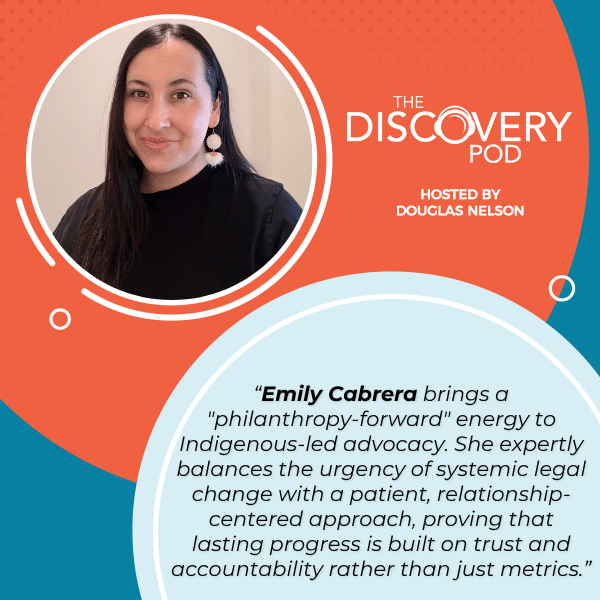
Traditional philanthropy in Canada has long been defined by transactions, KPIs, and metrics. But what happens when we shift the focus toward relationships, reciprocity, and the long-term stewardship of the next seven generations?
Today, we sit down with Emily Cabrera, Executive Director of RAVEN (Respecting Aboriginal Values and Environmental Needs), to explore what it truly means to be a “philanthropy-forward” leader in the Indigenous-led sector. As we navigate the complex, often clunky systems of charitable giving, Cabrera offers a roadmap for moving beyond the transactional—advocating for a model rooted in accountability, trust, and shared values.
Join us as we bridge the gap between conventional giving and Indigenous worldviews. We dive into:
- The power of relational philanthropy
- The indigenous-led legal frontier
- Moving the needle
Whether you are a donor, a leader, or an advocate, it is time to rethink how we mobilize resources. Discover how Indigenous organizations are building a future grounded in justice—and how you can extend your hand to support that movement.
—
Listen to the podcast here
Rethinking Philanthropy Through An Indigenous Lens With Emily Cabrera, Executive Director, RAVEN
In honor of Indigenous History Month, we’re bringing forward conversations that center indigenous leadership and indigenous organizations doing the work to advance justice, equity and right relations across the country. In this episode, I’m joined by Emily Cabrera, Executive Director of RAVEN, who leads philanthropic efforts to support access to justice and advanced indigenous rights in Canada. Emily is a philanthropy leader of Ojibwe, Mexico, and European ancestry and is a member of the Fort William First Nation.
Her work is grounded in the building of relationships that are rooted in respect, reciprocity and shared values. In this episode, she talks about stepping into the leadership of a movement-based organization, the emerging role of indigenous philanthropy in Canada. She also shares her commitment to serving the organization and the team that deliver the work on a day-to-day basis. Her optimism is what it takes to balance the patience required in the work she’s doing and continue the urgency of this purpose that she in her colleague serve. Please enjoy my episode with Emily Cabrera.
—
Welcome to the show, Emily.
Thank you so much for having me, Doug.
Emily, I am so looking forward to the conversation that we’re about to have in wanting to better understand the role of indigenous philanthropy and indigenous-led organizations across Canada. Your name and your organization come out at the top of any lists or as an organization that we wanted to learn more about. Also, a leader that we wanted to learn from. As we get started, Emily, tell us about RAVEN. What’s the purpose of your organization? Who do you serve?
The Purpose And Vision Of Raven
For full context and framing, I joined RAVEN in October of 2025. I’m a relatively new leader for the organization. RAVEN stands for Respecting, Aboriginal, Values and Environmental Needs. It was founded in 2009. It exists to support indigenous nations and expand access to justice and enforce their rights and jurisdictions. Our vision is a feature grounded in indigenous laws and legal orders where lands and waters thrive and all people live in just and reciprocal relationships.
We partner with indigenous nations to raise and steward funds that support indigenous-led legal action advancing self-determination. Nations will lead their legal strategies while RAVEN is the one mobilizing financial and public support. Their actions can proceed on their terms. We try to incur our work in indigenous leadership while investing in the systems that will sustain all our efforts in the movement. We contribute to that long-term legal precedent and strengthen environmental protection. Overall, more just an equitable future for all.

Philanthropy: We partner with Indigenous nations to raise and steward funds that support Indigenous-led legal action advancing self-determination. Nations lead their legal strategies, while RAVEN mobilizes financial and public support.
Quite an incredible scope and mandate. You mentioned you’ve been with the organization since October of 2025. What brought you to the organization? What made you say, “This is the organization I want to be the executive director of?”
I’ve always been familiar with the organization. I’m over here in La Quinta territory. As someone who’s been in fund development and philanthropy for over a decade and in the indigenous-led space. Whether it’s been language revitalization or in the higher education, doing versarries and programming fundraising. I go to events and there’s always a shout out to RAVEN in the land acknowledgment portion of an event. I was like, “RAVENs got those good grassroots relationships.” That was something that always caught my attention. Also, what drew me to this role is not just what they were seeking like to have someone that is philanthropy forward in the position but just the timing.
The organization is about seventeen years old. Most organizations go through so many different iterations within that time. Knowing that the RAVEN now is a lot different than back in 2009. Not because the mission changed but knowing as a person existing in this world that the need has grown and the need for this type of work has grown. It’s something that I was pulled into and the opportunity as a whole.
An important organization doing very critically important work. I want to come back to a phrase you said there that made me smile. That the organization was looking for a philanthropy forward leader, which sounds like how you describe a bottle of wine or something. More organizations should be looking for a philanthropy forward leader in my view. In the course of your career, you’ve worked at a number of organizations stepping into a movement-based organization. What did you find different from previous roles that you had?
Prioritizing Trust And Relationships In Philanthropy
One thing that I’ve appreciated a lot since joining RAVEN is how much trust and relationship building is at the center of the work. We could not be here as an organization without the relationships with the indigenous nations that we partner with. A lot of the time, when you’re in a role supporting a fundraising body, which is essentially what RAVEN does. It does a lot of things but we are seeking dollars to support this work.
When people think about fundraising organizations, they think primarily about donations. For us, it’s about relationships and accountability. We work in this space that’s somewhat contentious. It’s rooted in the histories of this country as to why we have to be here. It’s human at its roots. A lot of the work is making sure we’re showing up in a good way, listening well, and understanding that communities know and are the experts of what they need.
Being able to walk that talk is something that I feel is often missing in other organizations. It’s also because of the way RAVEN has been this grassroots organization that it has grown into, now we have nine active campaigns across the country and two funds. We’re in a position where we need to expand the type of fundraising that we’re doing and the type of awareness building that we’re doing. It’s this opportunity to see what that means for RAVEN as an organization. That’s exciting.
It’s remarkable. As an organization that has been growing and is movement-based, I want to ask you because this is something that is always very fascinating to me getting to work with a number of movement-based organizations across the country. There is so much energy and fuel and that sense of justice that drives people who most people that work in these movement-based organizations. As a leader, how do you protect or sustain or support your team through all the ups and downs of the work that you undertake?
I appreciate the question because it is a very real thing. Regardless of what movement you might be a part of, folks typically come into this work because they care about the mission of an organization. Burnout is real. People are so closely linked to a particular cause. If you feel that cause or those values aren’t being heard when you’re going out there in the world, it can create an impact. It’s also very challenging to balance. We know as a sector that we have metrics and things we’re trying to achieve.
Regardless of the movement, people are drawn to this work because they care about an organization’s mission. Share on XWe know that there’s systems in place in order to be successful in meeting our goals that are evident in many organizations such as move management and those KPIs that we’re all striving for. At the same time, there’s people. We also need to pay attention to that and ensure that we have the capacity and resources to do the work so that we are having the best impact that we possibly can. I will say that for an organization like ours that is indigenous-led, it’s tricky. We’re often operating within systems that aren’t designed for us.
The sector, as a whole, can be quite transactional or focused on urgency and competition. That’s something I’ve experienced in almost all my other fundraising types of positions. Also, it’s needed. We need those dollars. We need those funds and the work is urgent. It is long, so you need that consistency across the board. I’ve also learned it doesn’t need to always be that way. You can focus on relationships. You can focus on shared growth within the organization. Creating those spaces for dedicated time for professional development individually or collectively. Ensuring we have appropriately leaves for staff as needed.
As a leader, not asking questions if someone is taking their health and wellness time. It sounds so simple, but we don’t need to question that. It’s very important. Trying to embed some practices and learnings that I get from talking to other colleagues and friends in the sector has been helpful. I do believe there’s a different path forward when we look at our organizations that’s rooted in relationship and abundance.
Focusing on our partnerships and other metrics that may not be directly attached to a dollar or number of figures. Also, recognizing it is clunky and imperfect. I don’t know any organization that’s figured it out fully. I’m grateful to have a team that is focused with a growth mindset to move forward and go through that journey with me. It’s been an exciting time.
I appreciate the way you describe that and accept that it’s clunky because it’s clunky everywhere. One of the things that I’m always reminded of when we have the opportunity to work with indigenous organizations here at The Discovery Group. Not soon after we start working, someone will often pull me aside or send me a note or be like, “Can we have a quick call?” They’ll say, “Fundraising like the way conventional or the way it happens in Canada, is culturally very different than how indigenous organizations tend to operate. This is foreign in many ways.” How do you bridge that? Do you agree that that’s true? If so, how do you bridge that? How do you combine those two worlds?
Redefining Philanthropy Through An Indigenous Lens
I almost disagree in a way just because when we talk about philanthropy and what we are talking about here. We’re talking about generosity and long-term impacts. If you look at many indigenous world views which are diverse and I want to make sure that’s very clear. There are themes of extreme generosity within our community’s reciprocity. Taking what we need and giving away the rest. Everything is built on a framework of looking ahead.
When we talk about philanthropy, we’re really talking about generosity—and its long-term impact. Share on XLooking at those next seven generations and making sure that as an individual, recognizing how we live and walk through our day-to-day lives is impacting all our relations around us. I would say there’s quite a lot of cross-sectional themes. While many communities may not see that as philanthropy, it is quite intersectional. Sometimes, there’s that difference. When I think about Philanthropy in Canada now. It didn’t emerge from a neutral space when you look at how wealth was accumulated. Therefore, philanthropy now can’t be a fully neutral space.
The sector as a whole, charities, foundations, donors, advice funds and all that good stuff was developed within economic and legal systems that emerge during a specific period of time. These systems would determine who could accumulate wealth, hold property, establish institutions, participate in financial decision-making and also who could not. For indigenous people, access to those systems was historically restricted in many ways. Understanding that history is important. Not because it invalidates philanthropy at all.
It’s because it helps explain why indigenous-led organizations have historically had less access to philanthropic networks, capital and visibility and why we continue to see a disproportionate amount of resources directed to indigenous-led organizations. I believe the numbers are still less than 1% of all philanthropic dollars in the country. I did a presentation a few weeks ago and I told them, “I’d love to change my slide on that,” but I haven’t been able to. It’s unfortunate. I also think there’s that other side to this story, which is the opportunity.
Across the country, indigenous communities are building and learning their own philanthropic organizations. There’s more and more indigenous-led philanthropic organizations that are building something special. There’s different funding models, trust-base philanthropy, community-led philanthropy that is more in the framework and coming into mainstream.
Their strategies for resource mobilization and doing things like having a youth advisory or indigenous-led advisory. Those types of mechanisms are important. From a statistics standpoint, we’re also witnessing a shift. Indigenous causes account for about 3.3 of online charitable giving in Canada. It is one of the fastest growing categories of giving in recent years. There’s also understanding that 70% of Canadians say they believe they personally have a role to play in reconciliation. There’s this huge untapped donor potential.
It’s important to note that while there have been these funding gaps, our organizations already exist and are operating at scale. Often managing endowments, multi-million dollars funds. Therefore, the infrastructure exists for some more transformational gifts. My hope is, as we’re entering this generational wealth shift that all of us in the sector are very much aware of. That indigenous-led organizations are part of that conversation, too.

Philanthropy: How do you extend RAVEN’s hand to be part of the solution? It’s about reaching out, joining the broader conversation, showing up in spaces where few of us are represented, and building networks that create change.
My next set of questions was about those statistics that you just shared. There’s growing awareness. There is what I believe and what I feel and how I move through the world, a much greater awareness of the need for reconciliation and what that means in a maturing understanding of what that means. Maybe not in everybody but in many people.
As the leader of an indigenous-led organization, what is your advice to other indigenous organizations or what advice do you follow in your own organization about putting that philanthropic value proposition out into the community? There’s some people wanting to do things and not knowing what to do. How do you extend that RAVENs hand to be a part of that solution?
That’s what it is. It’s extending the hand. It’s being a part of the broader conversation. It’s showing up in spaces that maybe there’s not a lot of us in those spaces and building that network. One of the things that I have found to be incredibly helpful for me is building that network of people I can trust in the sector. Who work in a cross different organizations and being able to also be a person who can help them come up in the space just knowing where your safe spaces are. That’s been important.
That’s just generally for folks that are working in the space. As RAVEN, we have the opportunity as well to share what we learn along the way. We’re not going to be about hoarding information or hoarding networks or opportunities. We’re wanting to be part of essentially sharing the wealth of things that we’ve been able to encounter and overcome change and amplify other voices that are in the space along with us.
You mentioned earlier on in our conversation that RAVEN takes on a number of campaigns, a number of cases, a number of issues all at once. How do you decide which ones to take on?
The Indigenous-Led Governance And Campaign Selection Process
There’s certainly a huge need out there. Every week, we get different applications for either our main litigation support or for either one of our funds like community action fund or intervener fund. Everything goes through our indigenous-led advisory, which is made up of indigenous lawyers from across the country that review. They look at various qualifiers for the applications of what’s like to be heard or what’s like to move forward. We take that advice to our board.
That’s how our governance process works in terms of decision making. It’s one thing that, hopefully, folks contextually with the type of projects that we do. When it comes to indigenous rights, their inherent rights that weren’t necessarily like government forms. They come from the nation’s own laws and governance systems and long-standing relationships that they have. When Canada was formed, those rights didn’t disappear. Instead, they became part of an ongoing relationship.
One that continues to be defined and sometimes contested now. These rights, whether they’re inherent or treaty based or affirmed to courts, are recognized in Canadian law. Including under Section 35 of the Constitution Act and globally through UNDRIP, the United Nations Declaration on the Rights of Indigenous Peoples. They’re shaping those expectations around self-determination and consent.
One of the things that we look for with the cases we take on is making sure that the indigenous nation is at the helm and leading their own legal cases defining their own issues and strategies. Also, these nations have broader implications for how development, environmental protection and indigenous rights are balanced across the country. It’s not contained within the one nation that it would impact. It usually has broader application across the country itself.
There’s so much there. Maybe for our readers, what’s an example of a campaign that you would say is emblematic of the work of RAVEN?
I’ve got a couple but what comes to mind is Beaver Lake Cree Nation. In 2008, Beaver Lake Cree Nation launched a landmark legal challenge against Canada and Alberta over the unchecked expansion of oil and gas development in their territories. Their case argues decades of cumulative impacts from oil sands extraction like land disturbances, pollution and habitat loss. It has made it increasingly difficult to exercise their own treaty right to their community to hunt, fish, and live from the land.
If successful, their case could force Canada and Alberta to reform how oil and gas projects are approved, which sets a precedent that governments must account for cumulative industrial impacts on all treaty rights. That is one example. If it’s okay, I’ll share one more. The other one I have is Health Sick Nation who had successfully managed their ocean territory since time immemorial. However, it’s been many years since the Nathan East Stewart sank and spilled over 110,000 liters of diesel and heavy oils disrupting their way of life, economy, history and identity and their spiritual connection to the land.
The spill contaminated key shellfish, harvesting areas and critical habitat for the Northern Abalone. RAVEN is raising funds so that the Health Sick Nation can continue this litigation that would result in tougher oil spill regulations. This would be applicable from coast to coast across Canada. We’re acquiring British Columbia and Canada to consult with indigenous peoples on the environmental impact assessment and remediation following an oil spill and set a precedent for aboriginal title from the foreshore to the sea bed as well. All of these of course are impacting well beyond a specific issue in a specific community. It’s something that then sets a precedent for other communities that are facing similar challenges.
Balancing Patience And Urgency In Legal Advocacy
Thank you for sharing those examples. Listening to both of those examples, I can’t help but hear the timeline. The urgency of change needs to happen now because there are harms now and injustices. Both of your examples started at least a decade ago. How as executive director in RAVEN do you balance that need for patience? You’re funding a legal process that takes its time or has its own time with the urgency of the movement that you’re leading, which is to restore that sense of justice for indigenous people across Canada.
A lot of it is in some of the other work we’re doing as well. We spend a lot of time educating, storytelling, building relationships with supporters and helping people understand that these legal battles affect everyone. Also, that they’re not going to be fast. Sometimes folks are looking for that quick win or impact. A lot of that is through our storytelling and communications. Our ability to share updates to communicate directly early and often to our followers, our donors and supporters and making sure that people are feeling informed.
The opportunity is to be part of meaningful and impactful change. Bringing people along with us so that they’re seeing the story through to fruition, but also being very transparent. Not just the work that RAVEN does. Many of these indigenous-led organizations that are doing important meaningful intergenerational work often are passed down from one generation to the next. Someone who might start a project or program or litigation might not see it all the way through.
Having that understanding that’s not dissimilar again to philanthropy that what you’re doing is having impacts well on your lifetime. For RAVEN, it’s being able to be accountable, to be communicative and to share what we know when we can, and how we’re able to balance that and to bring people into the space with us in an accessible way. Also, a very real and communicating that we might not see the end of this within our time working at RAVEN or within the next decade even. We’re here and we’re accountable. We’re going to continue to show up for as long as it takes.
What’s interesting to me in listening to you while you share that answer. There’s no regret in the time or it may not be us. It could be the next, but a lot of resolve. That resolved for movement-based organizations and a lot of grassroots organizations across lots of sectors in the social profit sector space. That’s what it takes of leaders. That persistent resolve and a bit of a smile that, “This is hard. I’m going to show up on Monday and I’m going to do it again.” As a leader, when you have those days that are some days are harder than others. We have those hard days. Who do you call or who do you reach out to check-in and restore that resolve?
It is the networks I spoke to earlier. Honestly, though, it’s going to end up being my child who gets to hear all my stories about my work day, about the travel I got to do or who I got to talk to you. Every day is a little bit different. Sometimes, you need the perspective of a young person. Sometimes you need the perspective of a sixteen-year-old teen girl who is in a completely different place but has a world of optimism. That is what I do as who I choose to communicate, too.
Every day is a little different. Sometimes you need the perspective of young people, and seeing youth-led movements emerging is incredibly inspiring. Share on XShe must be so proud of her mom.
Likewise. She’s somebody who has seen the work. What’s exciting is this next generation. Every era of folks are more informed about the world around us and the impacts that we might have. To see my daughter and also the people that are around her as well that are looking towards the future and what type of roles they want to go into for herself. She’s interested in the environment and sustainability, so that’s amazing. We’re going to support that as much as possible.
Seeing some of these youth-led movements that are popping up is an incredible thing to do. One of the things that I worked on with our board chairs is how do we build that pathway into our work. How are we bringing people into our governance systems that will gain experience from my other being on our board or working with our organization as a volunteer? RAVEN has a robust volunteer program. It’s ensuring that we can have some access into the space to gain experience and see if it’s for them or not. Also, be able to be a part of work that matters to them.
You mentioned the board chair. I want to ask a couple questions about the board. It’s often that transition into a new organization or into that executive chair for the first time or second time that this is different than it was before. This is totally different than anything I’ve done before going from reporting to a boss to reporting to bosses. Depending on the number of people around the table. What has your experience been like at RAVEN as you’ve come on board and working with that board of directors?
It was honestly good timing for all of us because the board of directors has been with the organization through a number of transition periods. It was a smaller board when I started. It’s coming into the organization with just a couple of board members who were directly involved in my recruitment and onboarding. They already knew me by the time I got here and we were. That support was embedded. Having that transition period and the ability to continue to connect with board members over that initial period first year or six months or whatever that looks like is something that is a must do in organizations.
It was deeply helpful for that continuity of information. We’ve built this wonderful trust to the point where in the coming months maybe by the time this episode is out. There will be more announcements of others who have joined our board. We’re growing operationally. They’re also growing in our governance as well. It’s mirroring the type of change of growth at RAVEN seeing. That’s been exciting.
That does sound very exciting. Almost every one of your answers ends on looking forward. Any readers to the show know the final question I ask all of our guests. Emily, what are you looking for?
A Long-Term Vision For Indigenous Justice
That’s part of the way in which I move through the world and can still be optimistic and smile through any challenges because you have to look forward. You have to look at what’s next and what’s ahead. What I’m looking forward to is all the good work that RAVEN has. We made a new strategic plan. We’ve got some exciting values and pillars that we’re going to be working towards that’s going to see this work sustained in the long-term way that it needs more broadly.
I’m looking forward to a world in which indigenous rights are not just theoretical. They’re supported by indigenous organizations like RAVEN and are upheld through consistent donor contributions and support. Tangibly just on the ground like how folks can get involved if they want to. RAVEN is also going to be holding a virtual silent auction. That’s going to be launched with proceeds going towards our core operations.
That funding is super important and critical because it allows organizations like ours to be responsive and to support nations as needs arise and to sustain that legal advocacy work. I’m looking forward to being a small part of shaping that future and one where the legal foundations for development and indigenous-led justice are stronger, fair and grounded in respect.
If people want to learn more about your organization, where can they find it?
They can go to our website. It’s www.RavenTrust.com.
Emily, I want to thank you so much for making time to be on the show, for sharing the information that you did and for leading the important work that you and your colleagues do every day.
Thank you so much.