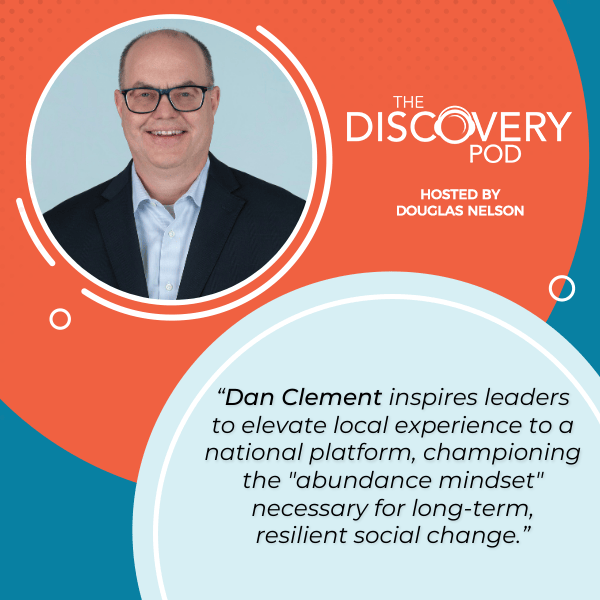
The landscape of local philanthropy and social change is constantly evolving, requiring organizations to innovate and adapt. Douglas Nelson has a great conversation with Dan Clement, President & CEO of United Way Centraide Canada, about the organization’s unique role as a “local impact, national platform” backbone for social good. Dan shares the three core pillars of their work—engaging Canadians, investing in frontline services, and community planning—and discusses how the movement is strategically renewing its business model to meet current challenges like the national housing crisis and shifting philanthropic trends. He also emphasizes the critical need for an “abundance mindset” within the social profit sector to drive resilient and long-term positive change across the country.
—
Listen to the podcast here
Local Philanthropy And Social Change With Dan Clement, President & CEO, United Way Centraide
We’re joined by Dan Clement, President and CEO of United Way Centraide Canada. Dan is a respected national leader with more than two decades of experience within the United Way movement at local, provincial and national levels. Dan has guided them through critical moments of change, bringing people together across sectors to strengthen communities from the ground up. In this episode, he talks about the changing face of United Way while retaining its core purpose across the country, the power of working locally and nationally and connecting the two on a daily basis.
Dan shares his views for the future of the sector, the role of leadership and the power of community to make a difference in the problems that are facing our communities across Canada. You’re going to enjoy this episode with Dan. He has a dry sense of humor and a clear vision for what will improve our social profit sector now and in the future.
—
Dan, welcome to the show.
Thanks, Douglas. It’s great to be here. Thank you for the invitation. I’m glad to join you.
The Unique Role: Local Impact, National Platform
We are going to have a great conversation. A lot of big issues are facing the social profit sector that in your role you have a very active role in those conversations and those adaptations, as well as hearing from many leaders across the country. I’m looking forward to getting into that. Before we do that, what is the role of United Way Centraide Canada?
I think a lot of people, a lot of your readers will know or might be familiar with our local United Ways across the country here in BC. We have United Way BC. We have 56 United Ways and Centraides across the country. Maybe a little tidbit, like we’re United Way in English Canada, we’re Centraide in Quebec. Interesting dual brand. You know we don’t have United Ways in Quebec. We are Centraide. Some people will often ask me like, “What’s United Way Centraide?” I say, “United Way Centraide is United Way, and United Way is Centraide.” You get to say it twice.
It’s also really important. We are working across the country, we are in all regions of the country, but we’re also in French and English and a bilingual movement. That’s an important part of our identity. United Way Centraide Canada, we are the national organization of this movement of local United Ways and Centraides. We play a particularly unique role within this movement. We are really here to bring the staff and volunteer leaders of the United Way movement together to think about what’s happening in philanthropy and what’s happening in social change and impact and where are we going as a national movement.
We also do things like brand stewardship and risk management and regulation of the brand. We set standards. What does it mean to be a United Way and Centraide, both in terms of governance, in terms of operations, but the delivery of mission. We’re also here to level up the experience of local United Ways and their partners at a national level. Our national office, United Way Centraide Canada will lead on federal public relations, social policy issues at the federal level. Think about the pandemic and what happened over that number of years. We were telling the story of local communities at a national level.
We really are the backbone organization of the United Way Centraide movement, both representing the movement, but in a lot of ways, just bringing this movement together. I often say that United Ways and Centraides are a community. Community of local leaders, volunteers, donors coming together both to make change locally, but then also see how we are building a better country together.

Local Philanthropy: We really are the backbone organization of the United Way, a movement we both represent and bring together.
I really appreciate that explanation. One of the interesting things or fascinating to me in a lot of social service organizations in particular, they have both an advocacy and a service provision mandate. I’m always curious when I’m talking with those leaders, how do you keep those two things in your mind at the same time, that advocacy role and that direct service role?
I think that just underlines how incredibly challenging those leadership roles are. In your role, you represent an organization that’s personified local impact. Local love is a common phrase in the movement. You do it at a national level. Local but national. Dan, how does that show up in your brain on any given Wednesday morning, the local and the national in the same breath at the same time?
I think about the movement in a couple of ways. One as local impact leaders, our DNA. I’m working at the national organization, but our DNA is local. What that means is deep relationships on the ground in communities, understanding how issues are playing out and need to adapt. At the same time, as we are activating and responding to big issues locally, we’re also a national platform. That’s how I think about it.
Let me get specific and think about this in a couple of good examples. Nowadays, housing affordability is an issue all across the country. What does that look like in every different town and city across the country? That’s local. What’s the housing supply? What’s the nature of affordability? What are the homelessness challenges? We know that’s a national issue. It’s happening across the country. Affordability is both the same and a little bit different in all regions of the country. We need to be able to say, “How is this playing out in British Columbia? How is it playing out in Toronto?”
I live in Scarborough. How is it playing out in Scarborough? At the same time, we can step back and say, what are the commonalities across the country? We know lower-income families have significant challenges. We know affordable rental is an issue. If I go to Perth-Huron in Ontario, they’re going to talk to me about affordable rural rental as a significant challenge. This idea of how do we connect the dots is to recognize that often, the same issues are priorities across the country.

Local Philanthropy: Our DNA is local. We keep relationships on the ground in the community, understanding how issues are playing out, adapting as needed, and responding to big challenges while staying rooted locally.
How we activate and localize the responses is how we get that impact. One size does not fit all, but the ability to talk about that issue and the experience across the country is how we marry the two. Does that make sense? That’s how I think about it every day. Local impact, national platform. Part of what our job at United Way Centraide Canada is to take that local experience and talk about it at a national level. There’s a role for the federal government, there’s a role for provincial governments, and there’s a role for local governments. There’s also a role for local philanthropists and those who want to engage regionally or nationally.
Renewing The Business Model & 3 Core Pillars
You can understand that everybody in Canada needs an overcoat in the winter, but depending on where you live you may need a different coat and depending on who you are, it’s going to need to be a different size. There’s a customization required in all that. Anyone who has been a part of our sector over the last decade and certainly accelerated by the pandemic has noticed United Way in different parts of the country looking at renewing its business model.
How are we facing the challenges of today? How are we facing the realities of how donors are giving and where people are giving? How do we anchor in a workplace campaign when people don’t go to the workplace anymore? All of those questions. From your perspective, how has that renewal taken shape? Appreciating it’s going to be different in different places, but your perspective on how that’s rolling out across the country would be really interesting to me at least.
So many different ways to talk about that, but maybe let me step back just a little bit and speak about what the things are that we do as a local United Way. I do think for those who will have known us historically, they might understand us, “I engage with United Way. I was part of my company. We did it at the work.” They understand us as a fundraiser and an investor. That’s really important. I think about the work that we do at three levels. The first level is part of our job is to actually engage Canadians in the life of their community.
That’s job one. It’s not like the fundraising is a byproduct, but the invitation to participate. Sometimes that’s through a workplace, sometimes that’s through participating in activities, sometimes it’s volunteering, but the invitation. We’ve raised about $600 million every year across the country, but 1 million volunteers and donors. A big part of our mandate is engagement. I think that’s really important.
The second part of our mandate, which I think a lot of people will understand historically, is our investments. We support an infrastructure of about 3,800 different essential frontline community services. That’s everything from after-school care for kids and tutorial and support. It’s community food programs, it’s the homeless and housing shelter, it’s domestic violence supports, and it’s seniors care.
Imagine your communities if we did not have that infrastructure that is supported in part and significantly from the United Way Centraide Canada movement. The third thing, which is really important and it’s one of the big areas of evolution in terms of the work that we do, is those experiences allow us as local United Ways and nationally to bring partners together.
From business, to labor, to donors, to community organizations and say if we are responding to the basic needs of individuals around food security and hunger, how do we come together and resolve those issues? The community planning is the third pillar of the stool. Engage Canadians, invest in a network of services, and then mobilize the community around shared initiatives that really get at the root cause. That’s the core of the business model. If that’s helpful, I want to give you a little bit of a picture of what we’re experiencing.
I think the other question, which is really important for leaders in the social sector, it’s something that we’ve experienced is while we’re doing those things, philanthropy is changing in Canada. There are fewer donors than there were and it is a twenty-year trend. Nobody is surprised by this. We’ve seen it. There are fewer donors, but those who are giving are giving more, which means the way we mobilize dollars and where it’s coming from is changing has real impacts on organizations.
Philanthropy in Canada is changing. There are fewer donors than before. Share on XCorporate partners who at one point were like, “Let’s get our employees and our dollars into community,” are now asking the question, “Well what is our interest as a corporate partner? What are we trying to change in community?” They’re looking for those points of alignment. I would say the same thing is with the government.
I’m going to say you’ve got to layer on everything from cyber security, new technology changes, which is fundamentally affecting our work, demographic changes. There’s a lot going on in our environment. One of the things I guess I would say to you is we spend a lot of time thinking about what do we do, but who are we doing it with? What’s happening in fundraising and how do we need to build the United Way for the future?
For us, this has been over a ten-year journey where we’ve really looked at what’s the nature of our organization. What’s our scale? Do we have the ability to attract talent who can help us with new technologies and digital engagement and participation and can we invest in new forms of philanthropy and fundraising? We’ve taken a hard look at our operating model.
I think you’ve seen this in your work in BC. We’ve gone from 108 United Ways over 10 years ago to 56. Not because we’ve declined, but because we’ve had a really hard look at what does it mean to build an organization that’s resilient and capable to both deal with a lot of the new challenges in our communities, but also new ways of working.
Local Philanthropy: We’ve taken a hard look at what it means to build an organization that’s resilient and capable of dealing with new challenges in our communities, while also adapting to new ways of working.
I can tell you a lot more about the story of how we got there and why that was important, but the leadership reason for having that conversation was we could see big change in social need and the way philanthropy was working. We sat down as executive leaders, as staff, as volunteers and we’ve asked ourselves, “Are we set up for success?” What could it look like if we envision a different future?
Dan, I think one of the art of what you just said there that I think is really important to underline for readers, the why you do the work and what you do in community isn’t what’s changing, it’s how you support, how you organize yourselves in order to be able to deliver that. The purpose remains the same. What you do on Wednesday morning when you come into the office maybe has changed a bit and in different communities would look different but that purpose remains the same.
That’s a really important point, what you just said, because change is hard as organizational leaders. I just want to reinforce what you said because when we thought about it. Change is hard, but when we said like, “What’s our mission? How do we envision doing it? If the mission is what we’re driven by, then we can figure out organizational change and dynamics.” If the organization is the most important thing, it just feels like hard change and we lose something. In our experience we always went back to why are we here? What’s our job? What’s important in the community and how do we ensure that we can play a role into the future?
Innovative Local Solutions & The Backbone Role
I think that anchoring in purpose as you’re doing is a part of that prioritizing abundance. This is what’s working about the United Way across the country and how that shows up in 56 different communities or hundreds of communities in which United Ways operate may be different than it was 10 years ago or 20 years ago or is different than it was, but in the end, you’re serving remains the same. In your role, because you get to see all the details, I imagine your office is just a series of televisions you’re watching United Ways across the country all day long.
Maybe that’s not how it works, but you do have that view as to what’s happening across the country. Are there examples that you can think of where organizations have made that pivot? Different United Ways have made that pivot in a way that’s been particularly effective, as you say, “Here’s an example that I hope others could follow.”
I think there are lots of different examples. Let me share a couple that come to mind. You’re in British Columbia. You’ve seen a significant amount of change. If I think about the work that United Way BC is doing, a couple of things at almost two very different levels but really interesting. At one level, this idea of engagement. They’ve got this amazing program where they engage local community neighborhood residents. I think it’s called the Hi-Neighbor program, where they engage them to become neighborhood activators, relationship builders.
If the mission drives us, then we can figure out organizational change and dynamics. Share on XThat is right at that core essence of what does it mean to be part of a vibrant community? Let’s invite you to participate in that way. On almost a totally different perspective, it’s more on that third pillar I talked about. How do we get at big intractable issue? The Better at Home work that they’ve done, where they’ve built a provincial-scale program with local delivery around seniors care. Two elements of the legs of the stool that I talked about.
I’ll give you a couple of other examples. I had a great tour in Perth-Huron, which is Southwestern United Way. Not United Way BC, much smaller towns and cities and a big rural community but highly innovative. One of the things that they identified was, I talked about housing earlier, a real challenge with affordable rural housing and rental housing. They’ve developed United Housing, which is the region’s first non-profit housing organization linked to United Way. They are now actively working in partnership with municipalities in smaller rural communities to create the possibility of building new rental and affordable housing.
When you think about United Way, would you have thought of us as housing developers? Not necessarily, but that’s an example of a local United Way saying we know our community and there’s a gap and how do we start to fill that gap strategically. You’ll see the same story in the Maritimes. Our United Way of the Maritimes has got a rural affordable housing strategy. It’s amazing. They are looking both at tiny home programs as we address the challenges of homelessness. They’re also looking at both rental and very low-cost ownership housing, working with a foundation and a developer to create new assets and housing in their community.
I’ve got a lot of different examples, but what they tell us is the role of United Way is not static. What we’re trying to do is understand what are the national issues, the big issues of affordability, poverty, housing? How are they playing out within our local communities? What are the assets on the ground? We don’t need United Way to build a housing corporation if we have great housing partners. If it’s a gap, we’re starting to see some of our United Ways innovate in that space to build something new in partnership with others.

Local Philanthropy: The role of United Way is not static. What we’re trying to do is understand the big issues of affordability and housing, and then, how they are playing out within our local communities.
How do you work with the many different United Ways? Of course it’s not one size fits all, but describing these two rural housing initiatives. If somewhere else in the country identifies that same problem, how do you in your role or you and your colleagues connect to here’s some folks who’ve considered a similar issue? How do you make sure that the learning or assuming they maybe didn’t get everything right the first time, maybe there’s some lessons that they learned that they could share with others?
That’s a great question and it speaks a little bit to our role as a national backbone organization. Some of your readers will understand collective impact and the role of a backbone organization, maybe around data gathering and insights and learning and evaluation etc. In our case, we have 56 United Ways. I often think of them as 56 innovation hubs. Each one of them is thinking and acting. One of our jobs is to bring this network together. It’s a community of leaders.
If we’re seeing really interesting emerging work on housing, one, we’re going to connect that to our advocacy agenda at the federal level. We’re going to tell the federal government about it. We’ll actually connect our United Ways and tell that story. We will host a national gathering of United Ways, volunteer leaders, staff leaders and community partners. This is one of the forums that we will use to share what everybody’s doing. We’re actually going to host some conversations about housing. Both the issue, what locals are doing about it, but we’re creating that environment for people to connect, to learn from each other. Part of our job is to make those connections.
We do that formally through things like workshops and conference gatherings, but we also host a lot of networks. Professional impact leaders across the country, we don’t always have to travel together. We’ll meet virtually. We have a community impact leaders network, a resource development leaders network, a marcom leaders network. We have forums for executive leaders to meet, talk to each other, share their experience, learn from each other. That’s part of our job of just activating a network and creating some of these collisions.
In any community environment with complex issues and multiple players, we need spaces to meet, talk, and exchange ideas. Share on XThere’s a place for people to come together and have those conversations.
That’s in the social. It’s important to remember also that’s work. Everybody’s busy locally. I know in my experience of the United Way movement, people love sharing their actions and what they’re doing, but they also love sharing it because they learn. Part of our job is to create the spaces for that exchange to happen. I think this is analogous to any environment in community. When you have complex issue, multiple players, we need spaces to meet and to talk and to exchange. One of the jobs that my organization does is to try to create those spaces for our United Way network.
Bridging Immediate Urgency And Long-Term Impact
One of the other really significant tensions that I’ve observed in having the chance to work with a couple of United Ways over the last number of years, the solutions are all long-term longitudinal incremental changes. In many cases, it’s going to take time. It may take a generation. The urgency is immediate. We’ve got a crisis or we’ve got this pain point, whether it’s housing or some level of social service or some type of social service. There’s an immediate need and the impact measurement is so long-term.
I think that it’s the real challenge of communicating the impact of giving through United Way because the solutions take time and the problems are right outside your door or right at right local in your community. How do you think about bridging that, the length of time solutions take because they really do take that long. That is very true with that feeling of urgency that probably most of your donors are feeling when they make their gift.
I think it’s a heart and a head story. I don’t know if you’ve heard that most of us from a philanthropic engagement point of view, at the end of the day, we care. Canadians care. We see a challenge, an emergency, whether it’s wildfires, environmental challenges that are displacing individuals, or it’s the significant line up at the local food bank. We see the immediate and we care. I think that’s about the heart. I think it’s really important not to lose sight of the heart and to talk about the stories about the immediate need that people are facing, the challenges in day-to-day life and the importance.
It's really important not to lose sight of the heart and to talk about the stories. Share on XI think it is fundamentally important for United Ways and for those engaging in philanthropy to say, “How do we meet those essential needs today?” When and you experienced this in BC, when there are significant community disruptions, there is immediate need. You can be low income and have that need, you could be high income and have that need. You are going to be displaced in some capacity. If your house was on fire, how do we respond? I think that’s important. I think the flip side of this is the head, which is what’s really happening.
What’s happening in the economy? Why is it that our families are struggling with food issues? Is it just income or is it a food desert in their community? Is there a lack of access to good food, for example? These are challenges that we have to make sense of. I think the opportunity for United Ways and for many others is to also speak about the bigger issues and try to frame these as yes, we’re meeting an immediate need but actually what’s causing this? What are the long-term solutions and let’s make sense of it.
This idea of immediate response and sense-making is the way I think about this challenge. I think as leaders, sense-making now is more important than ever. Just step back. We have affordability challenges. We just did a study with Leger that looked at financial insecurity. Fifty-five percent of respondents to that national survey said they were feeling financially insecure.
We are seeing tremendous disruption in global economic trade environments. What are the impacts locally? We are living in a world that’s changing really quickly and people are looking for guidance and to make sense of what’s happening in their community. I don’t know if I’ve helped you answer that question, but the two are really important.
I think our job is to marry the immediate response with the sense-making, which says if we want to get to the bottom of this, we’re going to have to think long-term. United Way, United is in the name. United means it’s not just us. It’s donors, it’s partners, it’s government, it’s business, and we’re going to have to find ourselves into those environments, we’re going to have to have those conversations. We may not be able to build great marketing materials around that, but the opportunity to talk about these issues and make sense of them is to me how we move that forward with long-term thinking.
I really appreciate that. That challenge of being able to show that immediate impact but understand the depth of impact really is only possible over a length of time is a really hard message to communicate. I think it comes down to, and in your answer you really touched on this, is the problems that United Way or our broader social profit sector are charged with addressing in or self-appoint in some cases to address really are the problems that government can’t and the private sector can’t solve.
We’re left with those really challenging knotty challenges that lack a simple solution or lack a sequential solution. If it was simple or it was sequential government, the private sector probably would have figured it out. Our sector is left with those problems that don’t have an easy answer. That’s actually a strength that we have the courage on a daily basis, monthly, annual basis, to keep showing up to address those challenges rather than a failure of the sector to solve some of these long-term problems.
The Sector’s Role With Government & Business
I agree with you but I’m going to add another element to this. We used to think about the three sectors. The social sector, the business sector. We all have a role to play. If we want a strong economy, we need individuals who we need families to have affordable childcare so that we can have economic participation. We need successful public education so that we can prepare ourselves for the future. When any one of us experiences a challenge, we need supports that help us over that challenge to continue to work in the community and to be productive contributors.
Some of that job just comes down to the social sector. Part of our job is also to help government and business partners actually understand the issues. I’m going to go back to the beginning when we talked about what does it mean to be really local. Actually, the local lived experience is really instructive on how you both solve short-term immediate problems and find long-term solutions. I’m sorry, but most of our governments are not operating at that level. They absolutely will see issues like GDP, employment rates, unemployment, or high school graduations.

Local Philanthropy: Part of our job is to help government and business partners understand the issues.
It’s really hard for them to say, “How do I solve that problem?” there’s lots of ways to solve those problems but you’re not going to solve it by playing at 60,000 feet. You’re actually going to have to get engaged with local community. That’s the job of United Ways and local foundations and frontline community service organizations. Also, really importantly, that even our organizations elevate the voice of individuals living in local communities.
They actually have the answers. We got to make sure that we make sense of those and prepare those experiences to be received by business, corporate partners, labor, government. The local experience and the sense-making is a big part of what our sector’s role I think, is a big part of what national movements need to do, because then, we can get good public policy, we can get smarter investment, and hopefully, frankly, smarter philanthropy.
The Magic Wand: Abundance Mindset For The Social Sector
Carrying those ideas and spotlighting those ideas I think is a critical role. I really appreciate that and I really appreciate that context on the value of the national perspective on these local issues. It really comes through. I also want to give you like an A-plus for diplomacy there in how you handled the conversation about government. For those who are reading, he kept a straight face through the whole thing.
Anyway, there are a lot of challenges in our sector and I think that so much of the work that we do here at The Discovery Group is really how do we start from abundance and what is working and build from there rather than helping to identify the problems that the sector is facing or the problems of the sector, many of which are very real. If you had a magic wand, Dan, you could change one thing about our social profit sector in Canada, what would it be?
First of all, I don’t think I’m going to answer this as one thing but one, I would love us to have an abundance mindset because I think we often have a deficits mindset. That’s one thing that I would change. I think it’s important for the country now, by the way, to have an abundance mindset. There are threats all over the place, but when I look around this country I see talent, smart leaders, tremendous natural resources and capability. We should be able to do a lot of things.
It’s important for the country today to have an abundance mindset. Even with threats, we have talent, smart leaders, and tremendous natural resources and capabilities. We should be able to do a lot. Share on XThat’s one. I think if we have an abundance mindset, we will find ways to work differently together and we might be able to let go of the things that hold us back. I talked a little bit about United Ways’ really reflective experience over the last decade as we thought about our structure. I actually think the community sector, the organizations, also need to think about this. That is, how many organizations are trying to do the same thing? How are we competing with each other? Do we need to think long and hard about our operating model and how we’re trying to deliver both good service and engage our local citizens in the life of their community?
I’m just riffing a little bit on your abundance theme because it’s one of the things I’ve been talking about, but it sets us up to be open to a different future. I think that’s what’s important. Writ large, we have a lot of challenges, we have a lot of things to deliver. We have community service organizations that are underfunded. We have short-term thinking, we have short-term funding, so much needs to change, but it starts with a framework of abundance which then takes us into how we work together differently. Never losing sight of the mission.
Looking Ahead: National Gathering & Shared Purpose
Dan, I can’t tell you how much I wish I had a magic wand to hand you to make that true. I think that’s really important. The organizations we have the chance to work with, the boards and the leaders that anchor in what is working in their organization and Mike McKnight’s team at the United Way here in British Columbia is a great example of that. Also, the very significant changes in their model that they’ve made over the last number of years to be relevant, to be meaningful, to be purposeful in their work.
When organizations start with we have a strength that we’re going to build on it is so much better than we have a problem we’re trying to solve and we don’t have enough in order to address it or to solve it is such a fundamentally different way of opening the doors or reporting on the work of the year or making a difference in the lives of people that you’re setting out to serve. I couldn’t agree with you more there. As we come to the end of our conversation, Dan, what are you looking forward to?
A couple of things that I’m looking forward to. I mentioned earlier, we’re going to be gathering our United Way Centraide movement. We don’t do that, like that’s every couple of years we do this. I’m really looking forward to that because one of the reasons I work at United Way Centraide, one of the reasons I’ve worked in this sector for a long time now, is I love working with purpose-driven people who work tremendously hard but are trying to do good things. When you get a couple of hundred of those folks together in a room, it’s great to reconnect personally.
Yes, we get to share stories but we build friendships and relationships. We support each other in the work that we do because none of these jobs are easy. We’re dealing with hard issues, we’re trying to mobilize resources and I just get a lot of value from spending time with like-minded colleagues who share that interest. It’s volunteers and it’s staff. We’ll see all of them together in the not-too-distant future. We’re going to have great conversations. I’m looking forward to it.
That’s great. I have so enjoyed our conversation, Dan. Thank you so much for taking the time to be a part of the show.
Glad to be here and glad you asked and I really appreciated it.