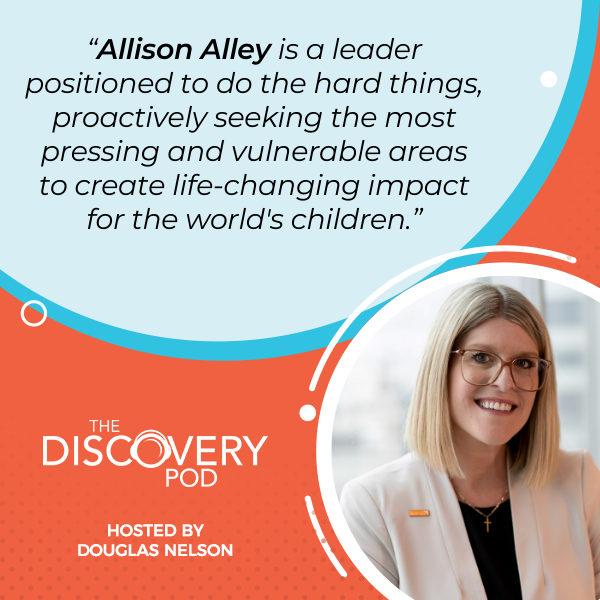
The continuous challenge of balancing advocacy, fundraising, and programs is a fundamental tension for leaders in the international development sector. Douglas Nelson explores this dynamic with Allison Alley, President and CEO of World Vision Canada, who oversees efforts to support the world’s most vulnerable children. Allison shares her unique perspective on leading through seismic shifts in the sector, detailing World Vision’s holistic and child-focused approach that encompasses emergency relief, long-term development, and critical advocacy work. She discusses her “bridge year” strategy to ensure the organization remains centered, clear, and cohesive, and reveals how fostering an attentive, “non-anxious presence” guides her leadership and commitment to continuous, incremental improvement.
—
Listen to the podcast here
Balancing Advocacy, Fundraising, And Programs With Allison Alley, President & CEO, World Vision Canada
Navigating Change: Meet World Vision CEO, Allison Alley
I’m joined by Allison Alley, President and CEO of World Vision Canada. In a sector where change seems to be the constant, perhaps no other part of our sector has seen more change than international relief and development organization. I’m really excited to have Allison join us and talk about the great work of World Vision Canada, where she oversees efforts to support the world’s most vulnerable children through advocacy, humanitarian response, and long-term development.
Under her leadership, World Vision Canada continues to respond to global crises while advancing programs that create lasting change for children, families, and communities. With over a decade of executive leadership in the charitable sector, Allison brings a global perspective, a strong sense of purpose, and a deep commitment to ending child poverty.
In this conversation, she talks about staying focused on what matters most and the environments of a lot of change shares the secret sauce of World Vision that keeps its donors coming back and how she sees the future of international development and children’s aid in the decade to come. It is deep, it is exciting, and it is worth a read. Please enjoy my conversation with Allison Alley.
—
Welcome to the show, Allison.
Thanks, Doug. It is wonderful to be with you.
I am really excited to have you on. I’m really excited to share the work of World Vision Canada and your work as the new CEO in the organization. As we get started with that conversation, tell us a little bit about World Vision Canada and the work that you do.
For sure. World Vision is a global relief development and advocacy organization, so our focus is on helping the world’s most vulnerable girls and boys overcome poverty and experience life and all its fullness. We are celebrating 75 years of impact globally in 2025, and we are Canada’s largest private relief development and advocacy organization.
World Vision is a global relief, development, and advocacy organization. Our focus is on helping the world's most vulnerable girls and boys overcome poverty and experience life in all its fullness. Share on XI think no one has grown up in Canada, certainly anyone who watched Saturday morning cartoons back in the day, who watched any television, doesn’t know World Vision Canada for its child sponsorship program. One of the things in getting ready for our conversation and certainly spending a lot of time in the space, World Vision is a lot more than that. If people just know you from the child sponsorship ads, what more do they need to know?
By the way, that’s how I learned about World Vision myself. That and the 30 Hour Famine that I was a part of as a young adult, so for sure, those who know, know. Most definitely, we have an integrated and holistic, locally led approach to addressing the root causes of poverty and injustice. It means that of course, we do emergency relief. When conflict or disaster strikes, we are often there within 24 hours on the ground, advancing lifesaving interventions.
Our flagship work is transformational development, which again, is child-focused, community-led interventions to ensure conditions are there for whole life transformation at the child and family level. In order to do that work and to have the environment conducive to human flourishing, I guess you could say, we do advocacy work. We work globally, nationally, and locally with different government leaders to really advocate for the rights and well-being of children and ensure that policies are in place that can ensure that our work takes root and really does have the sustainable impact that it needs.
Navigating The Core Tension: Balancing Advocacy, Fundraising, And Programs
Whenever organizations are carrying that dual mandate of providing a service, raising the money to provide the service, acting in community and advocacy, there’s often a tension. I’m so curious to ask leaders about it, because as CEO, you can show up on a Tuesday morning and you’re in advocacy mode, which is a very different tone of voice, probably a different set of clothes, then let’s get to work and let’s make sure that our programs are operating back as. As you’re new to the role, how do you think about balancing that, the importance of that advocacy role, which is critically important to the work that you do the day-to-day on the groundwork that your donors enable?
I think first and foremost, one of the most important things to do is actually to name the wide variety of tensions that we do have to manage as a sector, as an organization, and just leaders in general. Certainly, at the highest level, it is being field-driven and participant-focused, but also supporter-driven and partner-focused in a way that we know we can’t enact our work on the ground and have the resources that we need for the lifesaving interventions without resourcing and supporters here.

Advocacy Fundraising: One of the most important things to do is actually to name the wide variety of tensions that we have to manage as a sector, as an organization, and just leaders in general.
I don’t have as much of an answer on how we manage the tension other than saying, naming it, normalizing that it exists, ensuring that you have the right voices around the table who are speaking into the right decisions. There are often indicators when you get too far on one side or the other of attention. You look for those indicators and then nudge yourself back to that center position. It certainly is difficult, but I would say if we are going to lean one way, our conviction is the need to be child-focused, to be field-led, to be a program-first organization that ensures that that is driving all of our other decisions and how we show up in other contexts.
The Vision To ‘Do The Hard Things’ For The World’s Most Vulnerable
That framing is really clear. You’re putting advocacy in that support role for the on-the-ground programming work that you’re doing. One of the things that I’ve heard you say that really jumped out at me that I want you to go a little farther into, you described both your leadership style and the organization as positioned to do the hard things to help the world’s children. Anyone listening to the news or reading it on their phone knows that there are a lot of hard things in the world nowadays. What does that do, the hard things? How does that guide the work that you do as CEO?
Our vision, by the way, is for every child life and all its fullness and for every heart, the will to make it so, and so we aim to really be about changing the way the world works for children, not just the children that we serve in our program, but the world’s children. Recognizing that challenges that large and that complex and interrelated require the thinking and action and care, frankly, of every citizen. Big, lofty mandate and vision.
Within that, we feel uniquely positioned and passionate about serving the most vulnerable children, which means we are proactively looking for where is it the hardest to be a child. Where are the conditions least conducive to their well-being? Where are others leaving maybe that we could forge ahead in their name? I think because of that lofty mandate and inherently prioritizing the most vulnerable and the most pressing areas, we tend to attract people that are this beautiful mix of big-hearted and big-minded.
We go back to tensions. They are here because they want to make an impact. They feel for the needs of the world, and they recognize that it requires our very best thinking, our best interventions, our best innovation. We continue to level up, Doug. I’ll tell you, one of the things that didn’t surprise me about entering into the organization is how high impact we are now. What has surprised me is just the radical pursuit to do more, to move faster, to deliver higher impact that exists every single day in this organization.
Everybody’s on their best behavior for the new CEO.
That’s what it is. I’m still on my probation period, that maybe they feel like they’re on theirs. I’m not sure.
Strategic Planning: The Rationale For A CEO’s ‘Bridge Year’
That, “Look busy, she’s coming,” wears off after a couple of weeks. I think you threw that period as CEO. One of the things that you and the team have done, and you were quite public about, was naming 2025, as you’re starting the fiscal year, you called it a bridge year. I’d be interested to hear you talk a little bit more about how you think about what’s on that bridge, and maybe what’s under it.
The context for us would be the interrelated factors of what’s happening externally and what’s happening internally. Of course, we know externally, the world is just rapidly changing. Seismic shifts in ways that we would say there is no more normal. There’s certainly not going back to the good old days, there is only forging and building a new way forward for the sector and for our organization.
The world is rapidly changing—seismic shifts in ways that mean there is no more normal. There's certainly no going back to the good old days, only forging and building a new way forward for the sector and for our organization. Share on XThat would be for the sake of your audience, of course, the longstanding increase of conflict of climate volatility of emergencies, and just how those create the perfect storm for the most vulnerable children. Also, it has been the shift in public opinion and political will towards our sector in dollars and resources available, which makes it even more stark and pressing for us to respond.
Internally, of course there is not only a new CEO on the block as you reminded, and just the natural ripple effect and seasonality of change that that brings. We actually were planning to complete our current four-year strategic plan. This would’ve been the year that we were building a new multi-year strategic plan. Instead of jumping right into that and really even taking a 3, 4-year view, we decided to take a 1-year view, which might sound counterproductive maybe, but to say actually, let’s give a little bit of space for some dust to settle, although it never fully will externally and internally.
To say, “What of the path we’ve been on so far needs to be enduring, we need to forge ahead with new urgency and passion? What are the areas that we need to stop now or, or pivot and adjust to in the name of being responsive to the moment?” The concept of a bridge for us is really in moving from one season to the next, in moving from one strategy to the next and recognizing, as I said, the past is no longer, there’s a future not yet realized, again, for the world, for the sector, for our org, that we very much need to discern quite attentively and forge ahead towards in new ways. It is a rally cry for us.
I think that’s really powerful. Given what’s happening in the international development sector with all of the upheaval originating from the United States and the changes that country’s having and how it faces the world, planning out what the next five years look like would be incredibly difficult, to say the least. The other piece in our work here at The Discovery Group, we often recommend to new CEOs and to their board chairs, before the CEO comes in when we have the chance is take time. Take 12 to 18 months.
If you put your new CEO, who’s going to be saying to the team, “I’m listening, I want to learn, I want to understand,” at the same time, you’re cranking on a 3 or a 5-year vision for the organization, that is an unhealthy tension. That listening and learning and becoming one with the organization, making it instead of me, the new leader to we, the team in pursuit of our organizational purpose, if you start to early on that planning process, you’re going to make mistakes.
Many leaders will overvalue certain elements of current operations that are going to be much less important eighteen months from now. The plan’s less likely to be relevant, and it’s less likely to be an effective tool. Just give it some time. I really love the image of a bridge because it seems helpful and necessary, which I think a pause before planning really is.
I’m encouraged to hear you say that. It’s been really a meaningful season for me in the listening and learning stage, really spending time, of course, with our global leaders and our board and our staff, but even my peers in this sector, our stakeholders, to say, “What do I need to understand about the world as you see it? What are your learning and observations to really shape my and our thinking?”
To your point, I was on the phone with the UNICEF Canada CEO, Sevaun, not to tell too much about her story, but she stepped in a few years ago now. They wrote out more than twelve months of the current strategy before launching into something new. For sure, I think there is a best practice there when it’s feasible.
The idea that the social profit CEO can come in and say, “I know you, I know this organization I know what we need to do there.” You’d have a major chord as the horse comes over the ridge in the Western movie. In my experience, that’s not how it works. It takes a lot of people moving in the same direction, and it takes time to build that internal coalition and that relationship with the board to really be credibly ambitious. You can say wild aspirations right out of the gate. Not recommended, but getting everybody on the same page is really important.
What’s interesting is for good reason, when a new leader steps in, leaders and staff are often asking the question, “What is your vision? What’s your vision for the future?” It is really tempting maybe to have something profound to say in that moment. Whereas in actuality, in my experience, one of the most powerful things you can do is underscore what’s not changing.

Advocacy Fundraising: One of the most powerful things you can do is underscore what’s not changing, what is enduring, where we’ve come from, and why that matters.
“Here’s what is enduring, here’s where we’ve come from and why that matters. Here’s what you can expect in the name of stability and values upheld.” Of course, the question behind the question is, what can we expect from you? What does it mean for us personally? What might it mean for the org? It’s uniquely difficult to navigate because, of course, people need inspiration and vision, or they perish, I’m sure someone smart said. It’s what are the appropriate things to talk about in that season and how to build that shared vision over time together. It’s definitely been the path for me.
Leadership Style: Cultivating A Non-Anxious And Attentive Presence
You’ve used the concept and the word a few times in our conversation, attentive. You’ve pointed to it as a watchword for your first few months on the role. How does that show up on any given Wednesday?
It’s interesting because I wouldn’t have realized that I used that word, but I think if I had my executive coach next to me, she would smile and say, “A-ha. We’ve been working on that for many years,” because I actually had been working quite proactively to be someone who is present. I have found that working in our sector for many years, there is always so much urgency.
There are a lot of stakeholders with different needs, different emotions, different perspectives, and there is a lot of context shifting and urgency to everything. It can easily make you feel overwhelmed or reactive or distracted in a way that is absolutely not effective. I think it cuts too many people out of the game prematurely.
You didn’t ask this question, but behind the scenes, one of the practices I’ve had in place for seven, eight years is actually complete silence and stillness in the morning. I wake up early, which my husband says is the middle of the night. I say it’s the peak time of the day, but really work to quiet out the noise, quiet out my mind to consider my day. I’m a relatively disciplined person, so I plan a 24/7 calendar. My sleep time’s in there, my quiet time’s in there, my deep work time in the morning to think and write and consider, my email time.

Advocacy Fundraising: Working in our sector for 13 years, there is so much urgency and constant context-shifting with different stakeholders, and it can leave you overwhelmed, reactive, or distracted in ways that aren’t effective and that push people out of the game too early.
I say all of that to say that kind of discipline and intentionality is what enables me to be present and attentive to those who I plan to interact with. Those who unexpectedly I come across their path or their mind. It does mean that I work to really listen well, to be curious, to ask questions that will surface the very hard things and have a high value on psychological safety and just modeling vulnerability and authenticity in ways that helps people feel safe to say the really hard thing they need to say. I’m certainly not there yet. It’s a path I’ll probably continue to be on, to be attentive and to be safe and to surface the right things. It’s a work in progress that I care about.
That’s really helpful. My alarm goes off at 5:03 in the morning because 5:00 is nuts. The weird people get up at 5:00. I’m not a weird people, so 5:03. I resonate that quiet time and being ready for what comes, whatever that is, I think, is a really important lesson for leaders. I remember earlier in my career, I had a boss who frequently scheduled three hours a day on the quarter hour. We’d have 15-minute meetings, and he’d have 4 of them in an hour, or 8 of them back-to-back.
One of the implications of that was a real crisis urgent feel to the whole space around him as a leader, which I guess is inspiring to some. I’m convinced that people do their best work in a very different kind of environment, particularly in our sector, particularly at the level of the senior management team that you’re going to be spending a lot of your time with. They need that space. They need that safety that you talk about. If, as leaders, we’re not modeling that or offering that, we’re really contributing to that everybody being in the red line all the time.
That’s right. I call that a non-anxious presence. In a world of just chronic crisis and anxiety and need, to have that non-anxious presence that can be attentive to and shoulder those real needs but to actually just quiet out that noise for others, I’ve experienced leaders like that. I would say that’s a superpower in this day and age.
When you say that, you exude that in our conversation. It instantly makes me feel relaxed, that non-anxious space, because there’s always that next thing. There’s the thing where it’s after I do this, I’m doing this. After this, I’m doing that. It is really essential for leaders in our sector, leaders anywhere, but especially in our social profit sector, to have that time to focus on the things that are important and not urgent.
The most effective leaders that I’ve had the chance to work with, either as peers or now in my role here at The Discovery Group, work with leaders, the very best of them take that space to think and aren’t subconscious about it, and aren’t sneaky about it. I don’t want anybody to know I have to think about this. I want to make it look effortless. I think that’s not a helpful trait but that important non-urgent space is so critically important for effective, sustainable leadership in our sector. The leaders that do it best tend to have teams that operate at the highest level.
Setting Internal Focus: Allison’s ‘Centered, Clear, Cohesive’ Priorities
Let’s make this really tactical. One of the things we talk about is specific tools. As a new leader, we know we’re going to get a lot of readers for this episode from people that work at World Vision Canada. They’re like, “What’s Allison saying about us?” Let’s give them something really to dig into. When you’re thinking about your team and folks at the organization, what is it that they can do to earn a gold star from you?
That is not the question I thought you were going to ask, but I love that. I would say that they know or are increasingly learning. I’ve let them know that one of my short-term priorities within the next 100-plus days is really becoming centered, clear and cohesive as an organization. What do I mean by that? Centered is, believe it or not, even in a mission-focused organization, over time, you can sometimes drift your gaze, your focus, your energy, maybe away from the core of why you exist, and the urgency around that to ancillary areas.
Believe it or not, even in a mission-focused organization, over time you can sometimes drift your gaze, focus, and energy away from the core of why you exist. Share on XReally focus on getting back centered on our mission, our vision, our values. The way we already pre-decided how we show up in moments like this. Centered for us, actually, and we talked about this in this episode already, also relates to the both end tensions that we need to manage as an organization that are core to our work. Big-hearted, big-minded growing relationships as we grow results. We’re a faith-based organization, so I would suggest being data-informed, but also spirit-led and really considering our faith in action. That’s becoming centered.
Clear is about driving ruthless focus in the organization. I think our sector is a complex sector, and there is, we already talked about, a lot to be done, but to really focus on what is the highest value priorities to deliver the highest impact in the field, to drive the highest engagement in Canada, to decomplexify where needed, and really find simplicity on the far side of complexity as an organization and to reduce waste and distraction. That’s the focus, the clarity.
The last is cohesion, which is to say, how do we think and act as one World Vision? How do we build not just unity of spirit, but unity of practice, driving greater alignment and integration internally first, so that we then show up in market with a more cohesive, compelling voice and offerings? How do they get a gold star? Maybe they just say any one of those words centered, clear, cohesive. That’ll be worth something.
A very practical tool. You’re welcome. I think that, as a new leader, the opportunity and the expectation from the team is often that you’re going to say, this is what success looks like. This is what I value as a leader. Those three words really are clear and give a path to those gold stars. Though I suspect your leadership style isn’t to hand out gold stars, but it was metaphorical. What was the question you thought I was going to ask?
I’m not sure. I don’t know. I just didn’t expect it to have to do with gold stars. Maybe what is your favorite thing about World Vision or what are you most proud of? Something to really make their ears perk up, perhaps?
Evolving Philanthropy: Donor Feedback And Personalized Impact
How about this? One of the really superpowers that ceos have both in conversation with the board and with your team and any of your essential partners, is the phrase, “When I talk to our donors, they say.” You have a different conversation with your supporters than anyone else in the organization, and they’re going to be more candid. In many cases, more candid with you than they may be with the fundraiser that they work with or the partner that they work with on a daily basis, on a more frequent basis. Allison, what are you hearing from your donors? What are they telling you about this organization as you’re finding your legs and establishing yourself there?
We have some of the most remarkable committed donors on the face of the planet, I would say. What I love about our donors is that it includes the teenager who’s giving away their birthday money to their sponsored child around the world. It includes the business who is giving some of their profits to help us deliver clean water in Kenya. It includes the donor who’s giving $1 million, $10 million.
Our donors are here because they believe in our model and they’ve seen the impact. They’re saying, “We want to be involved to a deeper degree beyond more passive giving to really be a part of offering our capabilities or offering our time in new ways.” Certainly, the days of more passive transactional engagement, as you would very well know in our sector, we are moving past, but we’re also hearing them say, “Help me understand. I believe in the impact. I’ve seen it. I have reason to believe it, yet, please personalize it for me so I can understand my personal reach, the personal outcomes from not just my donations, but my time.”
Our team has done amazing work. We’ve been redesigning from the inside out. This is now where I’m going to get a gold star. I truly mean it, though. Redesigning from the inside out, building capabilities to become a relevant modern organization that can deliver not just higher impact in the field, but personalized evidence of impact to our supporters. We’re really excited because part of this bridge year for us is going to market with those new capabilities to be able to invite Canadians in new ways, to delight them with personalized experiences in new ways, and to show them their impact in more vibrant, practical ways.
I think the way you frame that leads me to my next question because I’ve always been impressed with World Vision and how the organization talks about its work and you just did it there again. There is a way to tell the story of the work your organization that is about crisis, that is about tragedy, that is about minor courts. We talked about the major chords coming over the hill. This is the minor chord part. I think that’s an important part of the work that you do and is an essential part of the storytelling.
Your frame there was really positive about what is possible, what is the role that donors can play, what’s the role that Canadians can play in changing that negative story? How do you, as a leader, as a person, keep that focus on ensuring you’re making that pivot and not getting stuck in the minor chord too often?
You know how we talked about becoming centered and really keeping what’s most critical at the core of our thought and our reflections. I think it is just too easy to sit in the knee to sit in what’s missing. I’ll tell you a really quick story. A while ago, someone was interviewing me in a casual setting with a group of live people and asked the question, “In your 12, 13 years in this sector, what is the most meaningful moment for you as a leader, your mountaintop moment?”
To see the problems and solve them, you need real feedback loops and the voices of the people you serve. Share on XI didn’t have to think very long to say, “It’s not actually the mountaintop moments at all for me.” It’s not the visits in the field, it’s not those huge fundraisers. It’s not those big rebrands. It’s actually continuous improvement every single day. It’s seeing the next opportunity, delivering improvement and starting again the next day. Over time, with grit, with endurance with follow-through, it’s amazing what you can accomplish when you keep moving in that same direction and make incremental daily improvement.
What needs to be true for that to happen is continuous feedback. Feedback from staff on what are the pain points? What are the barriers we need to overcome? What are the opportunities as you see it? Certainly, feedback loops from our par participants in the field and our partners here in Canada to say, “Help us serve you better. What’s next? What do we need to solve together?”
I mentioned that to say my default is to see the problems and solve them, but what needs to be true to do that is the feedback loops and the voice of those you serve. When you hear that and you ask the right questions about what they believe in, what they see as possible, it can’t help but inject that optimism and belief in you as well.
That’s incredible. One of the things I’ve seen leaders do is that you sometimes want to shortcut that feedback loop. Sometimes, you hear things you don’t want to hear or something that you think was a really great innovation or a great evolution, or this incremental step is really going to, and you hear no, whether it’s internally or externally and maintaining that commitment to always be learning and integrating that into what your next steps are is a real leadership discipline that I think is very few leaders have it on their first day.
Do they have it on their list, whatever that looks like, is the question.
A Vision For Tomorrow: Why The Future Belongs To The Youth
The last is more likely to be of their own choosing if they develop it way. Allison, as we come to the end of our conversation, I get to ask my favorite question, which is what are you looking forward to?

Advocacy Fundraising: The emerging generation in Canada is breaking barriers and shaping new ways of thinking, living, and acting as citizens — and as global citizens.
I think I mentioned earlier our vision as an organization. For every child, life and all its fullness, and for every heart, the will to make it so. In our desire to be child-focused, field-led, community-owned work, it really is, as I just mentioned, the voices and the perspective and the ideas and the vision of the future that the children that we serve have in Canada.
In that will to make it, I am seeing the emerging generation in Canada as well as being, of course, globally minded citizens who are breaking through barriers and building new ways forward and how we think, live and act, frankly, as citizens, never mind global citizens. To me, I’m just excited to see how children will lead us into the future, both from a programmatic perspective and a partnership perspective here in Canada.
We will make ways that we can’t even imagine to have a world that is more just, more compassionate, more equitable, where every person and certainly every child can realize their fullest potential. My heart and ears are attentive to the youth in this season, and I’m really excited to learn from them and to see how they’ll shape and mold us as an org and as a country.
I’m so looking forward to seeing you and your colleagues at World Vision Canada and the great work that you’re going to be doing in this bridge year and beyond. Thank you so much for taking the time to be on the show.
My pleasure. Thanks for having me, Doug.