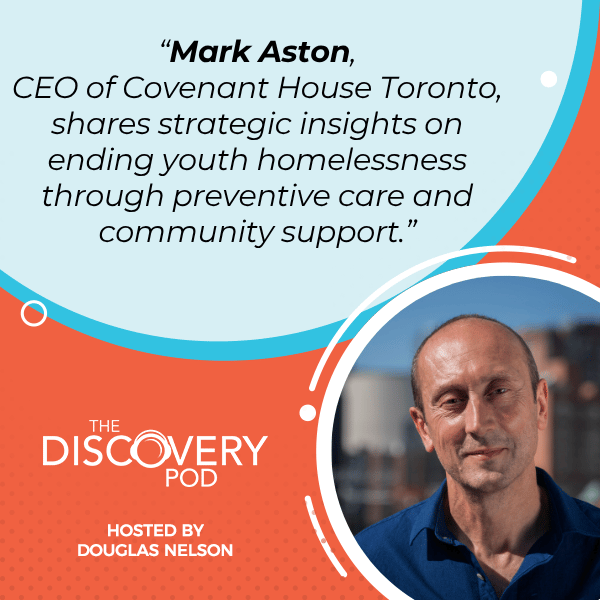
Solving complex social issues requires a shift from emergency crisis management to preventative, holistic support. In a compelling conversation on ending youth homelessness, Mark Aston, CEO of Covenant House Toronto, shares how Canada’s largest charity serving youth in crisis is expanding its scope to support young people before homelessness takes root. Host Douglas explores how Mark balances frontline visibility with strategic leadership while maintaining an organizational ethos grounded in unconditional love and dignity. From scaling mental health interventions to driving major capital campaigns, this discussion offers key leadership insights for social profit executives navigating growth and community impact.
—
Listen to the podcast here
Leading Through Mission Expansion With Mark Aston, CEO Of Covenant House Toronto
The Mission Of Covenant House Toronto
I’m joined by Mark Aston, CEO of Covenant House Toronto, Canada’s largest charity serving youth in crisis. With over 30 years of experience in the social profit sector and a passion for ending poverty and homelessness, he founded the Toronto Alliance to End Homelessness, a volunteer association of 50 organizations focused on ending chronic homelessness in Toronto.
He also chairs the Toronto Youth Homelessness Sector Strategy Group, the coalition of youth serving organizations across the city that includes Covenant House Toronto, where he has been since 2019 to change young people’s lives. In our conversation, Mark talks about the role of the CEO and how it expands as the organization does.
How to make time to ensure that you’re focusing on the things that only the CEO can do, and the critical role that Covenant House Toronto is playing in its vision to end youth homelessness in Toronto. Mark is a thoughtful leader who shares a really candid look at how he thinks about the role of CEO and the importance of the work that his organization does on a daily basis. Please enjoy my conversation with Mark Aston.
—
Welcome to the show, Mark.
Thank you, Douglas. My pleasure to be here.
It is excellent to have you on the show. We have had your colleague and arm, your fellow traveler, Deb Lester of Covenant House Vancouver, on the show. She participated in our Discovery Dialogues last year. We have had the chance to work and learn with her and her organization over the last couple of years, and her constant advice to me is “You’ve got to talk to Mark.” They are doing incredible things in Toronto. We are going to share those great things with our audience. Are you ready for that?
I am. It is very kind of Deb to say that.
As we get started, for some of our audience who may not be familiar, tell us about the work of Covenant House Toronto and who you serve.
Covenant House Toronto has been operating, working in Toronto for young people now for since the early ‘80s. In that time, we have served about 110,000 young people. Doors are open 24/7, 365 days a year. Covenant House Toronto started as a shelter, a small program focused on providing young people a safe place to spend the night, some nutritious food, and those types of emergency services, clothes, laundry, all of that stuff. 43, or 44 years later, it offers a wide range of services to young people.

Covenant House Toronto: The objective is really to be there for young people in need, help them through crisis, and then walk with them to really help them discover, rediscover their path in life.
The objective is really to be there for young people in need, help them through crisis, and then walk with them to really help them discover, rediscover their path in life and provide the resources they need to realize that. I have been at Covenant House Toronto now for about seven years, and it has been an incredible experience. A couple of things I would mention as to why it has been incredible. One is just, my office is on our largest or located at our largest program site. I am interacting with young people every day. There is just even for young people going through difficult times and crises, there is just so much hope and optimism.
That is the first thing that I just love. The second thing is, is just the ethos of Covenant House where I think people really believe that how you treat somebody is at least as important, if not more important than what you do for them. We hold ourselves to that standard of absolute respect and unconditional love. All of our staff and volunteers have to wrestle with what that means for them and how they apply it in their day-to-day work at Covenant House. Anyway, sorry for a long answer. It has been an incredible six, seven years for me.
That was not long at all. One of the things you said at the end there, I want to come back to that concept of offering unconditional love. How does that show up inside your organization?
The most honest answer I can give is that people wrestle with that in an individual way and have to find out what that means for them. Many people would talk about seeing somebody for everything they are, for all their potential, not just for the crisis or the way they are presenting at a particular time, seeing the value in each young person. Really treating young people holistically as individuals. Some themes run through that. Probably the most important thing is that it challenges each of us to think about what that means to us in our day-to-day work and to ask ourselves from time to time, are we really living up to that standard, as staff and volunteers?
What does that concept of unconditional love mean for you?
Leading With Unconditional Love And Dignity
For me, it is about no judgment. It is about accepting young people unconditionally, whatever state or stage they are in, whatever crisis they are experiencing. The idea that we are there for them on an ongoing basis. It does not matter that a young person has a bad day, that they yell and scream at staff. There are some issues that come with that, but Covenant House looks deeper than that and understands that there are many reasons why young people can be in crisis. Just like somebody would for their own children.
If I have three kids, they are on their twenties now, when they were, let us say when they were teenagers and living at home, if one of them got upset with me one day and threw something across the room and called me a bad name, it does not mean I am going to throw them out of the house. Why? It’s because I have unconditional love for my children. That is really the type of thinking and ethos that we try to bring to Covenant House. I truly believe it is something that sets our organization apart.
That idea of unconditional love is something I think is baked in and is often an unspoken and unspoken truth in a lot of client-serving organizations in our sector. It is really cool that you say it right at the top of our conversation. It sounds like it is something that runs right through your organization.
Yes, I think it does. It is a very worthy goal to aspire to. Let us put it that way.
How you treat somebody is at least as important, if not more important than what you do for them. Share on XMark, one of the things that I was really looking forward to talking to you about as we were coming together for this conversation. In my travels across the social profit sector here in Canada, I have had the opportunity to work with a number of organizations. My colleagues here at the Discovery work with a number of organizations that started with a single purpose. You mentioned the shelter and emergency services for Covenant House Toronto.
Over a number of years, and particularly over the last ten years, and the COVID and post-COVID time especially. We have seen a number of mental health and youth-serving organizations rapidly expand the suite of services that they offer to meet the need. As a leader, do you think about the need to expand the aperture of your organization to meet these needs and add that complexity to your organization?
I guess there are a couple of things that come to mind. One, we have got to be responsive to the young people who are coming to our sites, about ten of them across Toronto now, with a main site at Young and Girard. We have got to be responsive to their changing needs. Two, we have really got to look at the type of results or outcomes that we are achieving. Continually ask ourselves, are we achieving the things that young people want? Are we really helping them in a transformational way?
Those questions and challenges of really what has driven the program expansion at Covenant House Toronto, for example, we have had to really lean into clinical services, mental health services. Addiction support services, partnerships with other health organizations, expedited access to psychiatric sessions, all of these types of things, because coming out of the pandemic into the current affordability crisis and lack of housing, there is just so much stress that young people feel.

Covenant House Toronto: We have got to be responsive to the young people who are coming to our sites. We have really got to look at the type of results or outcomes that we are achieving.
Not to mention that late teens and early twenties are often a period for onset of some serious mental health conditions. That expansion was directly a result of the needs we were seeing from young people showing up at our door. I can look at another area where we really changed what we are doing quite markedly, and that is going, “Look, yes, youth homelessness demands a crisis response, but it also demands something more.”
We need to look upstream at the circumstances and systems that are driving youth homelessness. If we can get a little bit of an understanding of that and we can come up with some interventions that are going to help or some systems work, we should be doing that because why allow young people to become homeless if we do not need to? We can prevent it before it happens, or we can prevent it at the point that it happens.
Expanding Beyond Emergency Care: Prevention And System Work
Covenant House has moved into a lot of different prevention work. Education and awareness work that we do in schools now. We are speaking to 20,000 to 30,000 young people across the GTA every year about the issues of homelessness, trafficking, what you need to know, what resources are there for you, how you can get help. Those are the types of things that have driven our expansion.
That expansion, as you walk us through that, of course, makes perfect logical sense. It is meeting the needs of the people that you serve. How do you have that conversation with your board, for example, that if someone came onto the board thinking they knew what Covenant House was as the shelter organization that provides those emergency supports, and now you are talking to 30,000 high school students on an annual basis? It is so wide. How do you keep your board informed as to the need to expand those services and expand the focus?
I would say that was a conversation that has happened and continues to happen. It has happened over the years. Covenant House Toronto was an organization with, and still is, a strong culture and a very clear sense of its identity and what it does. For many years, that was about emergency response. That was the identity that our board and many of our staff were very attuned to and aligned with. The conversation was to say, “Look, is this really enough? What about community support? What about housing in the community?
What about prevention? What about family counseling, reconnecting young people to their families, working with schools?” All of these types of things. That was a long and at times intense conversation at many different levels in the organization, certainly at the board level, because it ties directly into strategic planning, which the board is obviously involved with, and really the mandate of the organization. Likewise for staff, it is asking staff to do different things, apply different approaches, learn new skill sets. All of that, it takes time. It takes good change management. That can be tricky. It is an ongoing process, is what I would say in short.
That openness to learning that is required within your organization to learn what the needs are and how Covenant House Toronto can expand your services to meet those needs? Having that capacity in the organization, and then the board needs to be open to learning that not only do we have this need, but we also have this capacity, and here is the investment required, or here is the strategic choice we need to make to move in that direction. That openness to feedback, openness to learning throughout the organization is one of the hallmarks of what we see is the really exceptional organizations is that continual learning. As the leader, how do you keep the organization open to that learning regularly?
It is a great question. There are some obvious answers to that. I have learned over 35 plus years in the sector and certainly, over a quarter century of reporting to boards that you just simply cannot communicate enough. Yes, with boards, yes, with board committees, particularly with staff. If you can frame change and you have got the evidence to say, “Look, this is about, it is not about us. It is not about what we would like to do. This is about changing to meet the needs of young people or better meet the needs of young people.” The staff that I have worked with at Covenant House have always been really open to that and open to changing, open to learning.
As a leader, you have got to be focused on things that only you can do. If your calendar is full with a bunch of filler, you are probably not working on the right things. Share on XThe details of that are we resourced to do it? Do we have the right policies? Do we have the right staff training in place? All of that stuff is really the devil in the details because you need to do that really well. That is challenging and taxing. If you do not do it really well, the staff will let you know. You are asked to implement these new policies. In fact, we do not have the training. You do it by keeping the client, the young person, front and center. That is what staff does every day. If you do not give staff the resources, and the training and the support and the recognition to make those changes and implement new programs, it can be difficult.
I guess, turning the lens back on you one more time here, Mark, given the complexity and the sheer volume that runs through your inbox and across your desk, how do you keep your own mind open to the necessary learning as the leader of this very important, very much growing organization?
Strategic Executive Leadership: Focusing On High-Value Priorities
When I have met people who I think are pretty exceptional leaders, even if I have just got five minutes with them, like the previous mayor in Toronto, John Tory, I remember asking, “Do you have a piece of advice for me? What helped you as a leader of Rogers?” I have always done that. Somebody I was speaking to recently who heads up Daniels Corporation, a development company in Toronto. He is an author. He is an activist. It is like, you do not know how he does everything he does.
I said, “How do you do this, Mitchell?” He said, “Mark, I control my own calendar. I really took that to heart.” I thought, as a leader, you have got to be focused on things that only you can do. If your calendar is full with a bunch of filler that really is not mission-critical and that somebody else could be doing. You are probably not working on the right things. You have got to be working on stuff that only you can do where you can add value to an organization. Anyway, I hope that answers your question.
It absolutely does. How do you do that? Working with clients, I will not even get into it. I will not turn this into a therapy session about my own calendar. How that discipline to say no, think is something that is one of the hardest challenges for new CEOs or new executive directors, time leaders, because you do not want to be the bottleneck. I want to be present for everyone every moment of the day. I mean this with respect. You are not a new leader. How did you get to that place of being able to even take the beat to think about what, what are the areas where I can have the greatest impact? What are the things only I can do? That time to ask yourself those questions is something that I think is quite rare, particularly for new leaders.
Humbly, respectfully, I would advise any new leader to avoid that.
We do not use the video for this show. For our audiences, I will just say, shaking his head as he says, “It is clear this is not a good thing.”
Covenant House Toronto: Receiving that money is a sacred trust. We really feel it that way. We have to make the absolute best use we can of that money and do the absolute best we can for young people.
It is difficult because people who get to positions are very competent in some areas, and they want things to run exactly how they want them to run. It is about faith in the people around you. It is about really giving them support and supporting their development and confidence. I send out a lot of emails to people saying it is your call. As in, thank you for asking me. I may put a couple of thoughts. It is your call. I am just fairly disciplined about that. That is how I manage the inflow.
Weekly or monthly, I do a pretty considered review of what the urgent issues are, whether there are any fires going on that I need to look at, and also what is important. Those things, usually, I am successful in prioritizing those areas. Look, I would say, Douglas, it is tricky because leaders cannot be buried away in an office. You are getting my opinion on this. This is why we are talking to you, respectfully. Particularly in the social service sector and social movements, you really cannot lead from behind. You have to be visible. Staff have to have a sense of who you are as a person.
That does require being out there, engaging, certainly with staff, engaging with young people too, and stakeholders. Defining what is a high-value activity for a CEO and what is not can be tricky, because there are some things that you might say, “Why did I spend the whole morning visiting two sites to speak with four staff and meet a couple of young people? Maybe I should have been on the phone to three donors during that time.” Those are the competing priorities that you have to wrestle with.
Avoiding Burnout And Navigating Organizational Change
That important non-urgent is something that I talk a lot about with clients and with leaders because the leaders that are most successful and are most sustainable in their jobs, like the ones that can last physically and emotionally, professionally in their roles, really do, are the ones that make time for those things that are important, not urgent. To what you said earlier, Mark, that is something that only the CEO can do. If the CEO is not doing it, no one else can fill in that gap. Other people could participate in it, of course. The value of that time, whether it is an hour a week or a couple of hours over the course of a few weeks, is really meaningful.
It restores the energy banks for leaders, and it provides an opportunity for you to bring a perspective to your leadership team that you would not otherwise have. If you show up as on fire and as emergency-responsive as everyone around you, what I have seen in organizations is that it contributes to burnout almost as much as anything else. Just underlining what you said for our audiences, that time to be mindful of what is most important is very rare in our sector. Hearing that from you in an organization that does have significant elements of emergency response as a part of it, I think shows just how important that is.
Mark, one of the things that is, I think, really fascinating to me is that, as an organization, how you are serving the clientele that you serve and where you are serving them, you mentioned that the focus on prevention has been more and more a part of the work. As well as getting ready to renew, you are on the verge of a large fundraising initiative to renew your capital space. You mentioned calling the three donors earlier. What do you think about the role of philanthropy in your organization?
Philanthropy was embedded in the DNA of Covenant House from day one. Covenant House in Toronto was founded by the local Catholic archdiocese and Covenant House International from New York. When Covenant House started in New York, there was very much sense there that look, we are doing this based on community support. That ethos really was transferred to Covenant House Toronto. The idea was that we are going to build an organization to help young people based on community support. We need the people of Toronto, the GTA, Ontario to support the work that we are doing. It is central to everything we do. It is 75% of our revenue.
It is tremendous.
In the social service sector and social movements, you really cannot lead from behind. You have to be visible. Staff have to have a sense of who you are as a person. Share on XIt comes from private sources. Thinking about the right communications, the right messaging, how we meaningfully stay in contact with so many people who support us, tens of thousands every year, really is central to everything we do. Philanthropy and the outcomes and results that it supports are, in many ways, the best of humanity. It is people who are able in a society to think about the types of improvement that they want to see in that community, think about the people who are in need and help. Covenant House is extremely grateful and humble. We are the vehicle for help that so many people have chosen over the years.
It is incredible. I have met so many different donors over my 6 or 7 years at Covenant House. It has been an incredible experience from older folks from Northern Ontario who write me these incredible letters as to why they are supporting Covenant House, how deeply they care about the future of young people, and keeping me and the whole organization in their prayers. It is an absolutely humbling experience, and receiving that money is a sacred trust. We really feel it that way.
We have to make the absolute best use we can of that money and do the absolute best we can for young people. As you mentioned earlier, we have a big campaign that we have almost got liftoff on that is going to that is going to push Covenant House to think about those relationships in different ways and to make some arguments and value propositions to some people who have not donated, I think, into the community social service sector.
The Strategic Role Of Philanthropy In Community Impact
We are going to be looking for some transformational gifts. What for? To end chronic youth homelessness in Toronto. It is an incredible opportunity we have. Again, it presents some incredible opportunities for philanthropy and donors. In many ways, I feel organizations that have not fully embraced philanthropy and community support are just missing so much. God bless the government for what they do. There is a whole other dimension and mission that comes from working closely with so many people in a community.
Have your conversations with donors changed over time?
It depends. There is a broad donor community. There is a good chunk of donors who have gotten a lot more sophisticated in the questions they ask. They are very interested in impact. If you are asking for substantial support, people are obviously interested in the history of the organization, the reputation, its sustainability, its financial foundation, all of those types of things. I am trying to think back over the last 10 or 15 years, and I still think it comes down to matching somebody’s interest and what inspires them to the work that you are doing. That has not changed. In some ways it has changed in other ways. For me, anyway, it has not.
Basic principles are still the same. Are you ever surprised by questions donors do not ask you? Like, why are you not asking me about it?
I am. I cannot provide the name here. Many years ago I was touring somebody who had, he was a very wealthy person. We went through the first 40 minutes of this tour, and there were a couple of other people with him who asked a few of the standard questions around metrics and the types of things you would expect. I thought, “No, I am blowing this. This person has not asked me a single question. I am done.” Somewhere towards the end of this hour-long tour, this person looked at me and said this was about homelessness as well.

Covenant House Toronto: If we get young people the help they need—and we can—we can make a transformative difference so they don’t become the chronically homeless adults of tomorrow.
Not the same organization. Says, “The loneliness must just be astounding, crushing.” I thought, “He has got it right?” He has connected. Something has connected with him on a human level here. I guess I would say I am not surprised by what donors do not ask. I do not have expectations for how they will respond or what they will ask because, in my experience, there are the usual set of questions, but then there are experiences that are completely out of the norm where people connect on very different levels to watch you presenting to them. You have to be open to that.
That is a great insight, Mark. Thank you for sharing that. As we come to the end of our conversation, I get to ask my favorite question. Mark, what are you looking forward to?
A Vision For The Future: Ending Youth Homelessness
I am looking forward to reducing and ending youth homelessness, particularly chronic youth homelessness in the GTA. I really believe it can be done. We have the know-how, have the interventions, and the programs. With the new government in Ottawa, I am hopeful that we are going to have housing. There is no reason we cannot do that. If we can impact youth homelessness, guess what?
We take a big bite out of adult homelessness because half of the adults who are currently chronically homeless started their homeless experience when they were young people, 12 to 24. If we can get the help young people need, and we can, then we can ensure that we can make a transformative difference and that they do not become the chronically homeless adults of tomorrow. Douglas, that is my greatest hope is that Covenant House can really make that happen over the next decade.
From what I have seen, there are few organizations well positioned to do just that, Mark. On behalf of all of us here at The Discovery Group, thank you so much for the work that you and your colleagues do. Thank you for being a part of the show.
It is my pleasure. Thank you so much for inviting me.