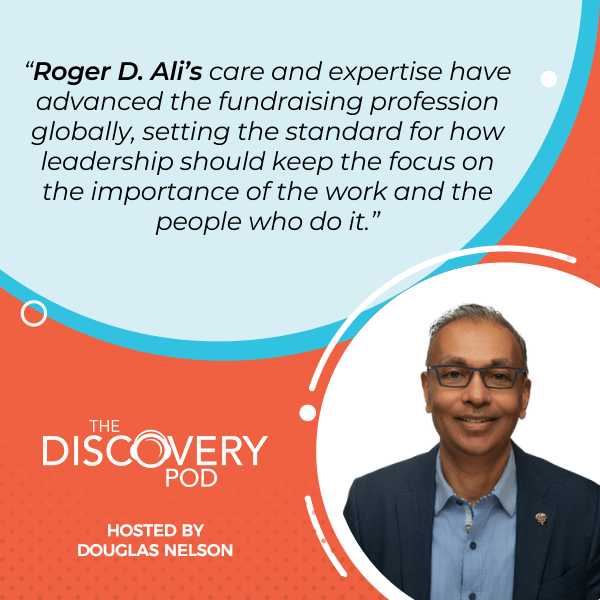
Navigating the complexities of fundraising leadership in a changing donor landscape requires both unparalleled expertise and a dedication to constant evolution. We sit down with Roger D. Ali, the second Canadian and current AFP Global Chair, to discuss his remarkable career and the key insights he’s gathered from the sector. Roger shares the biggest concerns he’s heard from AFP members, including the critical challenge of donor retention, the role of technology in a relationship-based field, and how to best equip the new generation of fundraisers. We also dive deep into the perils of transactional matching campaigns versus long-term stewardship, what it takes for a fundraiser to successfully transition into a CEO role, and Roger’s powerful leadership concept for uncertain times: “Leading Lightly.”
—
Listen to the podcast here
Fundraising Leadership In A Changing Donor Landscape With Roger D. Ali, AFP Global Chair
We’re joined by Roger Ali, Chair of the AFP Global, Board of Directors. In this episode, I’m a big fan of Roger. For many years, Roger has led major gifts, capital and endowment campaigns for comprehensive fundraising programs that have raised more than $150 million. His leadership span senior roles at the Niagara Health Foundation, Hamilton Health Sciences Foundation and The Bishop Strachan School Foundation.
I’ve had the chance to work with Roger in his role as Chair of the Global Board. Let me tell you. He is one of the best, most compassionate leaders you’re ever going to come across in our sector. In this episode, he talks about the future fundraising, the role that AFP locally, nationally and globally plays in the development of the profession and what leaders need to be successful in these times of ambiguity. Roger is a special leader with a very special message. I’m so glad to be able to share with you, our readers. Please enjoy Roger Ali.
—
Welcome to the show, Roger.
Thank you. It’s great to be here.
Roger, I am excited to share your energy, your expertise, and your commitment to professional fundraising with all of our readers. I’m sure most of our readers know the role of the association of fundraising professionals that it is an international organization. As the second Canadian Chair of that organization, I want to start with you. How did Roger Ali come to be the AFP International Chair?
That is a great question. I’ve had such a long history with AFP. I started way back in the late ‘90s as a Chamberlain Scholar. I had my first aha moment at an international conference not knowing a lot about fundraising. From there, it was experienced at the local chapter level and then AFP Canada Foundation and serving on several task forces, then an invitation to consider the chair’s roles.
That was something that others supported and lifted me up. Back in mid-pandemic, when it all started. It was a time where I had more time to reflect on it. I felt that I was at a point in my career where I wanted to do more with AFP and for the profession. I was humbled and certainly honored to be selected. They were five other individuals who had applied, so I’m told. I’m thrilled. I took the role seriously because I wanted to have a stronger Canadian presence at the Global.
In our respective travels through the sector and across the country, you and I bumped into each other. I marvel at the travel schedule in the and the dedication that you demonstrate. When we were together for the AFP Leadership Summit, you were in a good mood the whole time and you’d been traveling for months. I don’t think you’d be home or something like that. How do you find the energy to keep going and to be that helpful presence as the chair?
It’s always important to be balanced and to maintain both a public presence and a personal presence. For me, self-care is important. Where I’m at, I’m always out there doing my runs and my workouts. I also feel that being present is about being your true self. I’ve always been positive and enthusiastic. I love people, and that’s probably a big part of it. My business to chapters, doing presentations and connecting with sector leaders is about conversation.
It's always important to be balanced and maintain a public and personal presence. Self-care is important. Share on XIt’s about hearing and listening to the good and sometimes not good things as well. I love that point of active listening. I always learn something and I’m also carrying something forward. For me, that’s the spirit I’ve always had. It’s one that has helped me in the roles so far. I still have more months to go in the role.
Biggest Challenges: Technology, Donor Decline, And Equipping New Fundraisers
Not that you’re counting the days. You’re still in half a month. That’s okay. That’s a good sign. I know anyone who’s had the chance to work with you, even prior to this role but certainly, in this role knows you as a tireless champion for the sector. You mention that active listening and learning. Do you think as chair, what would have been the biggest learnings or the biggest a-has or insights that you’ve heard from members of the profession?
The one thing I’ve heard a lot of is the concern or the importance of what is AFP doing in the role of technology. That’s certainly been a big piece. As we all know, the digital landscape is fast-paced. For members and leaders, it’s more about how we use technology in our relationship-based profession. That’s a big piece of hearing.

Fundraising Leadership: The digital landscape is fast-paced. For leaders and members, it’s more about how we use technology in a relationship-based profession.
The second is about the concerns and the decline in giving particularly with smaller donors and the ability to retain them. That’s been a piece and we’ve heard that before. The research studies show that. There’s an increased concern about what we do or what’s new and what’s important to maintain. That’s the second piece. The third and the big concern is about the new fundraisers that are coming in and how we equip those talented individuals with the tools and the support that they need to be successful.
There’s a lot there I want to jump into, but let’s start with the end part of that. You and I probably started roughly the same time in the late ‘90s as fundraisers. We are Grizzled Veterans of the sector or you may have been elevated to Elder Statesman. I’m probably still in the Grizzled Veterans Day. When you got into fundraising, what was the pathway? What was that door that you walked through to become a professional fundraiser?
It happened by accident, quite honestly. I was at McMaster University and I was looking for a part-time job. I saw a posting to participate in their first capital campaign calling alumni. I didn’t quite know what that meant, but I love talking. I thought, “This is going to be fabulous,” and it was. It was fantastic. It was the first entree into fundraising. What’s important was the importance of understanding research and making that connection with alumni. Also, following up on the request that they had.
It was more transactional and that’s certainly changed over time where there’s certainly an increased focus on relationship building and less on the institution or the charity. As we see with new donors or future donors are Millennials or Gen Z’s. It’s about the cause. It’s about a project. Back then, that was the recipe or the secret sauce if you will on what fundraisers needed to know. While some of those elements are still foundational, I certainly think it’s evolved over time.

Fundraising Leadership: The focus is clearly shifting toward relationship building and away from the institution or charity itself. For new and future donors—like millennials and Gen Z—the priority is the cause or a specific project.
The New Generation Of Fundraisers: AFP’s AI Agent Nova And Microlearning
“I accidentally became a fundraiser,” is a very common story for people that started certainly before 2000 and even for that first decade. Now, we’re seeing the new generation of fundraisers or new fundraisers into the sector far more diverse, many with academic certifications to support their entree into the fundraising profession. How does that change the role that AFP plays in that career building pathway?
It’s important because AFP is thinking about the pathway in providing more, what we would call micro learning opportunities like videos and things that younger fundraisers can pull off the shelf and do whenever they want to do it. Versus, your traditional chapter event that is scheduled at a certain time and you connect. Those were things and are still important. For younger fundraisers, it’s having the opportunity to have those forums.
There’s a lot of digital elements to it as well to increase their knowledge when they want it and how they want it. AFPs have been doing a lot of that. Specifically, we’ve just launched an AI agent called Nova. If you go on the website and you’re looking for information, “I’m a new fundraiser. I’m at my first job. I’m looking to develop an annual giving plan.” Nova will tell you, “Here’s some of the information.” There’s also a second agent if you’re a member. You can log in and pull over 4,000 presentations that’s curated. It’s our version of ChatGPT but it’s filtered. It’s all AFP curated approved content.
That’s excellent. The importance of the chapters gives the strength to AFP and that connection for leadership or the profession across not only Canada, but across the world. As global chair, what are you seeing as the trends that are affecting or what makes a chapter successful? What are the key or common elements of those chapters that are thriving?
A former chapter leader, I often felt that I struggled with all the administrative and all the pieces that had to be done. The recipe for success is certainly having an engaged group of volunteers and board members that are experienced in education, governance, and in relationship building. I also think that wearing the fundraising hat, is important to develop a vibrant, sustainable chapter. The important piece is to be in touch with members.
The recipe for success is certainly having an engaged group of volunteers and board members who are experienced in education, governance, and relationship building. Share on XThere are twenty chapters in Canada, and each one is unique. There are similar elements as well for smaller chapters in particular in developing that strong robust offering. Both online and virtually in a way in which it is easy to access is important. Also, the networking opportunities. That’s another piece that’s important for chapters.
Lastly, the ability to respond to member’s needs. I say that in terms of one geographical area. It may have a need in terms of mental health issues. They may have a need in terms of what fundraisers are looking for and providing what I would call quick easy key messaging and pieces that are important. That’s also another important element of strong chapter relationship building.
Decoding The Donor Quandary: Stewardship, Storytelling, And Transactional Giving
I want to do a quick shout out to Kyle Torney, who is the chapter lead in my hometown of Vancouver, who’s just ended his term and who did an exceptional job at all of those elements that you described. Thanks, Kyle, for all your work. Now, I want to go back. You talked about some of the trends. This is where I get excited because in our travels, my travels at The Discovery Group and the organizations we get to work with and the leaders that we get to support. The reality of the diminishing number of donors. The ever-escalating amount of money being donated is a quandary around board tables and around every fundraising team meeting that I’ve been a part of over the last number of years. Roger, what’s going on?
When I think of trends, there are probably three or four that come to mind. I would say that we’re undergoing such a significant shift in the donor landscape. The expectations are changing. It’s beyond a tax receipt. It’s beyond a thank you. It’s those deep connections that donors are looking for. That’s also tied to what I mentioned earlier about the decline in giving and the client and trust.
Fundraising Leadership: We’re undergoing such a significant shift in the donor landscape because expectations are changing. It’s beyond a tax receipt; it’s beyond a thank you. Donors are looking for that deep connection.
Going back to some of the basics, it’s important because donors want to feel connected to the cause and to what they’re supporting.
For us and what I’m seeing is, the importance and focus on stewardship. To have those one-on-one meetings and to be able to tailor or curate a report, that’s not AI generated. It’s something that you write. There’s that piece. I also think the second is the shifts in giving. There’s certainly more of a reliance on online giving. We have an opportunity to integrate technology in a way that strengthens our fundraising programs and our practices. Also that we still have the human element at the forefront.
That’s the other piece. The third is the importance of looking at what I would call storytelling and to be able to bring the mission moments to the donor in a consistent way and a more authentic way. Those are some things, hearing and seeing. It also gives us the opportunity to be more laser focused on those three areas.
I agree with all of that. Here’s my follow-up question. This is as close to a hardball question you’re going to get on this show, Roger. We want to build relationships and tell stories. Yet so many organizations are relying on double, quadruple super whammy matches to encourage donors to give, which highlights and spotlights the transaction of giving rather than the relationship of giving. I certainly don’t think it’s the greatest comfort or the biggest problem.
The more I see organizations, in particular the clients we get to work with, highlighting the value of the transaction, trying to give urgency and create that sense of community through a matching program. When you’re emphasizing the transaction, you’re not building a long-term relationship. The response is often, “It works,” but the number of donors is going down. The retention rates are going down. I would say it doesn’t work or it doesn’t necessarily work. Do you want to respond to that or do you want to just pass?
I’ll respond to that because you’re right. I saw that with a campaign that I was doing over the holidays. There was a matching program, and as you rightfully said, that was being promoted in several ways using several channels. What happened was that the individuals who give and give regularly gave, but there were a number of them who never gave. There’s a bit of a misnomer that helps with giving. While it helps from what I would call a public marketing standpoint. I don’t know if it necessarily helps in long-term giving or building a strong donor relationship.
The Path To CEO: Mastering Strategy, Governance, And Agility For Fundraisers
The biggest challenge with that is often is if it’s too tricky like if it’s not real. We’re trying to build long-term relations with donors, but we’re tricking them a little bit and people get that. Certainly, if they don’t get it the first time. They might get at the 3rd or 4th, or 5th time that the double super whammy match is put in front of them.
One of the common themes in this show and something we do in our work and collectively as a team in our travels is like be careful when you’re saying a match. Make sure that you can put a name in a face and there’s money at risk. If they’ve already given the gift, it’s not a match. It’s a, join us. It’s a call to action. There’s a great story to tell but don’t be tricky about it. Anyway, I’ll get off my high horse and ask you another question.
A lot of the readers to this show are folks who are interested in taking on those leadership roles in fundraising programs in their organizations or in organizational leadership. What are you seeing as the determinants? What makes someone successful as they are transitioning from maybe fundraising manager or frontline fundraising champion into organizational leadership roles? What are the elements that make people successful in that transition?
When I think back to my career, at the first half. I focused on practicing fundraising as chief development officer. I worked hard to transition into my first job as state executive director. It’s important that you build on what I would call the science part of fundraising and look at how you apply strategy and how you hone your governance skills. I was reporting to a board. More importantly, to a board chair that changed either every year or every two years. Every board chair was different. I feel that element of governance and that element of strategy.
The last piece is the ability to be agile and nimble because it’s important to have clarity, focus, a plan and a strong team. There’s always the unknowns in situations that you have to deal with. For me, that was the learning. When I talk to fundraisers and colleagues who want to move into that big role as executive director or CEO. That’s the piece you have to work hard at. You’re drawing on intuition and soft skills. That’s about formal training. It’s less about the technical side of things.
It's important to have clarity, focus, and a strong team. But with the unknowns you have to deal with, you also need the ability to be agile and nimble. Share on XLet’s look down the other end of the telescope there. What can organizations do? What can organizational leaders do to make it more likely that the fundraising leader they’re promoting is successful? What are the conditions that organizations have some accountability or responsibility to make sure are in place as new leaders move into those more senior positions?
First and foremost, helping the aspiring leader to have what I would call a development plan, which includes coaching. It includes professional development and that element about what is that leadership style. Giving access to whether it’s the AFP local chapter events or conferences or networking opportunities locally with other business groups. That’s important.
The other aspect of it is giving the latitude for that person to be themselves. There are times as fundraisers, we have to conform to the direction of the organization, which is important. At the same time, we also curtail one’s energy and enthusiasm by making it too confined. I would say opening that up, giving space and providing professional development support is a path that would help those individuals to aspire into those leadership roles.
Fundraising Leadership: We all curtail one’s energy and enthusiasm by making it too confined. Opening that up, giving space, and providing professional development support is a path that would help individuals aspire to those leadership roles.
Is the path to those senior roles fair and equitable enough now, Roger?
I can say for myself. I struggled. I remember for one year I applied for maybe five different roles. I had five interviews and made it to the second level and the third level. You’re sometimes painted with a brush as a fundraiser. Even though you might have leadership technical training or you can show you’ve participated in a strategic planning process and sat on volunteer boards.
The issue is shared experience. Have you led an organization? Do we put our trust and faith in you? That’s certainly a big challenge. The importance of looking at that or how we spotlight that as this is an opportunity for someone to move into the role to blossom or to be themselves is very important. I know I’ve struggled. I struggled for that first job.
It’s fascinating to me. You’re going to get all my rants. I’m ready to go, but I’ll make this very short. The idea is around board tables and the problem of likeness. They need to look like us or look more like me than you maybe. Also, the members of the board may feel that someone who understands the private sector can come in and lead a charity and bring some private sector rigor. Which has always been absurd to me.
The Royal Bank would never hire the CEO of Shopify or the CEO of an oil company, however, successful she or he was because they don’t know the business. They don’t have that expertise. That certainly applies in our sector. No one knows the work of the sector and the levers of the business model better than the fundraising leadership. Maybe that’s something we can do with AFP, Roger. What is the academy or the credentialing or the process we can do to support people making it more straightforward for boards to select fundraisers as their next CEO? How’s that sound?
There’s more work to be done there. One of the programs we’re most proud of is our leadership development program. In the last couple of years, we’ve had a number of fundraising aspiring leaders go through by jobs right on the board side. How do you bring more diversity into those leadership roles in a way in which you give space unlike with anything. No one’s perfect. If the individual can fulfill the role, how do you support them and they’re set up for success?
Powerful Leadership Concept: “Leading Lightly” In Uncertain Times
On that concept of leadership, one of the things I’ve admired in getting to watch you in this role is how you have kept the focus on the importance of the work and the people who do the work. Again, when we had the chance to spend some time together in the summer of 2025. You talked about this concept to your trying to lead with, which is leading lightly. Can you share a little bit about what that is? How did you come to that?
Leading lightly is about reflecting on the situation you are in and can all agree that the last 2 or 3 years we’ve had such a degree of uncertainty, but leading lightly is looking for clarity. Looking for clarity in situations where you focus on the truths and on the insights. You focus on the values. It helps you to what I would call lead in a way that’s not prescribed. You’re leading to be able to adapt. For me, what that means is that you’re not fixated on solving problems. You’re not looking for perfection. You’re not looking for doing it all yourself, but you’re focused on connections.
Leading lightly is looking for clarity in situations. You focus on the truths, the insights, and the values, and it helps you to lead in a way that's not prescribed, but allows you to adapt. Share on XYou’re focused on bringing the issue to the table and hearing various perspectives. It includes not trying to fix the situation right away but pause and give yourself the gift of understanding. How did this come about? Those pieces are more of a discipline when I say leading lightly that you practice. You’re being more intentional about the style and that leads us to aspects of it. That’s the concept if you will lead lightly.
It’s something I’ve talked about a lot because I feel strongly that in these uncertain turbulent challenging times we should step back. It’s like, does the leadership style we have or we prescribed to the right one or the best one maybe? The best ones probably but the right way of describing it for us now as we can call it.
What I saw is an example of that. It was you very clearly saying, “This is the direction the organization is going to take.” This was in the context of greater diversity in the profession and how we support people who are new to this sector to be successful and to ensure the charitable sector reflects the community. It serves with professionals who reflect the community that is being served. This is where we’re going. This is it.
I almost physically saw you step back and say, “Let’s have a conversation about how we get there.” The leadership part was, this is the direction and not a debate. This is where we’re going appropriately. This is where we’re going. Now let’s have a conversation about how we get there. Which in almost a physical way, brought the room closer together to have that conversation. It was almost a goosebumps moment for me because you just held that space for people to have that conversation.
You didn’t have to say anything else. You just nodded as the conversation went. That is such a perfect example of leadership and leading lightly as you call it. It was how you bring people together, how we get engagement for our fundraising volunteers, our teams, our organizations, and our boards. That was a perfect example of providing leadership, and then making space for others to share. Did you start that way? Is this the way leadership was to you? How did you come to that as the underpinning of how you’re leading this organization?
I didn’t start that way because I led more collaboratively. I’ve always tried to be an active listener. As I continued and started the role, it made me pause and think about some of the challenges we were faced with. Not just with the association, but in the current time we’re in and our geopolitical situation and the role that I was holding and moving into. It made me think about what might be a more appropriate style because I was engaging and listening to so many people. Given that we were in the first part or the first year of our strategic plan that we had launched. I wanted to make sure I was present but also being purposeful about the connections I was making.

Fundraising Leadership: I wanted to be present, but also purposeful about the connections I was making.
The Future: Uniting The Canadian Fundraising Community
Roger, you mentioned at the outset that you got a little less than a year to go in your role as global chair. What are you looking forward to?
I’m looking forward to more chapter visits. Connecting with chapters particular in Canada. Ironically, I’ve done so many visits in the US in 2025. I’ve done some visits in Canada. Saskatoon was awesome. Also, I was out in Vancouver very briefly, but I’m looking forward to that. I’m looking forward to more open, enriching dialogue and for what I would call more unity and cohesiveness in our Canadian fundraising community. That would be my wish.
It’s a great wish. We could do a whole other episode on what exactly that would look like. Do you want to give us a little taste?
For me, it would be individuals who are willing to roll up their sleeves. For example, should we have a Canadian conference for us as fundraisers? Should we tackle big issues that we are seeing and talking about? There’s more to come. Let’s say that. There’s lots of things we could talk about on that subject.
Watch this space. As we come to the end of our conversation, Roger. I want to thank you for the incredible amount of time but more the care and expertise that you have committed to advancing the profession and advancing AFP as an entity across the world and for the good of fundraising in Canada and beyond. Thank you for all the great work you do. We look forward to seeing all the great things that are going to be accomplished in these remaining months.
Thank you. This has been great.