Osteoporosis may seem like a normal part of aging, but it is actually a sign of some internal problems that you must address at once. Dr. Famida Jiwa, President and CEO of Osteoporosis Canada, joins Douglas Nelson to share how they are raising awareness about the wrong perceptions about bone health and fractures. She discusses how their team balances real science with real human stories, the unique challenges of fundraising for a national healthy charity, and what it takes to lead with a strong identity and purpose.
—
Listen to the podcast here
Shifting From Cases To System Change With Dr. Famida Jiwa, President & CEO, Osteoporosis Canada
I have the pleasure of welcoming Dr. Famida Jiwa, President and CEO of Osteoporosis Canada. Dr. Jiwa has been leading Osteoporosis Canada since 2006, guiding the organization’s mission to support bone health, advanced research, and ensure people across the country have the knowledge and care they need to live well. Before stepping into this national role, she helped design and launch Ontario’s provincial osteoporosis strategy and contributed to a range of important public health initiatives through the Ministry of Health.
With deep expertise in health leadership, public policy, and system-wide collaboration, Dr. Jiwa brings a powerful perspective to advancing bone health across Canada and around the world. As a CEO, she balances advocacy and fundraising, working with districts all across the country and health authorities all across the country. Her lessons in leadership are ones you will not want to miss. Please enjoy my conversation with Dr. Famida Jiwa.
—
Dr. Famida Jiwa, welcome to the show.
Thank you for having me.
Osteoporosis Canada: Canada’s National Charity
I am so looking forward to the conversation we are going to have about Osteoporosis Canada, the condition itself, and how your organization is positioned to serve Canadians who are managing the disease daily, but also those who are concerned about it as something in their future. As we jump into the conversation, tell us a little bit about the organization, who it is you serves, and how the organization operates.
Osteoporosis Canada is Canada’s national charity. Our head office is located in Toronto, but we do have a presence across the country. In terms of structure, we have a very robust scientific advisory council, which is responsible for developing our clinical practice guidelines, our protocols, position statements, in addition to some of our knowledge translation tools, which are focused then to healthcare providers or even patients.
We also have a strong patient arm called the Canadian Osteoporosis Patient Network. It is comprised of people living with osteoporosis or people supporting those living with osteoporosis. A very active group. We are very happy with our patient engagement because our patients are engaged in each part of our organization. We even have patients sitting in our clinical programs, our committees, developing guidelines, and providing the patient’s position.
I would say it is unique for a national health charity. Many national health charities will either just have a clinical arm or a patient arm, but really, the strength in our organization is bringing them both together. Those are our two main advisory groups. We have also recently engaged and started a youth advisory group. Targeting individuals who would not typically be thinking about osteoporosis, or charitable organizations. The mandate is really twofold.
Number one, to gain their input in terms of how we message about osteoporosis to the general public, but particularly the younger cohort. Also, to understand their own communication channels. The communication channels that we traditionally would know may not be those that are emerging within that group. We are very proud of having that group as part of our organization. We are governed by a national board of directors.
With your youth group, you have a lot of Twitch and Snapchat.
I believe we will. We are just starting that work. I do think that it will. I have always believed that you do not know what you do not know. Looking within your own circles to try to do something to reach a new demographic sometimes may work, but I think bringing in external, newer individuals, newer age groups really add to the robust nature of that.
It is really interesting as an organization. I mentioned at the top the big role that advocacy plays in working with provincial health authorities and provincial governments around funding and providing services to people with osteoporosis. I want to get into some of those specific initiatives as we go through the conversation. Communicating the urgency for fundraising that I think jumps out at many of our audience who are charged with raising money for their organization, CEOs who listen to the show, looking for tips and tricks about how they can tweak the system that they lead. How do you see the role of philanthropy in your organization, and really, what role does it play?
It is the backbone of our organization. Similar to other charities, whether they be in the health sector or not, Osteoporosis Canada relies on the generosity of our donors and our funders. They come in different pockets. There are corporate donors who fund us for various programs. We receive foundation grants from various foundations across the country.
We receive a small amount of government funding as well for a certain province. Canadians living with osteoporosis or supporting those living with osteoporosis are truly the backbone of our organization in terms of support. There is absolutely no way that we would be able to conduct the programs and services that we do without their support. To your point, it becomes challenging to operate within a donor-based organization.
There are many challenges environmentally, especially currently, we are all experiencing economic uncertainty, I would say, certain sectors more so than others. The issue is that when you run a health charity, it does not really matter which sectors are vulnerable. Canadians living with diseases may operate within those sectors, which then changes their financial fluidity and impacts their ability to give.
Osteoporosis Is Not A Normal Part Of Getting Old
It is one of the interesting added challenges of organizations like Osteoporosis Canada. Correct me if I am wrong. There is a perception, among people with the disease, that it is just a part of their health condition. It is not the primary focus. The call to action for fundraising can be a bit like, “That is just something I deal with, and maybe that is not the top of mind.” How do you think about that challenge, and as an organization? How do you respond?
We hear from patients, people living with osteoporosis, in addition to healthcare providers, in addition to policymakers, that osteoporosis is a regular part of ageing, that it happens as you get older. That tends to be your biggest battle. In fact, 80% of fractures in people over the age of 50 are caused by osteoporosis.
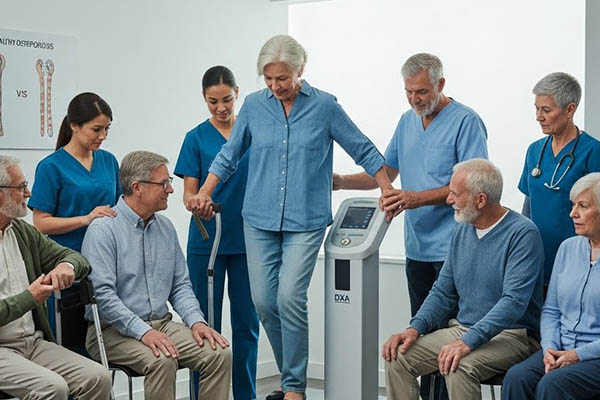
Osteoporosis: 80% of fractures in people over the age of 50 are caused by osteoporosis.
What that means is that when you fall from standing height, you should not break a bone. Your body should be able to withstand that level of force. I am not talking about people standing on a ladder or being in a car accident. Those are traumatic injuries. If you fall from standing height, you should not break a bone. Particularly over the winter months, which we are now entering, people will call us and say, “I fell hard on the ice.”
Even that should not cause you to break a bone if you are falling from standing height. The prevalence of the disease is very high. The impact of the disease is very high. One in three women and one in five men will suffer an osteoporotic fracture in their lifetime. If that fracture is a hip fracture, that completely changes the trajectory of your life.
Whether it be your ability to get back to your activities of daily living, whether it be the impact on your respiratory health just from not being able to move for a significant period of time. The impact is tremendous. It is not a normal part of ageing. For us as an organization, our challenge has been creating the link between a broken bone and osteoporosis. Many people will break a bone. Again, as I said, attribute it to external factors as opposed to internal factors.
Their bone health, the quality of their bone, and the density of their bone. It is astounding. Fractures from osteoporosis are more common than heart attack, stroke and breast cancer combined. It is not known to the general public. That is why we, as an organization, really spend a large amount of our resources educating healthcare providers in addition to policymakers, in addition to all Canadians about the importance of their bone health throughout their lifetime.
When you break a bone, it is not because of external but internal factors, such as the quality and density of the bones. Share on XIt is not a normal part of ageing. It might sound revolutionary to people who had not thought about this before. How do you communicate that on a consistent basis to be able to imagine, even to caregivers who deal with people who are a little older, that is just what happens?
Repetition is key. Diversity is key.
You should go on a podcast and talk about it.
Osteoporosis Canada’s Fracture Liaison Service
Particularly, I will just highlight one program that we do across the country. It is not unique to Canada, but it did start in Canada. It is now global. It is called Fracture Liaison Service, whereby an individual in the hospital, through the fracture clinics, will identify patients as having sustained an osteoporotic fracture when they come into the fracture clinic. Again, I am talking about people who fall from standing height, not those who have been in car accidents, not those who have fallen off a ladder or through trauma.
The numbers are astounding. We have had a program running in Ontario for twenty years. The reduction in hip fractures over that period of time is close to between 15% and 20%. That is tremendous. It does not seem like a lot, but it is tremendous. When you think about all of the health costs associated with treating a hip fracture, that includes day surgical care, post-surgical care, and rehab. Those do not even touch upon the impact on the individual’s life.
If they are employed, it impacts their ability to earn an income, and it impacts their ability to support their family. We are very proud of this program, whereby people are identified as having sustained an osteoporotic fracture. They are then referred for bone mineral density testing and treatment. There are various follow-ups done to make sure that these patients have stayed on their treatment. In terms of long-term outcomes, we look at the prevention of hip fractures.
By this intervention, how many hip fractures have been prevented? The data is robust. As I said, these programs are global now. They are not unique to Canada. However, we by no means have scalable services across the country. Many regions are underserved or just simply not serviced. As the Canadian demographic ages, that is going to certainly become more of a burden on individuals, on healthcare dollars, on healthcare services. It is going to be tremendous.
Balancing Cold Science Of Healthcare With Real Human Stories
Thank you for sharing that about the Fracture Liaison Service. It is a great example of how a charitable organization and an advocacy organization can really change the trajectory for people living with osteoporosis. One of the things I cringe a little bit about in all of us in the sector, we start to talk about the importance of our work as we measure and save healthcare costs. It’s very true. What our donors are giving to when they give to our organizations is those human stories, like the ability to live independently is extended if those fractures do not take place.
To me, that is just such a powerful story of the individual lives that are touched by the work that you and your colleagues do. As a leader, you have been with the organization for a number of years. How do you balance the sometimes cold science of the statistics related to the health care outcomes in the condition and the very real human stories of the individuals who are managing with the condition on a daily basis?
That is a very timely question. All people save for retirement. Financially, they save for retirement. That is great. We always seem to focus on the financial implications of retirement, but we do not focus on the health implications of retirement very often. What a shame it would be if you had put yourself in a situation of financial solvency, so that by the time you retire, no matter what age that would be.
All people save for retirement financially but fail to prepare for its health implications. Share on XYou have set yourself up to do what you wish to do. Travel, visit family, volunteer, whatever that is. You have a hip fracture. Suddenly, it does not really matter how many dollars you have saved. It does not really matter all of the preparedness that you have had because this one sentinel event will change the trajectory of your life. As I look at our organization, and this has been on my mind for a few months now, particularly as we enter winter.
It is really taking, as you mentioned, the hard clinical scientific findings and translating them into, “What does that mean for me? How does that impact me as an individual?” There is an art to that. There is an art to be able to translate what would be important from a clinical perspective, from a research perspective and how that impacts your life. That is what it really comes down to, the impact on your life. It is tremendous. It has the potential to significantly alter the trajectory of your plans.
There is a healthy tension. You need to have those statistics, that data, that is what fuels your advocacy efforts and changes policy and health policy and care in different provinces and across the country. Motivating donors and volunteers, telling those stories of those positive stories of the work of your organization, what it has meant for individuals.
Balancing that with the scare of “If you do not look after yourself, here is what could happen,” which is a very difficult fundraising message in the health care philanthropy space. The reality that we have seen through our work here at The Discovery Group, we have seen with a number of clients, is that the donors seem to be less likely to respond to individual stories.
They want storytelling that they see themselves in, but they struggle when you tell the story of someone in St. Catharines, Ontario, who maybe participated in the Fracture Liaison Service and had this great outcome and was able to return to normal or was able to return to the retirement she had imagined.
Keeping The Donor Community Motivated Through Storytelling
Donors can have that responsive, “Good for her.” It does not move them to give, it does not move them to lean in, it does not move them to run to the computer to donate. What are you hearing from the donors to your organization in terms of what is motivating them to be a part of the great work that you and your colleagues do there?
There is a cohort of our donors who are motivated by stories. The trick is to have varied stories, to have a repository of them, and this is just reflective of the disease. Not one patient is similar to another, not one patient’s experience is similar to another’s. Having a repository of a multitude of stories is important, but really showing the impact of our interventions as an organization on the lives of Canadians, on how they impact the cycles of life. How they impact not only how Canadians live, but also how they work, how they interact with their family, how they access healthcare, and how they are identified through healthcare services.
We are really making every attempt to normalise the screening of osteoporosis within the healthcare system so that people who perhaps have not heard of Osteoporosis Canada and have not heard of our work are not missed on the health services side. Those stories are critical because they really speak to a system change as opposed to simply asking for funds to do X, Y, or Z. It is more of a system change. That is really the key to success, no matter which disease state we speak of.
A CEO’s Experience Of Managing A Multitude Of Systems
One of the challenges all national health organizations face is that healthcare is provincial. I am not telling you anything you do not know, of course, the healthcare is provincial. Connecting the work of a national organization to the day-to-day experience of a patient can vary significantly across the country. How do you think of it as CEO? How do you think about telling that big national story and connecting it to the varied experiences that different patients may have across Canada?
That is a really important point. I do a lot of global work in osteoporosis as well. One of the things you hear from your global colleagues all the time is, “Canada has a publicly funded program. It must be easy for you to establish services because it is all one system.”
It must be.
It is a multitude of systems. It is challenging. It is challenging as an organization because we established national guidelines for disease, national best practices, which is great. If we want to establish services, publicly funded services that are accessible to all Canadians, we have to then knock on the door of each province and territory. Let me tell you, they are not equal across the country. Even the provision of medication is not equal across the country. The formulae are not equal. This is nothing new to you.
As a health charity, it is frustrating. It is frustrating because you know what the national gold standard is. To implement that within a health system takes knocking on a multitude of doors. We do not stop. We certainly do not stop that. All Canadians should have access to proper osteoporosis care management and follow-up. It is certainly from an advocacy perspective, we are not bored. There is a lot of work to be done in that space, and we continue to do so, but it is difficult to translate the value of that to the donor.
How To Balance Self-Care With Professional Life
As someone who has been so closely professionally connected to osteoporosis for so much of your career, you mentioned the international work that you are doing. You have been with Osteoporosis Canada since 2006. Professionally, so identified with the cause. As a CEO, is that a hat you can hang up when you go home or when it’s not time to work anymore? How do you find that barrier between being the champion for osteoporosis care and advocacy in the country and just being at home on a Friday night?
It is very much part of my identity, not only because of my tenure with the organization, but also my training within Musculoskeletal Health. It is a part of me, and it does not stop when I go home. I have had wonderful conversations on flights with individuals who did not know about us or the disease, or individuals who did and had questions about it.
There is no hanging of a hat for me per se, because it is through, I really feel that it is through partnerships and collaborations that we are going to be able to move things forward. I am always talking to somebody about bone health or about developing unique avenues by which to address these concerns. I love it. I really do enjoy it. It is not something that I wish to put in a corner when I get home. It is certainly a part of my life.
I am not going to ask you the work-life balance questions. We are not going to go there. It is one of those things in an organization that is a cause for you, that is your life’s work. How do you balance that with colleagues around the office who are exceptional professionals, who really care? Maybe it is not. Maybe they do not have that identity with their personal identity with the organization. How does the team around you find their own balance when it comes to working at your organization?
I will say that over the course of my career, the one thing that has become more important to me as the years have gone by is self-care and balancing self-care with your professional life. I am a strong advocate for that, both for myself and for my team as well. It is important not to always be in the rat race of life. A lot of creativity, a lot of unique ideas come from slowing down the pace. I do encourage our entire team to do that.
A lot of creativity and unique ideas come from slowing down the pace. Share on XIt is important to give yourself the grace for that, but also to give that grace to others. Sometimes I feel that can be missed. It is a reminder because it is a strong part of who I am as a leader to ensure that the team has found that balance, knows how to find that balance, or at least has the tools to help them find that balance. Ultimately, if you are not complete in your own life, independent of work, you are not going to be complete with work. There is no job in the world that is worth risking that.
Maybe it would be helpful if you could think about what is an example of slowing down the pace around your leadership table?
Interestingly, you ask that question. These questions are timely for me. When we were trying to establish certain programs, particularly the Sentinel FLS program, there were a lot of opportunities to create networks, collaborations, and meetings just to move that trajectory forward. Certainly, if they are in front of you and you can do that, you should. However, it is really important to realise what is critical for your attendance and what is not.
There is no shortage of opportunities to meet, whether or not that involves travel or not, it involves time ultimately. You could fill your week with meetings and appointments and coalitions and working groups. If you really stop to analyse the top of the pyramid, which ones are critical for your work? Which ones are critical for your organization? Which ones are critical for you? It is amazing how many are not.
They may be aligned quite well for somebody else. It is important, and this is what I mean by slow down, is really analyse all of the requests that come to you and see whether they are mission-critical for you to attend and whether they are critical for your staff to attend, because your team can become overwhelmed if you keep sending them requests. We do delegate to a certain degree in our roles, but there can be over-delegation and employees then feel obligated. I do not think they have that space of flexibility, which is really important.
Why A Leader Should Always Be Present
You have touched on a really important point. It comes up again in a lot of our work with CEOs. Imagine that the work of an organization, the work of a CEO, is like being on a beach that is full of shells, and each shell represents some part of the organization. When you pick it up, you will see what is going on underneath that shell. As CEO, almost every single time, you can make whatever you find a little better. You will drive yourself to burnout by picking up every shell.
How do you know which shells to pick up? Which are the ones to look at and go, “I am not going to deal with that right now and move on?” How do you identify those top 2, 3, or 4 things that, as CEO, it matters that you are in the room, it matters that you are in that conversation, it matters that you are there with that partner? How have you learned to distinguish where you essentially must be?
Certainly scalability. If there is a project that requires a national voice or, for me, an international voice because of my work globally, I recognise that my presence is important. I will always make time, no matter how small, to meet and thank donors and sponsors. That is non-negotiable for me. I will always do that. If there are ways in which my presence can help to support a team that is struggling or help to create a linkage that can only be created through me, I am absolutely there.

Osteoporosis: A leader’s presence is important in a non-profit organization. They must always make time, no matter how small, to meet and thank donors and sponsors.
I am more than happy to give my time to enable the success of others. As a leader, that is important. Many other aspects of our sector are good to know, but that information can be gleaned in other ways besides being there personally. That is one of the most tangible ways I would determine my presence. I need to be there to move something forward for my organization or for somebody who is struggling. If it is a coalition or a group of individuals speaking, is this information can I glean other ways?
I just want to comment on your Shell story. Not only for the leader to get engaged to make change, but you really have to be cognizant of what you are asking your team to do. It is important not to look in that shell and think, “I know who can fix this.” If that incremental fix is going to take an atypical amount of work to complete, with very little benefit. It is a weighing game. Everything could be perfect, yes, but at what cost? The cost to your staff and to your team, whether they be staff or volunteers, is really critical to assess.
I have a very vivid memory of learning that lesson. It was taught to me. It was not one that I discovered on my own by any means. It had gone to be. I was working in San Francisco at a hospital foundation that was trying to raise money for two new hospitals, around $3 billion to build the hospitals. The annual fund program was one of the most perplexing, confusing things I had ever seen. I did not understand it, it was expensive, and it was not working.
All of my heart wanted to jump in and fix this program, because it was so janky and weird. My colleague at the time, Karen Zhu, said, “Doug, if you fix that, it will go from raising $2 million to $2.5 million, and we need to raise $3 billion. What are you doing?” I was like, “Oh.” The funny thing is, I still think about what I would do to fix that broken. I let it go. I left that shell on the beach, but I still go, “We could have fixed that.”
That is a skill that cannot be emphasised more. The value of recognising that almost everything can be incrementally, but on balance and on weighing the cost of doing so versus the cost of doing something else. It is a skill. It is a skill that we continue to learn.
I was going to say, I have a couple of examples of when I demonstrated a good execution of that skill. I am sure others around me today could point out several where I have not done that. Leaders of any kind of organization or anywhere in an organization struggle with that, or need to benefit from being reminded that you do not have to fix everything. You can focus on what is going to add the most value, where you are going to help the most people, and where you are going to move things forward the fastest.
There is no shame in asking for advice. Mentors are underrated, particularly when you have been in a senior leadership role for a very long period of time. It does not change the value of mentorship. It does not change the value of seeking input. That is very valuable. Sometimes that has righted my course. For sure, there is great value in that.
How Dr. Jiwa Asks For Help Or Advice From Other People
When you have a hard issue or a challenge, or something comes up, who do you call? Who is on your emergency 911 list as CEO?
I have a cadre of people I would call. I do not just call one person. That is the thing. If Famida has a problem, many people are going to hear about it because I will seek input from different perspectives. Some people who are directly involved in this field. I find sometimes the most valuable advice comes from those who are not, because they are not constrained by the framework in which we all operate. I spread my wealth of questions.

Osteoporosis: The most valuable advice comes from people who are not constrained by the framework you operate in.
The Culture Of Giving In The Digital Space
I appreciate that. Sometimes, that external view can see through the complexity to the simplicity of the path forward. That is really good advice for any CEO who is tuning in or anybody who wants to be a CEO. That is really valuable to take from this conversation. As we come to the end of our conversation, what are you looking forward to?
Within our sector, the next ten years are going to be pivotal because the culture of giving is very much tied to demographics. As we emerge into increased use of the digital space, increased use of AI, unfortunately, trust issues with the digital space and trust issues with AI. It is going to create unique challenges that have not been faced before within the donor space. We are just taking a small step in terms of engaging the youth in our disease state.
What I really look forward to seeing in the next 15 or 20 years is what the health charity sector or just the charity sector in general looks like. Are we reaching a pivotal change in the next decade for our donors? I was just having this conversation with another leader recently, talking about the decade of donors, exactly those words were used. The nature of donation is going to change. The nature of philanthropy is already significantly changing. I am very excited to see the next phase of this sector.
I also think a lot of it will be dependent on atypical partnerships, atypical collaborations that may not have existed in the past simply because of the enabling nature of technology and the enabling nature of AI, both within the consumer space, but also within the clinical space. It is very unique. A little bit uncomfortable because it is an area which is new, particularly for me. The value of discomfort and change cannot be overstated. It often leads to those transformative changes. I am really looking forward to seeing what the next evolution of the charity space will be.
It is going to be quite a ride this next decade, there is no doubt about it. I so appreciate you and the work that you and your colleagues are doing at Osteoporosis Canada. You were able to make time to join us on the show.
Thank you so much for having me.