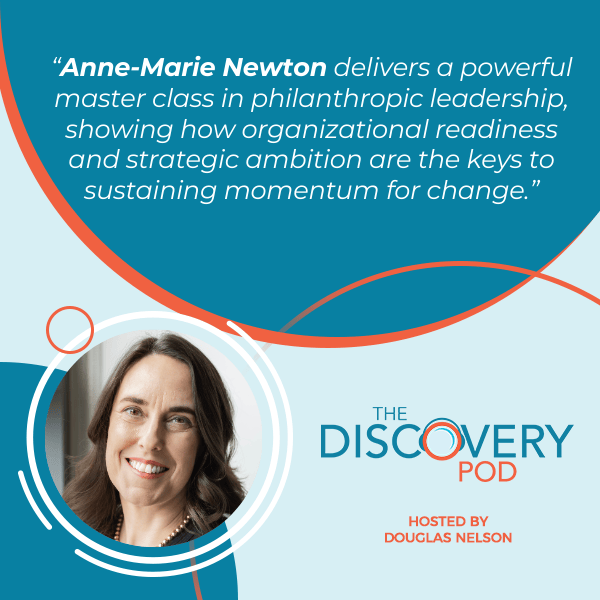
How do you maintain momentum after the record-setting success of a $600 million campaign? Learn the critical role of organizational readiness and strategic ambition in this master class on philanthropic leadership. Douglas Nelson sits down with Anne-Marie Newton, President & CEO of the Centre for Addiction and Mental Health (CAMH) Foundation, who openly shares her experience navigating the transition from Chief Philanthropy Officer to CEO. She discusses how to successfully lead a team through the crucial “retool and refuel” phase that follows a major campaign, the importance of consistent, authentic donor stewardship, and how the Foundation partners with the hospital to drive system-wide advancements in mental health—the defining public health challenge of our time.
—
Listen to the podcast here
Organizational Readiness & Strategic Ambition With Anne-Marie Newton, President & CEO, CAMH Foundation
Leading Transformational Change In Mental Health Philanthropy
Welcome to the show. In recognition of the continued importance of mental health in our communities, we are highlighting an organization that is leading the way in mental health support, advocacy, research, and care. Our guest is Anne-Marie Newton, President, CEO of the Centre for Addiction and Mental Health Foundation, also known as CAMH Foundation.
Anne-Marie is a nationally recognized leader in philanthropy, driving transformational change in support of mental health at Canada’s leading mental health hospital. She has more than twenty years of experience leading fundraising campaigns, building high-performing donor-centered teams. In CAMH, she played a key role in the record-setting $600 million No One Left Behind campaign, one of the largest mental health fundraising efforts in the world.
In our episode, Anne-Marie shares her experience leading that campaign. What comes next after the campaign in terms of fundraising for the organization? It is a master class in what it takes to be a fundraising leader transitioning to the CEO’s seat. What is involved in that change of perspective? You will hear it all in this great episode, this excellent conversation with Anne-Marie Newton.
—
Welcome to the show, Anne-Marie.
Thank you, Doug. It is really nice to be here.
The CAMH Foundation Story: From Asylum To Open Campus
This is a conversation that is too long in coming, but I am really looking forward to what we are going to get into, learning more about the great work that you and your colleagues at CAMH Foundation have been undertaking over the last number of years, and learning more about what you are looking forward to. As we get started, tell us a little bit about CAMH Foundation, the people that you serve.
Our story really starts with CAMH’s story, which is that we were founded in 1998 as an official academic teaching hospital. We are actually quite young relative to other hospitals in downtown Toronto. For well over 150 years, we have been a psychiatric facility. CAMH started as the provincial lunatic asylum in 1850 on the site of our Queen Street campus. Obviously, the models of care, if you can call it that, back in that day, over time, have really evolved.
Our campus has really reflected that evolution, growth. If you think back to the dark night, Arkham Asylum, that is very much how our original campus looked. You can imagine, as someone experiencing that, it is almost how that would feel to live in what essentially was a prison. That has obviously changed over time, but really, through the 1990s, early 2000s, that was the feel of our campus.
When I moved to Toronto in 2006, we were in a brutalist building or a block of buildings, which felt very much like a prison. That is what I knew CAMH to be when I first arrived here. Our campus has now been completely redeveloped. That has been because of philanthropy. Within those buildings that have been completely changed from very dark and purpose-built to keep the community out, keep patients in, we have really evolved into a beautiful open campus where people come, walk their dogs.
There is a flower market on Saturdays. There are holiday markets, tree lighting, those kinds of things. We are really part of a very vibrant, cool West Toronto neighborhood. In a lot of ways, that reflects how we engage with our community. We are very different from the standard physical health hospitals. There is just such nuance provided around the care that we provide and the communities that we serve.
Certainly a work in progress. We can always be doing better, but just a really wonderful place to work. The foundation has been really integral in funding, not just the physical transformation, but the research that happens here at CAMH. We are both a teaching hospital, but we are also a very well-respected global research facility.
It is a remarkable place. Many of our audience would be surprised to hear that it was founded in 1998. It is not something that has always been a part of the health system. You mentioned that philanthropy played a central role, I would say a really impressive role. The No One Left Behind campaign, the world’s largest fundraising campaign for hospital-based mental health research, concluded in 2025. Walk us through a little bit about how the case came together for that, because to work with your hospital partner on something of that enormity, I know, is a challenge many of your adult acute care, pediatric hospital colleagues are managing on a daily basis.
For full disclosure, I came to CAMH in January of 2023. I joined at the end of the campaign. I was not as involved in it.
You can put it on your resume.
I am totally claiming that as a win. I very much came in for the final phase. It was obviously quite critical because we had to complete a very significant fundraising effort for our research building. The genesis of the campaign was that we had done these campus redevelopments in phases. The first three phases were done in chunks of time. First, we did some addiction units.
We did some inpatient, ambulatory care units. The final phase is this research building, which is going to unite all of our researchers who are scattered across Toronto. Bring them all into one place on our campus in proximity to patients, which is incredible. We are redeveloping our secure care, recovery unit.
The forensic unit where people who come into contact with the justice system are patients who can age because they are found either criminally not responsible or their illness is so severe they are better placed in a secure facility, versus a jail. Those two pieces are the final phase of our full redevelopment. Once we are finished with that, at least for the time being, we will be done with our building projects, but our work will not be done because we will need to fill those spaces with really awesome people, amazing programs.
A Campaign Is A Water Station, Not A Finish Line
I was going to say, it is often, particularly when folks are working with their boards, telling them about the course, the life cycle of a campaign, whether it is capital or comprehensive. Comprehensive usually has a really big capital component in it. What I have come to understand is that many board members who have not been through it before, even cabinet members who have not been through it before, see the campaign goal as a finish line. That we will run across it. All together feeling victorious, we will break the tape.
We will stop. One of the things that is challenging for folks like you, as CEOs, chief development officers in our work here at The Discovery Group, is convincing people or showing it is a water station, it is not a finish line. It is the end of that part of our organizational race. It is at the end. As someone who had come into the organization at the tail end of the campaign, and coming into the CEO role subsequent to that, how did you marshal the team to understand that this finish line, while important, was worth celebrating, was not the end?
I really credit our former CEO, Deborah Gillis, who knew she would be retiring, with really weighing the groundwork for whoever succeeded her to have that idea of future growth in mind. The way that I have always understood any kind of campaign is that it is really meant to get an organization to a certain threshold and maintain it. The next campaign gets you to the next threshold.
Any kind of campaign is really meant to get an organization to a certain threshold and maintain it. Share on XThat is certainly my background, expectation of any campaign I am part of. If you have been in this business for a long time, that is second nature. You know that your goals are never going down. If you are working alongside a really high-performing institution, their ambition growth is going to be significant. We have to keep pace. That is actually from a team mobilization perspective that is really motivating.
What is most important is making people feel empowered to a certain degree, responsible for the hospital’s success in some way. It is certainly not only on the foundation to enable growth, but to feel like we are really important partners in delivering what the hospital has set out to do for the people we serve. When you have your work, your focus is so tied to the mission of the organization, really feeling like you have a hand in making the world a better place. That is the kind of environment I want to work in. That is the kind of environment I try to hire for.
As you say, I think folks, those of us who have been in the sector for a long time, participated in a lot of campaigns, understand that one of the primary advantages of a campaign is that step change in the ongoing level of giving that happens. It is those volunteers sometimes that need to be brought along on that learning curve. As you finish, you celebrate. The Prosecco bubbles are still popping. One of the things that I am curious about is to better understand your experience.
How do your conversations with donors change? At the end, you are doing the final push to a really significant, tremendously successful campaign, “Help us get to the finish line. Who are we going to motivate to be the capstone gift? How are we going to get that? How are we going to tell that story of the campaign through the voices in the eyes of our donors, those that we serve?” A couple of weeks go by. Now you are talking to donors again. How does that conversation change for you?
In a lot of ways, you really have to double down on stewardship and reporting on impact as a campaign goes on or as someone’s gift ages. Always being mindful that the best way to keep growing is to keep the people who have been your strongest supporters engaged. Get them to keep giving. We have certainly seen that as a pattern at CAMH.
If you are doing your job well, you are showing people what their investment has enabled, what it makes possible down the line. Ideally, it is actually not that hard at all for them to say, “I would love to hear what is next. How do you see us playing a role in that?” The better you get to know people about when that timing is right, the more you just really spend time with your donors, whether they are giving a $25,000 gift or $250 million, it actually does not matter.

Organizational Readiness: If you are doing your job well and showing people what their investment has enabled and what it makes possible down the line, ideally, it’s actually not that hard to sell for them.
You have to ingrain that practice throughout the organization, through all your fundraisers, and even in our more digital mass communication. Donors do want to see impact. The way that we position that does change, either based on the donor or based on the era and generation. If you are not demonstrating that, it will be harder to reignite people’s interest in giving again or desire to stay involved.
You are saying that the best way to keep your donors engaged is to talk to your donors.
All the time. Generally, acting for money.
Navigating The CEO Transition: From Peer To Boss
Start a revolution. Making light of it, but it is a challenge for many organizations coming out of a very successful campaign because there is an institutional exhale. At CAMH Foundation, you had a CEO change, which certainly would not have been an exhale for you coming into the role. A lot of emailing. The organizations that the shoulders can come down. There can be a little bit of a break. Having been on the leadership team, moving into the CEO role, how did you think about that transition for yourself?
I am generally someone who just approaches things, trying to be as straightforward and authentic as possible. In a lot of cases, whether it was with board members whom I had worked with, they are now my boss, essentially. It is navigating a new relationship. I think just being curious, asking the question, “How do you want to work together now that this is a different set of dynamics?” Certainly, on the board side, that was an important conversation that I had with almost every board member over the summer as I transitioned into the role.
It was a really nice way to connect. What I was so grateful for. I do not know why I was surprised, but very surprised by how eager people were to help, set me up for success, which just felt like such an important endorsement as I was starting a big phase of my career. That same type of redrawing of boundaries has continued to happen with people who were my peers on the leadership team or with direct reports who I am still managing to a degree as I try to find the person to succeed me in the Chief Philanthropy Officer role.
It has just been a lot of very frank conversations about, “This is a little weird,” or, “This is different.” Aligning with what works. Also, just coming back to our core values of courage, respect, and excellence. Those are things that we try to imbue in our work anyway, but also what has made us successful in the past should be what makes us successful going forward. That is just some joint accountability, transparency.
It sounds like you thought a lot about it, making that transition, of course, and it comes through. You have this bold new big job that you are moving into at the end of the campaign. Your peers in the leadership team still have a lot of work to do, but they are not moving into that role. You are ready to run. New set of shoes. Let us go. Let us get after it.
It is very natural, we have said, for there to be a relaxation that happens at the end of a big campaign. How did you manage that balance of this big new adventure for you as the CEO, understanding that the reason why a lot of organizations relax is that people need a break? It is very true. How did you balance that? “Let us get after it,” understanding that the organization may have needed to take a deep breath.
One thing to really keep in the back of your mind is that we have been in a campaign at CAMH since 2004 without any breaks. The idea of rolling straight into yet another campaign, everyone was ready for what we are calling a retool, refuel period. We completed a new strategic plan last year. We consider what we are doing.
Of course, that really ladders up to the hospital’s strategic plan, its goals to advance care, get upstream in the course of disease, lift societal health, and really focus on health equity. What are we doing to support those goals? We also worked to develop a revenue generation plan that would be the how of how we are going to achieve this strategic plan, which aligns those our vision. We started that under Deborah Gillis, my predecessor. It was a fairly consensus-driven set of goals that I then came into to lead as CEO. There are certainly different ways that we are looking at things now.
We are changing a lot of how we report. Moving away from the more accounting-focused reporting to actually thinking about what the KPIs are that actually define fundraising, a brand-driven organization, which is a very different way of looking at how we go about our work. However, the core principles, the general direction were aligned well before I came in. I had a hand in creating that. Also felt like it was something that I could authentically lead. That really smoothed the way for me. I am grateful for that.

Organizational Readiness: We’re changing a lot of how we report; we’re moving away from kind of the more accounting-focused reporting to actually thinking about what are the KPIs that actually define fundraising and a brand-driven organization.
As a peer becoming the CEO, it is the dream of most fundraisers. More fundraisers need to be the CEO of organizations. Having walked that path myself, I am a big fan of it. The board made great choices when they hired CEOs. I asked you how your conversations with donors changed at the transition of the campaign to your refueling, retooling phase. How did your conversation change with your peers as you moved into that CEO role, your former college?
There is a certain level of consistency that it is important to show people. Not showing up as a completely different person when you suddenly become their boss is probably a good move. That is not how I would want to operate.
What happened to me?
I do not think I have changed that much. I am more obviously focused on enterprise-wide thinking versus just leading the team that I had to be responsible for. That is a shift personally, where you cannot default to what is comfortable. You actually have to think through, in the best industry or organization, my comfort zone might be major gifts, but we really do have to think about how we invest in brand, how we prioritize other lines of the business, so that we are going to grow across all channels.
That piece would be how people see me showing up differently. I also think when you move into this role, there is a really important lesson in speaking less, letting people go first, because you can really stifle conversation if you come in too hard. That is an ongoing challenge for me. I am working on it for sure.
When you move into the CEO role, there's a really important lesson in speaking less and letting people go first. Share on XIt is so hard to be quiet when you know the answer.
Also, it is like what makes you successful earlier in your career, you cannot come at it with the same approach when you are at the very top. It is different.
Years ago, when I made the transition from being the head of fundraising at a university to a CEO role at the BC Cancer Foundation, when I was uncomfortable about the enormous learning curves I had in finance, administration, and granting, all of it, I would default to wanting to do more fundraising. That is where I enjoyed it. I liked talking to donors.
I would spend a lot of time with donors. My first board chair, who ended up being a tremendous mentor for me, said, “Look, we know you are a good fundraiser. That is why we hired you. We did not hire you to be the fundraiser for the organization. We hired you to be the CEO.” That is a different job. What stuck with me from that was my first reaction was, “What is the point of this job if we are not raising money? That is the only thing.”
As the wave of defensiveness crashed, I was like, “I get it.” It is a fairly natural thing for fundraisers moving into that CEO role to experience that, as you said, what made us successful, what makes you the best person to lead the fundraising program, is different than what makes you the best person to be the CEO. Most fundraisers figured it out. How have you found it so far?
It is definitely a process. It makes you uncomfortable to have to let go to some degree. Especially when it is relationship-based, as I am sure you found. You have wonderful relationships with your donors. To bring someone else in to lead it, to take over, really does take a high degree of trust, a little bit of risk-taking in your perception. Part of it, too, is just recognizing, for me especially, is just that there is not one way to do everything.
Let people who are skilled and good professionals do their job, and what you will get back from them will be so much more. Share on XSomeone may come in with a different energy, a different style, and do a great or greater job. You just have to let people who are skilled, good professionals do their job. What you will get back from them will be so much more around if you are not trying to control everything or stay way too involved. Honestly, just by necessity, I cannot be in everything. You just have to trust that you hire great people. They can handle it.
In my own career have always learned so much when I have been given these opportunities when someone has left. I have just jumped in to take over a portfolio. I really do want to recreate that for the folks on my team who had some vacancies that were caused by this transition. Letting people really lean into some stretch roles. They have over-delivered. It is also nice to see it turn out the way you want it to.
Mental Health: The Public Health Challenge Of Our Time
Seeing people step up makes you feel really good. Speaking of stepping up. Mental health has been an issue as an issue coming out of the shadows in many respects, evolving from the prison setting to more of a community feel, as you described in the evolution of CAMH. What we are seeing across the country is a number of organizations that maybe do not have or have not had mental health as a focus of their fundraising, really wanting to add it as a piece.
We hear it from organizations saying, “Donors are really excited about funding mental health. We need a mental health priority,” which is not a good fundraising strategy for anyone listening. That urgency of “We need to meet this need.” You have a really strong working relationship with CAMH, a fully integrated relationship in many ways.
I am sure there is a lot of work to it, but straight line in terms of finding out where the priorities are, what is that margin of excellence philanthropy can play. Many other folks who do not have that kind of relationship with the level of expertise, care that you do, are struggling to find those connections. What advice would you have for a hospital CEO who is bored with saying, “We should do something in mental health?”
There is a lot in not trying to boil the ocean. It is also just picking where you fulfill either a very specific or unique need. That is what is compelling about your value proposition as an organization. I would just say from personal experience. My mom has a very serious mental illness. That has been a three-line throughout my whole life.
We know that there is not enough mental health consideration given, even in physical health settings. There is, for sure, a need throughout healthcare for mental health to be brought into the conversation around physical health. I do not discount at all that I am sure that patients are presenting with more complicated mental illness, addictions, all those kinds of things. The lens we take at CAMH is that we are obviously Canada’s leading mental health hospital, but we cannot be the only provider at all.
Mental health is a real thing that you have to take care of. Share on XEveryone has to be part of the system. It is for us to think of how we lead that system change. What can we generate here that can be translated out into other communities, other regions? Also, what are those regions, communities prepared to accept, adopt from a place like CAMH, or from other places that are doing well in whatever it is that they are trying to treat? A lot of it does come down to partnerships, and really understanding how to build a better system by taking what works from other places.
The perception is working in the space is that the stigma around mental health is lifting, not fully resolved or dealt with. In your fundraising, the relationships you are building, the communications you are putting out, how are you pairing that idea of destigmatizing mental health, addictions in mental health with the call to action for fundraising?
From a business perspective, if you are an employer, mental illness is the leading cause of disability worldwide. If we are not thinking about how we can better take care of people’s mental health, we are not thinking about building a more productive, independent workforce, society. At its core, this is the public health challenge of our time. That is the value proposition anyone can make to their health-focused, or even productivity, or economic development-focused donors.
That I think really became apparent in the pandemic is that mental illness, mental health, is a real thing that you have to take care of. When everyone is experiencing it. It did crack open the opportunity to really talk about it in a more real way. There is a long way to go. There is still a ton of stigma out there. The more transparent you can be about the real issues and how they impact health outcomes generally, the more important piece of the case debate in banking.
Balancing Progress And Need: The Discover, Share, Lead Approach
This is too much of an insider question, but I am curious because you work very closely with the hospital. The hospital knows the demand, knows the urgency. Of course, you do too. Wanting to report to donors that the investments they are making in your foundation are making a difference, changing the story for individuals, hopefully for more at a system-wide level. How do you balance showing progress in your donor communications with the reality that the system, as it is, cannot meet the need that patients have for that mental health system, not just in Toronto, but across the country?
I generally approach proposals. We do this systematically across the foundation from this idea of discover, share, and then lead. What we discover here, even in terms of basic science, is the molecular basis of disease, and really granular cell-based root causes of mental illness. How do we take that and translate it into actual interventions? How do we get those interventions out to the greatest number of people? That is really the end-to-end approach that CAMH takes. Wherever a donor is coming from in terms of their interests, some people are very interested in just the basic neuroscience.
That is really important because we do not know enough about the brain. There are a lot of people who really just want to see better care, see a better future for their kids, grandkids. There is a piece of that that every person can own, pick for themselves where they want their investments to go. If we are having really authentic conversations with donors, it is just engaging them in that spectrum, that cycle. That is how we move the needle generation after generation.
You can certainly put support around a young person to make sure that they have the best possible chance to have a job, live independently, have a family, pursue education, all those kinds of things. Share on XI think donors know that there is a lot of work to do across the healthcare system. One of the things that I take the chance whenever I can to talk to boards or work with the leadership teams is that no one thinks healthcare in Canada is just one tweak away from being fixed. It is not a $100,000 gift or $100 million gift away from being fixed. If it were, it would be. Our donors are really clear that there is a tremendous amount of work that needs to be done. The organizations that partner with them say, “Yes, let us do it together.” They are going to be successful.
We see that. We have a lot of really good examples of, for example, the first episode of psychosis. If someone exhibited signs of psychosis twenty years ago, there was very little to do to disrupt that progression of the disease. Full-on schizophrenia is probably the most complex form of mental illness. It is tremendously impactful, not just on the person, but on their family, community.
A lot of those folks end up in our forensic system because they come in contact with the logs. It seems like an almost intractable issue. Essentially, a death sentence for that person. It is actually something that we have developed here. Implemented here is if you recognize the signs early, you can actually get upstream.
You are never going to cure the disease, but you can certainly put supports around a young person to make sure that they actually have the best possible chance to have a job, to live independently, have a family, pursue education, all those kinds of things. The other thing we always have to be mindful of is just pointing to the playbooks that we know work. There are those playbooks out there. That is very hopeful. It feels very solution-oriented.
Finding progress in the midst of a lot of pain. Anchoring to that, bringing donors along with it. It is really incredible work. Really great stories that you and your colleagues tell. Great work that you represent in your donors’ fund. As we come to the end of our conversation, Anne-Marie, what are you looking forward to?
Looking Ahead: The Upside For Mental Health Philanthropy
I just feel like more people recognize mental health as the issue of our time. We have barely scratched the surface in getting the people who want to be part of the solution involved. It just feels like we have so much upside in front of us. I am so lucky to work alongside an incredible hospital that really does offer incredible solutions. It just feels like that alignment is there. It is really almost a wide-open field to move the dial in a cause that we have just overlooked for far too long.
Anne-Marie, I so appreciate the work that you and your colleagues are doing there at CAMH Foundation. I really appreciate you making time to be on the show.
It was a joy. Thank you for having me, Doug.
Important Links
- Anne-Marie Newton on LinkedIn
- Centre for Addiction and Mental Health Foundation
- Centre for Addiction and Mental Health Foundation on Facebook
- Centre for Addiction and Mental Health Foundation on X
- Centre for Addiction and Mental Health Foundation on LinkedIn
- Centre for Addiction and Mental Health Foundation on YouTube