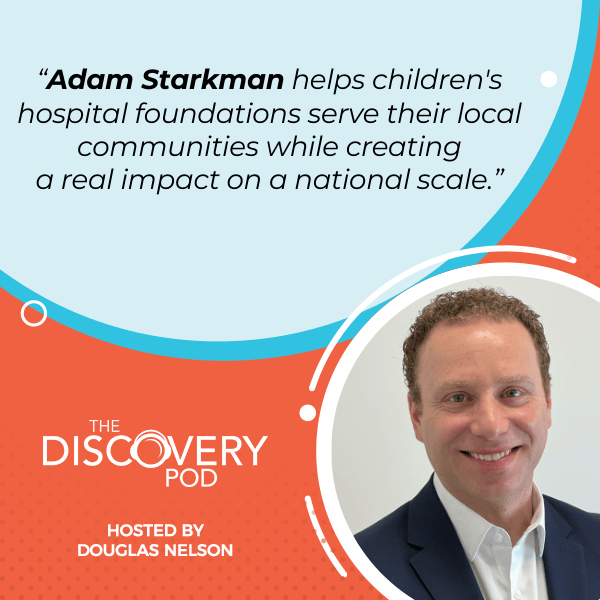
Whenever the economy stumbles or takes a moment to take a breath, the social profit sector gets concerned about what will happen with corporate philanthropy. Douglas Nelson delves into the current state of corporate partnerships in Canada with Adam Starkman, President and CEO of Canada’s Children’s Hospital Foundations. He offers valuable insights on building and driving meaningful change within your own organization while navigating the ever-evolving landscape of corporate philanthropy. Adam also emphasizes the importance of taking an intentional approach to culture building to unlock stability and growth in your team.
—
Listen to the podcast here
Transforming Philanthropy And Organizational Culture With Adam Starkman, President & CEO, Canada’s Children’s Hospital Foundations
We’re joined by Adam Starkman, President and CEO of Canada’s Children’s Hospital Foundations. Adam stepped into the role in 2023 to lead the national network of thirteen Children’s Hospital Foundations, advancing shared priorities in pediatric research, care, and fundraising. He brings nearly two decades of experience from SickKids Foundation, where he helped shape one of the country’s leading corporate partnership programs. Adam is known for his collaborative approach, commitment to innovation, and belief in the power of partnerships to drive meaningful change for children and families.
In this episode, he shares the current state of corporate partnerships in Canada, looks into his crystal ball, and tells us a little bit about what’s coming in the future for those corporate partnerships, how to build and drive meaningful change within your own organization, and in his organization. He shares some really exciting things to come for an organization that is increasingly becoming essential for the lives of children and families across Canada. Thank you for listening to this episode of The Discovery Pod. Adam Starkman, everyone.
—
Welcome to the show, Adam Starkman. How are you?
I’m doing very well.
The Mission Of Canada’s Children’s Hospital Foundations
Adam, I am so looking forward to our conversation. You are the CEO of an organization that is spoken about and whispered about as this entity that’s growing and building and lots of exciting things coming out of it. I’m eager to get into what’s behind it and the trends that you’re seeing in your work. Before we do that, tell us a little bit about Canada’s Children’s Hospital Foundations and the work that you do.
Canada’s Children’s Hospital Foundations, or CCHF as we often refer to it, is a not-for-profit organization in Canada. We raise money for thirteen children’s hospitals across the country, and we do that predominantly through corporate partnerships, although we have some examples of individuals who have wanted to support the collective thirteen hospitals. We really work directly with corporate partners and raise money in support of the great work that’s happening across the country.
For us, it’s critically important that the dollars that we raise stay in those communities. As a founding principle of ours, we believe that dollars raised locally stay local. Through our partnerships, if a dollar is donated in Alberta, that dollar supports the Children’s Hospital in Alberta. The same holds true in Nova Scotia and other parts of the country. We work directly with our corporate partners and our member foundations to find the opportunities that exist for both parties.
In my experience working with children’s hospitals, but when I was in a role and working in pediatric oncology through my time at the BC Cancer Foundation, one of the things that’s true about raising money for children is that it can be a fairly complicated space to make partnerships in. What’s the approach that your organization takes to keep all thirteen foundations at the table?
One of the key differences and objectives of our organization is to raise unrestricted dollars for the member foundations. To your question and to your point, by doing that, we really put the power in the foundation’s hands to determine what investments their hospital, their community, needs. Because we’re working with large national, international, and multinational corporations, the ability to raise those unrestricted dollars is possible. We generally raise our funds almost a dollar at a time. The idea that Canadians want to support and give back to their local children’s hospital really allows us to raise very significant dollars year over year. As I say, empower the local hospital and foundation to allocate the funds as they seem appropriate and needed.
You’ve been established for a while. As a path of funding, I’m sure that’s well-worn and well understood. What was it like in the early days? It sounds like all the dollars raised in the community stay in the community. People nod their heads. “Adam, prove it.” How does that resonate or how does that work today?
It speaks very, very much to the need for relationships and for the ability to demonstrate the impact. Transparency is an absolute key for us and our partners. We want to make sure that as a consumer makes that donation at the cash register or as a roundup, they know that that donation is getting to their children’s hospital. We focus a lot on showing that transparency and showing the dollars flow from us to the local foundations.

Corporate Partnerships: Donors deserve transparency. They must know that their dollars are flowing to the right local foundations.
In turn, storytelling and showing and talking about the impact that those dollars are having in the community. Taking examples of new spaces, new clinical activities, research, innovation, all of the things that philanthropy helps to make possible, sharing that back to our partners and to the community so that they really understand the difference that their donations are making is a key part of our work.
The power to designate locally or have an impact locally, but the advantage of a national scale. It seems obvious. What took so long?
It’s not new. That’s one of the things about CCHF that is important. We have been in this business for quite some time. We work very closely with Children’s Miracle Network, which is an international organization that follows the same model. Some of our partners have been raising money through Children’s Miracle Network for 30, if not more, years. Together, we have raised hundreds of millions of dollars through the very model that we’re talking about. A dollar at a time and focusing on ensuring that those dollars stay in the community where they’re raised, and allowing the hospitals to make the kinds of investments that they know will make a difference.
The Role Of Collective Giving In CCHF
Adam, I want to make sure we save a fair bit of our time to talk about corporate partnerships because it’s top of mind for many organizations across the social profit sector in Canada. Before we get there, I want you to talk a little bit about the power of collective giving. In our travels here at The Discovery Group, we meet with lots of organizations that are trying to move from community-based fundraising to major gift fundraising and transformational giving, and everyone is chasing up that donor pyramid. There’s a logic to it. Some make it to the top of the pyramid, and others struggle a little bit along the way. You’ve managed to demonstrate a different path with some really inspiring results. What is the role of collective giving in CCHF’s world?
The opportunity to inspire the masses, to inspire everyday Canadians to make a small act of generosity or giving in their day-to-day, is a really powerful opportunity. We know that people love their children’s hospitals. We know that there is a desire, a commitment, and a passion for those children’s hospitals.
It stems from either their own personal experiences or the experience of a family or friend who has been through the hospital. In some cases, a recognition of just how fortunate we are to have these children’s hospitals in our communities, in the event that one day we might need them. We find that when asked, most Canadians want to give, support, and help the children’s hospitals. As you pointed out, not all can give at the transformational level or even the major gift level or become a monthly donor, but the opportunity to give in the course of a day feels really good for them.
Similarly, a result of that for our corporate partners, this becomes a real highlight in their employee groups in a year. They look forward to our campaigns. They get excited about bringing their passion, their energy, their enthusiasm, and their love for the children’s hospital into their work. The combination of those two things is really quite amazing to watch take place.
The Current State Of Corporate Partnerships In Canada
It is a special feeling, and the results are hard to argue with. It is certainly a growing trend, a growing wave of support. Now let’s get into corporate partnerships. Whenever the economy stumbles or takes a moment for a deep breath or a pause, there’s concern across the social profit sector about what’s going to happen with corporate philanthropy. This time, paired with that deep breath or pause that many are anticipating or feeling, is the change in ESG. The pendulum is swinging. For some, it feels like it’s swinging quite wildly and quickly. In these sorts of tumultuous times, what is your perspective, or how are you navigating those waters at CCHF?
I’ve been working with corporate partners for almost two decades now, and I certainly have seen the pendulum swing and I’ve seen it swing back in various ways. I’m actually quite excited about where we are right now. I think that in some ways it’s a return to the core principles of philanthropy and giving, and also corporate philanthropy, which is a recognition that there is an opportunity for companies to give back to the communities.
That is when it is done in a way that is sincere and authentic and aligned to those companies’ values and leadership qualities. It really can make a difference. Where we have seen either imposed or self-imposed rubrics and frameworks for reporting and trying to shoehorn giving into a single framework, I think, is where we started to see some of those challenges and some of those stumbling blocks.
When done in a sincere and authentic way, corporate philanthropy can make a real difference in the world. Share on XNow, with, as you raised, the reluctance to go down that path or the concerns about it being too narrowly focused, we’re starting to see companies come back to this idea of, “This is good for the community. This is good for our organization. This is good for the people that we work with. Let’s find the appropriate model, the appropriate partnership that feels true to us and not force something that doesn’t feel natural.”
I think that’s an excellent point. It was with an organization just last week and one of the board members who was helping in quotation marks was talking about, I hope they’re not listening, was talking about how the problem with corporate fundraising is they have these people that work in community investment and all you have to you have to ignore those people and get around them and get to the CEO or get to the senior vice president. Adam, is that advice you would give to an organization?
No, not in those direct terms. I think that the folks that we work with to help bring the campaigns to life are absolutely critical. In fact, they have a really deep understanding of their own organizational culture and what needs to be in place for something to be successful. I don’t believe that our work is to get around them or to bypass them. In fact, I think it’s about building those true partnerships and understanding what their objectives are.
What have they been tasked with within their own organization to achieve, to advance, to enable? How do we, as a partner, work with them to do that? If we come to a partner with our own objectives and goals, and that’s in contradiction to what they as a business are trying to achieve, we’re never going to be that true partner. However, if we understand what they as a business are trying to achieve through their corporate philanthropy, we have a real opportunity.
It’s really working with those individuals. What I agree with is that I don’t think the conversation can stop there. I think part of our job, and certainly the work that my team and I are very focused on, is how do we deepen the relationships that we have with our corporate partners? How do we engage with key decision makers and influencers within the organization? How do we better understand where they are going or trying to go with their giving? In doing so, we’re able to be much more reactive and responsive to those shifts and bring positive solutions forward that allow us to deepen the connection and achieve more together.
I would imagine you have a fair bit of expertise that your partners are interested in, both in the connection to the children, but also the number of corporations that you’re working with. I’m sure not too many days go by that one of your partners says, “What are they doing over at that company? What are they doing at that bank?” How do you manage the confidentiality of that, Adam?
It’s interesting. We certainly are careful about that and ensure that there is good confidentiality between partners. We have also seen amazing examples where partners want to collaborate in our part of the world differently from their own business challenges. We have seen on occasion and engaged leaders from two competitors in a sector sit on the same stage and share ideas about how they can raise more money or how they could leverage their networks to do more in support of that shared cause.
It is interesting to strike that balance where, absolutely, we need to ensure the confidentiality of our partners, but also be open to and responsive to their acknowledgement that this is something that they care deeply about and are willing to look at it differently than their other elements of their business.
Compete in the marketplace, but come together around the important issue of the Children’s Hospital Foundation.
Battle on the field and then enjoy a beverage together after the game.
How To Restart Corporate Partnerships
It’s good to hear. Given your deep expertise, and you mentioned you’ve been at this corporate partnership game for a while now, what advice would you have for an organization that is at the stage of needing to recommit to corporate partnerships? Maybe they had them. The virus we had a few years ago disrupted some business model things, and they haven’t really gotten back to it. What would be your advice about restarting those partnerships if you had to do it today?
I think corporate philanthropy is so much like all parts of the business. It is around relationships. It’s around finding those champions within a partner organization, whether they are formally in their role or as part of their desk activities. I believe that it really is about finding those champions and then doing the work to understand the company and understand the culture, and understand the opportunities that exist.
Corporate partnership is about finding champions, understanding a company’s culture, and recognizing the existing opportunities right now. Share on XWhere we see the greatest success in our partnerships is when the company is leveraging its own communications channels, it’s looking at the various ways that they track or measure, and using all of those tools that they are so successful in to drive the fundraising and impact efforts that they have. When it feels like it’s outside of the business, I think, that’s where we sometimes stumble and fall because it’s not integrated into the way that the company thinks. It feels different. This is so foreign to us. Where it feels natural, where it feels like them, it really resonates. I think that’s where we start to see the pickup and the groundswell of activity and enthusiasm across the organization.
Managing 13 Children’s Hospital Foundations Across Canada
Corporate philanthropy starts with people, too. I think that’s intuitive to most people working in the sector. Maybe not always to their boards, but certainly to the individuals, the professionals that would be listening to this show. I’m curious, as an organization that is made up of the thirteen children’s hospitals across Canada. The organizations are moving at different paces, some in campaign, some not in campaign, some really big and sophisticated, some emerging in their sophistication. How do you work across the country in the same tone of voice or at the same level of partnership with all of those thirteen?
If I’m understanding the question correctly, I would say that, for us, this is about getting back to a core principle of ours, which is that CCHF wants to help all member foundations achieve something that they could not achieve on their own. At the core of our business is the opportunity to engage nationally with corporate and philanthropic partners who want a single point of contact, who want to develop a single comprehensive campaign, but believe in the power of having those dollars support the local children’s hospital.
We see our work as being additive to the amazing work that our member foundations do every day. They are working to build local relationships, cultivate those relationships, and engage with partners of all sizes, scales, and maturity, as you talked about. What we really want to be able to do is knit that together and offer a national solution to those partners where and when it makes sense.
When you have those, so meeting them where they’re at, sounds like, and then helping them to get where they want to go. I think that’s really important. One of the things that I love about this work so much and being in the sector is that it connects us to people and Canadians in the most human way. In healthcare philanthropy. You hear stories of families of triumph and tragedy. Often in the same story, there is triumph and tragedy. It is such a powerful way to make a living, a wonderful way to make a living. For your organization, you’ve been the CEO for a couple of years. With the team that you have, how do you connect to the mission of each of the thirteen children’s hospitals that you’re working with?
That’s where the power of storytelling really comes into play. I do love that connection of both tragedy and triumph in many of these stories. I have been involved with the children’s hospitals for almost twenty years now. Often, people would ask, “It must be so hard. It must be so sad to work in the children’s hospitals.”
I would and continue to respond to say, in fact, it’s the opposite. It is inspiring, it is uplifting to be connected with these hospitals. I have now had the chance to visit all thirteen of our hospitals, and I can tell you that they are all remarkable institutions that we as Canadians should be very proud of. The people who work in these hospitals are the most caring, the most innovative, the most resourceful, and the most resilient people that you will meet.
The families who volunteer their time and their willingness to share their story have an unbelievable sense of perspective. Even those families that have endured the most tragic of circumstances still find in them a way of recognizing that they didn’t have it so bad. Others had it worse than they did. I would say that is possible because of the staff who work in these hospitals and the incredible care that they have provided to those families.
There is a sense of gratitude and a sense of awe that those families have for their doctors, for their nurses, for the researchers, the clinicians, and right down to the support staff who have cared for them. Time and time again, we just hear these amazing stories about the staff in these hospitals and how they are like no one else that we’ve met. Yes, there are, of course, tragic and sad stories out of our children’s hospitals, but they are always surrounded by examples of people going above and beyond to care for and take care of these children and these families.

Corporate Partnerships: There are always tragic and sad stories in children’s hospitals. But they are always surrounded by people going above and beyond to take care of patients and their families.
What you’re describing there is one of the reasons why we see the average tenure of folks working at Children’s Hospital Foundations is significantly longer in all roles. My view is that Children’s Hospital foundations do a better job of promoting from within than other parts of our sector. Maybe I cannot think of one that does it better, but this isn’t very scientific of me at all.
I think it’s that connection to the humanness, to the reality that, often, a lot of philanthropy comes from tragedy and people wanting to memorialize, to recognize, to do something so it may not happen to another family down the road. Children’s hospitals do such an incredibly effective job of helping people to make meaning out of tragedy and to show gratitude out of triumph, and sometimes gratitude out of tragedy. Working at a national level, how do you connect your team to that wonderful spirit of collective action?
It is a challenge. It’s one of the things that I, even in my transition from working for one of the member foundations to the national team, struggled with, is that you do feel a little bit further removed than being able to just walk across the street or down the hall and feel that connection to the children’s hospital. We work really hard and in partnership with the member foundations to surface very powerful stories.
We have an incredible group of patient ambassadors and champions who are willing to tell their story on a national scale and to a national audience. That’s one of the ways that we connect our team to the great work that’s happening across the country is we get a chance to hear these thirteen stories, understand the care that they received in their children’s hospital, and the impact that that support has had on their lives.
We do our best to come together as a network. We come together annually at least, not in person, if not on other occasions. We meet regularly virtually as a network as part of those engagements. We always want to connect to the cause and share stories and measures of impact. That’s another way that we facilitate and foster that connection for our staff. I would say lastly is the benefit of some of the work that we do for our corporate partners, which is the impact reporting function of our work.
We spoke a little earlier about the need to report back to our partners on the impact that they are having through their fundraising and/or corporate giving. As we reach out to our member foundations to collect and gather insights into the impact work that is enabled. We get the benefit of sharing those stories internally, understanding them, and taking some real pride in feeling a part of that work and helping to enable the work that’s happening across the country.
Building A Hiring Structure And Workplace Culture
Keeping the purpose of the organization front and center helps people stay engaged in the work. There’s no doubt about that. Adam, one of the issues that we’re hearing a lot in conversations with CEOs and heads of fundraising, certainly over the course of 2025, has been the challenge of recruitment and retention and building teams. Even in spite of that powerful messaging that you’ve got and the inspiring leadership that you demonstrate as CEO, which you’ve shared already in this podcast. How do you approach the concept of building, retaining, and recruiting the team that you need to do your work?
That has been a real focus of ours and of mine specifically over the last couple of years. When I joined the organization, we were in a period of fairly significant turnover and change. Like many organizations, coming out of the pandemic was really challenging, and in our business, many of our partners weren’t able to conduct the in-store fundraising that we rely on so heavily. It was a very significant period of change for CCHF.
My approach to that was to really stabilize the organization and come back to ensuring that we had good tools, good processes, good resources in place, that people had clarity in their role, that they understood how they would be treated as an employee, and what our responsibilities as an employer were. We built the infrastructure that CCHF now sits on very deliberately and methodically.
We have to be deliberate in identifying the core elements of our business before adding or taking on new initiatives. Share on XOnly then, once we felt that we had the right tools and infrastructure in place, did we start to recruit people and bring people on board. Our attention shifted very significantly to culture and making sure that we built a culture within the organization that was authentic, that was trusting, that was collaborative, that was true to who we were as leaders. We are seeing the very positive results of that work.
We have for the last, and I knock on wood because I hope it carries on, but we are currently experiencing a really strong period of stability within the organization. That is helping us to bring on new programs, bring on new partners, and extend our reach because we have solidified the team and ingrained the culture into what we are trying to do. We’ve attracted and are retaining wonderful people who are committed to doing the great work that we do every day.
What I want to underline in your answer there for our audience, and I’m sure they caught it, but I’m just going to highlight this, bookmark this, is the intentionality of what you walk through, which was to get those internal processes in place, to understand what it was like to work at the organization, what you wanted it to be, what the tools were people needed, and then move into that next phase of recruitment.
You still need to be doing work the whole way, raising money and working with partners all along the way. One of the phrases that I’m hoping to put down in our sector so that we never use it anymore is build the airplane while we’re flying because that’s just dangerous. It’s not good for the people in our organizations and the respective organizations.
Yes, you have to do the work of the day-to-day as you’re making a big change, but that idea of being methodical, of moving to do what we have to. What’s in place? Now, what people need to be successful in a place. Now let’s get the people, now let’s focus on culture. Now let’s focus on utilizing and leveraging those people, that culture, and those processes to achieve our purpose.
It is such a beautiful articulation of leadership and of patience and what it takes to build exceptional organizations in our sector. If you haven’t written a book yet, Adam, you should start because it is just so important that leaders get that message of being deliberate and being patient. It yields a much better result than trying to do everything all at once.
I think that the key is that it really did and continues to require some very strategic, thoughtful choices of what we cannot take on or cannot take on yet. If we chase the shiny objects or get too far out in front of our skis, we run the risk of false starts, missed starts, or stalled activity on some critically core elements of our business. We really were very deliberate in identifying the core elements of our business that we need to get rock solid in before we start adding and taking on new initiatives.
Maintaining A Well-Rounded Senior Leadership Team
I love it. Adam, you’re describing a place that is a wonderful place to work with a tremendous cause. I’m sure every day, he’s rewarding and it’s all right, but not every day goes smoothly. When you have a particularly difficult challenge or a rough day, who do you reach out to for advice?
For me, it comes back to building the team that we needed. For me, that starts very much at our senior leadership team and senior leadership table. It is critically important for me as a leader to have people around me who I can bounce ideas off of, who I can ideate with, who can challenge my thinking, and who can introduce new thinking. In building the senior leadership team, I was very mindful of wanting diversity of thought, diversity of perspective, and diversity of skill set.

Corporate Partnerships: A diversity of perspectives can strengthen your senior leadership team.
I believe very strongly that it is diversity that strengthens us as a leadership team. It doesn’t happen overnight. We find ways of listening to each other, understanding different perspectives, and understanding how to prioritize the work. It is done respectfully, it’s done professionally, and that’s a key element for me in terms of overcoming those day-to-day challenges.
I think it also extends and includes our board of directors, and making sure that we have built the kinds of relationships with our board and specifically our board chair to ensure that they have the information that they need in a way that they can process it, that we’re keeping them focused on the work of governance versus operations. That was another piece of work that we did over the last few years, which is really starting to shift and evolve the governance of the organization.
Making sure that there is absolute clarity on the role and function of our volunteer board and what the function of management is, and the work that I and the senior leadership team are focused on. Making sure that there’s good communication across both of those lines. I would say that those are two key elements to managing those challenging and complex days.
Launching A New Strategic Plan For CCHF
Adam, what are you looking forward to?
We have just launched and initiated a new strategic plan for CCHF, and I have to say I’m incredibly excited about where we are headed on that. We are very clearly focused on a growth mandate for the organization. We believe that there is an opportunity to raise more and more dollars for our member foundations.
We see an incredible need to raise the level of awareness around children’s health and children’s health care across our country. There is a real need to ensure that our children’s health care system is properly funded and properly resourced. We’re looking forward to rolling out some very powerful and exciting work that is going to highlight and demonstrate the impact that investing in children’s health care can have on our country. I’m excited to continue to watch our organization grow and flourish.
There’s still work to be done around our structure and our team, and continuing to invest in our people and in our culture. As well as the evolution of our governance models and how we work with our member foundations, with whom we are absolutely committed to driving value. I just believe that we are hitting our stride and have an incredible opportunity in the coming years to contribute even more meaningfully to the children’s hospitals across this country.
It is exciting to hear about. We’ll be listening and watching for all of that great news that you referred to. Adam, thank you so much for being on the show.
I appreciate it.