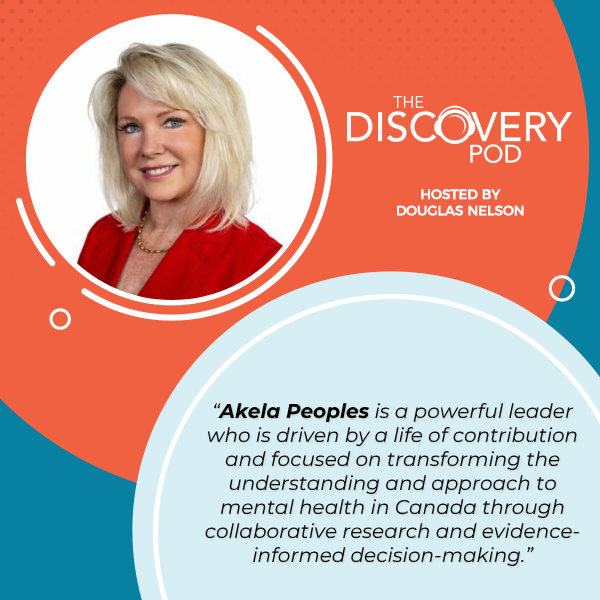
The current landscape of mental health support in Canada is more critical and complex than ever, with Canadians continuing to struggle under economic pressures and global uncertainty. To explore the path forward, we’re joined by Akela Peoples, CEO of Mental Health Research Canada and a leader twice recognized as one of Canada’s most powerful women.
In this essential conversation about the future of mental health leadership, Akela shares her insights on transforming the national approach to mental health. She emphasizes the urgency of collaboration among organizations, advocating for “authentic points of intersection” to achieve collective impact. Akela also discusses how leaders can foster a resilient workforce by embracing flexibility as a key element of mental wellness, drawing on MHRC’s experience of going fully decentralized in 2025, and the critical role of data and evidence-based digital solutions in meeting the country’s rising mental health needs.
—
Listen to the podcast here
Shaping The Future Of Mental Health Leadership With Akela Peoples, CEO, Mental Health Research Canada
Everyone, we are joined by Akela Peoples, CEO of Mental Health Research Canada. Akela is a leader who has spent her career working at the intersection of education, community impact, and mental health. She is focused on transforming how we understand and approach mental health in Canada through research and collaboration.
She has been recognized twice as one of Canada’s most powerful women, but what really drives her is living a life of contribution. Whether it is through her work at Mental Health Research Canada, or the volunteer projects she has taken on around the world. In our conversation, she talks about the importance of collaboration, especially in an issue like mental health, where so many are trying to make a difference all at one time. How do we know that we are making a difference?
How do we coordinate our efforts? She introduces the concept of authentic points of interaction as a way for organizations and Canadians to come together to improve mental health. She talks about going fully decentralized, a virtual organization earlier in 2025, what that has meant for her team, and how she is encouraged and motivated to look to the future for better mental health and a more effective organization. Please enjoy my conversation with Akela Peoples.
—
Welcome to the show, Akela.
Pleasure to be here, Doug. Thanks so much for having me.
The Role Of Mental Health Research Canada (MHRC)
This is an important conversation about mental health in Canada, your organization, and the number of organizations that have been established just in the last few years to support mental health in many forms across the country. Your organization, Mental Health Research Canada, has a really unique place in this ecosystem. Maybe we could start the conversation. What is Mental Health Research Canada, and who do you serve?
Thanks for the opportunity, Doug, to tell you a little bit more about us. We are a national independent charity, and we strive for a future where mental health is improved using data, evidence, and stakeholder engagement. We work collaboratively with as many organizations as we can across the country. You’re right, there are a tremendous number of organizations doing great work in Canada.
However, I do not think there is enough collaboration in the sector. One key element of how we operate as an organization is to look forward to collective impact and authentically believe that organizations must work together to try and improve mental health for all Canadians. As an organization, we started as a provincial organization.
In 2018, that organization was reconstituted into a national entity. We started as the Ontario Mental Health Foundation 55 years ago. We are now Mental Health Research Canada with a national view and a national mandate. We are best known for the work that we do with Health Canada project funding to track the mental health of Canadians.
Since early in the pandemic, we have been talking to Canadians and formally reporting on mental health in Canada directly from Canadians. We rapidly report on that information so that stakeholders, policymakers, and anyone in Canada who cares about mental health can have current action-ready data on which to make decisions and inform policy discussions and decisions.
It is a really vital role in our work here, in my work here at The Discovery Group, in getting to work with several organizations across the country, many of whom were purpose-built for mental health supports or mental health interventions, and several who were not, but have boards that are saying we should do something in mental health. I would imagine you are seeing quite a flood of opportunities for collaboration. Probably some of them are a bit cringy. From your perspective, what do you see happening in the mental health space in our social profit sector across the country?
First of all, there has never been a more important time for mental health. You might not be surprised to learn that the mental health of Canadians has not returned to pre-pandemic levels. We are facing economic pressures and challenges as the cost of living continues to rise, geopolitical tensions around the globe, and many other issues that are contributing to Canadians struggling more than ever.

Mental Health Leadership: We are best known for our work with Health Canada project funding to track the mental health of Canadians.
Many organizations are working to advance this, but it is really important that organizations, regardless of their size or their mandate, find authentic points of intersection where they can amplify each other’s messages, where they can come to the table without an elbows-up approach because charities always compete for dollars and resources, and those are always limited, never enough.
We really have to put that aside as leaders. I really believe that from the leadership perspective, that is where it starts. We have to approach other organizations. We have to reach out and find those authentic points of intersection as to how we can work together, staying in our lane, but exploring those points of intersection that will enable us to move the needle forward in mental health in Canada.
I love that phrase, authentic points of interaction. What does that look like in a tangible? What is an example of an interaction that has been successful?
I will use an example from some of our population polling work that we do. We report on this work now quarterly. We were partnering with Polara and Leger and going into the market, conducting population polls every 6 to 8 weeks through the pandemic. Within a month, turn out a report in a very easy-to-consume format. That means elementary school language, infographics, colorful non-academic speak, so that anybody could pick up a report, and it could be helpful and useful.
We are now going into poll 28, and we have this enormous data set that we can compare and contrast Canadians’ experiences. As part of that work, we also hold webinars so that when we report on that data, we can bring it to life through lived experience. If there is a particular issue around a demographic group, perhaps it is youth, or perhaps it is caregivers, or whatever the case may be, our first step is to reach out to another organization working in mental health to invite them to that webinar and be an expert to bring life to the data that we are presenting.
We have partnered with Jack.org as an example, when we have been reporting on our data that focuses on youth, or some of the reports that we have done from the data that specifically focuses on youth. We have done the same with other organizations that are experts in a particular area of mental health. Those kinds of partnerships bring something very different to the table than just presenting data.
Instead, we bring an organization together that is downstream, working in the field, doing this work every day, and we are upstream, collecting, presenting, and creating insights and context around the data. There is an example where you can see two organizations working together towards the same goal, but bringing something very different to the table.
You have a really unique perspective in the mental health space in the country, given the relationship you have with Health Canada in terms of the project funding. You have a bird ‘s-eye view of a lot of what is right. In an area where I would characterize the response with Intersectors, when somebody should do something, and lots of people are doing some things, some of them very effective, some of them really powerful and impactful, others not as much. What is working?
Normalizing Mental Health Discussion
Collaboration, I will underscore, of course, because that is what we are all about. I would like to approach that question from a slightly different angle. When it comes to mental health in Canada, we need to change our thinking about mental health. We will all talk about it when we walk into the office, and we have our arm in a sling, we will talk about having a broken arm, or we will talk about being off because we had a cold or something of that nature.
We are not yet able to have conversations and normalized discussions about mental health. I truly think that we can reduce stigma and really start to change what is happening in our country about mental health when we all start talking about it in our relationships and our families around our dinner tables with our colleagues in the same way that, as I said, we would about physical health. The reality is we all have mental health, just like we all have physical health.
We can reduce stigma and change mental health in our country when we talk about it openly—at home, with friends, and at work—just like we do physical health. Share on XThe pandemic perhaps gave us a gift there because we all felt enormous pressure around isolation and lockdown. In some cases, people used to think that mental health is someone else’s problem. That is someone who has a problem, has a mental health issue. You and I have mental health. Everybody has mental health. Our mental health is closely integrated with our physical health and thus our overall health.
We are just not there yet, where we are talking about it in the same way we do our physical health. I do think that what is working and what will work is if each of us does our part in talking about mental health and in increasing our personal knowledge around mental health literacy, getting to understand that stress in life is a normal part of life. It does not mean you have a mental health issue, but starting to be aware of our mental health, talking about our mental health, and becoming aware when our mental health is starting to interfere with our ability to function at work and in our personal lives.
Embracing Digital Solutions
We may be noticing that it might become a problem where we might need some support. Individually, we all have a role to play in trying to change our culture about how we approach mental health. There are lots of other examples, too, that we could talk about. The other thing I would like to mention is that we live in this digital age, and AI is not going away. It is moving faster and faster. In mental health, there is never going to be enough money.
There is never going to be enough clinicians. There is never going to be enough support to meet everyone’s needs. Responsible digital solutions must be part of the plan. Whatever organization or entity is working in the mental health space, we somehow have to embrace responsible digital solutions. There are over a million mental health apps now around the globe, and not all of them are evidence-based, of course.
How we go about enabling our citizens to access credible, ethical, research-based, evidence-based digital resources is going to help. Because even if you are in a long waiting line to see a clinician, you may be able to be helped to some degree or be supported to some degree until you get to the front of the line, when you can see someone. Lots to talk about there in what is working or what could be working.
There are two pieces there that I want to touch on. The first is one, I have a hypothesis or thought that we talk about mental health, and it would be more illustrative or more tangible for people to talk about mental wellness and mental illness. Mental health, as a broad category, makes it really difficult. If I say mental health and you say mental health, and the third person joins us and talks about mental health, we could be talking about very different things, or very different elements of mental health. Is there a language gap we need to close around how we talk about this, not just whether we talk about it at all, which I agree with you 100%, but how we talk about it seems to be an opportunity for greater clarity.
You are absolutely right. I think mental wellness is what we should be talking about. It is much less intimidating somehow and perhaps more comfortable to talk about. You are onto something there. If we can switch out those words, health with wellness, I think those conversations might happen a little more often and with a little less trepidation.
It is not as simple as just changing the word. Of course, I did not want to make light. It is just that we need to talk about this. I spent a lot of time earlier in my career in the cancer space, and talking about cancer was a big push in the research and certainly in the cancer survivor community. The words really mattered a lot. Through the podcast and through our work here at The Discovery Group, we have worked with several organizations that feel like they are having to use a lot of words to describe something that could be clearer. I certainly do not have the background to pick the word. I was just curious what your perception of that was.
Whatever it is, just the personal commitment to bring those conversations on a daily basis into our lives, I think, is what will help.
Whatever words you use, just talk about it. That is really great advice. The second thing that you said, I actually had a physical reaction to it as a parent of two teenagers. You said that the technology and AI are likely a part of the solution. On an intellectual level, I can nod along with that. As a parent of teenagers, I feel that often, technology is the problem in this mental health crisis. Help me think about that in a better way.
We need to unpack that a little further. You are absolutely right. Screen time is something that our organization looks at from a data perspective and a connection. Screen time over six hours of personal use, not for work, but personal use, has a high correlation with poor mental health. From the parents’ perspective, that is something important to note. The other thing that we have started to look into recently, which is also technology-based, is online gambling.
There have been some legislative changes recently in 2021 that took place, or that came into play in 2022, allowing single-game betting. You may have noticed, as I have and many other people have, the dramatic increase in ads everywhere you turn, whether it is through a feed on your phone or when you’re streaming or watching TV. The ads are everywhere. This is a big problem.
We are at the front end of a wedge. Yes, you are absolutely right. The technology can be part of the problem here for this generation. The point to underscore is that technology can also be used for good. When we are in an environment where the mental health needs are higher than ever, and there is never going to be enough money and never going to be enough clinicians, just like every other sector, we have to find responsible ways to use evidence-based solutions.
I would point to apps and digital platforms that are created by credible organizations and credible institutions, rather than going to the app store and downloading a mental health or mental wellness app. It is important that you really want your children, your family, and yourself to be using apps that are not going to be causing more damage than good and that are definitely rooted in evidence.
Thank you for that. I knew there was a technology for good line in there, and you certainly communicated it the first time, but it was just that feeling that technology is the problem, and I guess it is also the answer, or it can be the answer. Given our audience here at the show, a lot of social profit leaders, one of the things that when we were doing these recordings and doing these episodes during the pandemic, we spent a lot of time asking people what they were doing to look after their mental wellness and their mental health as leaders. It is a very real concern or a very real issue in our social profit sector, particularly for leaders. Again, with that bird’s eye perspective, the polling you are doing, what are you seeing in terms of mental health and leadership?
Leadership & Workplace Flexibility
I will tell you that, personally, COVID changed me as a leader. There is no doubt about that. I became much more flexible and much more empathetic. We all had to be in COVID because we did not know what was ahead. We did not know how long the lockdowns and issues around COVID were going to last. I do not know about you, but in some cases, I look back at that, and it feels like a bad dream. It really does feel like a dream.
If somebody had said to me two years before COVID hit that we were going to essentially be locking down the world, I do not think I would have believed it. As leaders, we probably became very aware that the people that we worked with all brought something different to the table in terms of what they were experiencing in their personal lives, whether it was employees who had young children, who were trying to manage online learning.
Remember that? That was very challenging. In particular, we had one employee who had two young children, one who was on a 45-minute class schedule and one who was on a 30-minute class schedule. He was up and down, getting his kids in and out of Zoom meetings all day long. Another employee had a mother in her 90s in a home, and could not see her, and had to just look at her through a window. Everybody was dealing with something very personal and unique.
It became very obvious, if we did not know it already, that we were bringing our whole selves to work, whether we wanted to or not, because we were cooped up in our home in front of our laptop working, but still dealing with everything around us. There was a blur between our professional lives and our personal lives. When I look back on that experience, I know that I changed in the ways that I mentioned.
One of the things that we instituted at Mental Health Research Canada, as we were trying to figure out how to support our team members, was to implement coffee chats. We asked everybody weekly to book a 20 or 30-minute meeting with each of their colleagues. The only rule was that you could not talk about work. It was a way for people to support each other and stay connected.
Even though we were at home for the first time, we were able to continue to build supportive relationships. To this day, we still have coffee chats in our organization, virtual coffee chats with the same rules. Do not talk about work. It is a way for people to connect and support each other and be empathetic to what their colleagues are experiencing, depending on what they are comfortable sharing.
Fast forward to now, and I just decided in July to close down our office. That was a big decision to take because that is not a decision you can walk back easily. Our organization grew significantly through COVID. This is when we started this population polling work, and monitoring and tracking the mental health of Canadians. So we grew substantially. When there was an opportunity to come back to the office, we did not have enough desks.
We had to rotate and figure that out. I told my board that I had a very high-performing team, we still have a high-performing team, and they are actually very productive and very happy working at home. This was a conversation with my board and my board’s HR committee, which was ongoing because I kept it front and center, because in the back of my mind, I knew eventually I was going to have to make a decision.
Either we were going to have to get bigger office space, or we were going to go fully remote. I did regularly connect with a CEO colleague who had already gone fully virtual a couple of years before COVID. I spent a lot of time talking to him during that time to learn from him the pros and cons. When it came time to make that decision, I was very confident that I had made the right decision.
COVID changed me as a leader. I became much more flexible and empathetic. We all had to adapt during COVID because we didn’t know what lay ahead. Share on XGenerally, we have staff who do not spend time commuting. They can manage their work day much better around their personal lives. By the way, we have different shifts. People can decide when they start and when they end. I have some colleagues who started at 7:00 and ended at 3:00, others who started at 8:00 and ended at 4:00, just whatever works best for them for their particular family situation.
It is interesting, our data at Mental Health Research Canada shows that one of the best ways you can support workplace wellness is to provide flexibility for people, much more so than providing gym memberships or massages or some of those other benefits, flexibility to be able to manage their time and their workday in the way that works best for them.
We are based in Vancouver, in North Vancouver, and have colleagues across the country. One of our colleagues who works in Toronto. She works all the time. She is great. She is very productive, but it is often like she is starting about 10:00 Toronto time, which is still earlier than most of us are at work here in Vancouver. Works later in the day because that is when she can interact with colleagues. I have talked to her. Is that okay?
She goes, “This is perfect. This is a feature, not a flaw. Thank you.” Giving people that space. Even as you are saying it and going through that, I think many of our audiences are experiencing that, whether it is hybrid or fully remote, there is still some element of surprise, like that flexibility is even an option. It seems both obvious and still feels very new. Is there still a learning curve? Mostly remote, then you go fully remote in July. Were there any surprises in that transition for you?
We are still learning about this, and I think the jury is still out. I will say that every organization and every sector is very different. It is not going to work for every charity to speak about our sector. We have just gone through a very recent return to the office here in Ontario with the Ontario government. People are back five days a week. Toronto traffic is already very bad, and everybody was talking about this in December and January because traffic obviously got a lot worse.
It is a very individualized conversation. It depends on the culture of your workforce, and it depends on the nature of the work that you do. Obviously, not everybody can work remotely, but I certainly hear that people have had a taste of working remotely for two years. If the organization that they worked for and the nature of the work they were doing lent itself to that. They feel like they proved that they could be productive at home. It is something difficult to generalize about.
Where it is possible to give some kind of flexibility, even if it is a day or two a week at home, I think employees really appreciate it. They are better able to manage their time. Spending time in traffic and commuting is such a big waste of time. I have spent decades fighting traffic and sitting in a car. When I look back on all those wasted hours, I cannot get that time back. I do not think people work less when they work at home.
In some cases, my observation, in our team, in our environment, I think people actually work a little bit more. I do not think they mind that we do not require them to work more, but they seem to work a little bit more because if they spell off early to pick their kids up from school, they come back to their computer and finish that report and send it in in the evening. I am very much focused on deliverables now rather than time in the seat. I can honestly tell you without a word of a lie, I have no idea what time everybody on my team starts and ends.
I know that there are shifts, but I do not know. Unless it is a direct report that I work with and speak with every day or every other day, I do not know what time frame their direct reports work. That is okay because the work is getting done. Our brand continues to grow. Our reports are highly sought after. For us, it is working. That does not mean that for every organization or every sector, I am naive enough to think that it is universally applicable.
Focus On Deliverables Over Time In Seat
I hear the qualification, and it has been such a live issue, particularly for national organizations where you have a distributed workforce. There is distance involved when you have team members across the country. One of the things that has really struck me, both through conversations on the podcast with organizations that have gone fully remote, but also through our work.
It is often the case that the leadership of the organizations gets comfortable quickly with the fully remote environment or a mostly remote environment. Sometimes it is articulating that to the board, where there is some pushback or some resistance, some old school, how will we know they are working? How did you approach that conversation with your board?
That is why I kept it as part of the ongoing conversation, because while I did not know when we came back to the office after COVID, I would eventually make the decision to close our office. I knew it was at least a possibility because our office was small, and we had hired people through COVID, and we did not have enough space. I knew that was on the horizon.
The basic math was working.
I kept it as a live conversation ongoing throughout the two years after COVID so that there would not be any surprises. I am not sure how that would have gone if that had not been a topic of discussion. All of a sudden, a couple of years later, I came back and said, “I would like to propose that we close our offices.”

Mental Health Leadership: Sometimes you have to take a board on a journey. You need to lead them to understand why something is important or why change is needed. Every board wants a surprise-free environment at the table.
Everybody had been socialized along the way that people were being productive, and people were happy. My HR person was saying everybody was very pleased with the flexibility and highly engaged, and the board knew that. I do not think there were any questions. I was surprised because I did not see it as a very big decision to close an office. After all, as I said, you cannot walk that decision back.
That is a very difficult one to walk back. You can walk it back, but it is complicated. I had an empathetic board, was impressed with our growth and our work, and felt we were doing a lot right and really were very supportive of putting our employees first, our employees’ needs first, and our employees’ satisfaction first. I am very grateful for that.
I do think that keeping the conversation live for some time really helped to make that decision, and for everybody to be comfortable with that, rather than just bringing it on without the board being aware of it. Boards like to be in the know about major decisions like that. Understandably so. I have been on boards, I have chaired boards, and you do not like information coming out of nowhere without context. Keeping it as a live conversation, I think, is helpful.
That is really good advice. Some of the advice we give often, when we are working with organizations where there may be some tension between the board and the management team, is not to surprise them. Only little kids enjoy surprise parties. Do not do that. It is not helpful. There are no ta-das in good governance. Always tell them, hint, show, tell, we are going to talk about this. The big reveal is not your friend.
Sometimes you have to take a board on a journey on a path. You need to lead them on a journey to understand why something is important or why something needs to be changed. A surprise-free environment is what every board wants around the table.
On that, as an organization that has grown, certainly grown in importance and prominence over the last number of years, as you have demonstrated value, the issue of mental health is becoming more commonplace in discussion. How have you articulated or had that conversation about what growth means with your board?
Strategic Nimbleness & Growth
Since COVID, our organization has grown more than expected every year. Our board is used to growth, but that also can be pressure for our CEO because of what the next stage of growth is, and what the staffing needs are to support the next stage of growth. We are undergoing some strategic planning right now, which I think is important for boards to do every few years. Gone are the days when you do a strategic plan that is for ten years. Everything changes so quickly.
Thankfully, I have had a board that has been very supportive and very flexible. As a brand new organization in 2018, even though we had a 55-year-old history, I was brought into the organization a year after it was established. We did not know the organization, and the board did not know how it was going to add value in a very crowded national landscape. I convinced my board, and they were very supportive of having a strategic direction, not a locked-in strategic plan.
I really wanted to maintain nimbleness and flexibility as an organization, so that we could, as an Ontario organization, evolve the organization to a national organization. At that time, the knowledge base was in Ontario. We had to go out there and figure out who was doing what across the country. It was very hard to have a locked-in strategic plan when we did not even know who was doing what, or where the gaps were, or where the opportunities were for us to add value.
We set out to have a strategic direction. We have maintained that for many years. We have been true to that. Collaboration has been a foundational principle in that. Maintaining our nimbleness as an entrepreneurial-type organization in a sector that has many very large governmental-type organizations, we can operate very differently because we are small and entrepreneurial.
Maintaining some of those brand attributes, the desire to be collaborative in all that we do, and the desire to maintain nimbleness so we can respond to needs and gaps as they arise. That is how this data has evolved for us. Within a week of COVID, we pivoted, and data work was not on our horizon at all. We realized nobody was collecting data about what was happening to Canadians’ mental health before the pandemic.
We jumped in there and said, “Somebody needs to be doing this, let’s do this.” I went to our board, and within days, we decided to free up some resources to partner with Polara and Leger and go into market on our first poll and turn out a report within three weeks, which was unheard of in the sector. That speed to market orientation is not something common in our sector. We were also able to find a unique value proposition there.
Back to the strategy and growth, we want to maintain those brand attributes that we see as being unique in the sector, so that we can continue to add value in unique ways as we evolve and grow. Honestly, I do not know what five years looks like from now at MHRC. There might be some other gap that we see. Because we are nimble and entrepreneurial, we may be able to pivot to fill it. The strategy piece is challenging sometimes for leaders because sometimes boards want to see a locked-in plan for five years.
I will say that it is easier to do if you are a large organization that is 95% funded by the government, and you have a five-year contract, and you know exactly how much money you are getting for five years. That is a much easier plan to build strategically. When you are an entrepreneurial organization with a diversified revenue strategy, and you do not know how much money is coming your way every year, hopefully more each year, but it is very difficult to create a plan that is locked in stone.
From my perspective, I would always encourage flexibility in strategic planning because things are moving so quickly in the world of work these days. Things look different every six months. Planning needs to reflect that. When boards try to really compress that planning and lock it in in such a rigid way, it does the organization a disservice. Flexibility in strategic planning requires you to have a direction.
There needs to be alignment with the board and the CEO as to where you are going. You need to have some foundational principles. You need to have some idea of the things you want to accomplish. But I think having the flexibility to enable the organization to add unique value and be responsive to opportunities as they present themselves is critically important in this day and age.
One of the things we see working with clients, and occasionally there will be a board member, I am thinking of a retreat where my colleague and I were doing a few weeks ago, and a board member said, “I just want to know what is going to happen over the next five years.” One of the other board members said, “We all want to know what is going to happen over the next five years. We just do not have any control over it.”
One of the things that we often find really helpful is that flexibility or nimbleness or resilience, another word that some organizations use to capture a lot of those same elements, is what we mean. Let’s make sure everybody, when we say flex, in your case, because you have used that word, let’s make sure that we can articulate, everybody knows what we mean by flexibility.
It does not just mean whatever we want it to mean. It does not mean that Akela is going to come in with her version of it, and then the board is going to have another version of it, or there will be five different definitions of it around the board table. If there is an understanding of the value and the principle, then it can be applied to situations. It actually can be very strengthening.
It can strengthen the governance culture quite a bit, and the board can add to the flexibility and add to the nimbleness of the organization, rather than the CEO needing to come and remind them every single time. Remember when you said we are going to be flexible, this is going to be different than what we thought. You said flexible, so this is what it means. That is really helpful. I really appreciate that approach because, particularly in the area of mental health, as you say, where are the gaps?
It is emerging as a society, as a country, we are learning that as a social profit sector, how to facilitate that collaboration. The answer is different today than it would have been three years ago. It will be very different three years from now, presumably. That is just a critical element of growing and supporting the sector as your organization does so well.
As we are evolving and growing here and at this moment in time in our country, where we are laser-focused on economic resilience, which is critically important for our country, there is an undeniable connection between having healthy Canadians, healthy employees, increased productivity, and economic resilience. It is critically important for leaders to acknowledge those connections.
Our productivity, like StatCan did a report that our productivity has been sliding in the last 9 of 10 quarters. We continue to slide on the global productivity scale. Focusing on mental wellness, the mental health of our employees is critically important. Burnout rates are high and increasing. People need support. They are dealing with a lot of challenges now.
Focusing on mental wellness is crucial. Employee mental health is more important than ever—burnout is rising, and people need support as they face increasing challenges. Share on XThe ROI argument as well is that employers will save money if they focus on employee wellness because the productivity costs are enormous now. There is no sign of that changing anytime soon, given what we are facing with the high costs of living that are rising, and geopolitical tensions around the world. We are facing some big challenges, and I do not see mental health indicators turning around anytime soon, given the state of what we are facing right now.
You are not going out of business tomorrow. You are not going to resolve the purpose. Akela, what are you looking forward to?
I am looking forward to continuing to grow and evolve Mental Health Research Canada and picking up on what we just spoke about a moment ago about strategic planning. I’m not quite sure what lies ahead, but I know that we are going to continue to grow. I know we are going to continue to partner and collaborate with like-minded leaders and like-minded organizations in the sector to try to do the best that we can to support data and evidence-informed decision-making in Canada, so that leaders are aware of what is happening with Canadians’ mental health. Hopefully, we can improve mental health so that all Canadians can have the help that they need when they need it.
Akela, thank you so much for the work that you and your colleagues do on a daily basis, and thank you for being on the show.
Thank you so much, Doug. It has been a pleasure.