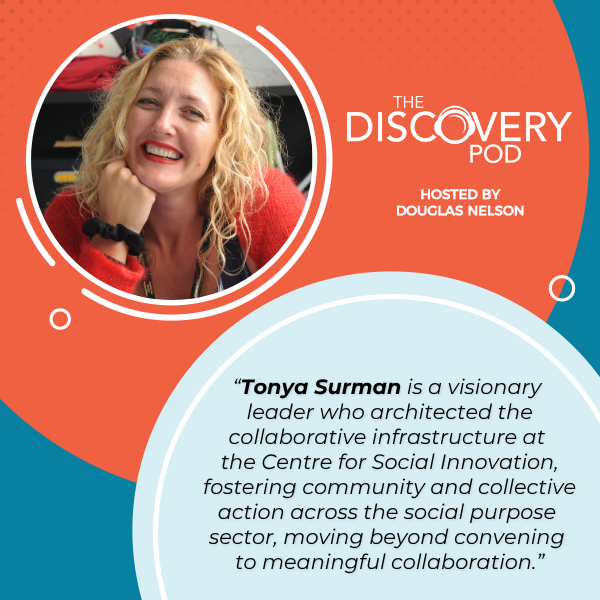
Tired of working in silos? For over two decades, the Centre for Social Innovation (CSI) has shown that collaboration—and the power of social capital—is the engine of change. In this deep-dive conversation, CSI Co-founder and CEO Tonya Surman shares the journey of building one of the world’s first co-working spaces—a home for changemakers where “the chaos is everywhere” and “the forks do not match.”
Discover how CSI evolved from a simple idea about shared space into a pioneering Collaborative Infrastructure Organization (CIO), designed to build the trust, relationships, and social capital needed to tackle the world’s biggest challenges. Learn why Tonya believes the future of social impact lies in moving beyond convening to true collective action—and why investing in long-term infrastructure is key to creating regenerative, movement-building solutions.
If you’re a leader, social innovator, or simply someone trying to make a difference, explore the power of intentional community design—and how strengthening social capital can shift the sector from scarcity to abundance.
—
Listen to the podcast here
Building Social Capital At Scale With Tonya Surman, CEO, Centre For Social Innovation
I am joined by Tonya Surman, co-founder and CEO of the Centre for Social Innovation. Now, if in your travels you have had the opportunity to meet Tonya, you will not soon forget it. Her energy, her commitment, and her ability to bring a whole room full of people together around a common cause are something that is very special. Tonya spent years building the collaborative infrastructure that helps social purpose organizations to do their very best work.
Bringing people together through shared space, shared ownership, and shared leadership. Under her leadership, CSI has supported thousands of initiatives across Canada and beyond, while continuing to evolve in response to a changing world. In this conversation, Tonya takes us on a journey that CSI has been on, talks about where the sector is today, the role of convening for purpose, and where that sector is heading in the future. This is a great conversation, one of my favorites we have had in a long time here on the show. Please enjoy my conversation with Tonya Surman.
—
Welcome to the show, Tonya.
Douglas, happy to be here.
I’m really looking forward to the conversation we are going to have. We have got a great plan for our conversation, and we will see where it takes us. Tonya, you are someone who is watched and read across our social profit sector in Canada and beyond as a real innovator. I am excited to talk about some of the innovations that are happening at the Centre for Social Innovation. As we get started, tell our audience more about CSI, who it is, and where you are headed.
Founding Vision And CSI’s Beginnings
First of all, thank you. The Centre for Social Innovation was just a little idea 22 years ago, with the concept of sharing. I had worked in the nonprofit sector since my early twenties. It was really clear that the cost of a photocopier at $500 a month was just astronomical for what we then knew at the time. Eighty-five percent of the Canadian not-for-profit sector had five or fewer staff and budgets of less than a million dollars.
It was this drive around efficiencies and effectiveness. I, along with my four co-founders, came up with this simple idea, like this question. What would happen if we shared? Twenty-two years later, the Centre for Social Innovation was the first co-working space in Canada. Our focus and our entire mission and mandate have been around supporting social innovation.
Catalyzing, supporting, and inspiring social innovation with this really ambitious idea that if we could share physical space, meeting rooms, fridges, we could then build the belonging and the social capital to be able to get people to work across sectors, and across fields. For 22 years, we have created physical spaces, such as homes and workspaces that have housed nonprofits, for-profits, charities, and people who are still trying to figure out where and how they connect into social purpose work.

Social Capital: If we could share physical space, meeting rooms, and fridges, we could build belonging and social capital, enabling people to work across sectors and fields.
We have grown from a bootstrapping little startup in 2004 with 14 founding tenants. To our height in 2019, right before the pandemic, when we had a thousand social purpose organizations in five locations in New York, Regent Park, we purchased two buildings, all with the nonprofit model. Of course, COVID radically altered our path, and we can get into that, but suffice it to say that now we are a 100% focused.
A very small organization again, down from 80 staff to about 15, and a thousand organizations down to about 500 or 600 organizations in one building. We are mortgage-free, and we are 100% community financed, and we are gearing up with a whole new vision and mission for CSI 2.0. Lots of blood and tears behind there, Douglas. Lots of challenges, and we can dig in anywhere you want. I will tell you all about my pain and suffering.
You skipped over a few sleepless nights in that run-through, I am sure of it. I should have said at the outset that this is not a declaration of conflict. The Discovery Group, our Toronto office, is in CSI, and we get to hang out there on a regular basis. My colleague, Thibault, is there almost every day. One of the things that makes this idea of place-based community collaboration such a powerful idea. We see it in research organizations that are planning new buildings, renovations, or facilities.
What they are looking for is ways to get these smartest kids in class out of their labs into the shared space so that ideas can connect and collide. It is what a lot of innovation, social or for-profit innovation, and creative spaces are designed to do as well. You were the first space in Canada to do that. I am curious what your thoughts have been as you have seen this idea expand well beyond our social profit sector.
Evolution Of The Co-Working Concept
We started out with a very modest idea, which was that we could bring non-profit organizations together so that we could get them to work across sectors, maybe they would be able to share mailing lists and content. It is interesting because that was before there was a huge social media world. The CSI came out of the days when the cell phone was still a new idea, and the laptop was still heavy. It was a heavy physical thing. That was really the turning point.
What we saw started with HTML. The internet gave us the ability to understand collaboration differently. Instead of a brand as a scarce resource that you wanted to covet, the brand became something that you wanted to be associated with others. That idea of a rising tide lifts all brands by us joining together and elevating this greater concept so that we are not just the Conservation Council of Ontario, or Creative Trust, or the National Anti-Racism Council of Canada, which we were all founding members of, and Corporate Knights magazine, we were all social entrepreneurs.
We were social innovators who had a shared belief that if we brought entrepreneurial thinking to changing the world’s challenges, we could do anything. I was naive 22 years later, but it has been amazing, actually, to watch how this concept of sharing, of co-working. We were the first by far, the first in Canada, arguably one of the first in the world. We called it virtual tenancy back then. It was not very hip and not very cool, but it did the job.

Social Capital: We were social innovators who shared a belief that if we brought entrepreneurial thinking to the world’s challenges, we could accomplish anything.
Now, watching as coworking has taken over so many other places, we go, “Of course, it makes sense.” It was a zeitgeist moment. Where we have really focused is that we were magnetizing people, not just for the workspace. We were really attempting to magnetically attract people who really wanted to make the world better.
We were agnostic of whether they are for-profit or nonprofit, ultimately, because we believed in the idea that innovation happens at the periphery and at the intersections. That was what we have been working to create. Yes, our story is grounded in real estate. Actually, the real work is what we call community animation.
It is how we build the practice of strengthening relationships between humans. How do we build these practices that allow people to connect, to build trust, to coordinate their work together, and then ultimately to collaborate? Watching how that is infecting the rest of the world is fantastic. I was on a Coworking global podcast the other day, and he goes, “Do you feel like you were the first in and you are not getting the credit you deserve?”
I was like, “I have always thought of myself in the social innovation field, not the coworking field.” Watching what we are able to learn as a society about the benefits of relationships is the ingredient that I think we are going to need more than ever going forward. I hope that the rest of the world steals more liberally from what we are doing at CSI because God knows we could use more relationships and fewer transactions on this dear planet.
I could not agree more. I would hope that the world would also steal more of your design and decorating motifs. It is quite a funky, wonderful place to look at. One of the things that really strikes me is that for people who have been in the space, you will know this. Those who have not, I encourage you to go check it out. It feels good to come through the door.
If you ever wondered where most of the newsletters in your inbox come from, you just walk along and see who is in whatever office going down one hallway on the third floor there. Like, “I get something from them, I get something from them.” It is that sense of collective action. I think that so much in leadership and social innovation can be very lonely.
Coming into CSI, being connected with a community at CSI from my perspective has been just a really loud, full-throated shout and a warm hug of “You are not alone.” Others are seeking to change the world for the better as well. Just that there is a place that encourages people to dream big, to do more, and to do good, I think, is a net positive in general. Keeping it going and keeping it evolving, I am sure, is an active challenge.
Especially the last five years. It has not been an easy ride. That is for sure. You are absolutely right. We call it a home for social impact or a home for social innovation, and the word home. I had a board member years and years ago who said, “You are using words like love and home and magic. What is this?” I was like, “This is actually what we need. We need love and home and magic because we are humans.” It actually speaks to the design and the thinking behind the design of this space.
None of our forks match. Nothing matches at CSI. The plates do not match, the glasses do not match, and nothing matches. I have found in my experience that when you have things that match and look too clean and too formal and too perfect, you tense up. You control what you say. Your body changes, and your somatics are different in those environments.
Yet when you walk into CSI, I hope you will feel like you are walking into a home where there is a big hug waiting for you, lots of warm food and nothing matches, and the chaos is everywhere. That kinetic energy is the bubbling of warmth and love and magic. In those environments, when we feel inspired and safe and creative and authentic in who we are, that is when we can build the trust that will allow us to let down our guard enough to be able to co-create extraordinary outcomes.
In environments where we feel inspired, safe, creative, and authentic, we can build the trust that allows us to let down our guard and co-create extraordinary outcomes. Share on XThat is what we have been doing at CSI for 22 years, really working on like, “How do we get you to meet the right people that you need to move your idea forward? How do we connect you to the right investors, get you the right acceleration programs, get you connected to whatever it is going to take?” What has been really cool is that in 22 years, I cannot believe it has been that long, I was obviously 12 when we started it, is the idea that we are ultimately that the rest of the world is catching up with us. We are not the only ones who run climate accelerators now.
Now Mars runs an amazing climate accelerator. We are not the only ones who are investing in social enterprise. The world has caught up. I feel really excited. Now, with so much change in our fates and recognizing how far the world has come, we are going through an amazing recasting of that original mission.
For me, I was really seeing social enterprise and purpose economy and next economy stuff, which is where I thought that is what we were. Our theory of change was that we need to radically redesign capitalism. We need to prove that these other models are possible. I still believe that. I still believe that with everything in my soul.
For CSI, with COVID having had such a huge impact on us, we are going back to that core vision again and asking ourselves, maybe who we were was the social innovation in many ways, the belonging, the connections. Where we were going was a collective vision that we are all working towards. Now we are going, “How can we become better at fostering the kinds of collaborations that will give us more scale, more scale for more impact at this critical moment in time in our history?”
I really appreciate that. I want to go to the CSI 2.0 in just a minute, but reflecting on the forks matching. One of the things when the forks match or most of the forks match, it trains us to think and identify differences. This one does not quite fit. This one is a little scratched. This one is a little tarnished. They are all the same.
When they are all different, when they are all from different sets, from different families and different lineages, and the collected forks through generations, it really focuses our attention on what is unique rather than what is different. That is a real strength of the place that you built in the community that you have nurtured, that there is a real power in the uniqueness of the people and the organizations that either call it physically their home or have been a part of the CSI journey over the last number of years.
There is such a strength to the Forks Not Matching. I would love to see more of it across our sector. Let’s now transition to 2.0. Moving from a space-based organization, as you have described, into something that you have called a collaborative infrastructure organization. Our sector needs more terms, new words.
More acronyms.
CIO, there would be a CIO at CSI. What is a collaborative infrastructure organization?
Impact Of COVID-19 And The Transition To CSI 2.0
It is a new term for me as well. I had the opportunity to work with the Rotman School of Business, Business Model Innovation Unit, with Emma Aiken-Klar and her team. We did a deep dive into other organizations that were grappling with the same business model challenges that we were. Let me just be really clear. In 2020, CSI went from 80 staff to 15, from five locations to ultimately now one.
We were Social Innovation Canada, Climate Ventures, TechSoup Canada, and CSI with five locations. It was a going concern, and COVID changed everything. Working from home completely altered the face of what we were doing. Interest rates doubled. Funding priorities changed across the country. It has been a hell of a ride, and it was just last year at the end of last year when we finally sold one of our two buildings.
I had spun off SI Canada, Climate Ventures, and TechSoup, and everything is now down super tight and clear. The question was, we went to Rotman, and we said, “Everything has changed.” Through their very beautiful work, there was this little concept in a link far down in one of the links that they provided that said that these health sectors, these health organizations were coming together and they had created a collaborative infrastructure organization.
What it was was an organization whose task was to ensure that the collaboration between the health units was successful. I got the concept of community animation from public health years and years ago. They do some really interesting things. I think because they get government funding, they may have different ways of thinking about organizing. I dug into that, and I loved it. I realized that is what we have been trying to be all along.
I have used the word platform for years, but I think that word has been taken over by the likes of Bezos and others. It does not have the same beautiful resonance. This idea that there is an organization whose mission is to foster those collaborations that the world needs just tickles me. It tickles me because we are a platform. We are a physical space, but we are a culture. When you walk in, you feel the vibe, you feel the culture. We are practicing.
We host rituals, gatherings, and convenings. We are the facilitators. Oftentimes, I literally just came from another event, hosting a summit with 25 people, looking at how we can co-create solutions together. If that is our raison d’être, if our mission is to build the social capital that can build the trust to get to meaningful collaborations, then I am doing the important work. Right now, we are focused on fixing the things that are broken inside our own organization.

Social Capital: If our mission is to build the social capital that fosters trust and enables meaningful collaboration, then I am doing important work.
Sarah Hanlon with the Canadian Centre for Food and Ecology has been an active part of our redevelopment at CSI. She came to us with a summit question. She said, “100% of CSI members to shift their food to sustainable food sources. What if we could get 25% of the food that CSI members eat to be sourced from sustainable food sources?”
I love that question. That question goes, “How do we collaborate on programs inside CSI? How do we collaborate with people who are food providers outside of CSI? How are we completely altering everything from how we are serving food in our kitchens, all the way to how we are disposing of waste? What does a circular system look like, and what are the collaborations that it would take?
It is revealing so very much. The same thing is happening in the climate right now. With that lens, we just launched Climate Coffees, and Climate Coffees is a collaboration of members who have come together to say, “We need a more robust economy that puts climate first.” Those kinds of collaborations can be of value from the basic connections all the way to the complex, facilitated collaborations.
One of the things that I hear a lot in my travels and the work that I get to do in the social profit sector across the country, here at the Discovery Group, is that a lot of organizations are embracing the concept of convening and bringing people together. What has been really satisfying for me to see over the last handful of years is the evolution of that concept to convening for purpose.
Rather than just bringing people together to talk about stuff or a thing, but to have a purpose when you bring them together. Several of the examples you have already shared are about convening to a purpose. How have you learned to think differently about the groups that you are bringing together through CSI and through your work more broadly to ensure that there is a purpose to the connections you are bringing together?
We are an ecosystem first and foremost. We are pretty much here and open to whoever is responding to the messages we are putting out to the world. You could call that a branding exercise, or you could just call it energy and flow. It is how we choose to invite. What is the act of invitation? For example, the climate coffees is an invitation for people who work in the climate space. We are putting ourselves out, and then they can choose to respond.
We are doing another coffee gathering around the purpose economy. We will be launching those on the second Tuesday of every month, with coffee from 8:30 to 10:00 in the morning. The idea here is that the clusters will start to emerge through invitation. The question is at an energetic level, where are we feeling flow? I am getting to the age now where I am so clear about my feminine energy, if you will, that I am okay with saying things like flow. I can see it. You walk in, you feel a vibe. How do you define vibe?
If I put out an energy that says, “Climate activists or climate professionals, come, let’s talk,” that is an energy back. I am constantly looking at how we are creating virtuous circles and virtuous invitations. How can we be the magnetic attractor that will allow people to feel at home, and then I give. My goal is to give a piece of us away. How do you take a little piece of CSI with you? How do I give it away? Our whole deal is co-creation, co-ownership, and co-design. How do we do this together?
Tonya, how do you think about the work that you are doing? How do you know that, as the CEO, you have had a good month? I did a good job as CEO this month.
If nobody hates me, that month is a good one. Staff is still talking to you. I had a wonderful conversation with my treasurer a couple of weeks ago, and he told me that I was focusing too much on the money. I loved that, to have it from the treasurer saying, “You need to level up and be thinking more about the mission.”
In so much of our day-to-day, it was a beautiful reminder. It was a really beautiful reminder of why board members volunteer. The money is a tactic, not the mission. Sometimes, when you are in the weeds on financials and how did you do and where is the funding coming from and where is the money flowing to, you lose sight of it. His prompting alongside this, when I walk into CSI, and I see people talking that I know did not know each other, I am good. That is it. I am good. I will say the retention, have we created a value proposition where people want to stay?
The money is a tactic, not the mission. Sometimes, when you’re in the weeds with financials—how you’re doing, where the funding is coming from, and where the money is flowing—you lose sight of that. Share on XPhysical space is no longer a limitation. We are opening up membership to people to be a part of a community now. You do not need office space. You do not require offices. You just have to want to be a part of connecting with people at a deeper level around the work that you are trying to do together, looking for the co-founders, the collaborators, the suppliers, the people who can help you to unlock what you need to do next in your work.
I like how you phrase that in other places, that membership is a contribution, not just access. Inviting the best of ourselves or the best of those who are members to share with others, who are in turn bringing the best of themselves. A month is successful if you see people connecting who did not know each other before. A lecture from your treasurer about focusing on mission, not dollars and cents, which I am sure most of our audience would really appreciate.
If you wanted to send that person’s name to anyone who is looking for a treasurer or chair of a finance committee, I am sure they would be very happy to receive them on their boards. You are the walking embodiment of convening, and what does it take for members of your staff to be on board with the mission, as they say? What are you looking for in the team that has you saying this person is a great fit, this person is doing a great job?
It is a moving target. I am looking for high emotional intelligence. Somebody who can synthesize, who can listen, and then take initiative to problem solve. The world is changing, and I think that AI is going to actually shift the importance of the soft skills that I already know I need. I do not need skills. You can learn things. You can learn anything. What I need is competencies. I need empathy, creativity, warmth, intelligence, and problem-solving skills.
Somebody who appreciates the somatic and can find their way out of a corner, because we do not need information anymore. That is easy. What we need is to know that we can manage relationships well. They know that they are successful. They are always looking for more clarity, and I am always handing them more chaos. That is a challenge that I have to deal with. It is like, “Check out the chaos we have here.” They are like, “I just want clarity.” I am like, “What?”
“Here is some more chaos.” In our work in governance, we refer to the healthy tensions, those things that are not there to be resolved, that are there to help you acknowledge or diagnose where tensions may be coming from. It sounds like you have got a nice, healthy tension between chaos and clarity.
The Collaborative Infrastructure Organization (CIO) Model And Its Focus On Action
One thing you were saying, I want to go back to Douglas, because it will not go away, which is about the convening. Lots of us are convening. That is a great start. I have been really probing around how we get from convening to collaboration. What is the actual mechanism? We all go to a conference, we build lots of great relationships, maybe we follow up with each other, maybe we do not.
We will even go to design sessions and social innovation labs, and we will do all these things that we are supposed to do. The question is like, “What happens then?” It has been really bugging me for about 30 years. That is where I am hoping that CSI can really do the work of going deeper. It is not one convening, but it is like how do we surface our collective self-interests in order to see the potential for collective impact?
I just want to say that, for me, it is one thing to host a party, and somebody described us as the best party organizers in the social sector. She thought it was an insult. I was totally delighted. Because you need that casualness, you need that comfort, but then the question is, “How do you get to the actual action and how do you get to people to actually reveal how they are vulnerable?”
If we are going to legitimately move to collective impact, what is a collaborative infrastructure organization, or a CIO? The CIO is to create the platform that will get us to collective impact. We need to look at facilitation, we need to look at governance, we need to look at trust, we need to look at planning, vision, and mission, and all those things.
None of that becomes useful until we can actually understand how to tap into the power of self-interest and not go blindly like “We are doing this for the good of everybody.” No, then it will not have the energy. It will not have the staying power. I just want to say we are really interested in co-creating what comes after the convening with people. That is where my real juice is. Let us do some things.
Often, with organizations that particularly want to engage donors and want to engage board members, asking a lot of why questions. The challenge with why questions at a certain level is that it becomes hard to harness all of the answers into a way forward. You can explore those same concepts using what and how questions.
How can we do this, not why should we do this, or why is this important? The how questions are so much closer to collective action because you are bringing people onto the same side of the table to say we have a shared purpose in our organization to cure a disease, to ameliorate hunger, or whatever the purpose of the organization is.
How are we going to take steps towards that vision, towards that purpose? It gives people a role. It gives meaning to the smaller actions that contribute to the larger progress. That requires the collaboration you are talking about. That is the power, the underlying power of the work that you and your colleagues have done, is far more than simply a place.
It is that there is a collective action, whether it is in climate or whether it is in the purpose economy, the examples you have shared today. There is a shared end that is roughly in the same direction. How can we collectively get started rather than worrying about how we are all different? The forks do not match. We focus on uniqueness, not difference. There is power in that.
They are all forks.
I do not want to describe what the personalities of people who are knives and who are spoons are. One of the other things that contributes to that, moving towards collaboration, is an understanding of our sector as something more than temporary or fragile. The problems that many organizations in our sector have are to free the world of, to unburden individuals of different things. Let us just hold our breath and run as fast as we can and get as close as we can to that purpose until we expire.
It seems to be how a lot of our organizations, based on scarcity and being under-resourced, operate. You invite them to think about people, think about their work differently, and need these robust systems. If someone says, it is usually not the people working in the organization, but if somebody outside that organization says, “Why invest in the infrastructure and the support of the organization? Is that money away from purpose?” How do you respond?
Building Organizational Resilience (The Fight For Freedom And Abundance Over Scarcity)
Poorly. It is a naivete. My ex-husband runs a global foundation, and he and I spoke many years ago about how much more solid nonprofits are in history. Interestingly enough, there are very few companies that are still around today that were here 50 years ago, but you can find institution after institution, and they are all those institutions tend to be nonprofits. Whether it is academia or the hospitals, which are the obvious ones, but also the Royal Society of the Arts in the UK.
We just paid off our mortgage after fifteen years of owning the buildings. We paid it off because we had to sell one of those buildings, and that is fine. What is interesting is now I am looking at going, “We have to break even, we have to make the model work,” but all of a sudden, we have leapfrogged to a world where we do not have this financial institution. How does that change the way we think about the future and timelines?
All of a sudden, I am thinking, “What does CSI want to be? What does it need to look like in 50 years or in a hundred years?” To answer your question. I worked so damn hard, Douglas, to buy our freedom to be able to not have to be reliant on external donors, and that we could create solutions that were not symptomatic. I am afraid to say this, but unfortunately, I think too many of us in the nonprofit sector are stuck treating symptoms.
It is really hard to get to the root causes of things. That is what social innovation is all about. Social innovation is all about getting at the root causes and going, “This system is broken. We have to fix this system.” The first system I was in was the system of renting office space. We saw that there was a pathway forward through social enterprise, which meant that we could buy our freedom to be able to make our own decisions so that we were not having to be in those conversations.
Social innovation is all about getting to the root causes and saying, “This system is broken. We have to fix it.” Share on XWe want those conversations, but we want those conversations from a position of strength, not a position of weakness. Not from a position of desperation, but from a position of empowerment and community legitimacy. I answer those questions with, “Would you like to be a part of fostering the kinds of collaborations that will build movements?” To me, that is one of the most challenging things that we have to face in the nonprofit sector and nonprofit leadership.
We are on this treadmill, and some of us have been blessed with longevity. Look at just the churches in this country, the different religious establishments. They have created, and they have the benefit of this longevity. I look at what they are doing with land trusts. I look at what they are doing with conservation lands. I am looking at how we are using our missions to amass resources so that we are actually coming from a position of strength.
To me, that is where the most exciting stuff is happening. I want to work with people who see that the interstitium, that organ in our body that holds us all together, is what we need in our sector, in our field. We need those organizations that are focused on capacity building, that are not just treating symptoms. We all know in the leadership that we need this. We are trying to figure out how to get the funding community to understand that it is not just fly-by donations.
I am really watching the work of many of the foundations in the US and a couple here in Canada that are going, “How do we change this power dynamic? How do we actually fundamentally evaluate what is working here?” I had a really fascinating conversation with somebody the other day who was like, “This foundation that amasses money through rather extractive and exploitative means is a US-based foundation.”
I will not defend anybody here in Canada. They are like, “We are the board of directors, but we do not even know what to do with this.” “This is crazy. You have got these foundations over here, and you have got these needs over here. How do we build regenerative systems? How do we build circular systems that are positively reinforcing, and how do we get rid of the silos in our sector and start to work at an ecosystem level?”
CSI has never gotten much funding from anybody in government because we are not health, we are not education, we are not environment. We are all of them. Nobody knows what to do with organizations that are about ecosystems. Until we change the conversation and come from a place of empowerment, we are always going to be on our back foot, and it is just hard.
Abundance over scarcity every time. Tonya, as we come to the end of our conversation, what are you looking forward to?
I am looking forward to the kinetic energy that happens when people come together and create new things that prove that the old models are no longer needed.
Tonya, thank you so much for being on the show.
Such a pleasure, Douglas. Thanks for spending time with me.