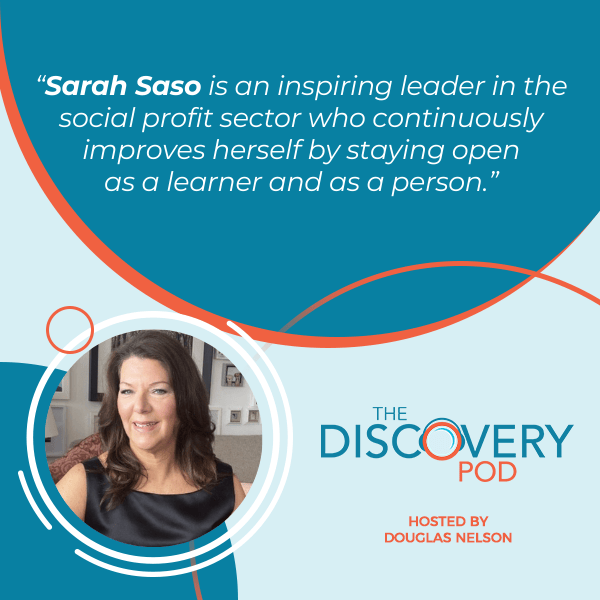
What does it take to build the right social impact partnerships? Douglas Nelson talks all about it with Sarah Saso, VP of ESG & Social Impact at Meridian Credit Union. She explains the importance of strategically aligning core business interests and maintaining open communication at all times in developing fruitful partnerships in the social profit sector. Sarah also talks about Meridian’s innovative programs focused on helping professionals build financial confidence and overcome economic barriers. Discover the right way to secure meaningful and long-term partnerships in order to move the needle on community impact.
—
Listen to the podcast here
Aligning Purpose, ESG, And Partnerships With Sarah Saso, VP, ESG & Social Impact, Meridian Credit Union
I’m pleased to be joined by Sarah Saso, Vice President of ESG and Social Impact at Meridian Credit Union. Anyone who has worked with Sarah or heard of Sarah and the great work of she and her team know she has been a leader, an advisor, a coach and a champion for the social profit sector. In her day job, she leads the work of embedding environmental social and governance principles and how Meridian operates with a strong focus on building resilient inclusive communities.
She brings deep experience from across the financial services and insurance sectors having led community investment in social responsibility work at organizations like HSBC, CIBC, Manulife, and Green Shield Canada. In this episode, she talks about the role of curiosity and developing new partnerships and her career.
She talks about how she chooses, works with, and develops partnerships in the social profit sector and gives some great advice on those organizations looking to work with organizations like Meridian Credit Union. She talks about the importance of connecting, the financial realities, the business strategy of Meridian to the work that she and her colleague do. It is a deep and meaningful conversation and I’m pleased to share with you. Please enjoy my conversation with Sarah Saso.
—
Welcome to the show, Sarah.
Thank you for having me, Douglas.
Sarah Saso And The Meridian Credit Union
Sarah, this is going to be great. Our readers that’s tuning in are like, “I want to hear what Sarah says about this work.” You are someone that anyone who’s anyone in the sector knows, knows of and appreciates the work that you’ve done. For the one or two readers that we may have who don’t know the great work of Sarah Saso and the Meridian Credit Union, talk a little bit about your role that Meridian and the role that Meridian plays in our social profit sector.
Let’s start with my role. I am the Vice President of ESG and Social Impact. I took on leadership of the DEI sector as well at Meridian, which is in our case diversity, equity, inclusion, reconciliation and belonging because we’re looking at the calls to action. I started with the ESG file and I came here with a background in many different things like, PR, marketing, social impact, ESG, CSR, employee volunteering, and philanthropy and came to work for Jay-Ann Gilfoy. She is our CEO who I had a prior relationship with who is a purpose leader having been at Vancity Community Investment Bank. I knew you were in that way.
When I was at different places, we kept talking all the time about what is purpose and what is social impact. When she asked me to come here and do ESG, I was excited because they had done a materiality assessment but they hadn’t formalized their plan. There was no regulatory requirement to do. It was Jay-Ann saying, “This is the right thing to do and we should organize.” I was lucky enough to get the role and fairly quickly realized that it was just me and I needed to galvanize and motivate people from across all of the lines of business to do this work.
I’m lucky to have a huge ESG working group that helps do this work and measure it. We’re doing a materiality assessment now to see if that work still relevant that we did in 2020 and are the things that we want to measure still matter. That’s ESG. On the social impact side about a year after that, I took on social impact. What was fascinating for me was to have had the benefit of seeing the organization across because of the ESG working group and because of the way we were talking about ourselves.
That helped me understand the business, what were their goals, how was the credit union different. I had had some experience working at GreenShield which is a nonprofit corporation. I had that understanding of that model of a social impact driven organization or an impact first organization. That’s the the credit union way. I had that opportunity and then I took on DIBR.

Social Impact: For people to live a better life, they must learn to build their financial confidence.
Thank you for sharing that. The leadership commitment starts with the conversation about what is purpose. Sarah, what is purpose?
The way I look at it is, anybody who’s in the role that I have is very lucky to be able to extend the company’s reason for being and I think about it in these terms. First of all, what do we do, who are we, what do we stand for, how do we show up and how do we interact with all of our stakeholders in a way that is true to our values and what we’re in the business of doing? Nobody in a role like mine is there because it’s nice to have.
We’re at the point now where this is table stakes. These kinds of rules are Integral to the organization, but they also have to support the business of the business. We’re not giving a bunch of money and told any more, “Willy-nilly, give it out.” It has to align with your strategic business interests. We’re in the business of wealth, retail banking and business banking. How do we show up in communities to support the offering that we have in the community and then align it to how we want to support the community.
One of the things we’re doing to give an example is around financial confidence, which some people might talk to as financial literacy. Jay-Ann very clear to say it’s not financial literacy that barriers people. You want to help people build financial confidence. How are we supporting through our social impact programs, which I can talk about depending on what your questions are. How do we help individuals get that financial confidence and realize that Meridian is a partner that they want to be aligned with for their financial service’s needs? They know that we’re here to help them live their best life, which is our reason for being.
One of the in a role like yours when you are at a conference or you’re in a gathering with there’s lots of representatives from lots of social profit organizations, all of your jokes are funny and every point you make is very insightful. It happens to be true in your case. It attracts a lot of attention. There is such a broad range of areas to support.
How To Set The Right Priorities
One of the things that is remarkable about what you and your colleagues at Meridian have done and certainly under your leadership is focused in two areas around climate change and affordable housing. Before we get into the specifics of those, I’d love to hear more about how you choose. When you can fund anything, how do you ow do you set those priorities that act as a guiding light for your work?
I’ll be honest. It’s working very closely with my business colleagues in retail wealth and business banking. They’re the drivers of growth of the company. To give you an example, working with business banking and understanding that they had a real commitment to housing, the housing sector, affordable housing or attainable housing. They had done some partnerships with CMHC, auctions for homes, or Habitat for Humanity. They were already there.
When I sat with them said, “What is the issue related to affordable housing?” We realized with some research that we didn’t have the people to build the affordable housing. I was in the ecosystem of what Meridian provides, which is lending for mortgages, lending for laneway housing, financing for construction, financing for developers, advocacy round affordable housing, and social impact commitment to something. What does that look like? We realized that the intervention that the social impact side could do was around the people to build the housing that we were helping finance. Eureka.
What does that look like? It came in lockstep with the business to understand where they were invested to excuse the fun and where we could add value to their work. To make a comment about me being here, I’m a dinosaur. I’ve been doing this for a long time. I believe what you support has to be strategic and align with your business imperatives because you’re supporting the business. If you’re not supporting the business, what are you doing it for that? Why? We’re in the business of financial services, so how do we execute on our social impact side around financial services? We’ve developed something quite exciting which I hope I get to talk to you about.
Let’s go right there. I’d love to talk about that now.
What’s interesting is, on the financial confidence piece outside of affordable housing. When we started to look at the people that we were putting through the programs around skilled trades, we learned that people that are facing an economic barrier option often don’t have that financial confidence. We looked at what we were doing as a financial institution. We’re showing up in community all the time delivering content around financial confidence.
There are a lot of scary financial acronyms you could be afraid to ask about. Break those barriers and live your best life. Share on XWe had an episode series around that. We have our retail associates talking to members every day. What does that look like? We figured, what if we could take the best presenters in our organization, up and coming employees who are out there talking every day and create a speaker’s bureau of those across the organization that could be trained up on access to banking and financial confidence and deliver that content? Plug and play them wherever they need to go.
In addition to that, in some of our philanthropic endeavors. We created financial confidence coaches. If you come into a program and you want to work with Meridian. We can give you somebody who you can ask a question about anything from what’s a variable rate to a fixed rate. You can ask questions in a forgiving way. You don’t have to feel embarrassed. You can match with somebody who helps meet you here you’re at and doesn’t further barrier but helps you understand.
For example, in some cases, how do you get off payday loans? How do you pay down your debt? Once you’ve established your credit, what does your credit rating help enable you to get? Related to financial products and services like credit cards, loans, saving for your future and then investing in your RESP or RSP. All of those things that are a lot of acronyms and very scary to ask about. We want to break down the barrier of that so that anybody feels welcome and accepted here and can again, back to our tagline, help you live your best life. Financial is probably one of the biggest things to help enable you to do that.
How Meridian Chooses The Right Social Profit Organization
There is so much shame and embarrassment that comes from not knowing and creating a place where people can ask those questions and can learn that information is valuable. I want to shift to some of the way you approach and the way you think about partnering with social profit organizations. What makes a social profit organization good partner for you and for Meridian?
My friend Danny Young is a former fundraiser professor at Humber. We did something during COVID called the do’s and don’ts of giving and getting. We did a webinar on that very topic, what does it make to have a good partnership? I will say you know he first rule is admitting that you don’t know what you don’t know. Be willing and open to learn from each other and have transparent and truthful conversations. Understand your gives and gets and build something that meets all of your stakeholder needs and if you’re in it for a longer period of time. I don’t like the one-year partnerships. I like long-term because it does take some time to get outcomes to admit that you might have to pivot if something’s not working.
The first step to a good business partnership is admitting what you do not know and being willing to learn from each other. Share on XI will say we’ve learned a lot about the financial confidence coaches and how to meet people who distrust in institutions and felt a little bit maligned like how do we show up authentically as who we are and help build trust. We take the council of the organizations that we’re working with to tell us in a lot of ways how to approach people. How do people see themselves working with you? That’s again something that we’ve been developing with the speaker’s bureau. It’s people they can relate to that have potentially some lived experiences or they see themselves in them.
In our travels here at The Discover group, we work with a number of organizations and we’re hearing a lot from organizations that are that are needing to transition from being largely government-funded to starting their fundraising journey. Particularly it’s often board members saying, “We should go to the banks.” You don’t need to comment on that. That’s a challenging path for anyone for lots of reasons and all of our readers would understand that.
What I’ve heard a number of times is it would be great if we could get Meridian. There’s this idea that your organization and you in particular as a leader is that seal of approval for organizations. If we have Meridian, it’s says that we are we’ve arrived or it would mean that we have arrived. Everyone wants your attention. As a leader, how do you approach those conversations in that line of organization? Some of whom may fit with your mandate and many of whom will not. You got to line up out the door. How do you think about the conversations you’re going to have?
I spent the first ten years of my career being a fundraiser. I get that you see a brand out there and we’ve been out there for a few years showing how we are different. That’s a great testament to our marketing and comms teams on that. I remember in my early conversations in my career or a couple financial institutions myself. You see your sign on the top of the building and they think, “Let’s just go there. They must have lots of money.”
You read their reports and you figure out how much money they’re giving out. You think, “That’s got to fit with me.” One thing I learned as the fundraiser and I carry through in the work that I’m doing on the other side is, it has to strategically fit. Learning about the organization, what its values are, looking at hat is publicly available through the ESG reports, the annual report on their website, and the partnerships they have, what are they interested in. How does it fit? How would it align with what you’re doing?
We worked very hard to create some strategic pillars. We have done things like empowering our branches. We have a program called the Good Neighbor program. I happen to live near Owen Sound. The calling what in Owen Sound branches I know quite intimately because they’re doing things that might be different from the Brampton branch and from the Niagara Branch. We have a conversation with our leaders across the branch network.
We have more than 80 branches and we say, “What’s important in your community?” We empower them to make decisions. There is going into the local branch and saying, “This is what we need support for.” That’s very different from my team. My team supports that group, but we also make strategic decisions based on our pillars of support and then how we’re going to look at grants and sponsorships around that. We’re coming out in the next couple of months on our website with that strategic alignment and that communication about what we’re supporting.
If you don’t tell people, then they do say, “There’s that sign up there. I’ve read the report. Let’s go and ask them.” I don’t want to waste anybody’s time. The thing that I’ve learned in my career that those in the sector have approached me and potentially hasn’t been a fit, is that I do often take the time to have a conversation and say, “This is what I learned about how you’re coming to us. This is where you might go. This is how you need to put something together.”
Ask the question about what the results you want. Three to five metrics are the things that I’m trying to measure with diversity, equity and inclusion. As a foundational, who am I serving? What am I trying to get out of it? What am I trying to measure? What am I looking to move the needle on? A lot of that stuff is available to you from reports that you have to take the time to read. You can’t just throw a blank proposal at a company and assume that you’re going to fit.

Social Impact: You cannot just throw a blank proposal at a company and assume your partnership will work. You have to do your search and gather the data to know if you are going to fit with each other.
I learned that from being a fundraiser first because I did a lot of those things where I was like, “This is going to fit. You’re going to support X.” Maybe not. You have to do your research. People are incredibly sophisticated as fundraisers back to when I started. You come a long way. There’s lots of programs now to help people.
There are lots of programs. I’m sure you see and it’s certainly in our work here, we see people still doing that spray and pray strategy, which doesn’t work.
It doesn’t serve you and it’s a waste of your time. You might as well spend the time and do the research and be strategic. Now you’ve got the glory of AI. Everything can help you. You can make mistakes faster or you could fact check. That proposal will never work. You can dump an annual report or an ESG report into AI and say, “This is my program. Based on what I’ve learned, what do you think?” It would be a good strategy to come forward. I’ll be honest, we’re using it as a tool for some of our work and it’s been fantastic. I’m now trying to raise the money now myself.
Constantly Improve Yourself Through Curiosity
Sarah, you mentioned that through our conversation a number of steps in your career. You are very much seen as a leader in the social profit sector and someone that folks look for guidance and what’s coming next. How do you keep learning? How do you ow do you focus on what you need to understand to continue to get better at the work you do?
I say this to my team all the time. They’ve probably tired of hearing it. The word is curiosity. I am not a predictor of the future, but I’m curious. I’m interested when somebody says, “My learning and development team are some of my best friends. I’m meeting with them this afternoon. How can I use AI to help me what’s coming next? What do I need to learn about?” I went to ICD and took climate governance so I could talk to my board of directors.
I take a course probably every year on whatever. I’m engaged and active in volunteering in my community to understand what organizations are doing. I want to be clear. These are organizations that don’t have a tied to Meridian. It’s my own passion project. I’m working on a women’s shelter fundraising campaign and female empowerment and some stuff around that and the arts, for example. These are things that are important to me. I continue to put myself out there. I continue to learn and take courses on things that may not be related to my job, but I’m curious about them.
Staying open as a learner and as a person.
I remember early in my career had a fantastic boss by the name of Karen Black. She was at the City of Toronto and she called me into her office. She said, “You’re smart. You should go and do your MBA.” I’m like, “No way. I’m not interested. I don’t like the finance or economics. I don’t want to do that. I don’t want to be a financial services head of operations or whatever.” She’s like, “It just helps you think.” Anyway, I didn’t do it and she said, “What’s the option?” I said, “I want to go out and get the real world MBA.”

Social Impact: Develop a network of engaged people who can shorthand things for you.
Pretty much with the marketing and comms and event management slant, I went and did that. I worked in PR, in the agency world, event management, and the Olympics. I kept being curious to get more and more learning. What’s interesting to me is how it all comes together when I’m in a role like this because I can use those skills. Hopefully, I’ll continue to develop, and also the networks that I’ve developed. I have a pretty wonderful network of engaged people that can short hand things for me.
That’s great advice. You’re not endorsing doing your MBA in there, but that diversity of experience and what it brings to your role. That’s true for leaders in the social profit space as well. One of the hallmarks of effective leaders, particularly those leaders who are with their organizations over an extended period of time. We see curiosity. It’s rarely strategic brilliance or saying the exact right thing at the exact right moment to the exact right donor.
Meridian’s Program On Overcoming Economic Barriers
That always helps but that’s more a function of learning and experience. That curiosity is sustained leaders and sustain organizations. When you’re looking at a potential partnership or making a film topic contribution or starting a conversation with an organization, beyond the purpose of that organization and making sure that’s strategic fit. Are there other characteristics that you’re looking for in those leaders or in those organizations?
Tied to the outcomes that I’m trying to achieve, I could give you an example if you want. Do you want me to give you my reframe program that I love?
I couldn’t stop you now if I tried.
Meridians invested in three organizations that are helping individuals facing an economic barrier get access to a skilled trade. We went out did some research. We’re working with social impact and nonprofit organizations who are doing in classroom education and on-site training to get a trade. It’s very interesting. Building tiny homes and modular homes right on site. We did some research learning about how women are affected in the trades. There’s a bit of a bro culture.
I’m not going to comment on that at all, but to say working inside a warehouse to build tiny homes and modular homes where you have access to washrooms and the temperature is regulated. You can sit down and have lunch with your colleagues and all of that. you get access to those skills that you need, some hand on experience and then get navigated to real-world projects wrapping around supports like financial confidence. The coaches that we talked about. Supports for budgeting, tools, and transportation. Mental health supports if you’re coming into the program with addictions and you need mental health supports. You’re getting that. It’s treating the whole person. It’s a wonderful program where we’re trying to measure what the graduation rates of someone who would get this full service and complement of services. What are the job employment rates of people and how are they getting these jobs? Are they feeling more economic well-being and confident and feeling like they’re going to achieve something?
An interesting thing that Nick did some modeling about taking one of our partners and looking at the economic outcomes of a program like that. Reduction, social services and judicial system support and then paying taxes once you get a job. What is the return to the economy from people being gainfully employed and educated? It’s fascinating and interesting to do some of the economics of that. I look to the late great David Pico from Boston Consulting Group who was measuring that outcome from pathways to education.
Again, talking about curiosity. I didn’t know David, but I called him up and said, “Can you can you talk to me about how you did this? I want to learn.” This is when I was back at Manulife. Learning what he did stayed with me of like, how do you build the business case for supporting a program like this? You look at the economic outcomes and the value drivers of that program and how they come together in a program that you can support with your philanthropic dollars. It’s fascinating.
What a compelling story that is and what a great thing to be investing in and supporting, but it’s quite nuanced. It is very specific. It’s not something you woke up one morning and say, “I know what we’re going to do. Let’s get on with this.” How did you and your colleagues put together the picture or put together that business case and find those partners who are going to help you to execute on it?
We did research. We always do research. I always do research of what the thing we’re trying to do and how are we going to do it and then how we know that we’ve done it. It’s that simple. What is the problem we’re trying to solve for? It’s related to our business. What’s the ecosystem of our business around affordable housing? What is a gap in that? How are we going to do it?
It’s using my network, going out in meeting organizations, and learning from those that have been studying the affordable housing continuum like the Centre for Social Innovation or Social Innovation Canada. Also learning from some Institute of Southern Georgian Bay, which was doing a lot of work on up in my community on affordable housing. Talking to anybody that you can listen to going on webinars and learning about those that were making interventions in this.
Taking all of that and saying, “What would be most meaningful and most impactful for the goals like the end state of what we are trying to achieve?” Working back from there to find organizations that fit. We looked at a couple of different models. I’m not going to lie. We settled on the social enterprise model because we saw that those organizations would tell you they aren’t completely reliant on government funding.
They are hoping to be self-sufficient. If these graduates take on home building projects and they get paid for those home building projects, so does the social enterprise. It’s a continuum of finance that they can use to grow. Markin at building up in Toronto has 4,000 applicants for 100 spots. People want these jobs opportunities.
Looking Forward To New Ways Of Doing Things
You have found a need and pulled together a network of partnership to make it happen. It’s a helpful example for many of our readers who would represent potentially one of those partners in this project or another to see how you’re thinking about it and how many enlightened corporate partners are. Sarah, as we come to the end of our conversation. I ask every guest this question. I’m looking forward to your answer. Sarah, what are you looking forward to?
In 2026, I was incredibly inspired by our Prime Minister’s speech at Davos. I was looking for leadership like that at this time. I’m very lucky to have that leadership in this organization. I’m doubly blessed. What I’m looking forward to is new ways of doing things. We talked about this at Canadian business for social responsibility at the end of 2025. What is your word? Somebody used resilient, and I didn’t like that word. I felt like that word is about coming from something that you’re trying to overcome. I don’t look back. I only look forward.
I see it as moving forward, potentially pivoting, being curious, looking at an opportunity in front of you and rising to the challenge. We’ve seen national pride at an all-time high. I’m very proud to work for a Canadian-owned and member-owned organization and to see how we can continue to show up in community in the way that it’s asking us to. I hope that we continue to evolve our practices in ESG and social impact and DEI to meet the needs of that community. I have the best job. I’ve always said that.
Some companies only have one person doing all the work to keep it running. In order to build collective impact and move our agenda forward, we need to work and learn from each other. Share on XI’m very fortunate to be able to do it. I have a wonderful group of colleagues internally and externally that support me in that work. I continue to learn from them and grow and evolve. This work is hard. A lot of people are doing this. To your audience, when you do look at a sign and a top of a building. Sometimes, there’s only one person doing this job inside the company. Some are lucky to have more than one, but many of us are lone practitioners inside our organization. We need to build collective impact, work with each other, and learn from each other to sometimes move our agenda forward.
Sarah, thank you so much for being on the show. Thank you to you and your college for the leadership that you’ve demonstrated in our sector of the last number of years. It’s been great talking with you. Thanks for being here.
Thank you.