
Strategic Insight Guide for Social Profit Leaders in 2026
Drawing from conversations with six social profit leaders as featured on The Discovery Pod
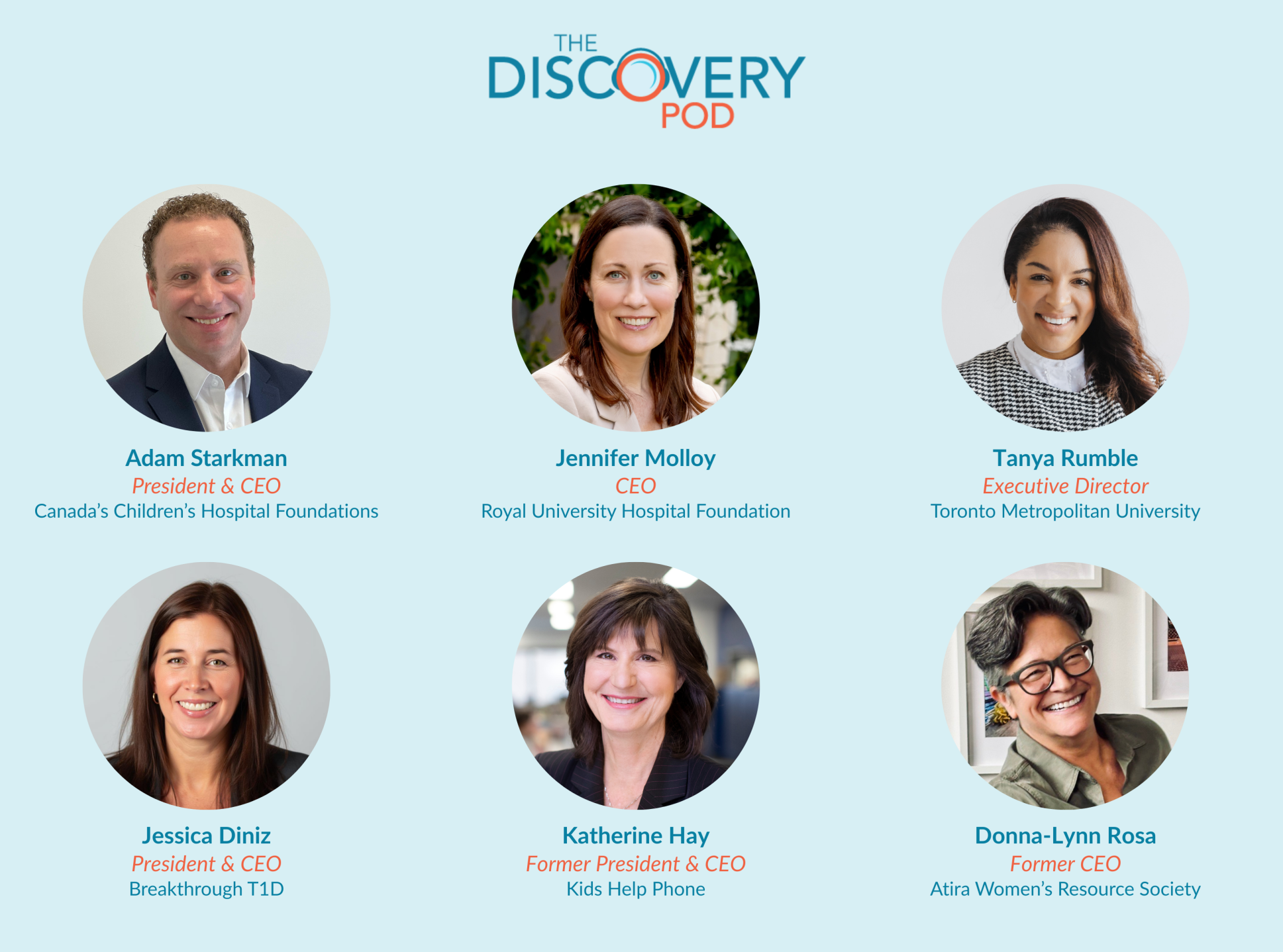
Leaders in the social profit sector are facing unprecedented complexity: evolving donor expectations, rapid technological change, shifting government priorities, and communities with urgent, growing needs. This guide synthesizes leadership insights from six recent conversations with CEOs and leaders successfully navigating this landscape.
These practical lessons are from leaders actively doing the work, managing organizations from startup community land trusts to national health charities serving millions. Whether you’re a first-time CEO or a seasoned executive, whether you lead a $1 million or $100+ million organization, the principles and practices shared can strengthen your leadership as you plan for the year ahead.

1. STRATEGIC MINDSET: Know Who You Are Before Deciding Where to Go
The Principle
Before setting direction, ensure that you understand your organization’s core identity, not just mission and values, but the fundamental nature of how they create change.
How Leaders Apply This
Katherine Hay (Kids Help Phone) describes a pivotal moment seven years ago when the leadership team asked themselves, “Who are we?” Setting aside their most visible identifiers of being a charity and working in youth mental health, they looked deeper. What emerged was a reframing that changed everything: an understanding that they are, at their core, an innovative, data-driven technology charity with a clear and unwavering focus on youth mental health.
This reframing fundamentally changed:
- How they organized their operations
- How they approached government and corporate partners
- How they funded themselves
- How they built for the future
Jessica Diniz (Breakthrough T1D) led a similar process when considering their name change from JDRF (Juvenile Diabetes Research Foundation). The decision wasn’t about marketing; it was about accurately representing who they serve: “88% of Canadians who live with Type 1 are over 19. We knew we needed to change.” The process took six months and involved extensive stakeholder engagement, but it anchored the organization in a clear identity, enabling more effective fundraising and community building.
Practical Application for Leaders
Whether you’re new to the role or seeking renewal:
-
- Resist the urge to act without reflection. Boards often want immediate strategic plans. Sometimes the wisest move is to pause and understand before committing to a direction.
- Go vertical through your organization. Don’t just meet with your direct reports. Katherine Hay engaged staff at all levels in understanding Kids Help Phone’s identity. Donna-Lynn Rosa visited 85% of staff in her first six months. Even established leaders benefit from regular connection to frontline reality.
- Ask the identity question: Set aside the obvious (your mission statement, your cause area) and ask: What is the fundamental nature of how we create change? Are you a convener? An innovator? A trusted community voice? A service provider? A systems change organization?
- Test your answer with essential partners. Jessica Diniz’s six-month name change process included extensive stakeholder conversations. Donna-Lynn Rosa created a bridge plan informed by frontline staff input.
Key Questions to Ask:
-
- If our most obvious attributes were set aside, what defines us?
- What would happen if we didn’t exist? What gap would remain?
- Who considers us essential, and why?
- What do we do that no one else can or will?
2. TRANSFORMATION THROUGH LISTENING: Build Strategy from Community
The Principle
The most successful organizational transformations are responses to what donors, clients, staff, and community are telling you they need.
How Leaders Apply This
Jessica Diniz (Breakthrough T1D) faced a moment of reckoning during COVID when their event-driven revenue model collapsed (68% of revenue from events). Instead of panic, they launched a four-month listening tour: “We did a listening tour for over four months and took back that feedback and listened. We heard, ‘I want to designate it and restrict it closer to what my interests are, steward me and engage me, tell me what’s going on.'”
The results were dramatic:
- Launched a $100 million campaign (largest for Type 1 diabetes in Canada)
- Completely flipped their revenue model in two years (now 68% from major gifts and corporate philanthropy)
- Donors felt heard and responded with transformational gifts
But the key insight was who participated in the listening: “Have every level of your development team involved so that everyone can learn… Having those uncomfortable conversations and being given feedback is a powerful learning opportunity.”
Jennifer Molloy (Royal University Hospital Foundation) made significant operational changes based on what donors told her: “The board said, ‘Prove to us that this is what we should be doing.’ We surveyed our donors… The data showed that yes, major gifts were the way to go.” This board education, showing them that if 90% of revenue comes from one source, 90% of time should go there, gave her permission to cut a 24-year gala, golf tournament, and radiothon.
Practical Application for Leaders
Setting Up Listening Systems:
1. Make listening structural, not occasional:
-
- Jessica Diniz: “We go out regularly to our donors and ask. We go out to our community, the Type 1 Diabetes community, and ask them for their priorities regularly.”
- This isn’t a one-time “strategic planning consultation”, it’s an ongoing practice
- Leaders who consistently engage with their donors and other key partners can inform and elevate board conversations about the organization’s direction. Start your observation with the magic phrase… “When I talk to our donors/clients, they tell me…”
2. Include all levels in listening:
-
- Don’t delegate all donor conversations to development staff
- Don’t delegate all client conversations to program staff
- Leaders who listen directly gain insights that summaries can’t capture
3. Close the feedback loop:
-
- Tell people what you heard and what you’re doing about it
- Even if you can’t act on everything, acknowledge what you heard
4. Be prepared for the uncomfortable truth:
-
- Don’t filter or sanitize feedback before sharing with leadership. Everyone needs to understand what is holding the organization back to fully embrace the necessary change.
- Don’t shrink from bringing your board into the conversation on what’s needs to change and how.
When to Launch a Major Listening Initiative:
-
- Before a strategic plan
- When considering significant operational changes
- When revenue models need transformation
- When community feedback indicates misalignment
- After a crisis or major external change
Key Questions to Ask:
-
- Who haven’t we heard from lately? (clients, donors, staff, volunteers, community partners)
- What assumptions are we making that we should test?
- If we asked our donors/clients to design our organization, what would change?
- What are people telling us indirectly through their behaviour?
3. COURAGE TO CHANGE: Revenue Model Transformation and Bold Pivots
The Principle
Sometimes survival requires dismantling what’s working to build what’s needed. This requires data, essential partner buy-in, and the courage to endure the uncomfortable middle.
How Leaders Apply This
Jennifer Molloy (Royal University Hospital Foundation) made one of the boldest moves in fundraising: she killed three major legacy events (a 24-year gala, golf tournament, and radiothon) to pivot entirely to major gifts. The risk was enormous:
“The first year was the scariest year of my career because I cut major events that historically raised significant dollars… You’re basically cutting your lifeline and saying, ‘I’m going to go for it.'”
The results took 12-18 months to materialize, “a year and a half where you’re holding your breath.” But when they did: “Our second year of transition was the best major gift year in the history of the foundation.”
What made this work:
- Data-driven board education: “If 90% of revenue from one source, spend 90% of time there”
- Patience through the transition: 12-18 months with no immediate wins
- Conviction when others doubted: “My board would say, ‘Are you sure? Is this the right thing to do?'”
Jessica Diniz (Breakthrough T1D) experienced a similar pivot, but with less choice; COVID forced it. When event revenue (68% of total) disappeared overnight, they had wanted to shift to major gifts for years but never had the urgency. The pandemic created it: “What I can tell you is that in two short years, we completely flipped the organization. 68% of our revenue now comes from major gifts in corporate philanthropy.”
Katherine Hay (Kids Help Phone) led perhaps the most dramatic transformation: scaling from 1.9 million interactions in 2019 to 22.5 million since March 2020. But the groundwork was laid years before through their “mindset shift” to become an innovation-driven, data-powered technology organization. When COVID hit, they were ready: “What we didn’t know in all our gumption… was that we were building for COVID. When COVID hit in March of 2020 and the world shut down, Kids Help Phone didn’t.”
Practical Application for Leaders
Before You Pivot:
1. Gather irrefutable and relevant data:
-
- Jennifer Molloy connected with donors to prove that a major gifts strategy was the right path
- Use data to make the case to skeptical board members
- Don’t rely on gut feeling, show the numbers, and share your insights with your board and leadership team.
2. Understand the timeline:
-
- Major changes take 12-18 months minimum to show results
- Plan for the “valley of death” between old revenue declining and new revenue growing
- Set board expectations about patience
3. Build financial reserves if possible:
-
- Transitions are expensive
- You may need to invest before you see returns
- Have a contingency plan if the pivot takes longer than expected
During the Pivot:
1. Communicate relentlessly:
-
- Regular board updates showing progress metrics
- Be transparent about challenges
- Celebrate small wins
2. Protect your team:
-
- If you don’t have your people with you, it won’t work
- Staff need confidence during uncertainty
- Don’t let the organization operate in perpetual crisis mode
3. Maintain quality:
-
- Katherine Hay kept wait times at 3.5 minutes and quality scores over 90%, even while scaling massively
- Jennifer Molloy maintained donor relationships during event transitions
- Don’t sacrifice core service quality for transformation
After Initial Success:
1. Invest in infrastructure:
-
- Katherine Hay spent a year investing in internal systems and people after their initial growth
- Success without infrastructure leads to burnout and eventual failure
- “Steady state is not an option” doesn’t mean never pausing to strengthen foundations
Key Questions Before a Major Pivot:
-
- Do we have data showing this is the right direction?
- Does our board understand this could take 12-18 months?
- What are our contingency plans?
- How will we support staff through uncertainty?
- What are we willing to stop doing to make room for this change?
Red Flags That Should Pause a Pivot:
-
- Lack of board support
- No financial reserves for the transition period
- Staff are already at burnout levels
- Unclear data about the opportunity
- The leader is hoping the change will “save” the organization
4. SCALING WITH HUMANITY: Growing Without Losing Your Soul
The Principle
Rapid growth can destroy organizational culture and mission focus. The most effective leaders grow deliberately while centring the human connections and values that make their work meaningful.
How Leaders Apply This
Adam Starkman (CCHF) stabilized his organization before pursuing growth. The sequence matters: “We focused on stabilizing the organization first before we thought about growing… we built the foundational pieces that needed to be in place: clarity of roles, clarity of expectations, making sure everyone had the tools they needed.”
This meant:
- Getting HR systems right
- Implementing clear performance frameworks
- Ensuring role clarity across the organization
- Only then moving to a growth mandate
Donna-Lynn Rosa (Atira) led BC’s largest provider of supportive housing for marginalized women, children, and gender-diverse individuals, with 2,500 spaces today versus one house 40 years ago. Yet her leadership philosophy centers on pause, presence, and individual dignity:
“We don’t think that people deserve to be put into 100-year-old hotel rooms… We believe that people deserve the dignity of a house. Everybody’s definition of hope is different. Mine and yours are different… It may be that I’m going to make it to lunchtime today. It may be that I’m going to see my kids this weekend. It could be anything. What it isn’t is my definition of hope for them.”
Her approach to scale:
- 80% of staff have lived experience: “Who better to walk alongside you than somebody who has experienced it”
- Person-centered care at scale: Each individual has a unique journey with tailored supports
- Leading with humility: “When I sit in judgment, I make bad decisions about myself or others”
Katherine Hay (Kids Help Phone) managed an extremely large scale of growth, increasing interactions from 1.9 million to 22.5 million. Her insight about the cost of that growth is instructive:
“Two years into COVID… I said to [the board chair], ‘I think it’s time to steady state for a while.’ He said, ‘Then you won’t be who you are if you are steady state.’… We spent a ton of time investing in our own people because our people were exhausted.”
The result? They spent an entire year investing in themselves, HR systems, internal technology, and staff support. Only then did they “take off again.”
Practical Application for Leaders
Recognizing When to Pause Growth:
Watch for these warning signs:
-
- High staff turnover
- Declining quality metrics
- Leaders working unsustainable hours
- “All hands on deck” is becoming permanent culture
- Systems breaking under load
- Loss of organizational identity
Maintaining Humanity at Scale:
1. Leader visibility:
-
- Donna-Lynn Rosa: Met 85% of staff in first 6 months
- Katherine Hay: Brought entire organization into the identity conversation
- Takeaway: Don’t lose touch with frontline reality
2. Lived experience as strength:
-
- Donna-Lynn Rosa: 80% of staff bring lived experience
- Adam Starkman: Built a senior team with diverse backgrounds
- Takeaway: Value different forms of expertise
3. Model the behavior you want:
-
- Set boundaries around work hours
- Model self-care publicly
- Take vacation
- Show vulnerability
4. Protect core quality:
-
- Katherine Hay: Maintained 3.5-minute wait times and 90%+ quality scores
- Donna-Lynn Rosa: Every person gets individualized support
- Takeaway: Don’t sacrifice service quality for growth numbers
Key Questions About Growth:
-
- Can our infrastructure support this?
- How will this affect staff wellbeing?
- Are we maintaining service quality?
- What do we need to pause or stop?
- Are we investing in our people as much as we invest in our programs?
- Can I honestly say we’re not “building the plane while flying it”?
5. VALUES AS STRATEGY: Clarity of Purpose as Competitive Advantage
The Principle
Organizations with clear values are more effective in fundraising, partnership development, and purposeful work. Neutrality is neither possible nor desirable.
How Leaders Apply This
Tanya Rumble (Toronto Metropolitan University) makes the case directly: “Inherently, charity is the opposite of neutral; you exist to solve this issue.” This insight challenges the common belief that charities should avoid taking positions on controversial topics.
Her research on gift acceptance policies revealed that most fundraisers don’t know their own organization’s policy, yet it’s one of the most critical tools for values alignment. Organizations that wrestle with these questions, whose money do we take, and under what conditions?, develop clarity that makes them more effective.
Donna-Lynn Rosa (Atira) leads an organization explicitly positioned on gender-based violence as an epidemic requiring systemic change. This isn’t neutral language, and it shouldn’t be: “We need to change the social norms around intimate partner violence. We need to change the narrative that we only need to protect women. We need to be holding our men accountable. We need to be growing boys who respect women.”
This clarity of values enables Atira to:
- Build powerful coalitions with other organizations
- Influence policy at provincial and national levels
- Attract staff and donors aligned with their mission
- Make difficult decisions about programs and partnerships
Practical Application for Leaders
Developing Values Clarity:
1. The Tanya Rumble Exercise:
-
- Write your organization’s point of view in one paragraph
- Answer: Why do we exist? What do we believe should change? How should the world be different?
- Test it: Does this actually guide our decisions?
2. Audit policies for values alignment:
-
- Gift acceptance policy: Whose money won’t we take?
- Partnership policy: Who won’t we work with?
- Investment policy: Where won’t we put our money?
- Marketing policy: What narratives will we reject?
3. Make values explicit in operations:
-
- Donna-Lynn Rosa: Leading with humility means checking ego daily
- Katherine Hay: “Love each other” isn’t soft, it’s core to mission success
Using Values for Decision-Making:
Ask yourself in difficult situations:
-
- What would we do if we were living our values fully?
- What would our best self-choose here?
- Ten years from now, will we be proud of this decision?
- Does this align with why we exist?
When Values Create Tension:
-
- With boards: Donna-Lynn Rosa educated her board on why an 18-month bridge plan (not a 3-5-year strategic plan) aligned with the organization’s values of humility and learning.
- With funders: Sometimes, values mean turning down money. Tanya Rumble emphasizes gift acceptance policies for precisely these moments.
- With partners: Adam Starkman suggests walking away from corporate partnerships that don’t align; authenticity over transactional relationships.
Key Questions About Values:
-
- Can we articulate our values in specific, actionable terms?
- Do our policies reflect our values?
- When did we last make a difficult decision because of our values?
- What would we need to change to live our values more fully?
- Are our values distinctive, or could they apply to any organization?
6. INNOVATION AS SURVIVAL: When “Steady State” is Organizational Stagnation
The Principle
Organizations that don’t innovate can lose relevancy. But innovation isn’t about shiny gadgets; it’s a mindset that must be embedded throughout the organization.
How Leaders Apply This
Katherine Hay(Kids Help Phone) articulates this most forcefully: “We do not want to be the Kodak of the not-for-profit sector. We know they had digital photography, but they chose to stay on paper. We chose not to stay on just the phone because if we had stayed on the phone, we’d probably be closed now.”
The board chair’s response when she wanted to “steady state”: “Then you won’t be who you are if you steady state.” The commitment to continuous innovation wasn’t optional, it was existential.
Their innovation approach:
- First movers in their space: First and only social profit using AI/ML for suicide risk triage in texting (response within 40 seconds)
- Technology as mission protection: Digital tools weren’t separate from mission, they enabled mission
- Shared innovation: Built widgets for resource mapping that other organizations can use
- Building for unknown crises: Their innovation work unknowingly prepared them for COVID
Jessica Diniz (Breakthrough T1D) demonstrates innovation in a different domain, partnership models that accelerate research: “We bring together, we call them consortia, on topics twice a year. We make them share their learnings and what’s working, what’s not, because we don’t really care where the cure happens. We need to move the field of research forward.”
Before COVID they had 29 active research grants, and after their new partnership approach, they had 75 research grants in Canada alone. These partners include CIHR, Stem Cell Network, Brain Canada, Diabetes Canada, UBC, doubling impact through collaboration rather than competition.
Adam Starkman (CCHF) innovates through collective impact models, including the “dollar-at-a-time” fundraising model, where local dollars stay local while the national organization provides infrastructure, coordination, and shared learning. Innovation here is organizational structure, not technology.
Practical Application for Leaders
Building an Innovation Mindset:
1. Katherine Hay’s Framework:
-
- Innovation requires courage at the board table
- Innovation requires willingness to keep changing your way of work
- Innovation without solid strategy is just “shiny gadgets”
- “If the quest is to innovate to perfection, that is your first failure”
2. Create permission to experiment:
-
- Not everything will work
- Fast failure is better than slow failure
- Learn from what doesn’t work
- Share lessons across the sector
The Pause Paradox:
Katherine Hay’s insight: “None of this is about going slow. This is about going fast with strategy, so you know exactly what you’re supposed to do.”
-
- Pausing to understand who you are enables faster movement
- Investing in infrastructure enables sustained innovation
- “Slow down to speed up” isn’t a cliché, it’s survival
Key Questions About Innovation:
-
- Are we changing as fast as the world around us?
- What would make us obsolete in 5 years?
- Where are we Kodak (choosing comfort over necessary change)?
- What innovations serve our mission directly vs. distract from it?
- Do we have permission to fail?
- Are we learning from other sectors?
7. PARTNERSHIPS OVER COMPETITION: Collective Success as a Strategy
The Principle
The scale of problems facing communities exceeds any single organization’s capacity. Leaders who build genuine partnerships accelerate scale and develop new ways of working.
How Leaders Apply This
Jessica Diniz (Breakthrough T1D) restructured their entire research funding model around partnerships: “We built a major partnership with CIHR… We’ve had two rounds of partnerships with them. The Stem Cell Network is a very close ally and partner with us. Brain Canada, Diabetes Canada, they’re the Canadian Islet Research and Training Network, UBC.”
The outcome: Doubling active research grants from 29 to 75 in Canada alone.
The mindset: “At the end of the day… it will take everyone. It will take the government to the table. It will take pharma or biotech at the table, and then the research community, and then our patient community. It’s really everyone mobilizing and bringing everyone forward together.”
Donna-Lynn Rosa (Atira) describes sector-wide collaboration on gender-based violence: “What has happened when it comes to gender based violence and intimate partner violence, we work collaboratively across the sector with folks to elevate our impact through our combined voice. Writing and influencing policy at the national level is a lot easier when you have representatives from so many organizations that are trusted.”
The approach shifts from “we need to win” to “we need to solve the problem.” Atira works with other service providers not as competitors but as essential partners in addressing an epidemic.
Katherine Hay (Kids Help Phone) challenges the sector directly: “My charge is we’ve got to work together. We at KHP don’t always get it right. For sure, we don’t, but we do build technology that we share.”
Their resource mapping widget, 40,000+ vetted services across Canada, is freely shared with other organizations. “We don’t care if you put KHP up as a brand, our promise is to the young people of Canada.”
On competition: “There is a lot of competition. I used to say there’s no competition for Kids Help Phone in the work we do, but there are a gazillion competitors for the funding we need to do the work we do… We look to solve the competition problem through partnership.”
Adam Starkman (CCHF) built an entire organizational model on collective impact: 13 children’s hospital foundations working together with shared branding, shared services, but local fundraising. The innovation is recognizing that competition among children’s hospital foundations serves no one; collaboration serves children.
Tanya Rumble (Toronto Metropolitan University) as the co-founder of Recast Philanthropy, she created a community of practice for fundraisers : “Hundreds/thousands of fundraisers, topics include difficult donor conversations, saviorism in marketing, gift acceptance policies, restorative philanthropy.” The recognition: we’re stronger when we learn together than when we compete in isolation.
Practical Application for Leaders
Shifting From Competition to Partnership:
1. Ask the right question:
-
- Not: “How do we beat other organizations?”
- But: “Who needs to be at the table to solve this problem?”
2. Identify natural partners:
-
- Organizations serving adjacent populations
- Organizations with complementary expertise
- Organizations with shared values but different approaches
- Organizations working on different parts of the same system
3. Build partnerships around:
-
- Shared learning (Tanya Rumble’s Recast model)
- Shared services (Adam Starkman’s CCHF model)
- Shared technology (Katherine Hay’s resource widget)
- Shared advocacy (Donna-Lynn Rosa’s GBV coalition)
- Shared funding (Jessica Diniz’s research consortia)
Making Partnerships Real:
1. Co-creation vs. coordination:
-
- Don’t just meet and share updates
- Build things together
- Share resources, not just information
- Take risks together
2. Get specific about roles:
-
- Who is best positioned to do what?
- How do we avoid duplication?
- Where do our unique strengths lie?
3. Bring resources to the table:
-
- Partnership isn’t “can you help us?”
- Partnership is “what can we build together?”
- Be willing to share your best assets
Key Questions About Partnership:
-
- Who else is working on this problem?
- What could we achieve together that we can’t alone?
- What unique value do we bring to a partnership?
- What are we willing to share or give up?
- Is this partnership advancing the mission or just making us feel good?
- How would we know if this partnership is working?
8. PERSONAL LEADERSHIP: Self-Awareness, Boundaries, and Sustainability
The Principle
You cannot lead others well if you’re not leading yourself well. The most effective leaders are ruthlessly self-aware and model the sustainability they want for their teams.
How Leaders Apply This
Donna-Lynn Rosa (Atira) is the most explicit about this work: “I know when I’m sitting in judgment. I know when I’m judging myself. I know when my whole body doesn’t feel regulated, to be honest. I know when my ego is taking over. To me, the best thing I can do is pause.”
Her daily practice: “Every day, I have to check myself, every moment. Again, I say, ‘Is my ego in this? Am I judging or am I truly leading with hope and kindness?'”
Katherine Hay (Kids Help Phone) admits to mistakes in the scaling journey: “That was our mistake, we didn’t invest in our people, and our people were exhausted, and they weren’t hearing what they needed to hear from their leaders.”
The correction: An entire year investing in organizational health, staff support, and infrastructure. Not just saying “self-care is important” but actually slowing growth to care for people.
Jennifer Molloy (Royal University Hospital Foundation) describes “the scariest year of my career” navigating major changes. She survived by:
- Having conviction in the data
- Support from key board members
- Maintaining honesty about uncertainty
- 12-18 months of staying the course despite doubt
Jessica Diniz (Breakthrough T1D) describes being “very open to change” as a personal characteristic that enables organizational change. But she grounds this in mission: “We have a grave responsibility to always make sure we’re doing the best we can for the community that we represent.”
Practical Application for Leaders
Building Self-Awareness:
1. Donna-Lynn Rosa’s check-ins:
-
- Is my ego in this decision?
- Am I sitting in judgment?
- Is my body regulated?
- Am I leading with hope and kindness?
2. Recognize your patterns:
-
- When do you make bad decisions?
- What triggers defensive reactions?
- When do you avoid difficult conversations?
Setting Boundaries:
1. Email and work hours:
-
- Donna-Lynn Rosa: “After 5:00, if it’s important, text”
- Don’t use “schedule send” as a workaround
- Model actually being offline
- Take real vacations
2. Decision fatigue:
-
- Adam Starkman: “If everything is important, nothing’s important”
- Not every decision needs you
- Delegate appropriately
- Create decision frameworks so others can act
3. The pause practice:
-
- Remember to pause and not have to react to everything right away.
- Not everything requires immediate response
- “Can this wait?” is a powerful question
- Give yourself thinking time
Key Questions About Your Leadership:
-
- What would my team say about how I handle stress?
- When did I last have fun?
- Am I modeling the culture I want?
- What am I avoiding?
- If I could only work 30 hours/week, what would I stop?
- What would I tell a friend to do if they were working like I am?
9. Leading with Optimism Grounded in Reality
The Principle
Hope is a conscious choice to believe change is possible, backed by strategy and action. In sectors facing seemingly intractable problems, hope is what keeps you moving forward.
How Leaders Apply This
Donna-Lynn Rosa (Atira) admits she didn’t understand this at first: “When I started in this role, I didn’t understand hope as a way forward. I was like, ‘You can’t lead from hope. You have to have a plan.'”
Her evolution: “What I’ve learned in this role is that the only strategy I have any control over is whether or not I have hope, because the rest of it is going to play out. I might have this much influence on it, but the hope that I bring into the job, the hope that I bring as I show up face-to-face with my team, that’s hope as a leadership strategy.”
The context matters: Atira turned away 5,000 people in 2024. They’re addressing an epidemic of gender-based violence. Five women were murdered in intimate partner violence in Vancouver in a recent period. This isn’t easy work, and naive optimism would be insulting.
But Donna-Lynn’s hope is grounded: “We have to focus on what we can do… [We need to] focus on the faces of the women and children, gender-diverse folks, and mixed-gender folks… These are the ones in our services… You have to put a focus on the good work that’s happening.”
Jessica Diniz (Breakthrough T1D) expresses hope through scientific possibility: “We are at the final stages [of developing therapies]. That is so exciting to be here.” After years of research funding, seeing human testing of potential cures creates momentum. But the hope is strategic: they’re building roadmaps to bring new therapies to Canadians, addressing regulatory, reimbursement, and awareness barriers before therapies are ready.
Tanya Rumble (Toronto Metropolitan University) finds hope in sector evolution: “Hopeful about diversity entering profession, excited about philanthropy’s role in addressing climate/poverty, envisions ‘moonshots for trillion-dollar gifts.'” Her hope drives action, co-founding Recast, teaching, researching gift acceptance policies, building community.
Jennifer Molloy (Royal University Hospital Foundation) stayed hopeful through “the scariest year of my career”: 12-18 months between cutting events and seeing major gift results. The hope was grounded in data and donor feedback, but it still required faith during the valley.
Katherine Hay (Kids Help Phone) maintains hope despite Canada’s mental health crisis: “There was a mental health crisis in Canada before the pandemic, suicide was the second leading cause of death in Canada, and our country had the third highest suicide rate in the industrialized world. That remains the same today.”
Her response: Build better systems, use technology thoughtfully, partner across sectors, advocate for policy change, and always be there at 2 AM when someone needs help.
Practical Application for Leaders
Cultivating Strategic Hope:
1. Acknowledge the reality:
-
- Don’t minimize challenges
- Start with truth, not platitudes
2. Find the evidence for hope:
-
- What’s actually working?
- Where have you seen progress?
- What would be different if you gave up?
- Who has already been helped?
3. Connect hope to action:
-
- Hope without action is denial
Leading Others with Hope:
1. Name the challenge and the possibility:
-
- “This is hard, AND we’re making progress”
- “We turned away 5,000 people, AND we housed 2,500”
- “The crisis continues, AND we’re scaling our response”
2. Celebrate progress:
-
- Don’t wait for the end goal
- Each milestone in scaling
- First major gifts during revenue model transition
- Recognize effort, not just outcomes
3. Tell stories of impact:
-
- Focus on the faces of people you serve
- Make the mission concrete and real
Key Questions About Hope:
-
- What am I hopeful about in this work?
- Where have I seen progress recently?
- What stories of impact keep me going?
- Am I modeling hope or despair for my team?
- How do I sustain hope during setbacks?
- What would hope look like in action right now?
Conclusion: Putting It All Together
These leaders demonstrate that effective social profit leadership isn’t about having all the answers, it’s about asking better questions, listening deeply, making courageous choices, and sustaining yourself and your team for the long journey.
The Common Threads
- Self-Awareness Before Strategy: Know who you are before deciding where to go
- Community Voice Drives Direction: Listen first, then lead
- Courage to Transform: Change is hard; do it anyway
- Human-Centered Growth: Scale doesn’t require losing your soul
- Values as Competitive Advantage: Clarity of purpose enables everything else
- Innovation as Survival: Status quo is organizational death
- Partnership Over Competition: We’re stronger together
- Personal Sustainability: You can’t pour from an empty cup
- Hope as Strategy: Optimism grounded in action
Tools for 2026
If you’re in a leadership transition (new role, new organization):
-
- Understand who the organization truly is (not just what it says it is)
- Listen to all essential partners (donors, clients, staff, community, board)
- Assess organizational infrastructure and capacity
- Build board relationships through honesty and data
- Model the culture you want to create
If you’re leading through transformation:
-
- Gather data to build the case for change and ensure the data is relevant to your transformation
- Understand realistic timelines (12-18 months for major shifts)
- Invest in people and infrastructure before scaling – the investment must precede the return
- Maintain quality and hope through the transition valley
If you’re an established leader seeking renewal:
-
- Revisit “who are we, really?” with fresh eyes
- Launch a listening tour, even if you think you know the answers
- Examine where “steady state” has become stagnation
- Identify partnerships that could multiply your impact
- Model the sustainability you want for your team
The Questions That Guide These Leaders:
-
- Who are we, really? (Katherine Hay)
- What are our stakeholders telling us? (Jessica Diniz)
- Is this aligned with our values? (Tanya Rumble)
- Are we moving as fast as the world around us? (Katherine Hay)
- Who needs to be at this table to solve this problem? (Donna-Lynn Rosa)
- What would we do if we were living our values fully? (All)
- What are we willing to stop to make room for what matters? (Adam Starkman)
- How do we maintain hope when the work is hard? (All)
A Final Word on Leadership
These leaders don’t have it all figured out. They make mistakes. They get exhausted. They doubt themselves. They face seemingly impossible challenges.
But they show up. They listen. They make hard choices. They invest in people. They maintain hope. They do the next right thing.
That’s leadership in the social profit sector in 2026.
And that’s the invitation to you.
Onward.
About This Guide
This guide was created by synthesizing insights from conversations on The Discovery Pod between September and December 2025:
- Adam Starkman, President & CEO, Canada’s Children’s Hospital Foundations
- Jennifer Molloy, CEO, Royal University Hospital Foundation
- Tanya Rumble, Executive Director, Toronto Metropolitan University & Co-Founder, Recast Philanthropy
- Jessica Diniz, President & CEO, Breakthrough T1D Canada
- Katherine Hay, Former President & CEO, Kids Help Phone
- Donna-Lynn Rosa, Former CEO, Atira Women’s Resource Society
For full podcast episodes and transcripts, click here.
The Discovery Pod is Canada’s leading social profit leadership podcast, hosted by Douglas Nelson, President and Managing Director of The Discovery Group.